
The role of whale falls: Insights from the Diamantina whale necropolis
-

-
REFERENCES
[1] Smith C.R., Glover A.G., Treude T., et al. (2015). Whale-fall ecosystems: Recent insights into ecology, paleoecology, and evolution. Annu. Rev. Mar. Sci 7:571−596. DOI:10.1146/annurev-marine-010213-135144 [2] Peng X., Zhou P., Song X., et al. (2026). A 5.3-million-year-old deep-sea whale necropolis in the Diamantina Zone. Nature 654:978-983. DOI:10.1038/s41586-026-10546-z [3] Jiao N., Herndl G., Hansell D., et al. (2010). Microbial production of recalcitrant dissolved organic matter: Long-term carbon storage in the global ocean. Nat. Rev. Microbiol 8:593−599. DOI:10.1038/nrmicro2386 [4] Smith C.R. and Baco A.R. (2003). Ecology of whale falls at the deep-sea floor. Oceanogr. Mar. Biol. Annu. Rev 41:311−354. DOI:10.1201/9780203180570-33 [5] Jefferson T.A., Webber M.A. and Pitman R.L. (2015). Cetaceans. Marine mammals of the world: A comprehensive guide to their identification, second ed. (Academic Press), pp: 95-171. DOI:10.1016/B978-0-12-409542-7.50004-4 -
ABOUT THIS ARTICLE
Cite this article:
Zhang P., Liu J., Zhao L., et al. (2027). The role of whale falls: Insights from the Diamantina whale necropolis. The Innovation Life 5:100255. https://doi.org/10.59717/j.xinn-life.2026.100255
Welcome!
To request copyright permission to republish or share portions of our works, please visit Copyright Clearance Center's (CCC) Marketplace website at marketplace.copyright.com.
Export File
Citation
Zhang P., Liu J., Zhao L., et al. (2027). The role of whale falls: Insights from the Diamantina whale necropolis. The Innovation Life 5:100255. https://doi.org/10.59717/j.xinn-life.2026.100255

Format
Content
 DownLoad:
-
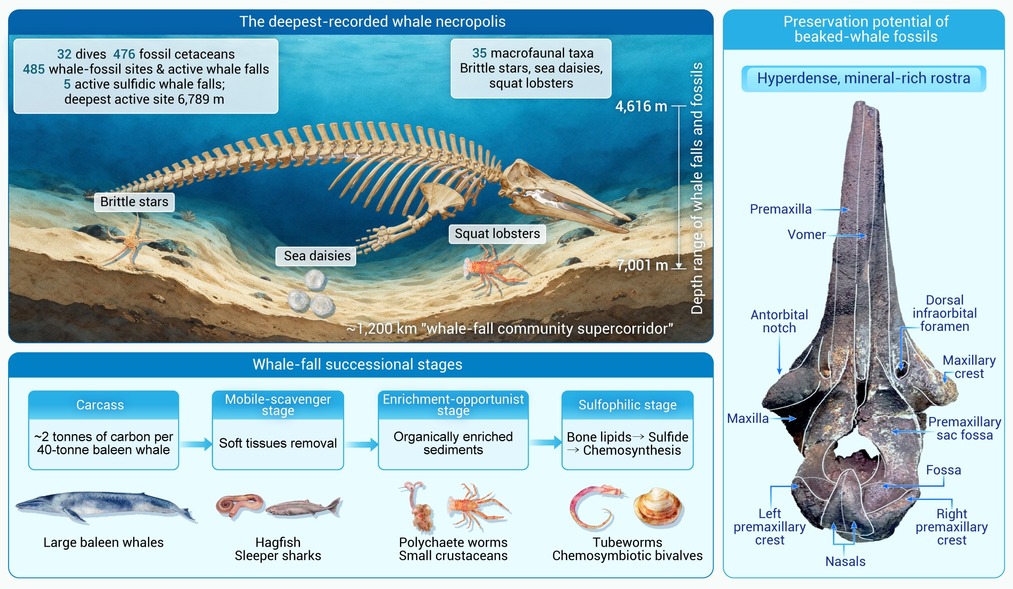
Figure 1.
Whale fall and necropolis in Diamantina Zone.
