
Beyond the linear genome: A population-scale Chinese pangenome for human genetics
-

-
REFERENCES
[1] Gao Y., Yang X., Chen H., et al. (2023). A pangenome reference of 36 Chinese populations. Nature 619:112−121. DOI:10.1038/s41586-023-06173-7 [2] Miga K. H. and Wang T. (2021) The need for a human pangenome reference sequence. Annu. Rev. Genomics Hum. Genet. 22:81–102. DOI:10.1146/annurev-genom-120120-081921 [3] Liao W.-W., Asri M., Ebler J., et al. (2023). A draft human pangenome reference. Nature 617:312−324. DOI:10.1038/s41586-023-05896-x [4] Jayakodi M., Shim H. and Mascher M. (2025). What are we learning from plant pangenomes. Annu. Rev. Plant Biol. 76:663−686. DOI:10.1146/annurev-arplant-090823-015358 [5] Wang Y., Duan Z., Chen D., et al. (2026). The 1000 Chinese Pangenome empowers medical and population genetics. Nature 654:121−130. DOI:10.1038/s41586-026-10315-y -
ABOUT THIS ARTICLE
Cite this article:
Shi L., Li W., Yi W., et al. (2026). Beyond the linear genome: A population-scale Chinese pangenome for human genetics. The Innovation Life 4:100256. https://doi.org/10.59717/j.xinn-life.2026.100256
Welcome!
To request copyright permission to republish or share portions of our works, please visit Copyright Clearance Center's (CCC) Marketplace website at marketplace.copyright.com.
Export File
Citation
Shi L., Li W., Yi W., et al. (2026). Beyond the linear genome: A population-scale Chinese pangenome for human genetics. The Innovation Life 4:100256. https://doi.org/10.59717/j.xinn-life.2026.100256

Format
Content
 DownLoad:
-
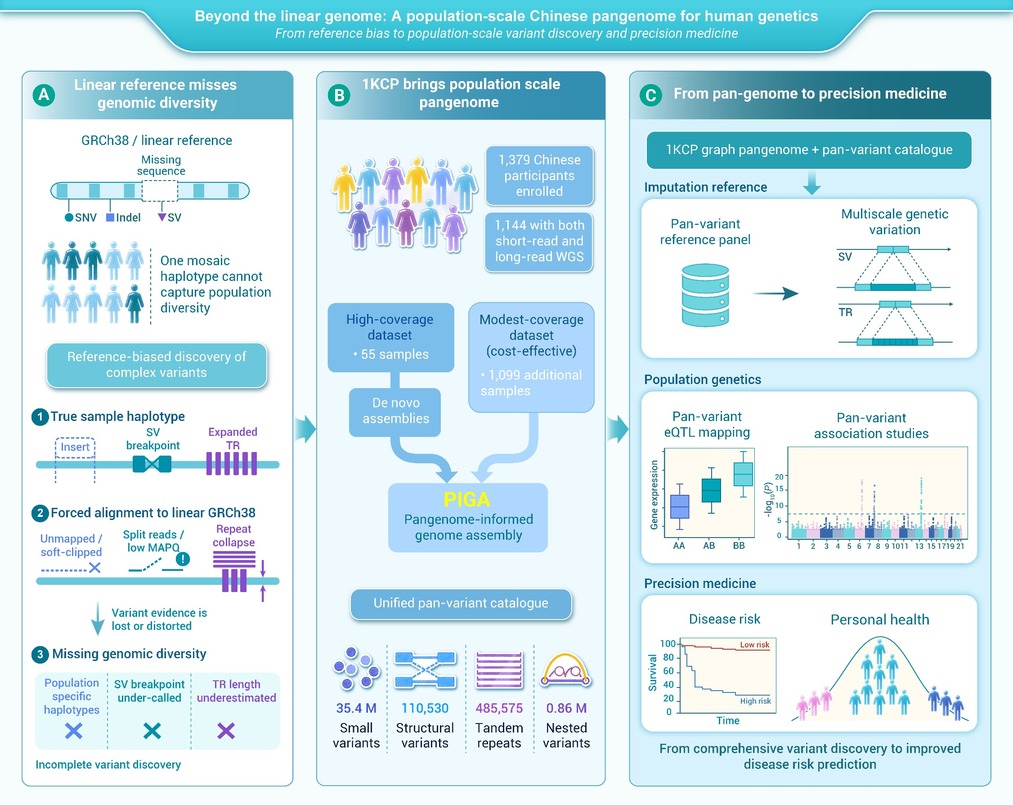
Figure 1.
Population-scale Chinese pangenome uncovers genetic diversity beyond the linear reference
