
When the master clock fails: A quasi-circadian backup network in stressed plants
-

-
REFERENCES
[1] Bass J. and Lazar M. A. (2016). Circadian time signatures of fitness and disease. Science 354:994−999. DOI:10.1126/science.aah4965 [2] Wang S., Su Y., Xu Y., et al. (2026). Discovery and heterologous reconstitution of a plant noncanonical quasi-circadian gene regulatory network. Cell 189:4437−4453.e20. DOI:10.1016/j.cell.2026.04.033 [3] Oravec M. W. and Greenham K. (2022). The adaptive nature of the plant circadian clock in natural environments. Plant Physiol. 190:968−980. DOI:10.1093/plphys/kiac337 [4] Nagel D. H. and Kay S. A. (2012). Complexity in the wiring and regulation of plant circadian networks. Curr. Biol. 22:R648−R657. DOI:10.1016/j.cub.2012.07.025 [5] Wang W., Barnaby J. Y., Tada Y., et al. (2011). Timing of plant immune responses by a central circadian regulator. Nature 470:110−114. DOI:10.1038/nature09766 -
ABOUT THIS ARTICLE
Cite this article:
Xu M., Liu W. and Wang W. (2026). When the master clock fails: A quasi-circadian backup network in stressed plants. The Innovation Life 4:100258. https://doi.org/10.59717/j.xinn-life.2026.100258
Welcome!
To request copyright permission to republish or share portions of our works, please visit Copyright Clearance Center's (CCC) Marketplace website at marketplace.copyright.com.
Export File
Citation
Xu M., Liu W. and Wang W. (2026). When the master clock fails: A quasi-circadian backup network in stressed plants. The Innovation Life 4:100258. https://doi.org/10.59717/j.xinn-life.2026.100258

Format
Content
 DownLoad:
-
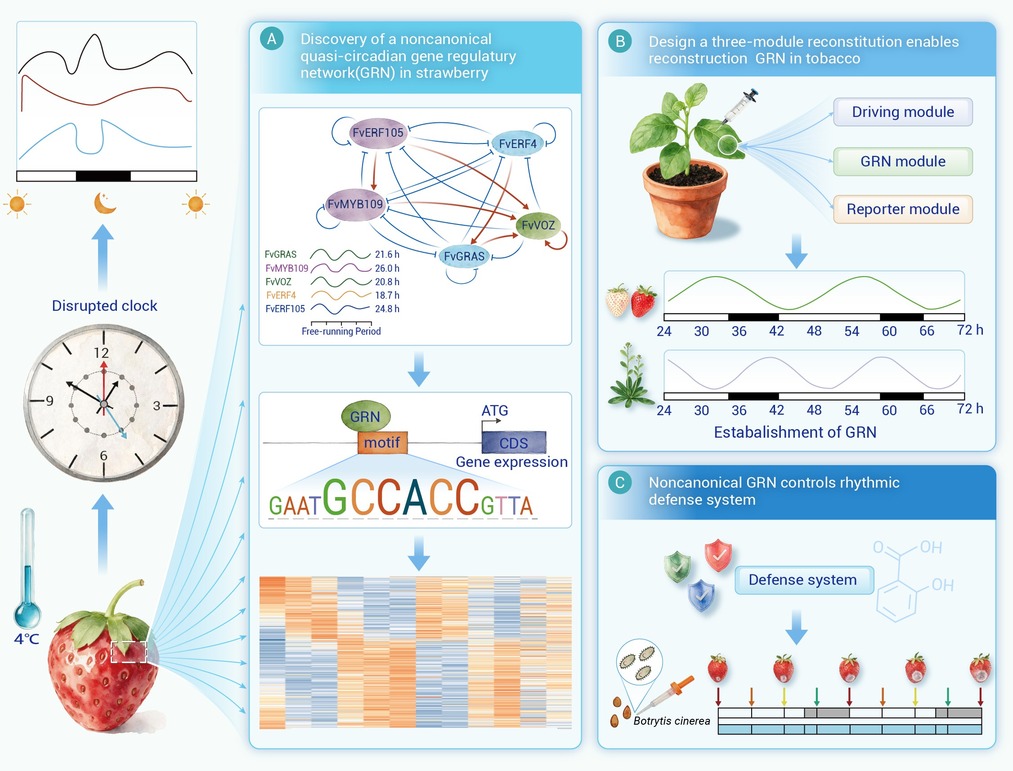
Figure 1.
A noncanonical quasi-circadian gene regulatory network (GRN) maintains rhythmic defence in postharvest strawberries
