
Catalyzing CAR-T innovation with AI virtual cells: Breakthroughs, bottlenecks, and the path forward
-

-
REFERENCES
[1] Bunne C., Roohani Y., Rosen Y., et al. (2024). How to build the virtual cell with artificial intelligence: Priorities and opportunities. Cell 187:7045−7063. DOI:10.1016/j.cell.2024.11.015 [2] Rafei H., Upadhyay R. and Sharma P. (2026). A guide to CAR T cell therapies: Development, current status and future prospects. Nat. Rev. Immunol. DOI:10.1038/s41577-026-01322-1 [3] Arkfeld E., Wang Z., Hakozaki H., et al. (2026). Whole-cell particle-based digital twin simulations from 4D lattice light-sheet microscopy data. Cell 189:4581−4593.e6. DOI:10.1016/j.cell.2026.06.010 [4] Driessen A., Born J., Castellanos Rueda R., et al. (2026). Modeling chimeric antigen receptor response at the single-cell level with conditional optimal transport. Cell Syst. 17:101591. DOI:10.1016/j.cels.2026.101591 [5] Ahlmann-Eltze C., Huber W. and Anders S. (2025). Deep-learning-based gene perturbation effect prediction does not yet outperform simple linear baselines. Nat. Methods 22:1657−1661. DOI:10.1038/s41592-025-02772-6 -
ABOUT THIS ARTICLE
Cite this article:
Liang X., Luo B., Jiang N., et al. (2027). Catalyzing CAR-T innovation with AI virtual cells: Breakthroughs, bottlenecks, and the path forward. The Innovation Life 5:100261. https://doi.org/10.59717/j.xinn-life.2026.100261
Welcome!
To request copyright permission to republish or share portions of our works, please visit Copyright Clearance Center's (CCC) Marketplace website at marketplace.copyright.com.
Export File
Citation
Liang X., Luo B., Jiang N., et al. (2027). Catalyzing CAR-T innovation with AI virtual cells: Breakthroughs, bottlenecks, and the path forward. The Innovation Life 5:100261. https://doi.org/10.59717/j.xinn-life.2026.100261

Format
Content
 DownLoad:
-
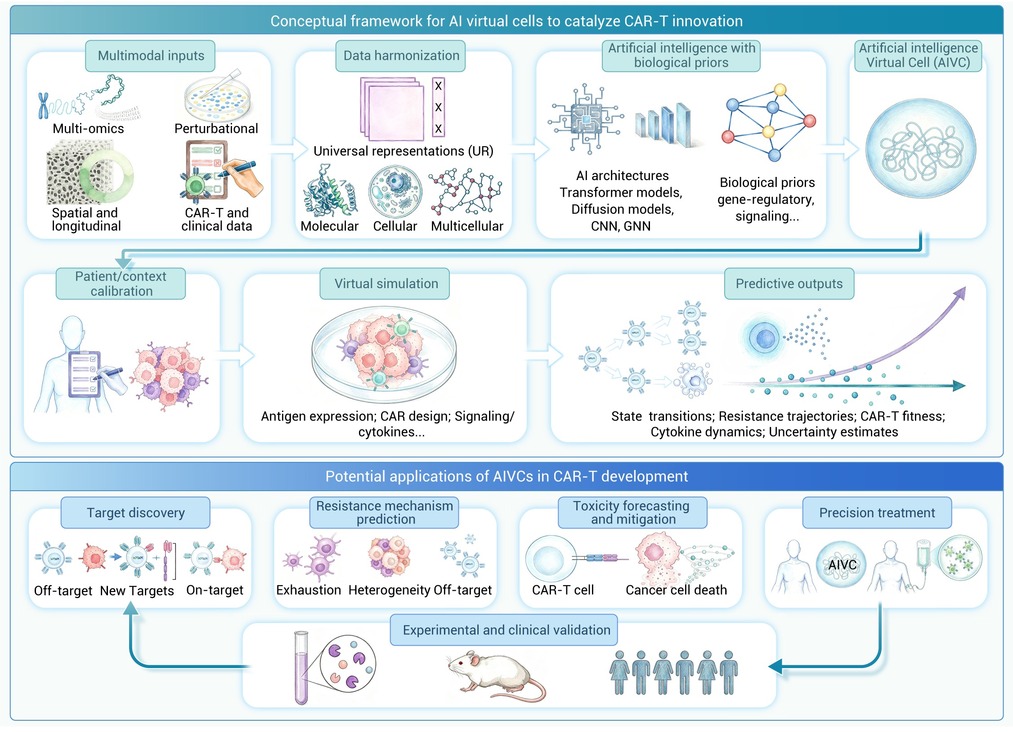
Figure 1.
Conceptual framework for AI virtual cells to catalyze CAR-T innovation
