
Taxonomy and beyond: From dark taxa to bright approaches—The four pillars of a disciplinary renaissance
-

-
REFERENCES
[1] Liu Y., Ji M., Yu T., et al. (2022). A genome and gene catalog of glacier microbiomes. Nat. Biotechnol. 40:1341−1348. DOI:10.1038/s41587-022-01367-2 [2] Amses K.R., Simmons D.R., Longcore J.E., et al. (2022). Diploid-dominant life cycles characterize the early evolution of Fungi. Proc. Natl. Acad. Sci. USA 119:e2116841119. DOI:10.1073/pnas.2116841119 [3] Schultz D.T., Haddock S.H.D., Bredeson J.V., et al. (2023). Ancient gene linkages support ctenophores as sister to other animals. Nature 618:110−117. DOI:10.1038/s41586-023-05936-6 [4] Lacher Jr T.E., Butchart S.H., Gumbs R., et al. (2025). The status, threats and conservation of critically endangered species. Nat. Rev. Biodivers. 1:421−438. DOI:10.1038/s44358-025-00059-4 [5] Pollock L.J., Kitzes J., Beery S. et al., (2025). Harnessing artificial intelligence to fill global shortfalls in biodiversity knowledge. Nat. Rev. Biodivers. 1:166–182. DOI:10.1038/s44358-025-00022-3 -
ABOUT THIS ARTICLE
Cite this article:
Su P.-W., Li B., Ren J.-L., et al. (2027). Taxonomy and beyond: From dark taxa to bright approaches—The four pillars of a disciplinary renaissance. The Innovation Life 5:100275. https://doi.org/10.59717/j.xinn-life.2026.100275
Welcome!
To request copyright permission to republish or share portions of our works, please visit Copyright Clearance Center's (CCC) Marketplace website at marketplace.copyright.com.
Export File
Citation
Su P.-W., Li B., Ren J.-L., et al. (2027). Taxonomy and beyond: From dark taxa to bright approaches—The four pillars of a disciplinary renaissance. The Innovation Life 5:100275. https://doi.org/10.59717/j.xinn-life.2026.100275

Format
Content
 DownLoad:
-
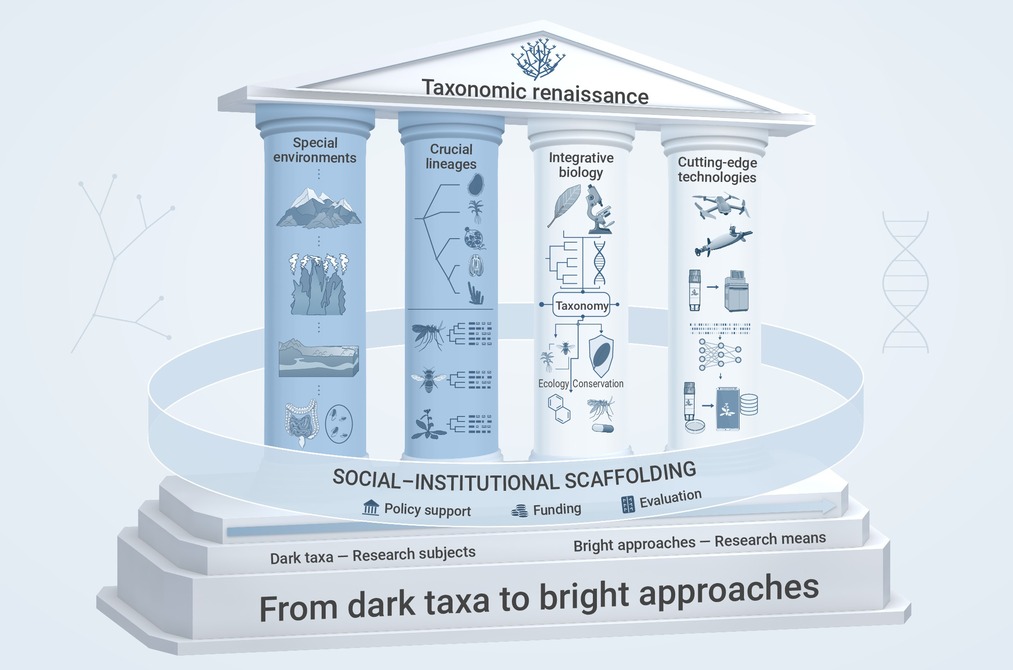
Figure 1.
Four pillars from dark taxa to bright approaches assisting taxonomic renaissance.
