
Chloroplast sunscreen: Phase separation mitigates midday high-light-triggered photoinhibition in crops
-

-
REFERENCES
[1] Thoday D. (1910). Experimental researches on vegetable assimilation and respiration. VI.-some experiments on assimilation in the open Air. Proc. R. Soc. Lond. B. 82:421–450. http://www.jstor.org/stable/80244 [2] Zhang M., Ming Y., Wang HB., et al. (2024). Strategies for adaptation to high light in plants. aBIOTECH 5:381–393. DOI:10.1007/s42994-024-00164-6 [3] Karina C. Pougy, Bruna A. Brito, Giovanna S. Melo, et al. (2025). Phase separation as a key mechanism in plant development, environmental adaptation, and abiotic stress response. J. Biol. Chem. 301:108548. DOI:10.1016/j.jbc.2025.108548 [4] Shao N., Chen M., Xu N., et al. (2026) Chloroplast sunscreening by protein condensates confers plant high light tolerance. Cell 189:5182-5197. DOI: 10.1016/j.cell.2026.05.042 [5] Tang W., Qin J., Yang K., et al. (2022) Mapping long-term and high-resolution global gridded photosynthetically active radiation using the ISCCP H-series cloud product and reanalysis data. Earth Syst. Sci. Data 14:2007–2019. DOI:10.5194/essd-14-2007-2022 -
ABOUT THIS ARTICLE
Cite this article:
Shao N., Wang B. and Li J. (2027). Chloroplast sunscreen: Phase separation mitigates midday high-light-triggered photoinhibition in crops. The Innovation Life 5:100276. https://doi.org/10.59717/j.xinn-life.2026.100276
Welcome!
To request copyright permission to republish or share portions of our works, please visit Copyright Clearance Center's (CCC) Marketplace website at marketplace.copyright.com.
Export File
Citation
Shao N., Wang B. and Li J. (2027). Chloroplast sunscreen: Phase separation mitigates midday high-light-triggered photoinhibition in crops. The Innovation Life 5:100276. https://doi.org/10.59717/j.xinn-life.2026.100276

Format
Content
 DownLoad:
-
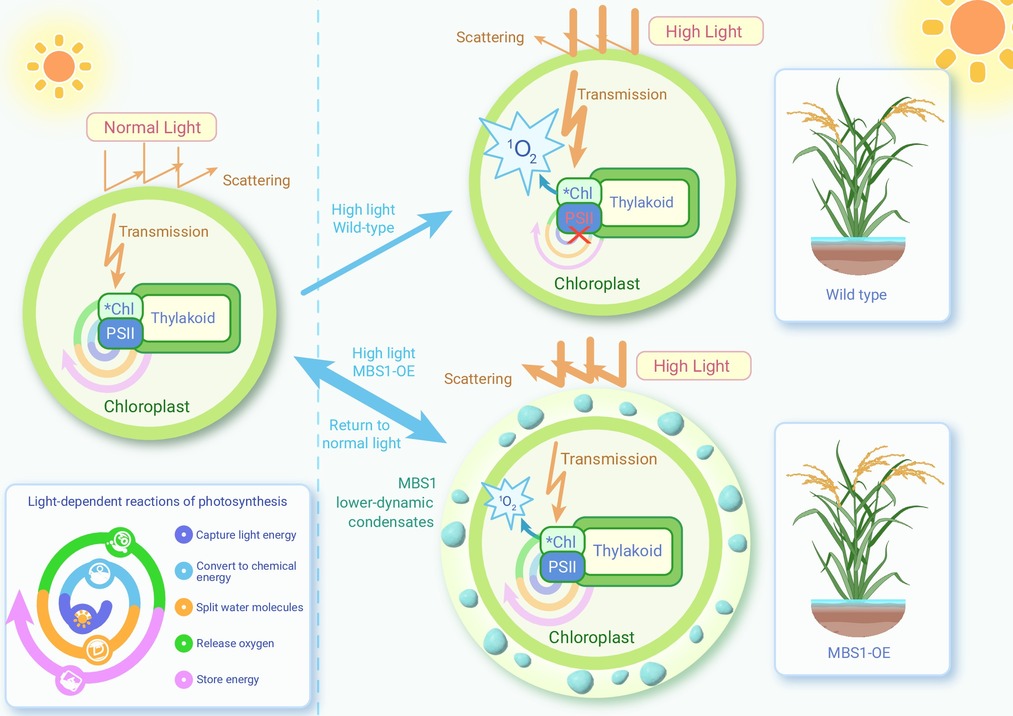
Figure 1.
MBS1-mediated phase separation forms a chloroplast sunscreen that mitigates midday photoinhibition in rice
