
Antigenic and genetic analysis of 2025 Chikungunya virus outbreak in China
-
ABSTRACT
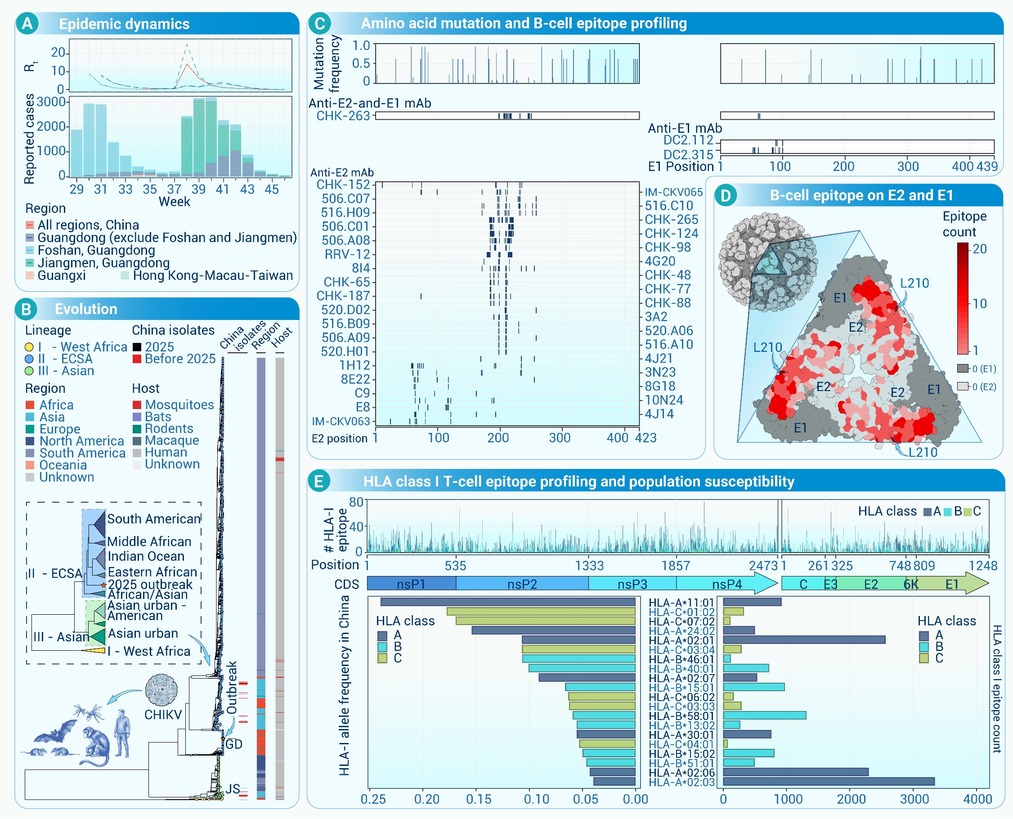
The 2025 Chikungunya virus (CHIKV) epidemic in China, primarily driven by the East/Central/South African (ECSA) lineage, has resulted in over 25,600 infections and one fatality, highlighting a significant public health threat. To elucidate the virological and immunological drivers of this outbreak, a comprehensive in silico investigation was conducted, integrating epidemiological, phylogenetic, and immunoinformatic data across 4,662 sequences. Phylogenetic analysis reveals that the outbreak likely originated from limited recent introductions, with the ECSA lineage comprising approximately 70% of the imported isolates. Temporal tracking of B-cell epitopes indicates an increase in mutation frequencies within the E1 and E2 glycoproteins since 2016. However, mapping against 38 known neutralizing monoclonal antibodies (mAbs) demonstrates that only six mutations in the 2025 E2 protein affect mAb binding sites, with just one mutation (L210Q) impacting a major epitope cluster. This indicates that the circulating variants have not yet achieved substantial B-cell immune escape. Furthermore, T-cell epitope profiling uncovers a critical population-level genetic vulnerability. While individuals with highly frequent alleles like HLA-A*02:01 are predicted to present abundant epitopes for a robust T-cell response, prevalent HLA-C alleles in the Chinese population (HLA-C*07:02 and HLA-C*01:02) present a critically low number of CHIKV epitopes. This reduced capacity for T-cell-mediated viral clearance in a substantial demographic underscores the necessity for prophylactic measures tailored to specific genetic vulnerabilities. Consequently, future vaccine development must focus on eliciting broad-spectrum neutralizing antibodies while incorporating promiscuous T-cell epitopes to protect these vulnerable populations. -

-
REFERENCES
[1] Wu D., Wu J., Zhang Q., et al. (2012). Chikungunya outbreak in Guangdong province, China, 2010. Emerg. Infect. Dis. 18:493-495. DOI:10.3201/eid1803.110034 [2] Wallau G. L., Abanda N. N., Abbud A., et al. (2023). Arbovirus researchers unite: Expanding genomic surveillance for an urgent global need. Lancet Glob. Health 11:e1501−e1502. DOI:10.1016/S2214-109X(23)00325-X [3] Ma J., Li H., Huang J.-D., et al. (2025). Remodeling peptide-MHC-TCR triad binding as sequence fusion for immunogenicity prediction. arXiv:2501.01768. DOI:10.48550/arXiv.2501.01768 [4] Augusto D. G., Murdolo L. D., Chatzileontiadou D. S. M., et al. (2023). A common allele of HLA is associated with asymptomatic SARS-CoV-2 infection. Nature 620:128−136. DOI:10.1038/s41586-023-06331-x [5] Vidal S. J., Lasrado N., Tostanoski L. H., et al. (2025). Mining the CD4 antigen repertoire for next-generation tuberculosis vaccines. Cell 188:6791−6803.e13. DOI:10.1016/j.cell.2025.08.027 -
ABOUT THIS ARTICLE
Cite this article:
Hu Y.-F., Ma J.-H., Zhang B.-Z., et al. (2027). Antigenic and genetic analysis of 2025 Chikungunya virus outbreak in China. The Innovation Life 5:100314. https://doi.org/10.59717/j.xinn-life.2026.100314
Welcome!
To request copyright permission to republish or share portions of our works, please visit Copyright Clearance Center's (CCC) Marketplace website at marketplace.copyright.com.
Export File
Citation
Hu Y.-F., Ma J.-H., Zhang B.-Z., et al. (2027). Antigenic and genetic analysis of 2025 Chikungunya virus outbreak in China. The Innovation Life 5:100314. https://doi.org/10.59717/j.xinn-life.2026.100314

Format
Content
 DownLoad:
-
Figure 1.
Antigenic and genetic analysis of 2025 Chikungunya Virus (CHIKV) outbreak in China
