
Regional diversity meets global representation in large-scale human pangenomics
-
ABSTRACT
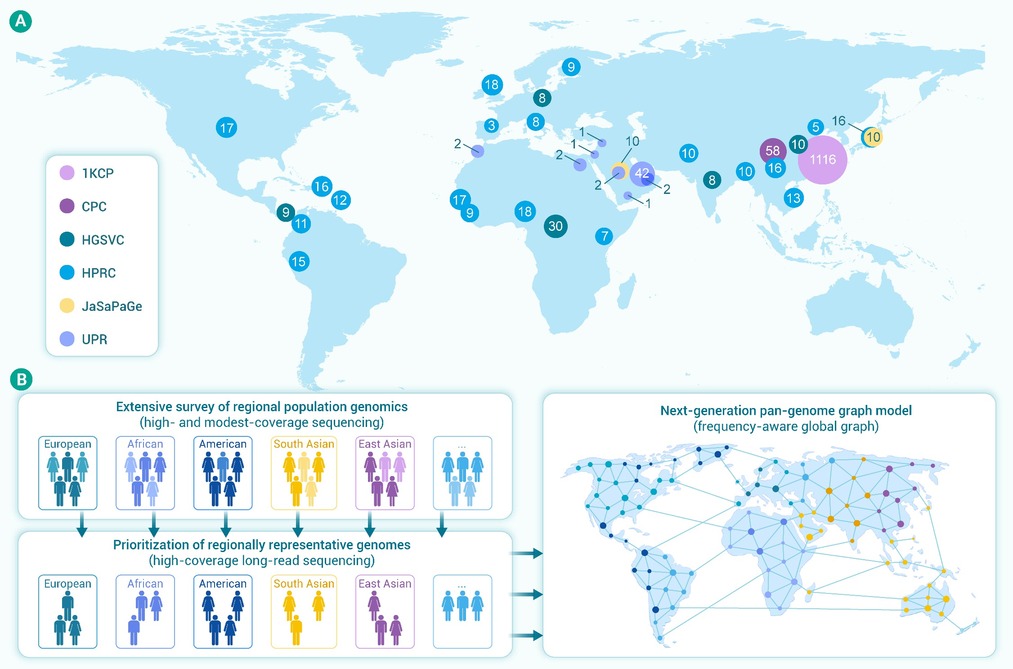
Human pangenomics is moving beyond the single linear reference paradigm towards population-scale representations that better capture complex genomic variation. Many current human pangenomes include both global and regional initiatives, but their limited sample sizes constrain the representation of population diversity. Recently, the establishment of the1000 Chinese Pangenome (1KCP) project represents a major milestone in large-scale regional pangenomics. By combining high-coverage de novo assemblies with pangenome-informed assembly of modest-coverage samples, 1KCP expanded the resource to 1,116 diploid genome assemblies while substantially reducing sequencing costs relative to uniformly high-coverage de novo assembly. This large-scale framework not only broadens the catalog of non-reference sequences and genetic variants, but also enables complex variants, including structural variants and tandem repeats, to be linked to gene regulation and human phenotypes, revealing classes of variation incompletely captured by conventional small-variant-centered analyses. Nevertheless, some challenges remain, including reduced assembly accuracy in repetitive and structurally complex genomic regions when using modest-coverage data. Broader and more balanced sampling will also be needed to better represent population diversity. Building on these insights, we propose a hierarchical framework for the next-generation global pangenome, where large-scale regional pangenomes guide diversity-informed selection of representative individuals for high-quality genome assembly, while global allele frequencies are integrated with the resulting pangenome graph. -

-
REFERENCES
[1] Nurk S., Koren S., Rhie A., et al. (2022). The complete sequence of a human genome. Science 376:44−53. DOI:10.1126/science.abj6987 [2] Liao W.-W., Asri M., Ebler J., et al. (2023). A draft human pangenome reference. Nature 617:312−324. DOI:10.1038/s41586-023-05896-x [3] Gao Y., Yang X., Chen H., et al. (2023). A pangenome reference of 36 Chinese populations. Nature 619:112−121. DOI:10.1038/s41586-023-06173-7 [4] Wang Y., Duan Z., Chen D., et al. (2026). The 1000 Chinese Pangenome empowers medical and population genetics. Nature 654:121−130. DOI:10.1038/s41586-026-10315-y [5] Logsdon G.A., Ebert P., Audano P.A., et al. (2025). Complex genetic variation in nearly complete human genomes. Nature 644:430−441. DOI:10.1038/s41586-025-09140-6 [6] Nassir N., Almarri M.A., Kumail M., et al. (2025). A draft UAE-based Arab pangenome reference. Nat. Commun. 16:6747. DOI:10.1038/s41467-025-61645-w [7] Kulmanov M., Ashouri S., Liu Y., et al. (2025). Phased genome assemblies and pangenome graphs of human populations of Japan and Saudi Arabia. Sci. Data 12:1316. DOI:10.1038/s41597-025-05652-y [8] Yang J., Benyamin B., McEvoy B.P., et al. (2010). Common SNPs explain a large proportion of the heritability for human height. Nat. Genet. 42:565−569. DOI:10.1038/ng.608 [9] Nassir N., Almarri M.A., Akter H., et al. (2025). Advancing clinical genomics with Middle Eastern and South Asian pangenomes. Nat. Med. 31:725−727. DOI:10.1038/s41591-025-03544-7 [10] Sun H., Zhang J., Liao S., et al. (2026). Population-level super-pangenome reveals genome evolution and empowers precision breeding in watermelon. Nat. Genet. 58:1176−1185. DOI:10.1038/s41588-026-02598-8 -
ABOUT THIS ARTICLE
Cite this article:
Chen K. and Fang Z. (2027). Regional diversity meets global representation in large-scale human pangenomics. The Innovation Life 5:100334. https://doi.org/10.59717/j.xinn-life.2026.100334
Welcome!
To request copyright permission to republish or share portions of our works, please visit Copyright Clearance Center's (CCC) Marketplace website at marketplace.copyright.com.
Export File
Citation
Chen K. and Fang Z. (2027). Regional diversity meets global representation in large-scale human pangenomics. The Innovation Life 5:100334. https://doi.org/10.59717/j.xinn-life.2026.100334

Format
Content
 DownLoad:
-
Figure 1.
Current pangenomes and the next-generation global pangenome model
