
-
ABSTRACT
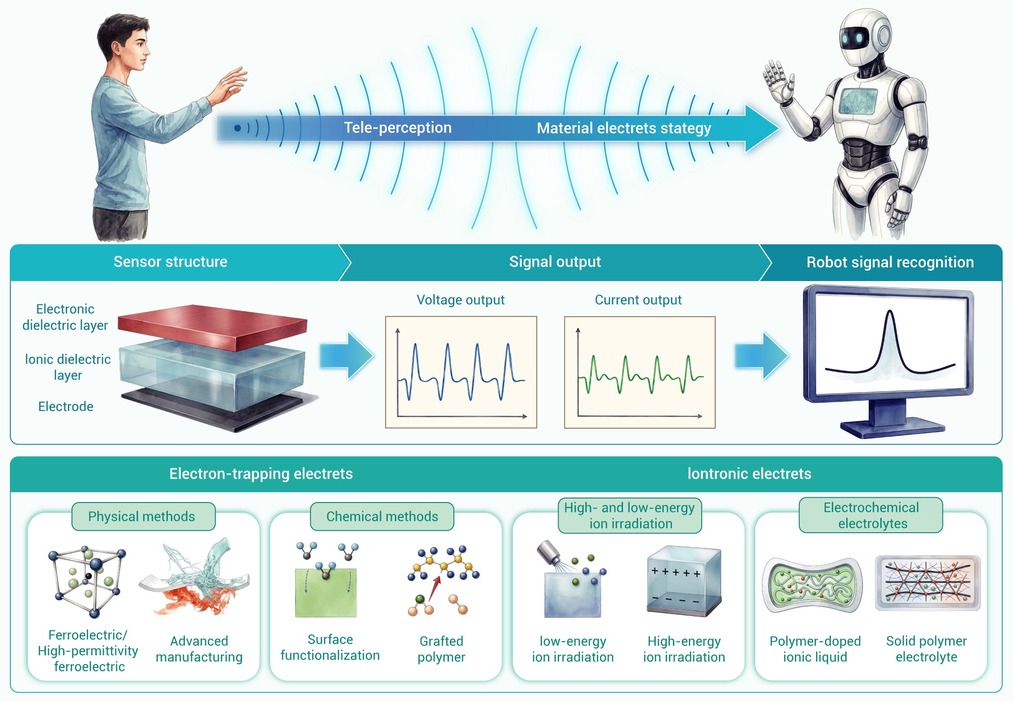
Tele-perception is an emerging non-contact sensing paradigm that enables long-range perception and establishes a new interface for intelligent human-machine interaction. Unlike conventional tactile sensing, tele-perception relies on material-generated spatial electrostatic fields, placing unprecedented demands on electret materials capable of generating, retaining and dynamically regulating electric fields. However, current electret research lacks a unified materials framework tailored to tele-perception. Here, we establish a materials perspective that classifies tele-perception electrets into electron-trapping and iontronic electret systems. Electron-trapping electrets generate persistent electrostatic fields through electron trapping and dielectric polarization, whereas iontronic electrets enable adaptive field modulation through ionic migration and space-charge redistribution. We further propose a paradigm shift from passive charge-trapping materials to active spatial electric-field engineering, establishing a unified materials design strategy for next-generation tele-perception toward embodied intelligence, autonomous robotics, and intelligent sensing in complex and dynamic environments.-
Keywords:
- Tele-perception /
- electron-trapping electrets /
- iontronic electrets
-

-
REFERENCES
[1] Du Y., Shen P., Liu H., et al. (2024). Multi-receptor skin with highly sensitive tele-perception somatosensory. Sci. Adv. 10:eadp8681. DOI:10.1126/sciadv.adp8681 [2] Du Y., Shen P., Liu H., et al. (2025). Meta-structured electret heterointerface for resilient and adaptive tele-perception in embodied intelligence. Matter 8:102363. DOI:10.1016/j.matt.2025.102363 [3] Wang J., Wu C., Dai Y., et al. (2017). Achieving ultrahigh triboelectric charge density for efficient energy harvesting. Nat. Commun. 8:88. DOI:10.1038/s41467-017-00131-4 [4] Liu Z., Huang Y.-z., Shi Y., et al. (2023). Creating ultrahigh and long-persistent triboelectric charge density on weak polar polymer via quenching polarization. Adv. Funct. Mater. 33:2302164. DOI:10.1002/adfm.202302164 [5] Li S., Nie J., Shi Y., et al. (2020). Contributions of different functional groups to contact electrification of polymers. Adv. Mater. 32:2001307. DOI:10.1002/adma.202001307 [6] Lee J. W., Cho H. J., Chun J., et al. (2017). Robust nanogenerators based on graft copolymers via control of dielectrics for remarkable output power enhancement. Sci. Adv. 3:e1602902. DOI:10.1126/sciadv.1602902 [7] Li S., Fan Y., Chen H., et al. (2020). Manipulating the triboelectric surface charge density of polymers by low-energy helium ion irradiation/implantation. Energy Environ. Sci. 13:896-907. DOI:10.1039/c9ee03307f [8] Šutka A., Fiedler H., Linarts A., et al. (2026). Space charge drives electromechanical conversion in ion-implanted polymers via an apparent piezoelectric effect. Phys. Rev. Lett. 136:056203. DOI:10.1103/th79-cjz6 [9] Han J. H. and Moon H. C. (2025). Monolithically integrated ionic triboelectric nanogenerators for deformable energy harvesting and self powered sensing. npj Flexible Electronics. 9:114. DOI:10.1038/s41528-025-00491-8 [10] Ryu H., Lee J.-H., Kim T.-Y., et al. (2017). High-performance triboelectric nanogenerators based on solid polymer electrolytes with asymmetric pairing of ions. Adv. Energy Mater. 7:1700289. DOI:10.1002/aenm.201700289 -
ABOUT THIS ARTICLE
Cite this article:
Du Y., Wang Z. and Wei D. (2027). Electret materials for tele-perception. The Innovation Materials 5:100260. https://doi.org/10.59717/j.xinn-mater.2027.100260
Welcome!
To request copyright permission to republish or share portions of our works, please visit Copyright Clearance Center's (CCC) Marketplace website at marketplace.copyright.com.
Export File
Citation
Du Y., Wang Z. and Wei D. (2027). Electret materials for tele-perception. The Innovation Materials 5:100260. https://doi.org/10.59717/j.xinn-mater.2027.100260

Format
Content
 DownLoad:
-
Figure 1.
Electret materials for tele-perception systems.
