
Structured Bayesian modelling advances longitudinal EHR research
-

-
REFERENCES
[1] Rasmy L., Xiang Y., Xie Z., et al. (2021). Med-BERT: Pretrained contextualized embeddings on large-scale structured electronic health records for disease prediction. npj Digit. Med. 4:86. DOI:10.1038/s41746-021-00455-y [2] Shmatko A., Jung A.W., Gaurav K., et al. (2025). Learning the natural history of human disease with generative transformers. Nature 647:248−256. DOI:10.1038/s41586-025-09529-3 [3] Urbut S.M., Ding Y., Nakao T., et al. (2026). A Bayesian framework for longitudinal EHR and genetic discovery. Nature 656:924−935. DOI:10.1038/s41586-026-10780-5 [4] Blei D.M., Kucukelbir A. and McAuliffe J.D. (2017). Variational inference: A review for statisticians. J. Am. Stat. Assoc. 112:859−877. DOI:10.1080/01621459.2017.1285773 [5] Corral-Acero J., Margara F., Marciniak M., et al. (2020). The ‘digital twin’ to enable the vision of precision cardiology. Eur. Heart J. 41:4556−4564. DOI:10.1093/eurheartj/ehaa159 -
ABOUT THIS ARTICLE
Cite this article:
Chen X., Li Z., Yang W., et al. (2026). Structured Bayesian modelling advances longitudinal EHR research. The Innovation Nutrition 1:100036. https://doi.org/10.59717/j.xinn-nutri.2026.100036
Welcome!
To request copyright permission to republish or share portions of our works, please visit Copyright Clearance Center's (CCC) Marketplace website at marketplace.copyright.com.
Export File
Citation
Chen X., Li Z., Yang W., et al. (2026). Structured Bayesian modelling advances longitudinal EHR research. The Innovation Nutrition 1:100036. https://doi.org/10.59717/j.xinn-nutri.2026.100036

Format
Content
 DownLoad:
-
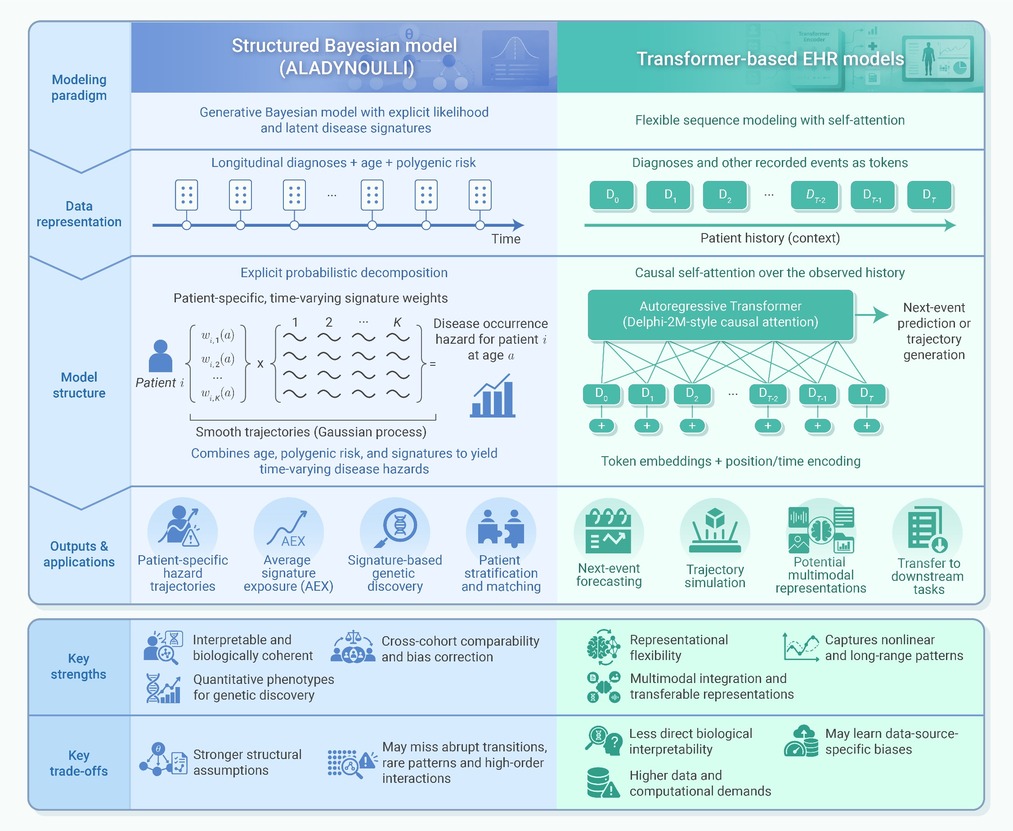
Figure 1.
Complementary paradigms for longitudinal EHR modelling
