
Eastern healthy diet derived from regional food culture is associated with lower long-term health risks in Chinese adults
-
GRAPHICAL ABSTRACT
 DownLoad:
Full size image
-
PUBLIC SUMMARY
-
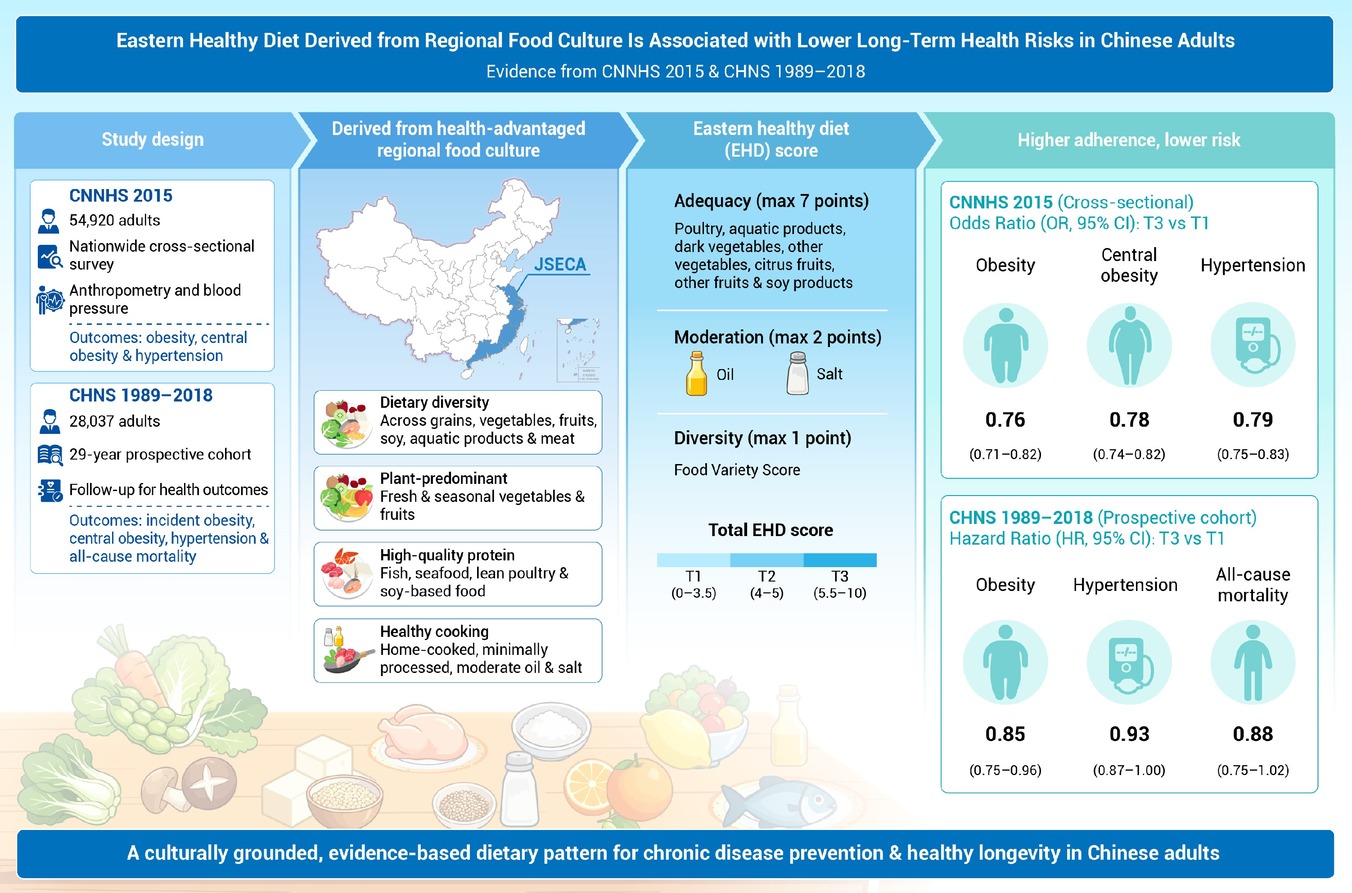
The Eastern Healthy Diet (EHD) is derived from the Jiangnan and Southeast Coastal Area (JSECA) of China.
The EHD features dietary diversity, plant-predominant, high-quality protein, and healthy cooking.
Higher EHD adherence was associated with lower obesity, central obesity, hypertension and long-term health risks.
The EHD provides a practical, evidence-based strategy for chronic disease prevention in China.
-
-
ABSTRACT
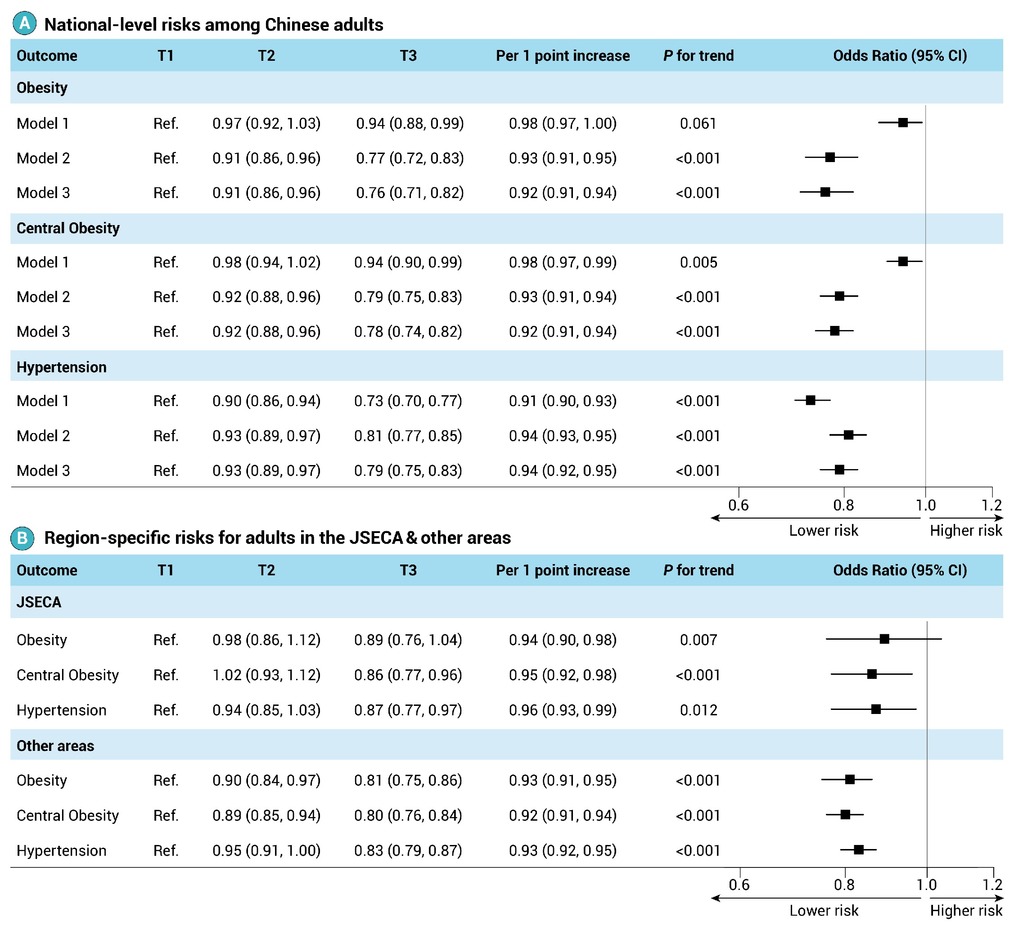
Sustainable and healthy dietary patterns require alignment with regional food cultures to promote long-term adherence and health benefits. The Jiangnan and Southeast Coastal Area (JSECA) of China, characterized by its dietary health advantages and exceptional longevity, provides a compelling foundation for a culturally grounded dietary framework. Using data from the China National Chronic Non-Communicable Disease and Nutrition Surveillance (CNNHS 2015), a nationally representative cross-sectional survey of 54,920 adults, this study derived the Eastern Healthy Diet (EHD) from the characteristic dietary patterns of the JSECA. The EHD was defined by high dietary diversity, high intake of dark-colored vegetables, other vegetables, citrus fruits, other fruits, aquatic products, poultry, and soy-based foods, and cooking methods that use less oil and salt. In fully adjusted logistic regression models, participants in the highest EHD tertile had had lower odds of obesity (odds ratio [OR] = 0.76, 95% confidence interval [CI]: 0.71–0.82), central obesity (OR = 0.78, 95% CI: 0.74–0.82), and hypertension (OR = 0.79, 95% CI: 0.75–0.83) than those in the lowest tertile. In the China Health and Nutrition Survey (CHNS 1989–2018), an independent prospective cohort, time-dependent Cox proportional hazards models showed that greater EHD adherence was associated with lower risks of selected adverse health outcomes. The EHD provides a practical, evidence-based strategy for chronic disease prevention in China.-
Keywords:
- Eastern Healthy Diet /
- Dietary Pattern /
- Obesity /
- Hypertension /
- All-Cause Mortality /
- Chinese
-

-
REFERENCES
[1] Wang S.S.Z., Zhang B., Wang Z.H., et al. (2021). Trend of food intake from Chinese 15 provinces (autonomous regions, municipalities) adults aged 18 to 35 in 1989-2015. J. Hyg. Res. 50:442−447. DOI:10.19813/j.cnki.weishengyanjiu.2021.03.016 [2] Wu X., Huang C., Ma J., et al. (2024). The status and trends of fruit consumption among adult Chinese residents from 1991 to 2018. Chin. J. Food Hyg. 36:1179−1184. DOI:10.13590/j.cjfh.2024.10.012 [3] Pan X.F., Wang L. and Pan A. (2021). Epidemiology and determinants of obesity in China. Lancet Diabetes Endocrinol. 9:373−392. DOI:10.1016/s2213-8587(21)00045-0 [4] Zhou Y.C., Liu J.M., Zhao Z.P., et al. (2025). The national and provincial prevalence and non-fatal burdens of diabetes in China from 2005 to 2023 with projections of prevalence to 2050. Mil. Med. Res. 12:28. DOI:10.1186/s40779-025-00615-1 [5] Global Burden of Disease Collaborative Network (2024). Global Burden of Disease Study 2021 (GBD 2021) Results. Institute for Health Metrics and Evaluation (IHME), Seattle. https://vizhub.healthdata.org/gbd-results/. [6] Trichopoulou A., Costacou T., Bamia C., et al. (2003). Adherence to a Mediterranean diet and survival in a Greek population. N. Engl. J. Med. 348:2599−2608. DOI:10.1056/nejmoa025039 [7] Appel L.J., Moore T.J., Obarzanek E., et al. (1997). A clinical trial of the effects of dietary patterns on blood pressure. N. Engl. J. Med. 336:1117−1124. DOI:10.1056/nejm199704173361601 [8] Gao M., Wang F., Shen Y., et al. (2018). Trajectories of Mediterranean diet adherence and risk of hypertension in China: Results from the CHNS study, 1997-2011. Nutrients 10:2014. DOI:10.3390/nu10122014 [9] Li S.Y., Lu Z.H., Leung J., et al. (2025). Dietary patterns modify the association between body mass index and mortality in older adults. Clin. Nutr. 46:20−29. DOI:10.1016/j.clnu.2025.01.016 [10] Wei L., Fan J., Dong R., et al. (2023). The effect of dietary pattern on metabolic syndrome in a suburban population in Shanghai, China. Nutrients 15:2185. DOI:10.3390/nu15092185 [11] Zhu Y.X., Huang J., Zhang Z.K., et al. (2013). Geography and similarity of regional cuisines in China. PLoS One 8:e79161. DOI:10.1371/journal.pone.0079161 [12] Jia M. and Zhen L. (2022). Food consumption characteristics and influencing factors in a grassland transect of Inner Mongolia based on the emergy method. Foods 11:3637. DOI:10.3390/foods11223637 [13] Zhang D., Ma W., Wu J., et al. (2020). Oral physiological and biochemical characteristics of different dietary habit groups II: Comparison of oral salivary biochemical properties of Chinese Mongolian and Han young adults. Food Res. Int. 136:109465. DOI:10.1016/j.foodres.2020.109465 [14] Li J., Zhao L., Yu D., et al. (2025). Regional dietary pattern associated with the risk of hypertensive dyslipidemia multimorbidity in Chinese elderly: Results from China nutrition and health surveillance in 2015-2017. Nutrients 17:852. DOI:10.3390/nu17050852 [15] Fang Y., Xia J., Lian Y., et al. (2023). The burden of cardiovascular disease attributable to dietary risk factors in the provinces of China, 2002-2018: A nationwide population-based study. Lancet Reg. Health West Pac. 37:100784. DOI:10.1016/j.lanwpc.2023.100784 [16] Zhang M., Wu J., Zhang X., et al. (2021). Prevalence and control of hypertension in adults in China, 2018. Chin. J. Epidemiol. 42:1780−1789. DOI:10.3760/cma.j.cn112338-20210508-00379 [17] Li X., Wu C., Lu J., et al. (2020). Cardiovascular risk factors in China: A nationwide population-based cohort study. Lancet Public Health 5:e672−e681. DOI:10.1016/s2468-2667(20)30191-2 [18] Yu D., Zhao L., Zhang J., et al. (2021). China Nutrition and Health Surveys (1982-2017). China CDC Wkly. 3:193−195. DOI:10.46234/ccdcw2021.058 [19] Popkin B.M., Du S., Zhai F., et al. (2010). Cohort profile: The China Health and Nutrition Survey--monitoring and understanding socio-economic and health change in China, 1989-2011. Int. J. Epidemiol. 39:1435-1440. DOI:10.1093/ije/dyp322. [20] Reynolds A., Mann J., Cummings J., et al. (2019). Carbohydrate quality and human health: A series of systematic reviews and meta-analyses. Lancet 393:434−445. DOI:10.1016/s0140-6736(18)31809-9 [21] Chen J., Jayachandran M., Bai W., et al. (2022). A critical review on the health benefits of fish consumption and its bioactive constituents. Food Chem. 369:130874. DOI:10.1016/j.foodchem.2021.130874 [22] Asbaghi O., Ashtary-Larky D., Mousa A., et al. (2022). The effects of soy products on cardiovascular risk factors in patients with type 2 diabetes: A systematic review and meta-analysis of clinical trials. Adv. Nutr. 13:455−473. DOI:10.1093/advances/nmab121 [23] Wang X., Yu C., Lv J., et al. (2021). Consumption of soy products and cardiovascular mortality in people with and without cardiovascular disease: A prospective cohort study of 0.5 million individuals. Eur. J. Nutr. 60:4429-4438. DOI:10.1007/s00394-021-02602-3. [24] Zuo X., Zhao R., Wu M., et al. (2023). Soy consumption and the risk of type 2 diabetes and cardiovascular diseases: A systematic review and meta-analysis. Nutrients 15:1358. DOI:10.3390/nu15061358 [25] Yu D., Zhao L., Ju L., et al. (2021). Status of energy and primary nutrients intake among Chinese population in 2015-2017. Food Nutr. China 27:5−10. DOI:10.3969/j.issn.1006-9577.2021.04.002 [26] Willett W., Rockström J., Loken B., et al. (2019). Food in the Anthropocene: The EAT-Lancet Commission on healthy diets from sustainable food systems. Lancet 393:447−492. DOI:10.1016/s0140-6736(18)31788-4 [27] Wang L., Zhou B., Zhao Z., et al. (2021). Body-mass index and obesity in urban and rural China: Findings from consecutive nationally representative surveys during 2004-18. Lancet 398:53−63. DOI:10.1016/s0140-6736(21)00798-4 [28] Tian Y., Zhao Z., Cao X., et al. (2023). Rapid increasing burden of diabetes and cardiovascular disease caused by high body mass index in 1.25 million Chinese adults, 2005-2018. Med 4:505-525.e3. DOI:10.1016/j.medj.2023.05.008. [29] Cao X., Zhao Z., Kang Y., et al. (2022). The burden of cardiovascular disease attributable to high systolic blood pressure across China, 2005-18: A population-based study. Lancet Public Health 7:e1027−e1040. DOI:10.1016/s2468-2667(22)00232-8 [30] Song Y., Cheng F., Du Y., et al. (2023). Higher adherence to the AMED, DASH, and CHFP dietary patterns is associated with better cognition among Chinese middle-aged and elderly adults. Nutrients 15:3974. DOI:10.3390/nu15183974 [31] Zhang K., Wu Y., Yi L., et al. (2025). Adherence to the Mediterranean diet and risk of depression: A cohort study in Chinese community residents. Nutrients 17:942. DOI:10.3390/nu17060942 [32] Song K., Luo J., Cao X., et al. (2025). Urban-rural differences in the successful aging among older adults in China. PLoS One 20:e0319105. DOI:10.1371/journal.pone.0319105 [33] Jia L., Lu H., Wu J., et al. (2020). Association between diet quality and obesity indicators among the working-age adults in Inner Mongolia, Northern China: A cross-sectional study. BMC Public Health 20:1165. DOI:10.1186/s12889-020-09281-5 [34] Tang D., Xiao X., Chen L., et al. (2022). Association of dietary patterns with obesity and metabolically healthy obesity phenotype in Chinese population: A cross-sectional analysis of China Multi-Ethnic Cohort Study. Br. J. Nutr. 128:2230−2240. DOI:10.1017/s0007114521005158 [35] Xiao M.L., Lin J.S., Li Y.H., et al. (2020). Adherence to the Dietary Approaches to Stop Hypertension (DASH) diet is associated with lower presence of non-alcoholic fatty liver disease in middle-aged and elderly adults. Public Health Nutr. 23:674−682. DOI:10.1017/s1368980019002568 [36] Barrea L., Verde L., Simancas-Racines D., et al. (2023). Adherence to the Mediterranean diet as a possible additional tool to be used for screening the metabolically unhealthy obesity (MUO) phenotype. J. Transl. Med. 21:675. DOI:10.1186/s12967-023-04546-0 [37] Luo Y., Wang J., Sun L., et al. (2022). Isocaloric-restricted Mediterranean diet and Chinese diets high or low in plants in adults with prediabetes. J. Clin. Endocrinol. Metab. 107:2216−2227. DOI:10.1210/clinem/dgac303 [38] Wang J., Lin X., Bloomgarden Z.T., et al. (2020). The Jiangnan diet, a healthy diet pattern for Chinese. J. Diabetes 12:365−371. DOI:10.1111/1753-0407.13015 [39] Wang Y., Zhang Y., Zeng X., et al. (2024). Association between cMIND diet and hypertension among older adults in China: A nationwide survey. Aging Clin. Exp. Res. 36:182. DOI:10.1007/s40520-024-02842-3 [40] Dai S., Xiao X., Xu C., et al. (2022). Association of dietary approaches to stop hypertension diet and Mediterranean diet with blood pressure in less-developed ethnic minority regions. Public Health Nutr. 25:3476−3486. DOI:10.1017/s1368980022000106 [41] Soltani S., Jayedi A., Shab-Bidar S., et al. (2019). Adherence to the Mediterranean diet in relation to all-cause mortality: A systematic review and dose-response meta-analysis of prospective cohort studies. Adv. Nutr. 10:1029−1039. DOI:10.1093/advances/nmz041 -
ABOUT THIS ARTICLE
Cite this article:
He Y., Wang H., Fang Y., et al. (2026). Eastern healthy diet derived from regional food culture is associated with lower long-term health risks in Chinese adults. The Innovation Nutrition 1:100038. https://doi.org/10.59717/j.xinn-nutri.2026.100038
Welcome!
To request copyright permission to republish or share portions of our works, please visit Copyright Clearance Center's (CCC) Marketplace website at marketplace.copyright.com.
Export File
Citation
He Y., Wang H., Fang Y., et al. (2026). Eastern healthy diet derived from regional food culture is associated with lower long-term health risks in Chinese adults. The Innovation Nutrition 1:100038. https://doi.org/10.59717/j.xinn-nutri.2026.100038

Format
Content
-
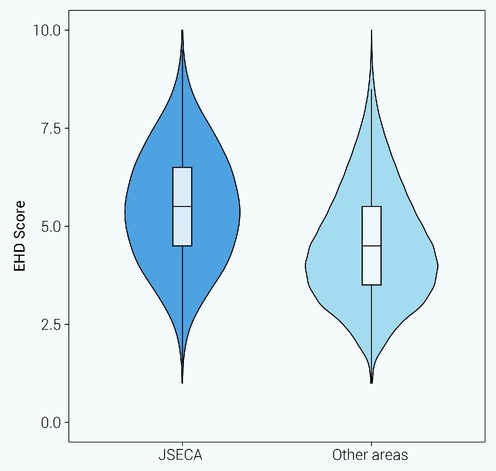
Figure 1.
Distribution of EHD score in different areas
-
Figure 2.
Associations of Eastern Healthy Diet (EHD) score with main health outcomes in China and different regions
