
Concurrent extreme heat and power outages: Health impacts, exposure assessment, and research priorities
-
GRAPHICAL ABSTRACT
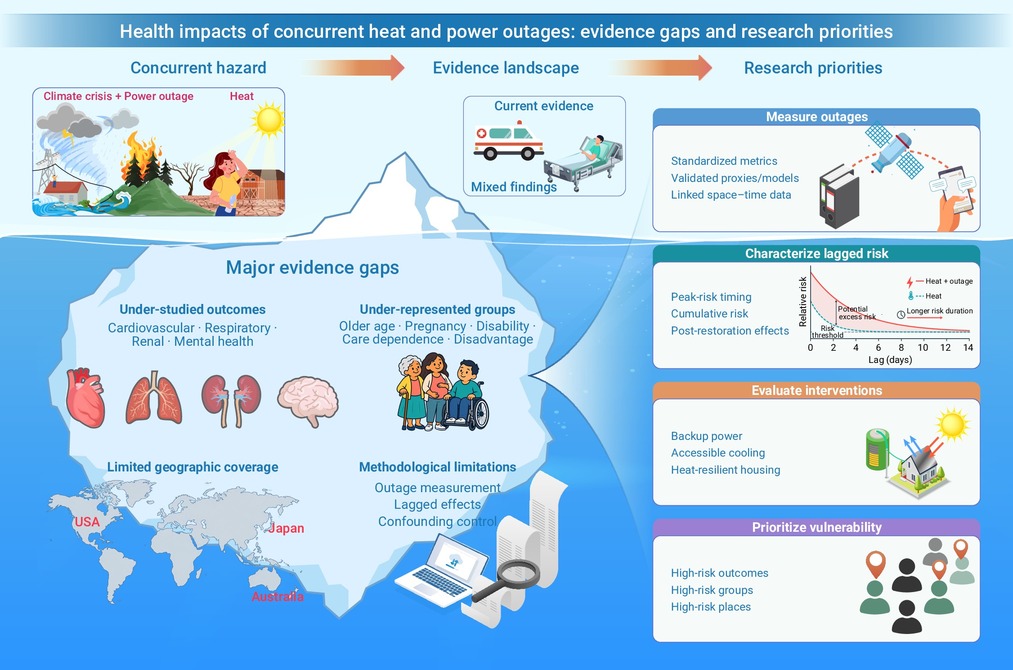
 DownLoad:
Full size image
-
PUBLIC SUMMARY
-
Extreme heat becomes more dangerous when power outages disrupt cooling and essential services.
Studies have linked concurrent heat and power outages to increased risks of some health outcomes, but the evidence remains limited and mixed.
Better outage monitoring is needed to identify who is affected and understand the health risks.
Reliable electricity, accessible cooling spaces and continuity of healthcare are essential priorities for protecting vulnerable communities.
-
-
ABSTRACT
As extreme heat intensifies, growing reliance on electricity for cooling and essential services creates a critical vulnerability: power outages may amplify health risks precisely when protection is most needed. We conducted an evidence review to synthesize quantitative evidence on the health impacts of concurrent heat and electricity disruption, examine exposure assessment approaches, and identify priorities for research and preparedness. MEDLINE (Ovid), Embase, Scopus, Web of Science and Google Scholar were searched, with the original searches completed in October 2025. Two reviewers independently screened records and charted study characteristics, exposures and health findings. Evidence was synthesized narratively without meta-analysis. Ten quantitative health reports met the core eligibility criteria, and one additional vulnerability assessment provided contextual evidence. Studies were concentrated in the United States, Japan and Australia and varied substantially in design, exposure definition and outcome assessment. Documented or satellite-inferred outages were associated with increased risks for selected outcomes, particularly respiratory hospital admissions and ambulance attendances, while findings for mortality and other outcomes were less consistent. Studies of electricity conservation reported inconsistent associations with heat-related mortality. Three scenario studies projected additional health burdens under assumed electricity or cooling failure rather than measuring observed outage-attributable effects. Outage assessment ranged from documented events and utility records to consumption-based and satellite-derived indicators, each with distinct limitations. A supplementary contextual analysis highlighted disparities in electricity reliability across development levels. Limited fine-scale outage data, potential confounding by concurrent hazards and sparse evidence on electricity-dependent populations constrain inference. Progress requires validated outage surveillance linked to health and vulnerability data, alongside evaluation of coordinated strategies spanning grid resilience, healthcare continuity, accessible community cooling and household preparedness.-
Keywords:
- extreme heat /
- power outage /
- health impact /
- vulnerability /
- preparedness
-

-
REFERENCES
[1] IPCC (2023). Summary for policymakers. Lee H. and Romero J. (eds). Climate change 2023: Synthesis report. Contribution of working groups Ⅰ, Ⅱ and Ⅲ to the sixth assessment report of the intergovernmental panel on climate change (Geneva, Switzerland), pp: 1–34. DOI: 10.59327/IPCC/AR6-9789291691647.001 [2] Satoh Y., Yoshimura K., Pokhrel Y., et al. (2022). The timing of unprecedented hydrological drought under climate change. Nat Commun 13:3287. DOI:10.1038/s41467-022-30729-2 [3] Tripathy K.P., Mukherjee S., Mishra A.K., et al. (2023). Climate change will accelerate the high-end risk of compound drought and heatwave events. Proc Natl Acad Sci U S A 120:e2219825120. DOI:10.1073/pnas.2219825120 [4] Hu Z.Z., McPhaden M.J., Huang B., et al. (2024). Accelerated warming in the North Pacific since 2013. Nat Clim Chang 14:929−931. DOI:10.1038/s41558-024-02088-x [5] Touma D., Stevenson S., Swain D.L., et al. (2022). Climate change increases risk of extreme rainfall following wildfire in the western United States. Sci Adv 8:eabm0320. DOI:10.1126/sciadv.abm0320 [6] Zhao Q., Guo Y., Ye T., et al. (2021). Global, regional, and national burden of mortality associated with non-optimal ambient temperatures from 2000 to 2019: a three-stage modelling study. Lancet Planet Health 5:e415−e425. DOI:10.1016/S2542-5196(21)00081-4 [7] Ballester J., Quijal-Zamorano M., Méndez Turrubiates R.F., et al. (2023). Heat-related mortality in Europe during the summer of 2022. Nat Med 29:1857−1866. DOI:10.1038/s41591-023-02419-z [8] Do V., McBrien H., Flores N.M., et al. (2023). Spatiotemporal distribution of power outages with climate events and social vulnerability in the USA. Nat Commun 14:2470. DOI:10.1038/s41467-023-38084-6 [9] Gernaat D.E.H.J., de Boer H.S., Daioglou V., et al. (2021). Climate change impacts on renewable energy supply. Nat Clim Chang 11:119−125. DOI:10.1038/s41558-020-00949-9 [10] Carvallo J.P. and Casey J. (2024). Weather-related power outages rising. https://www.climatecentral.org/report/weather-related-power-outages-rising [11] Liang J., Qiu Y.L., Wang B., et al. (2025). Impacts of heatwaves on electricity reliability: Evidence from power outage data in China. iScience 28:111855. DOI:10.1016/j.isci.2025.111855 [12] Abir M., Jan S., Jubelt L., et al. (2013). The impact of a large-scale power outage on hemodialysis center operations. Prehosp Disaster Med 28:543−546. DOI:10.1017/S1049023X13008844 [13] Zhang W., Sheridan S.C., Birkhead G.S., et al. (2020). Power outage: an ignored risk factor for COPD exacerbations. Chest 158:2346−2357. DOI:10.1016/j.chest.2020.05.555 [14] Casey J.A., Fukurai M., Hernández D., et al. (2020). Power outages and community health: a narrative review. Curr Environ Health Rep 7:371−383. DOI:10.1007/s40572-020-00295-0 [15] Northrop A.J., Do V., Flores N.M., et al. (2025). Power outages and carbon monoxide poisoning in children. Pediatrics 155:e2024068213. DOI:10.1542/peds.2024-068213 [16] Rouhana F., Zhu J., Bagtzoglou A.C., et al. (2025). Examining rural–urban vulnerability inequality in extreme weather-related power outages: Case of tropical storm isaias. Nat Hazards Rev 26:04025039. DOI:10.1061/NHREFO.NHENG-2235 [17] Rubin G.J. and Rogers M.B. (2019). Behavioural and psychological responses of the public during a major power outage: A literature review. Int J Disaster Risk Reduct 38:101226. DOI:10.1016/j.ijdrr.2019.101226 [18] Kim Y., Gasparrini A., Hashizume M., et al. (2017). Heat-related mortality in Japan after the 2011 Fukushima disaster: an analysis of potential influence of reduced electricity consumption. Environ Health Perspect 125:077005. DOI:10.1289/EHP493 [19] Lin S., Fletcher B.A., Luo M., et al. (2011). Health impact in New York City during the Northeastern blackout of 2003. Public Health Rep 126:384−393. DOI:10.1177/003335491112600312 [20] Yamasaki L., Kamada T., Ng C.F.S., et al. (2024). Heat-related mortality and ambulance transport after a power outage in the Tokyo metropolitan area. Environ Epidemiol 8:e292. DOI:10.1097/EE9.0000000000000292 [21] Xu Z., Xu R., Chen G., et al. (2025). Power outages increase the risk of ambulance attendances associated with non-optimal temperatures. Environ Res 285:122396. DOI:10.1016/j.envres.2025.122396 [22] Jia M., Li X., Gong Y., et al. (2023). Estimating natural disaster loss using improved daily night-time light data. Int J Appl Earth Obs Geoinf 120:103359. DOI:10.1016/j.jag.2023.103359 [23] Sun H., Wang Z., Wang J., et al. (2016). Data-driven power outage detection by social sensors. IEEE Trans Smart Grid 7:2516−2524. DOI:10.1109/TSG.2016.2546181 [24] Lee S.M., Choi J.Y., Jung G.S., et al. (2023). Predicting power outage during extreme weather events with EAGLE-I and NWS datasets. 2023 IEEE 24th International Conference on Information Reuse and Integration for Data Science (IRI). IEEE, pp: 211–212. DOI:10.1109/IRI58017.2023.00042 [25] Centers for Disease Control and Prevention (CDC) (2013). Heat-related deaths after an extreme heat event—four states, 2012, and United States, 1999–2009. MMWR Morb Mortal Wkly Rep 62:433–436. [26] Ai D., Crago C.L., Mullins J.T. (2026). Heat, power outages and mortality in the United States. J Environ Econ Manage 137:103275. DOI:10.1016/j.jeem.2025.103275 [27] He G., Tanaka T. (2023). Energy saving may kill: evidence from the Fukushima nuclear accident. Am Econ J Appl Econ 15:377−414. DOI:10.1257/app.20200505 [28] Broome R.A. and Smith W.T. (2012). The definite health risks from cutting power outweigh possible bushfire prevention benefits. Med J Aust 197:440−441. DOI:10.5694/mja12.10218 [29] Nairn J., Williams S. (2019). Power outages during heatwaves: Predicting mortality burden in Australian cities. https://web.archive.org/web/20250723120334/https://aemo.com.au/-/media/files/initiatives/strategic-partnerships/2020/power-outages-and-mortality-burden-australian-cities.pdf. [30] Stone B. Jr., Gronlund C.J., Mallen E., et al. (2023). How blackouts during heat waves amplify mortality and morbidity risk. Environ Sci Technol 57:8245−8255. DOI:10.1021/acs.est.2c09588 [31] Bratanova A., Chen H., Pham H., et al. (2026). Hot and powerless: Identifying vulnerable population clusters under hypothetical concurrent heatwave and loss-of-electricity conditions in Australia. Sustain. Futures 12:102033. DOI:10.1016/j.sftr.2026.102033 [32] Sheridan S.C., Zhang W., Deng X., et al. (2021). The individual and synergistic impacts of windstorms and power outages on injury ED visits in New York State. Sci Total Environ 797:149199. DOI:10.1016/j.scitotenv.2021.149199 [33] Lin S., Zhang W., Sheridan S., et al. (2021). The immediate effects of winter storms and power outages on multiple health outcomes and the time windows of vulnerability. Environ Res 196:110924. DOI:10.1016/j.envres.2021.110924 [34] Xiao J., Zhang W., Huang M., et al. (2021). Increased risk of multiple pregnancy complications following large-scale power outages during Hurricane Sandy in New York State. Sci Total Environ 770:145359. DOI:10.1016/j.scitotenv.2021.145359 [35] Qu Y., Zhang W., Ye B., et al. (2021). Power outage mediates the associations between major storms and hospital admission of chronic obstructive pulmonary disease. BMC Public Health 21:1961. DOI:10.1186/s12889-021-12006-x [36] Deng X., Friedman S., Ryan I., et al. (2022). The independent and synergistic impacts of power outages and floods on hospital admissions for multiple diseases. Sci Total Environ 828:154305. DOI:10.1016/j.scitotenv.2022.154305 [37] Lin S., Qi Q., Liu H., et al. (2024). The joint effects of thunderstorms and power outages on respiratory-related emergency visits and modifying and mediating factors of this relationship. Environ Health Perspect 132:067002. DOI:10.1289/EHP13237 [38] Román M.O., Stokes E.C., Shrestha R., et al. (2019). Satellite-based assessment of electricity restoration efforts in Puerto Rico after Hurricane Maria. PLoS One 14:e0218883. DOI:10.1371/journal.pone.0218883 [39] Mao H., Thakur G., Sparks K., et al. (2019). Mapping near-real-time power outages from social media. Int J Digit Earth 12:1285−1299. DOI:10.1080/17538947.2018.1535000 [40] Zhai C., Chen T.Y.J., White A.G., et al. (2021). Power outage prediction for natural hazards using synthetic power distribution systems. Reliab Eng Syst Saf 208:107348. DOI:10.1016/j.ress.2020.107348 [41] Rizvi M. (2023). Leveraging deep learning algorithms for predicting power outages and detecting faults: a review. Adv Res 24:80−88. DOI:10.9734/air/2023/v24i5961 [42] Guikema S., Pagan-Cajigas Z., Fant C., et al. (2025). Climate change impacts on tropical cyclone–induced power outage risk: Sociodemographic differences in outage burdens. Proc Natl Acad Sci U S A 122:e2502266122. DOI:10.1073/pnas.2502266122 [43] Stefanowska E., Jawad M., Bomba P., et al. (2025). Leveraging large language models and social media for power outage detection. IEEE EUROCON 2025—21st International Conference on Smart Technologies. IEEE, pp. 1–6. DOI:10.1109/EUROCON64445.2025.11073383 [44] Zhou Z., Li Y., Yu X., et al. (2026). A causal-guided multimodal large language model for generalized power system time-series data analytics. IEEE Trans Smart Grid. DOI:10.1109/TSG.2026.3714202 [45] Gasparrini A., Guo Y., Hashizume M., et al. (2015). Mortality risk attributable to high and low ambient temperature: a multicountry observational study. Lancet 386:369−375. DOI:10.1016/S0140-6736(14)62114-0 [46] Gasparrini A. (2021). The case time series design. Epidemiology 32:829−837. DOI:10.1097/EDE.0000000000001410 [47] VanderWeele T.J. and Knol M.J. (2014). A tutorial on interaction. Epidemiol Methods 3:33−72. DOI:10.1515/em-2013-0005 [48] Kim S.E., Hashizume M., Armstrong B., et al. (2023). Mortality risk of hot nights: A nationwide population-based retrospective study in Japan. Environ Health Perspect 131:057005. DOI:10.1289/EHP11444 [49] Gagnon D., Schlader Z.J., Jay O. (2026). The physiology behind the epidemiology of heat-related health impacts. Physiology (Bethesda) 41:30−42. DOI:10.1152/physiol.00012.2025 [50] Meade R.D., Akerman A.P., Notley S.R., et al. (2020). Physiological factors characterizing heat-vulnerable older adults: A narrative review. Environ Int 144:105909. DOI:10.1016/j.envint.2020.105909 [51] Kenny G.P., Yardley J., Brown C., et al. (2010). Heat stress in older individuals and patients with common chronic diseases. CMAJ 182:1053−1060. DOI:10.1503/cmaj.081050 [52] Balmain B.N., Sabapathy S., Louis M., et al. (2018). Aging and thermoregulatory control: the clinical implications of exercising under heat stress in older individuals. Biomed Res Int 2018:8306154. DOI:10.1155/2018/8306154 [53] Bouchama A., Dehbi M., Mohamed G., et al. (2007). Prognostic factors in heat wave–related deaths: a meta-analysis. Arch Intern Med 167:2170−2176. DOI:10.1001/archinte.167.20.ira70009 [54] Molinari N.A., Chen B., Krishna N., et al. (2017). Who’s at risk when the power goes out? The at-home electricity-dependent population in the United States, 2012. J Public Health Manag Pract 23:152–159. DOI:10.1097/PHH.0000000000000345 [55] Bean R., Snow S., Glencross M., et al. (2020). Keeping the power on to home medical devices. PLoS One 15:e0235068. DOI:10.1371/journal.pone.0235068 [56] Asplund R., Åberg H. (1992). Health of the elderly with regard to sleep and nocturnal micturition. Scand J Prim Health Care 10:98−104. DOI:10.3109/02813439209014044 [57] DeHaan E. (2021). Using and interpreting fixed effects models. SSRN preprint 3699777. DOI:10.2139/ssrn.3699777 [58] Ganz S.C., Duan C. and Ji C. (2023). Socioeconomic vulnerability and differential impact of severe weather-induced power outages. PNAS Nexus 2:pgad295. DOI:10.1093/pnasnexus/pgad295 [59] Chen Y.J., Chindarkar N. and Xiao Y. (2019). Effect of reliable electricity on health facilities, health information, and child and maternal health services utilization: evidence from rural Gujarat, India. J Health Popul Nutr 38:7. DOI:10.1186/s41043-019-0164-6 [60] Banerjee R., Mishra V. and Maruta A.A. (2021). Energy poverty, health and education outcomes: evidence from the developing world. Energy Econ 101:105447. DOI:10.1016/j.eneco.2021.105447 [61] Shobande O.A. (2020). The effects of energy use on infant mortality rates in Africa. Environ Sustain Indic 5:100015. DOI:10.1016/j.indic.2019.100015 [62] Byaro M., Mmbaga N.F., Mafwolo G. (2024). Tackling energy poverty: Do clean fuels for cooking and access to electricity improve or worsen health outcomes in sub-Saharan Africa. World Dev Sustain 4:100125. DOI:10.1016/j.wds.2024.100125 [63] Romanello M., Di Napoli C., Drummond P., et al. (2022). The 2022 report of the Lancet Countdown on health and climate change: health at the mercy of fossil fuels. Lancet 400:1619−1654. DOI:10.1016/S0140-6736(22)01540-9 [64] Feng K., Ouyang M., Lin N. (2022). Tropical cyclone-blackout-heatwave compound hazard resilience in a changing climate. Nat Commun 13:4421. DOI:10.1038/s41467-022-32018-4 [65] Houghton A., Bole A. and Balbus J. (2025). Climate resilience for health care toolkit. https://toolkit.climate.gov/sites/default/files/2025-02/CR4HC_Toolkit_Final_12.20.2024.pdf [66] World Health Organization (2026). Heat-health action plans: guidance, second edition. https://www.who.int/europe/publications/i/item/9789289062930 [67] Meade R.D., Notley S.R., Akerman A.P., et al. (2023). Efficacy of cooling centers for mitigating physiological strain in older adults during daylong heat exposure: A laboratory-based heat wave simulation. Environ Health Perspect 131:067003. DOI:10.1289/EHP11651 [68] Duan T., Zhang F., Li Q. (2025). Uncovering cooling center usage as an adaptation strategy for hurricane-blackout-heat compound hazards during Hurricane Beryl (2024). NPJ Nat Hazards 2:53. DOI:10.1038/s44304-025-00110-6 [69] Centers for Disease Control and Prevention (2026). About heat and your health. https://www.cdc.gov/heat-health/about/index.html [70] U.S. Food and Drug Administration (n.d.). FDA offers tips about medical devices and natural disasters. https://www.fda.gov/medical-devices/emergency-situations-medical-devices/fda-offers-tips-about-medical-devices-and-natural-disasters -
ABOUT THIS ARTICLE
Cite this article:
Xu Z., Xu R., Chen G., et al. (2026). Concurrent extreme heat and power outages: Health impacts, exposure assessment, and research priorities. The Innovation Reviews 1:100015. https://doi.org/10.59717/j.tirv.2026.100015
Welcome!
To request copyright permission to republish or share portions of our works, please visit Copyright Clearance Center's (CCC) Marketplace website at marketplace.copyright.com.
Export File
Citation
Xu Z., Xu R., Chen G., et al. (2026). Concurrent extreme heat and power outages: Health impacts, exposure assessment, and research priorities. The Innovation Reviews 1:100015. https://doi.org/10.59717/j.tirv.2026.100015

Format
Content
-
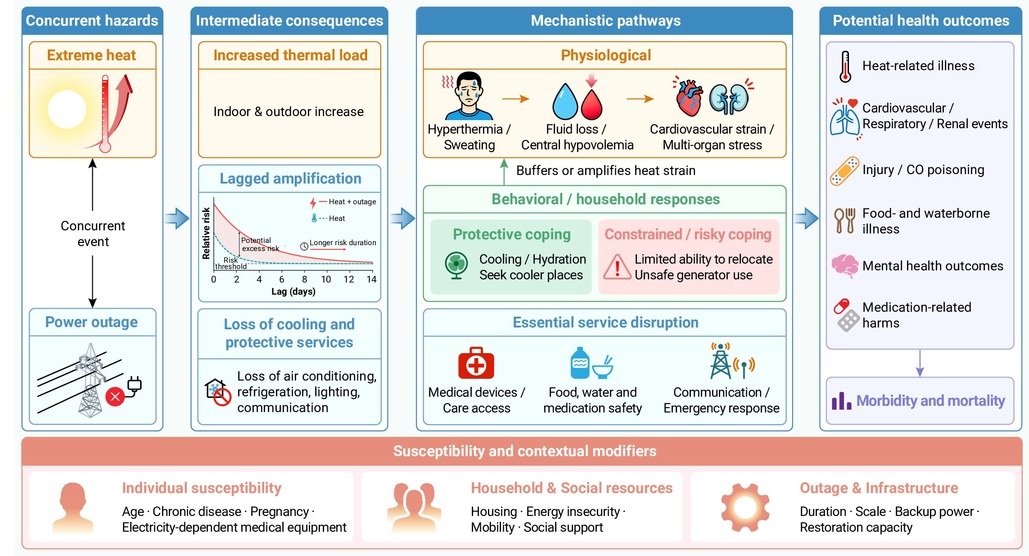
Figure 1.
Pathways linking concurrent extreme heat and power outages to health impacts
-
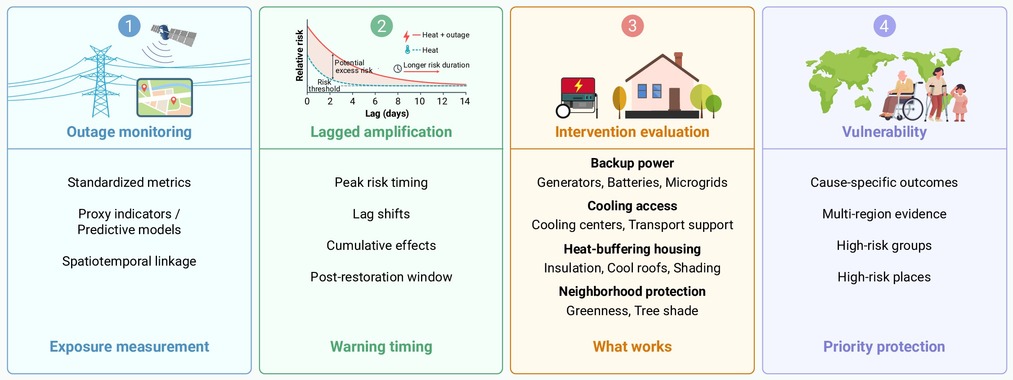
Figure 2.
Research priorities for studying the health impacts of concurrent heat and power outages
-
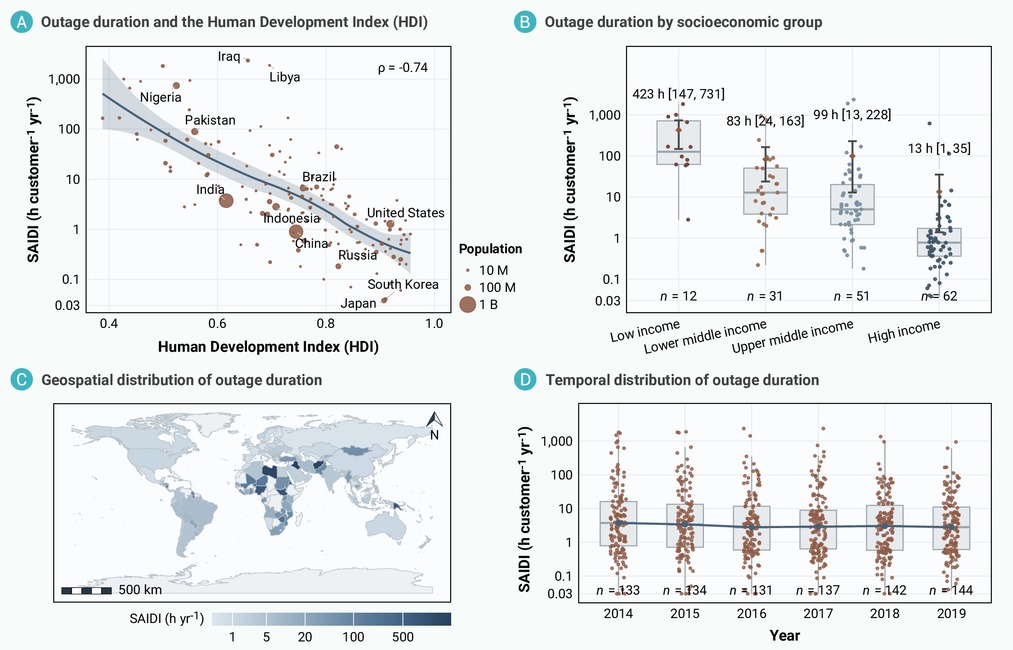
Figure 3.
Power outage duration across development levels, socio-economic groups, geography and time
-
Figure 4.
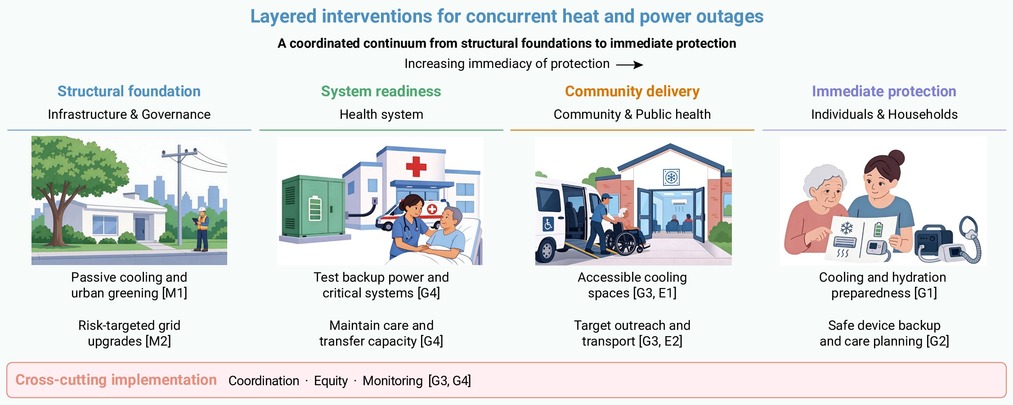
A layered intervention framework for concurrent extreme heat and power outages
