
Overoptimism about human activities on reemerged lakes in Northwest China
-

-
REFERENCES
[1] Tao S. L., Fang J. Y., Ma S. H., et al. (2020). Changes in China’s lakes: climate and human impacts. Natl. Sci. Rev. 7:132−140. DOI:10.1093/nsr/nwz103 [2] Ding Y. J., Zhang S. Q., Chen R. S. (2017). Changes and prediction of glacier water resources. Ding Y. J. (ed). Introduction to Cold-Region Hydrology. Science Press, pp:123-124. https://book.sciencereading.cn/shop/book/Booksimple/show.do?id=B542DF3823A58024CE053020B0A0A82CF000 [3] Guan W. J., et al (2026). Changes in glaciers and their runoff in the Shule River Basin of the Qilian Mountains from 1980 to 2100 based on remote sensing data and modeling. Land 15:1217. DOI: 10.3390/land15071217 [4] Huss M., and Hock R. (2018). Global-scale hydrological response to future glacier mass loss. Nat. Clim. Change 8:135−140. DOI:10.1038/s41558-017-0049-x [5] Tao S. L., Zhang H., Feng Y. H., et al. (2020). Change in China’s water resources in the early 21st century. Front. Ecol. Environ. 18:188−192. DOI:10.1002/fee.2164 -
ABOUT THIS ARTICLE
Cite this article:
Zhuang Y., Li W., Wang Z., et al. (2026). Overoptimism about human activities on reemerged lakes in Northwest China. The Innovation Water 1:100007. https://doi.org/10.59717/j.tiw.2026.100007
Welcome!
To request copyright permission to republish or share portions of our works, please visit Copyright Clearance Center's (CCC) Marketplace website at marketplace.copyright.com.
Export File
Citation
Zhuang Y., Li W., Wang Z., et al. (2026). Overoptimism about human activities on reemerged lakes in Northwest China. The Innovation Water 1:100007. https://doi.org/10.59717/j.tiw.2026.100007

Format
Content
 DownLoad:
-
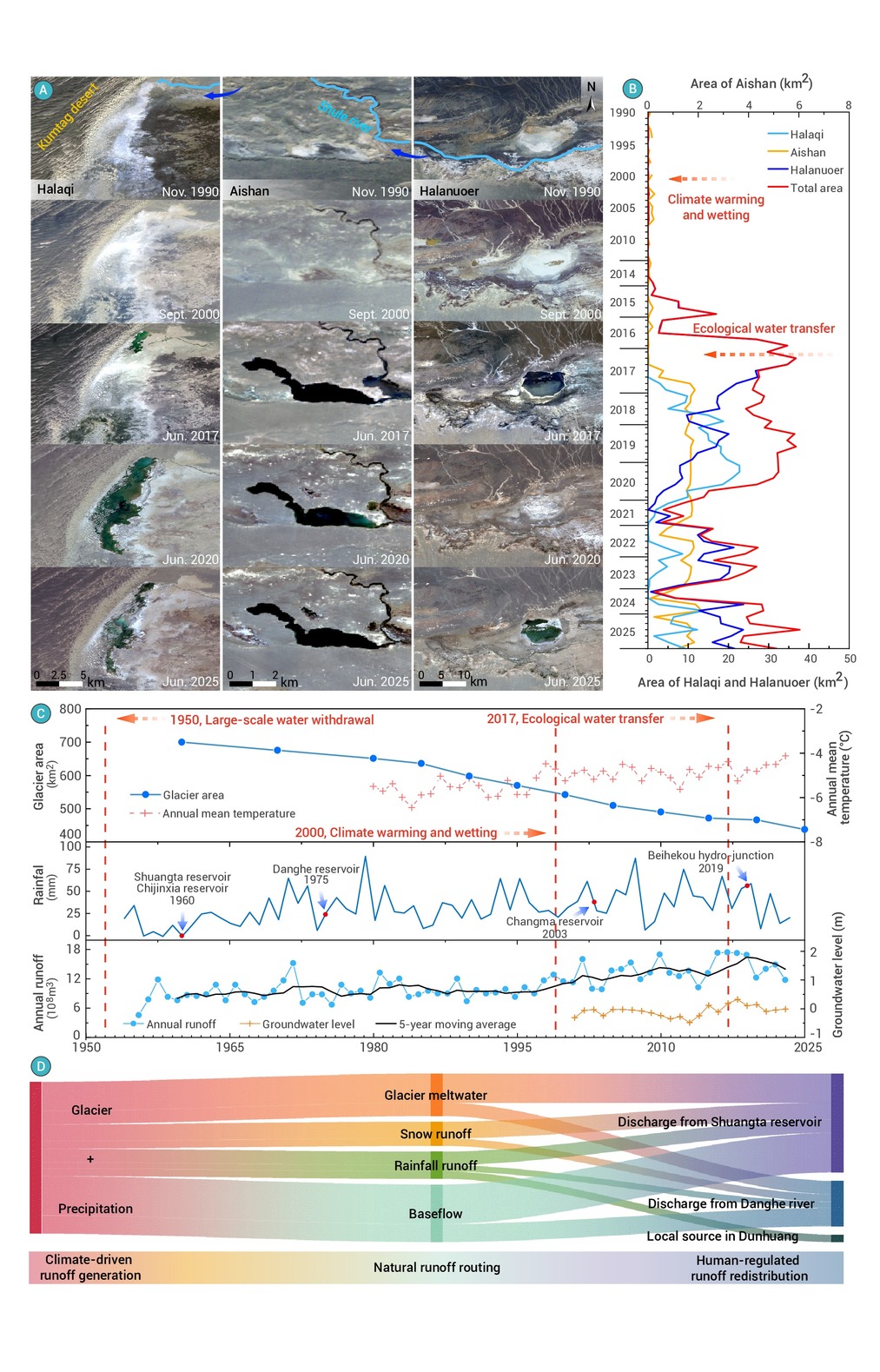
Figure 1.
Change trends and driving mechanism of three lake area in Dunhuang region
