
The role of sediments in understanding and managing the environmental impacts of deep-sea mining
-

-
REFERENCES
[1] Gazis I., Stigter H., Mohrmann J., et al. (2025). Monitoring benthic plumes, sediment redeposition and seafloor imprints caused by deep-sea polymetallic nodule mining. Nat. Commun. 16: 1229. DOI:10.1038/s41467-025-56311-0 [2] Peacock T. and Ouillon R. (2022) The fluid mechanics of deep-sea mining. Annu. Rev. Fluid Mech. 55:403-430. DOI:10.1146/annurev-fluid-031822-010257 [3] Sweetman A.K., Smith A.J., de Jonge D.S.W., et al. (2024). Evidence of dark oxygen production at the abyssal seafloor. Nat. Geosci. 17:737-739. DOI:10.1038/s41561-024-01480-8 [4] Jones D.O.B., Arias M.B., Van Audenhaege L., et al. (2025). Long-term impact and biological recovery in a deep-sea mining rrack. Nature 642:112-118. DOI:10.1038/s41586-025-08921-3 [5] Stewart E.C.D., Wiklund H., Neal L., et al. (2025). Impacts of an industrial deep-sea mining trial on macrofaunal biodiversity. Nat. Ecol. Evol. 10:318–329. DOI:10.1038/s41559-025-02911-4 -
ABOUT THIS ARTICLE
Cite this article:
Fan Z., Tian Z., Guo X., et al. (2026). The role of sediments in understanding and managing the environmental impacts of deep-sea mining. The Innovation Water 1:100018. https://doi.org/10.59717/j.tiw.2026.100018
Welcome!
To request copyright permission to republish or share portions of our works, please visit Copyright Clearance Center's (CCC) Marketplace website at marketplace.copyright.com.
Export File
Citation
Fan Z., Tian Z., Guo X., et al. (2026). The role of sediments in understanding and managing the environmental impacts of deep-sea mining. The Innovation Water 1:100018. https://doi.org/10.59717/j.tiw.2026.100018

Format
Content
 DownLoad:
-
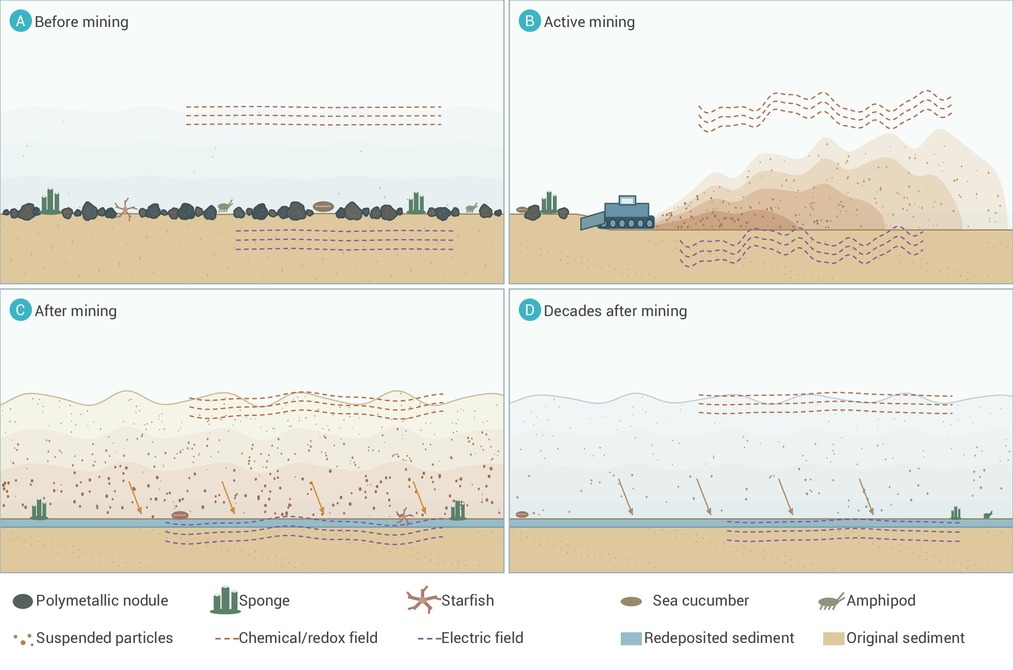
Figure 1.
Deep-sea sediment as the memory and regulator of mining-induced environmental responses.
