
Beyond ideal fractal models: A testable biophysical framework for aquatic floc as living microecosystem
-

-
REFERENCES
[1] Spencer K.L., Wheatland J.A., Bushby A.J., et al. (2021). A structure-function based approach to floc hierarchy and evidence for the non-fractal nature of natural sediment flocs. Sci. Rep. 11:14012. DOI:10.1038/s41598-021-93302-9 [2] Zhang N., Li H., Xu F., et al. (2025). Drag acting on suspended sediment increased by microbial colonization. Nat. Geosci. 18:396−401. DOI:10.1038/s41561-025-01679-3 [3] Wu N., Grieve S.W., Manning A.J., et al. (2024). Flocs as vectors for microplastics in the aquatic environment. Nat. Water 2:1082−1090. DOI:10.1038/s44221-024-00332-4 [4] de Lange S.I., van der Wilk A., Chassagne C., et al. (2024). Migrating subaqueous dunes capture clay flocs. Commun. Earth Environ. 5:729. DOI:10.1038/s43247-024-01901-x [5] Jaganathan J.S., Abdullah S.R.S., Sanusi S.N.A., et al. (2025). Machine learning and explainable artificial intelligence in coagulation-flocculation: A contemporary review. J. Environ. Chem. Eng. 13:119664. DOI: 10.1016/j.jece.2025.119664 -
ABOUT THIS ARTICLE
Cite this article:
Ye L., Hope J. A., Manning A. J., et al. (2026). Beyond ideal fractal models: A testable biophysical framework for aquatic floc as living microecosystem. The Innovation Water 1:100019. https://doi.org/10.59717/j.tiw.2026.100019
Welcome!
To request copyright permission to republish or share portions of our works, please visit Copyright Clearance Center's (CCC) Marketplace website at marketplace.copyright.com.
Export File
Citation
Ye L., Hope J. A., Manning A. J., et al. (2026). Beyond ideal fractal models: A testable biophysical framework for aquatic floc as living microecosystem. The Innovation Water 1:100019. https://doi.org/10.59717/j.tiw.2026.100019

Format
Content
 DownLoad:
-
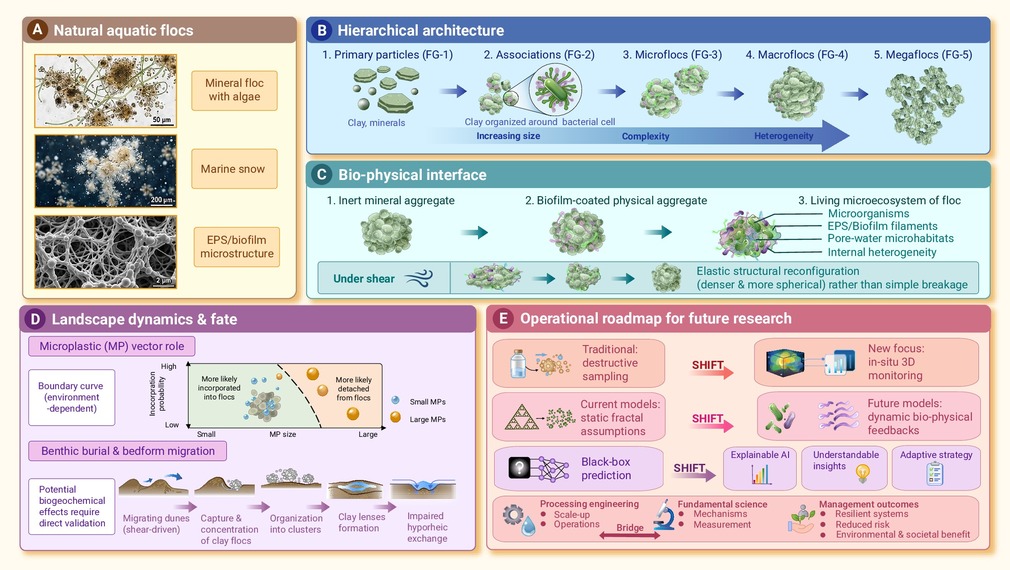
Figure 1.
From idealized, scale-invariant physical representations to a testable bio-physical framework for aquatic flocs
