
Anaerobic microbiomes: Hidden infrastructure for resilient and carbon-neutral water systems
-
ABSTRACT
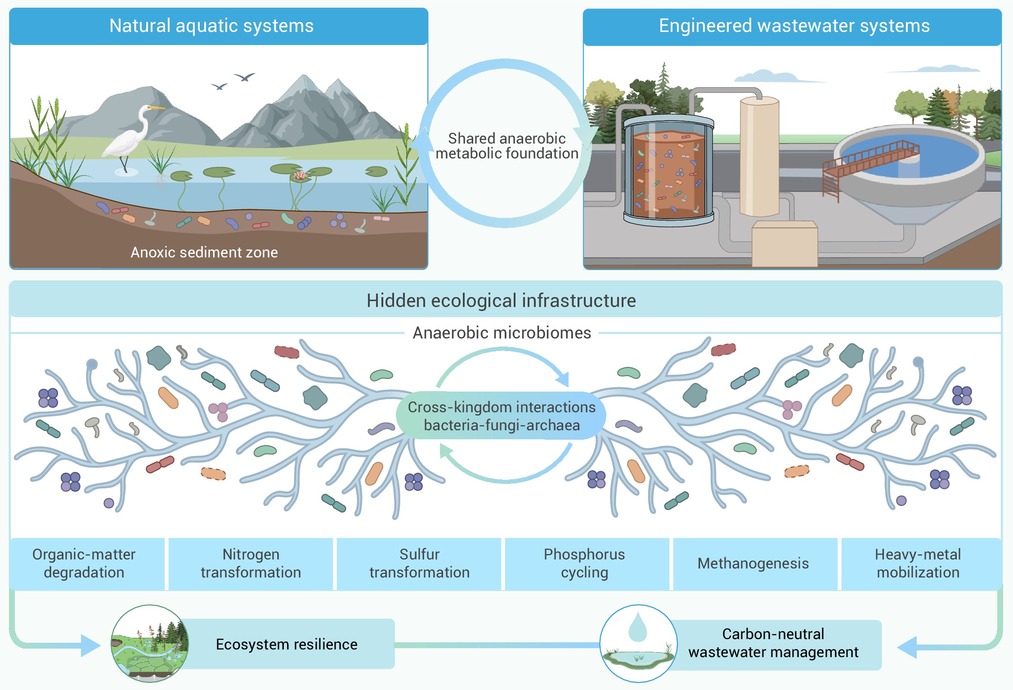
Contemporary water management prioritizes macroscale engineering metrics and bulk water quality indicators, often overlooking the microbial processes that sustain water system functioning. Here, we propose a conceptual shift: anaerobic microbiomes should be recognized as ‘hidden ecological infrastructure’. Across natural aquatic habitats and engineered wastewater systems, these dynamic, cross-kingdom consortia regulate key biogeochemical fluxes and contribute to functional resilience. Despite their shared metabolic foundations, natural and engineered microbiomes remain largely separate subjects of research and management. Bridging this divide chasm requires a unified framework centered on conserved anaerobic pathways. Such a framework would extend beyond assessments of individual functions to incorporate complex syntrophic networks into water research and management. A deeper understanding of this hidden infrastructure could inform strategies to manage greenhouse gas fluxes, advance carbon-neutral water treatment and strengthen ecological resilience under interacting global stressors. -

-
REFERENCES
[1] Borton M. A., Mcgivern B. B., Willi K. R., et al. (2025). A functional microbiome catalogue crowdsourced from North American rivers. Nature 637:103−112. DOI:10.1038/s41586-024-08240-z [2] Woolway R. I., Tong Y., Feng L., et al. (2024). Multivariate extremes in lakes. Nat. Commun. 15:4559. DOI:10.1038/s41467-024-49012-7 [3] Clavel T., Faber F., Groussin M., et al. (2025). Enabling next-generation anaerobic cultivation through biotechnology to advance functional microbiome research. Nat. Biotechnol. 43:878−888. DOI:10.1038/s41587-025-02660-6 [4] Holohan B. C., Trego A., Keating C., et al. (2025). Anaerobic microbial core for municipal wastewater treatment - The sustainable platform for resource recovery. Curr. Opin. Biotech. 94:103317. DOI:10.1016/j.copbio.2025.103317 [5] Zhang X. X., Wang Y. W., Jiao P. B., et al. (2024). Microbiome-functionality in anaerobic digesters: A critical review. Water Res. 249:120891. DOI:10.1016/j.watres.2023.120891 [6] Cummings D. E., Caccavo F. J. r., Fendorf S., et al. (1999). Arsenic mobilization by the dissimilatory Fe(III)-reducing bacterium Shewanella alga BrY. Environ. Sci. Technol. 33:723−729. DOI:10.1021/es980541c [7] Cavicchioli R., Ripple W. J., Timmis K. N., et al. (2019). Scientists' warning to humanity: Microorganisms and climate change. Nat. Rev. Microbiol. 17:569−586. DOI:10.1038/s41579-019-0222-5 [8] Shan Y. L., Tian K. L., Li R. Q., et al. (2025). Global methane footprints growth and drivers 1990-2023. Nat. Commun. 16:8141. DOI:10.1038/s41467-025-63383-5 [9] Lu Y., Liu T., Hu S. H., et al. (2024). Coupling partial nitritation, anammox and n-DAMO in a membrane aerated biofilm reactor for simultaneous dissolved methane and nitrogen removal. Water Res. 255:121511. DOI:10.1016/j.watres.2024.121511 [10] Liu B., Straeuber H., Centler F., et al. (2023). Functional redundancy secures resilience of chain elongation communities upon pH shifts in closed bioreactor ecosystems. Environ. Sci. Technol. 57:18350−18361. DOI:10.1021/acs.est.2c09573 -
ABOUT THIS ARTICLE
Cite this article:
Liu J., Gulzar A., Liu X., et al. (2026). Anaerobic microbiomes: Hidden infrastructure for resilient and carbon-neutral water systems. The Innovation Water 1:100022. https://doi.org/10.59717/j.tiw.2026.100022
Welcome!
To request copyright permission to republish or share portions of our works, please visit Copyright Clearance Center's (CCC) Marketplace website at marketplace.copyright.com.
Export File
Citation
Liu J., Gulzar A., Liu X., et al. (2026). Anaerobic microbiomes: Hidden infrastructure for resilient and carbon-neutral water systems. The Innovation Water 1:100022. https://doi.org/10.59717/j.tiw.2026.100022

Format
Content
 DownLoad:
-
Figure 1.
Hidden ecological infrastructure linking natural and engineered aquatic systems
