
Age-specific flood risk management under climate change and population aging
-

-
REFERENCES
[1] Tipaldo J. F., Balk D. and Hunter L. M. (2024). A framework for ageing and health vulnerabilities in a changing climate. Nat. Clim. Change 14:1125−1135. DOI:10.1038/s41558-024-02156-2 [2] Li D., Sun L., Feng K., et al. (2025). Disproportionate flood exposure for slum populations of the Global South. Nat. Cities 2:626−638. DOI:10.1038/s44284-025-00273-3 [3] Yin J., Yang Y., Yu D., et al. (2024). Strategic storm flood evacuation planning for large coastal cities enables more effective transfer of elderly populations. Nat. Water 2:274−284. DOI:10.1038/s44221-024-00210-z [4] Ban J., Sutton C., Ma Y., et al. (2023). Association of flooding exposure with cause-specific mortality in North Carolina, United States. Nat. Water 1:1027−1034. DOI:10.1038/s44221-023-00167-5 [5] Zhang B., Ouyang C., Cui P., et al. (2024). Deep learning for cross-region streamflow and flood forecasting at a global scale. The Innovation 5. DOI: 10.1016/j.xinn.2024.100617 -
ABOUT THIS ARTICLE
Cite this article:
Yang W., Li R., Zhao Z., et al. (2026). Age-specific flood risk management under climate change and population aging. The Innovation Water 1:100004. https://doi.org/10.59717/j.tiw.2026.100004
Welcome!
To request copyright permission to republish or share portions of our works, please visit Copyright Clearance Center's (CCC) Marketplace website at marketplace.copyright.com.
Export File
Citation
Yang W., Li R., Zhao Z., et al. (2026). Age-specific flood risk management under climate change and population aging. The Innovation Water 1:100004. https://doi.org/10.59717/j.tiw.2026.100004

Format
Content
 DownLoad:
-
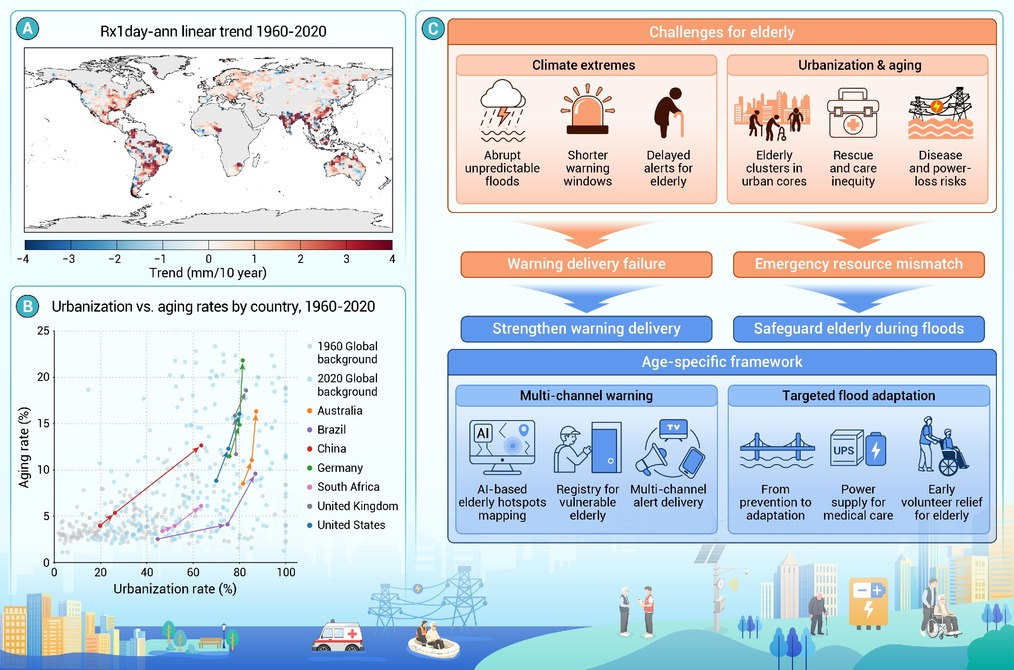
Figure 1.
The (A) annual trend of maximum 1-day rainfall from the 1960s to the 2020s, (B) decadal trends of urbanization and aging rates from the 1960s to the 2020s, and (C) conceptual diagram of challenges faced by the elderly and an age-specific framework for flood resilience enhancement.
