
Expanding groundwater drawdown funnels in North China Plain: A new insight from satellite gravimetry
-
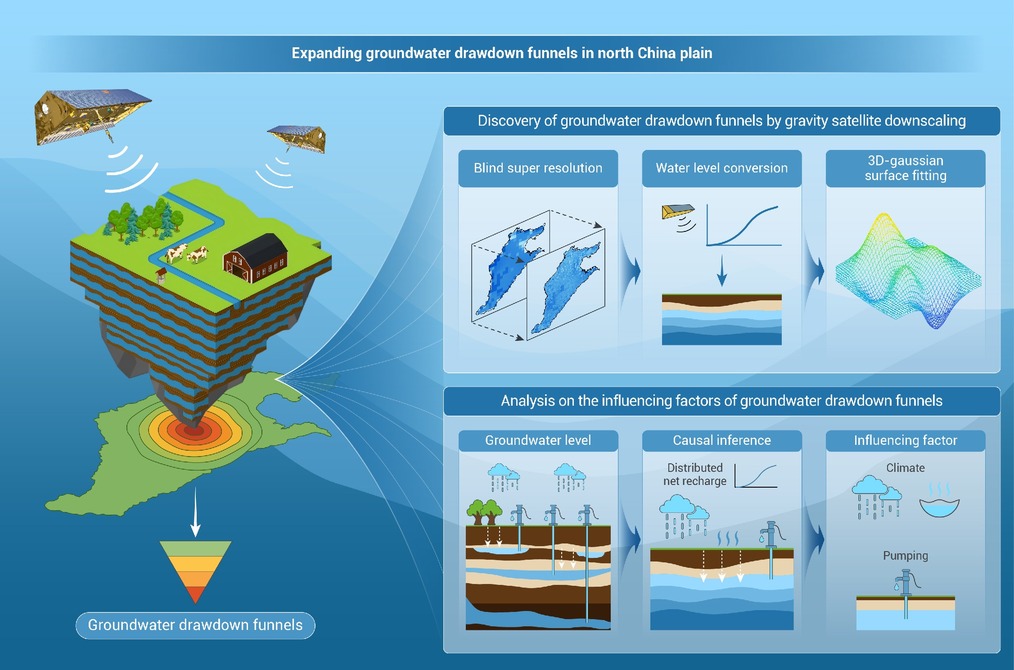
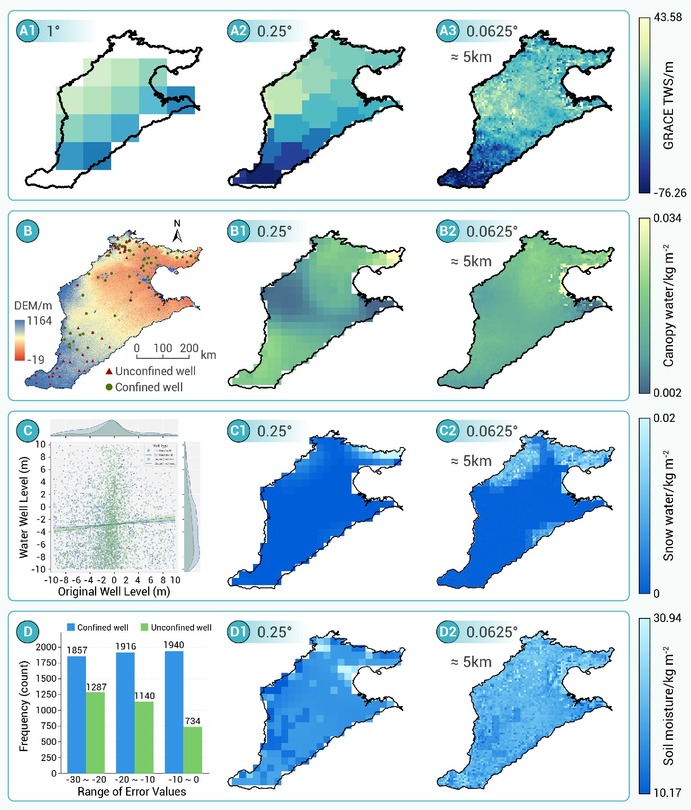
GRAPHICAL ABSTRACT
 DownLoad:
Full size image
DownLoad:
Full size image
-
PUBLIC SUMMARY
-
Blind downscaling reveals 5 km funnel expansion trends in North China Plain.
Funnel morphology changed with > 30 m deepening and horizontal broadening.
Response time rose from 20 to 60 months, indicating aquifer buffering decline.
Causal analysis shows early climate control, later pumping, then partial rebound.
-
-
ABSTRACT
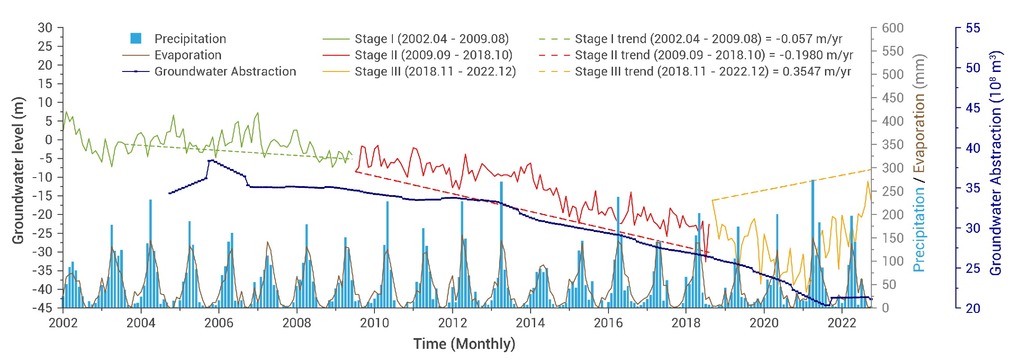
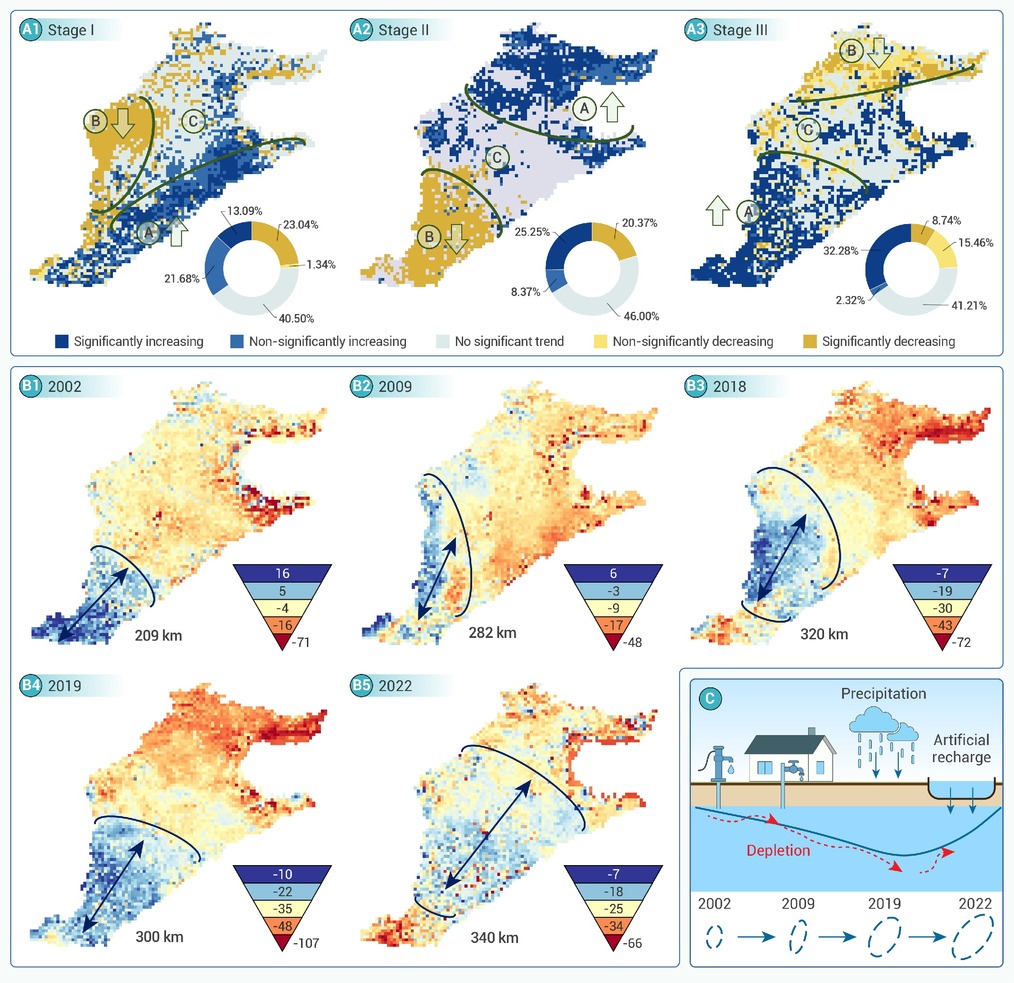
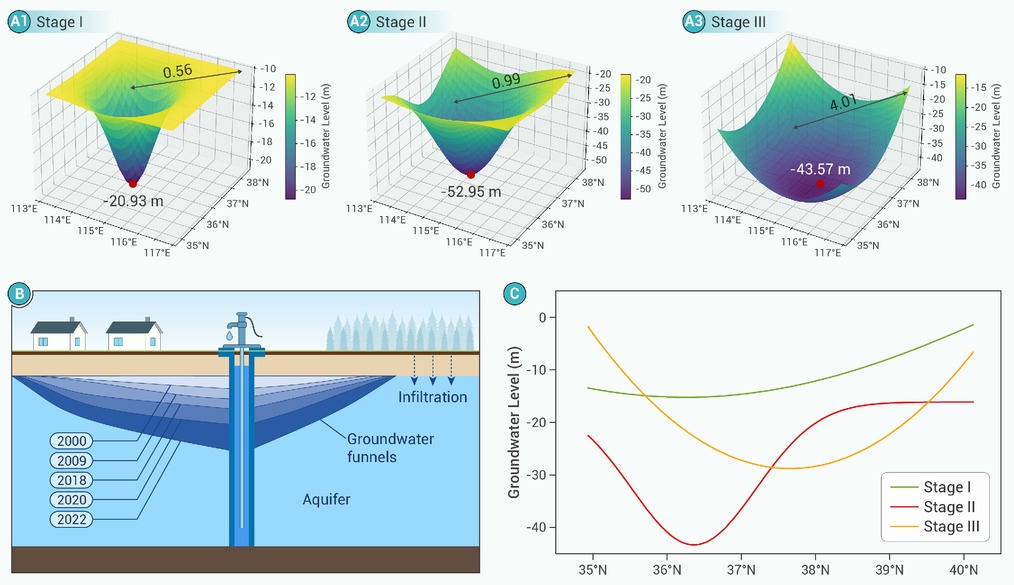
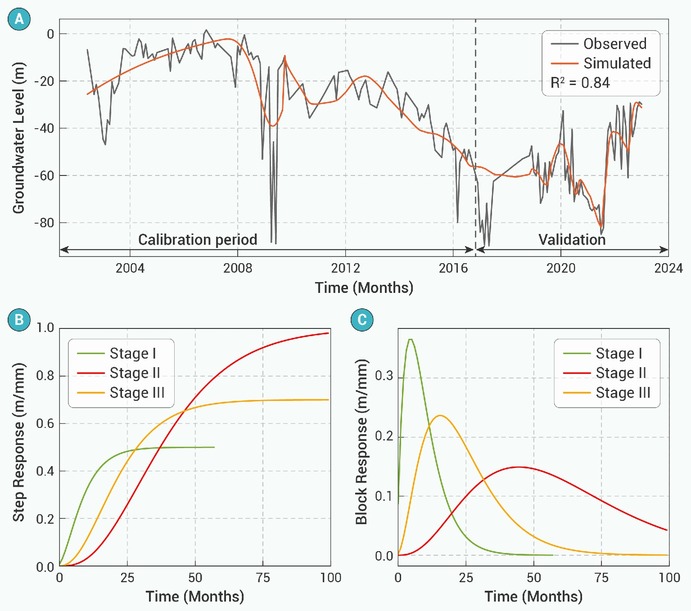
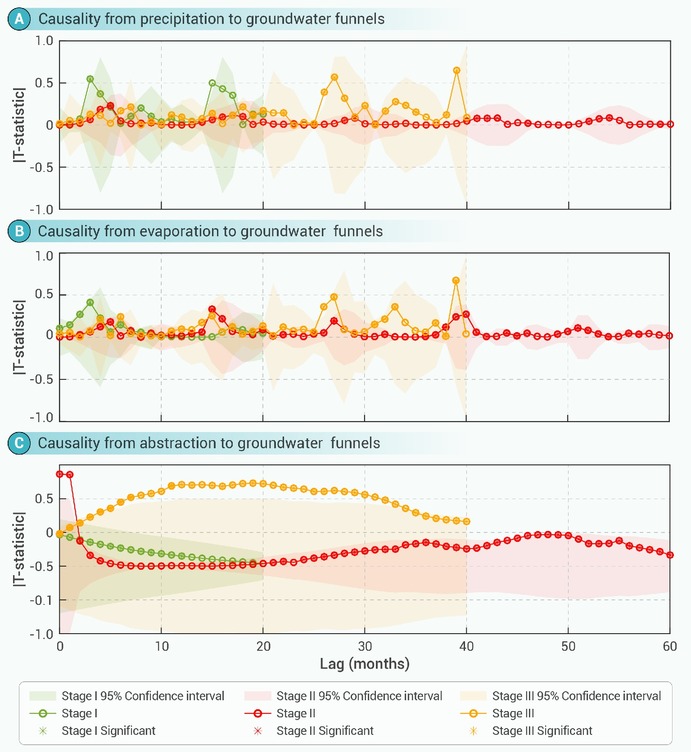
Quantifying the evolution and recovery of groundwater drawdown funnels in the North China Plain (NCP) remains a grand challenge due to limited spatial resolution, vertical ambiguity, and attribution complexity in current satellite-based monitoring. Here, we present an integrative framework that addresses these bottlenecks by combining data-driven downscaling of GRACE gravimetric data, stratified signal separation using multi-depth well observations, and causality analysis driven by climate and groundwater abstraction indicators. This framework enables ~5 km resolution groundwater storage reconstruction, delineates 3D funnel morphology via Gaussian fitting, and attributes dynamic changes through wavelet-informed causality inference. Our key findings include: (1) The NCP groundwater system experienced a three-stage trajectory—initial slow decline (–0.05 cm/year), accelerated depletion (-0.19 cm/year), and partial recovery (+0.16 cm/year)—with funnel radius expanding from 209 km in 2002 to 340 km in 2022. (2) Funnel morphology transformed substantially, with the lowest groundwater level deepening from 20.93 m to 52.95 m and lateral half-width expanding from 0.56 m to 4.01 m over two decades. (3) The combined analysis of the transfer function noise (TFN) model and causality analysis based on information flow further revealed that early funnel changes were dominated by climate (~75% contribution), later shifts by intensive pumping (~90%), and recent recovery partially driven by precipitation (~16%), with aquifer response time increasing from 20 to 60 months, indicating a weakened response and delayed recovery. The lagged responses revealed by the causality analysis redefines our understanding of anthropogenic impacts on aquifer systems and offers a transferable path toward sustainable groundwater governance under changing climate and socioeconomic pressures. -

-
REFERENCES
[1] Jasechko S., Seybold H., Perrone D., et al. (2024). Rapid groundwater decline and some cases of recovery in aquifers globally. Nature 625:715−721. DOI:10.1038/s41586-023-06879-8 [2] Liu P.-W., Famiglietti J. S., Purdy A. J., et al. (2022). Groundwater depletion in California’s Central Valley accelerates during megadrought. Nat. Commun. 13:7825. DOI:10.1038/s41467-022-35582-x [3] Cuthbert M., Gleeson T., Bierkens M., et al. (2024). Concerns regarding proposed groundwater Earth system boundary. Nature 635:E4−E5. DOI:10.1038/s41586-023-06083-8 [4] Hasan M. F., Smith R., Vajedian S., et al. (2023). Global land subsidence mapping reveals widespread loss of aquifer storage capacity. Nat. Commun. 14:6180. DOI:10.1038/s41467-023-41933-z [5] Zhong Y., Zhong M., Feng W., et al. (2018). Groundwater depletion in the West Liaohe River Basin, China and its implications revealed by GRACE and in situ measurements. Remote Sens. 10:493. DOI:10.3390/rs10040493 [6] Feng T., Shen Y., Chen Q., et al. (2022). Groundwater storage change and driving factor analysis in north china using independent component decomposition. J. Hydrol. 609:127708. DOI:10.1016/j.jhydrol.2022.127708 [7] Yang W., Long D., Scanlon B. R., et al. (2022). Human intervention will stabilize groundwater storage across the North China Plain. Water Resour. Res. 58:e2021WR030884. DOI:10.1029/2021WR030884 [8] Long D., Scanlon B. R., Longuevergne L., et al. (2013). GRACE satellite monitoring of large depletion in water storage in response to the 2011 drought in Texas. Geophys. Res. Lett. 40:3395−3401. DOI:10.1002/grl.50655 [9] Rodell M., Famiglietti J. S., Wiese D. N., et al. (2018). Emerging trends in global freshwater availability. Nature 557:651−659. DOI:10.1038/s41586-018-0123-1 [10] Gou J. and Soja B. (2024). Global high-resolution total water storage anomalies from self-supervised data assimilation using deep learning algorithms. Nat. Water 2:139−150. DOI:10.1038/s44221-024-00194-w [11] Chen Y., Wang Y., Li L., et al. (2024). Monthly monitoring of inundated areas and water storage dynamics in China's large reservoirs using multisource remote sensing. Water Resour. Res. 60:e2023WR036450. DOI:10.1029/2023WR036450 [12] Zhao J., Li G., Zhu Z., et al. (2024). Analysis of the spatiotemporal variation of groundwater storage in Ordos Basin based on GRACE gravity satellite data. J. Hydrol. 632:130931. DOI:10.1016/j.jhydrol.2024.130931 [13] Rateb A., Scanlon B. R., Pool D. R., et al. (2020). Comparison of groundwater storage changes from GRACE satellites with monitoring and modeling of major US aquifers. Water Resour. Res. 56:e2020WR027556. DOI:10.1029/2020WR027556 [14] Bhanja S. N., Mukherjee A., Saha D., et al. (2016). Validation of GRACE based groundwater storage anomaly using in-situ groundwater level measurements in India. J. Hydrol. 543:729−738. DOI:10.1016/j.jhydrol.2016.10.042 [15] Feng W., Zhong M., Lemoine J. M., et al. (2013). Evaluation of groundwater depletion in North China using the gravity recovery and climate experiment (GRACE) data and ground‐based measurements. Water Resour. Res. 49:2110−2118. DOI:10.1002/wrcr.20192 [16] Frappart F. and Ramillien G. (2018). Monitoring groundwater storage changes using the Gravity Recovery and Climate Experiment (GRACE) satellite mission: A review. Remote Sens. 10:829. DOI:10.3390/rs10060829 [17] Li H., Pan Y., Huang Z., et al. (2023). A new GRACE downscaling approach for deriving high-resolution groundwater storage changes using ground-based scaling factors. Water Resour. Res. 60:e2023WR035210. DOI:10.1029/2023WR035210 [18] Wang Y., Li C., Cui Y., et al. (2024). Spatial downscaling of GRACE-derived groundwater storage changes across diverse climates and human interventions with Random Forests. J. Hydrol. 640:131708. DOI:10.1016/j.jhydrol.2024.131708 [19] Chen L., He Q., Liu K., et al. (2019). Downscaling of GRACE-derived groundwater storage based on the random forest model. Remote Sens. 11:2979. DOI:10.3390/rs11242979 [20] Yin W., Hu L., Zhang M., et al. (2018). Statistical downscaling of GRACE‐derived groundwater storage using ET data in the North China plain. J. Geophys. Res. Atmos. 123:5973−5987. DOI:10.1029/2017JD027468 [21] Long D., Pan Y., Zhou J., et al. (2017). Global analysis of spatiotemporal variability in merged total water storage changes using multiple GRACE products and global hydrological models. Remote Sens. Environ. 192:198−216. DOI:10.1016/j.rse.2017.02.011 [22] Reichstein M., Camps-Valls G., Stevens B., et al. (2019). Deep learning and process understanding for data-driven Earth system science. Nature 566:195−204. DOI:10.1038/s41586-019-0912-1 [23] Humphrey V. and Gudmundsson L. (2019). GRACE-REC: A reconstruction of climate-driven water storage changes over the last century. Earth Syst. Sci. Data 11:1153−1170. DOI:10.5194/essd-11-1153-2019 [24] Kalu I., Ndehedehe C. E., Ferreira V. G., et al. (2024). Statistical downscaling of GRACE terrestrial water storage changes based on the Australian Water Outlook model. Sci. Rep. 14:10113. DOI:10.1038/s41598-024-60366-2 [25] Liang X. S. (2014). Unraveling the cause-effect relation between time series. Phys. Rev. E 90:052150. DOI:10.1103/PhysRevE.90.052150 [26] Thomas B. F. and Famiglietti J. S. (2019). Identifying climate-induced groundwater depletion in GRACE observations. Sci. Rep. 9:4124. DOI:10.1038/s41598-019-40155-y [27] Li P., Zha Y., Shi L., et al. (2021). Identification of the terrestrial water storage change features in the North China Plain via independent component analysis. J. Hydrol. Reg. Stud. 38:100955. DOI:10.1016/j.ejrh.2021.100955 [28] Alam S., Gebremichael M., Ban Z., et al. (2021). Post‐drought groundwater storage recovery in California's Central Valley. Water Resour. Res. 57:e2021WR030352. DOI:10.1029/2021WR030352 [29] Li M., Sun J., Xue L., et al. (2025). Characterizing aquifer properties and groundwater storage at North China Plain using geodetic and hydrological measurements. Water Resour. Res. 61:e2024WR037425. DOI: 10.1029/2024WR037425 [30] Gong H., Pan Y., Zheng L., et al. (2018). Long-term groundwater storage changes and land subsidence development in the North China Plain (1971–2015). Hydrogeol. J. 26:1417−1427. DOI:10.1007/s10040-018-1768-4 [31] Cai X. (2008). Water stress, water transfer and social equity in Northern China-implications for policy reforms. J. Environ. Manage. 87:14–25. DOI:10.1016/j.jenvman.2006.12.046 [32] Chen X., Wang P., Muhammad T., et al. (2020). Subsystem-level groundwater footprint assessment in North China Plain – The world’s largest groundwater depression cone. Ecol. Indicators 117:106662. DOI: 10.1016/j.ecolind.2020.106662 [33] Yang J. and Huang X. (2021). The 30 m annual land cover dataset and its dynamics in China from 1990 to 2019. Earth Syst. Sci. Data 13:3907−3925. DOI:10.5194/essd-13-3907-2021 [34] Zongyu C., Yuhong F., Jinxiang M., et al. (2009). Analysis on evolution of groundwater depression cones and its leading factors in North China Plain. Resour. Sci. 31:394–399. https://www.resci.cn/EN/Y2009/V31/I3/394 [35] Zhao X., Yu Y., Cheng J., et al. (2024). A novel framework for heterogeneity decomposition and mechanism inference in spatiotemporal evolution of groundwater storage: Case study in the North China Plain. Water Resour. Res. 60:e2023WR036102. DOI:10.1029/2023wr036102 [36] He H., Yang K., Wang S., et al. (2021). Deep learning approaches to spatial downscaling of GRACE terrestrial water storage products using EALCO model over Canada. Canadian J. Remote Sens. 47:657−675. DOI:10.1080/07038992.2021.1954498 [37] von Asmuth J. R., Bierkens M. F. and Maas K. (2002). Transfer function‐noise modeling in continuous time using predefined impulse response functions. Water Resour. Res. 38:23–21–23–12. DOI: 10.1029/2001WR001136 [38] Collenteur R. A., Bakker M., Klammler G., et al. (2021). Estimation of groundwater recharge from groundwater levels using nonlinear transfer function noise models and comparison to lysimeter data. Hydrol. Earth Syst. Sci. 25:2931−2949. DOI:10.5194/hess-25-2931-2021 [39] Liang X. S., Xu F., Rong Y., et al. (2021). El Niño Modoki can be mostly predicted more than 10 years ahead of time. Sci. Rep. 11:17860. DOI:10.1038/s41598-021-97111-y -
ABOUT THIS ARTICLE
Cite this article:
Yao J., Hao H., Wang M., et al. (2026). Expanding groundwater drawdown funnels in North China Plain: A new insight from satellite gravimetry. The Innovation Water 1:100010. https://doi.org/10.59717/j.tiw.2026.100010
Welcome!
To request copyright permission to republish or share portions of our works, please visit Copyright Clearance Center's (CCC) Marketplace website at marketplace.copyright.com.
Export File
Citation
Yao J., Hao H., Wang M., et al. (2026). Expanding groundwater drawdown funnels in North China Plain: A new insight from satellite gravimetry. The Innovation Water 1:100010. https://doi.org/10.59717/j.tiw.2026.100010

Format
Content
-
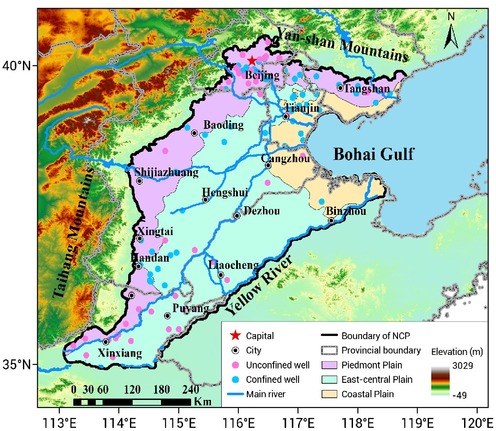
Figure 1.
Overview of research area.
-
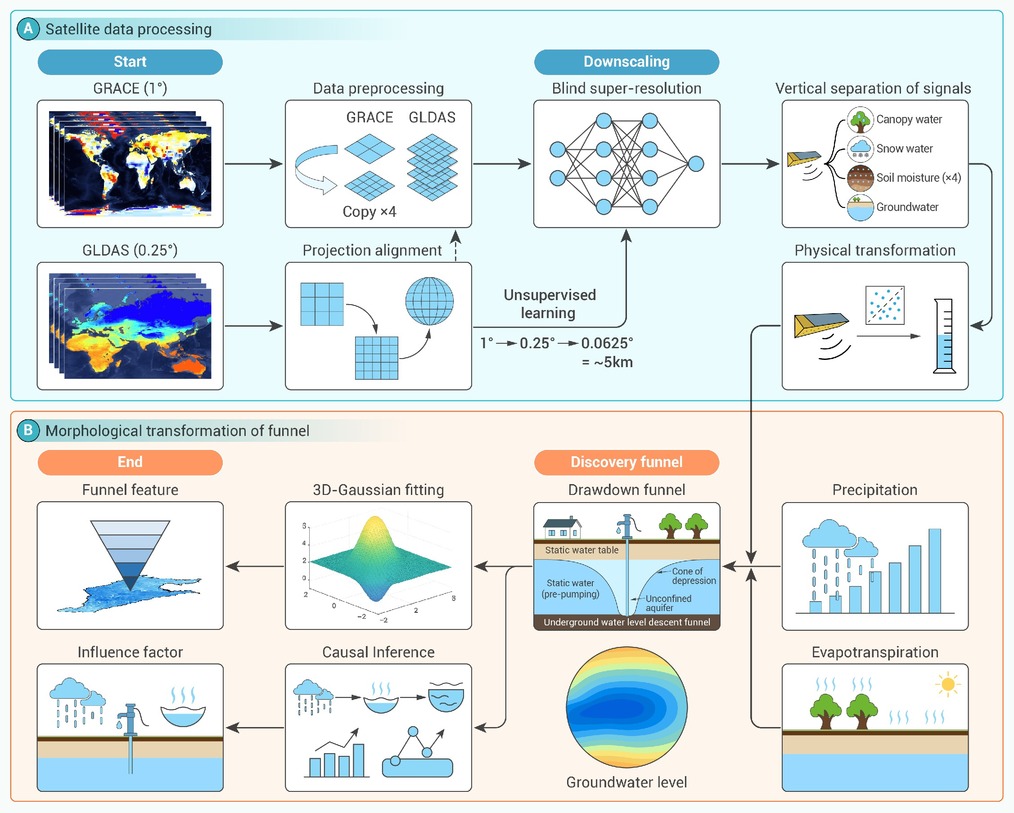
Figure 2.
Integrated technical framework for groundwater funnel detection and attribution in the North China Plain
-
Figure 3.
Time series of groundwater levels, precipitation, and evaporation in the North China Plain.
-
Figure 4.
Drawdown funnel distribution of groundwater in the North China Plain
-
Figure 5.
Temporal and spatial changes of morphological characteristics of groundwater drawdown funnel in the North China Plain
-
Figure 6.
TFN-Based simulation and dynamic response analysis of the groundwater funnels
-
Figure 7.
Lagged causal information flow of the groundwater funnel in the North China Plain
-
Figure 8.
Accuracy verification of downscaled GRACE terrestrial water storage products
