
Environmental steroid hormones in aquatic systems: Biogeochemical dynamics, mixture risks, and sustainable mitigation
-
GRAPHICAL ABSTRACT
 DownLoad:
Full size image
DownLoad:
Full size image
-
PUBLIC SUMMARY
-
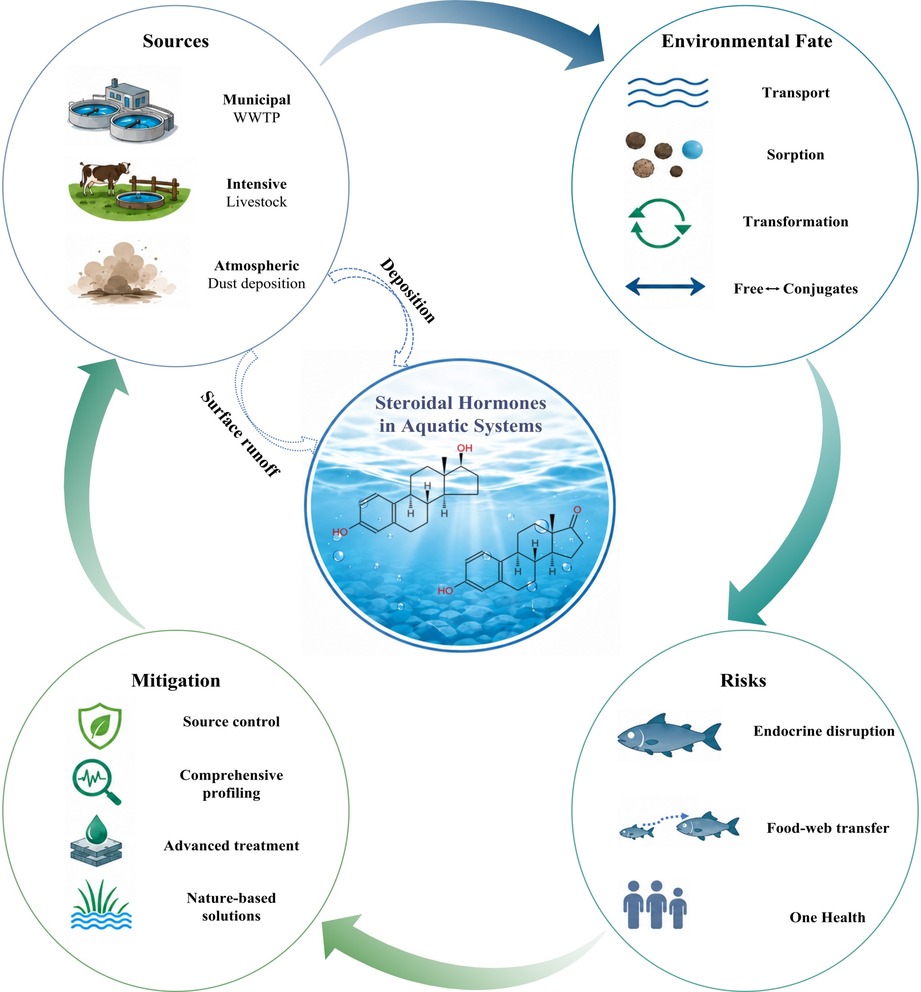
Steroid hormones enter and persist in waters via wastewater, manure runoff, and airborne particles.
Conjugated forms and transformation products can be missed, while mixtures can amplify pollution risks.
These pollutants can disrupt reproduction in aquatic life and may pose broader risks to human health.
Monitoring, source control, and nature-based treatment provide a sustainable path forward.
-
-
ABSTRACT
The pervasive occurrence of steroidal sex hormones in aquatic ecosystems poses a substantial challenge to aquatic ecosystem health and may also have implications for public health. Some of these potent endocrine-disrupting chemicals act at ultra-trace concentrations, challenging traditional single-substance toxicological paradigms, and are often incompletely removed by conventional wastewater treatment. This review critically synthesizes the biogeochemical dynamics of aquatic sex hormones, tracing their trajectories from anthropogenic sources through environmental transport, transformation, and persistence. It highlights the need to expand monitoring beyond targeted quantification toward comprehensive steroidal profiling, with particular attention to the potentially overlooked contributions of conjugated forms and uncharacterized transformation products. Furthermore, this review evaluates biological effects through the lens of adverse outcome pathways and the One Health framework, integrating well-established ecological effects in aquatic organisms with the more limited and emerging evidence relevant to human health under real-world mixture exposures. To address these threats, the efficacy and sustainability of advanced and emerging removal technologies are critically assessed, including catalytic oxidation, enzymatic biotransformation, hybrid systems, and nature-based solutions. Ultimately, safeguarding aquatic ecosystems requires an integrated, multi-barrier strategy that combines proactive source control, mixture-aware risk assessment, fit-for-purpose wastewater treatment, and sustainable mitigation aligned with circular economy principles.-
Keywords:
- steroid hormones /
- mixture toxicity /
- adverse outcome pathways /
- nature-based solutions /
- One Health
-

-
REFERENCES
[1] Amory J. K., Page S. T. and Bremner W. J. (2006). Drug insight: recent advances in male hormonal contraception. Nature Clinical Practice Endocrinology & Metabolism 2:32−41. DOI:10.1038/ncpendmet0069 [2] Adeel M., Song X., Wang Y., et al. (2017). Environmental impact of estrogens on human, animal and plant life: A critical review. Environ. Int. 99:107−119. DOI:10.1016/j.envint.2016.12.010 [3] Waniek J. J., Osterholz H. and Frazão H. C. (2025). A global inventory of natural and synthetic estrogens in aquatic systems. Annu. Rev. Mar. Science 17:511−536. DOI:10.1146/annurev-marine-032123-025855 [4] Mattison D. R., Karyakina N., Goodman M., et al. (2014). Pharmaco- and toxicokinetics of selected exogenous and endogenous estrogens: A review of the data and identification of knowledge gaps. Crit. Rev. Toxicol. 44:696−724. DOI:10.3109/10408444.2014.930813 [5] Diamanti-Kandarakis E., Bourguignon J.-P., Giudice L. C., et al. (2009). Endocrine-disrupting chemicals: An endocrine society scientific statement. Endocr. Rev. 30:293−342. DOI:10.1210/er.2009-0002 [6] D’Onofrio V. and Sékaly R. P. (2024). The immune–endocrine interplay in sex differential responses to viral infection and COVID-19. Trends in Immunology 45:943−958. DOI:10.1016/j.it.2024.10.004 [7] Soto A. M. and Sonnenschein C. (2010). Environmental causes of cancer: endocrine disruptors as carcinogens. Nature Reviews Endocrinology 6:363−370. DOI:10.1038/nrendo.2010.87 [8] Leroux N., Baekelandt S. and Kestemont P. (2025). Teleost fish metamorphosis under the influence of estrogenic hormones: targeting the thyroid axis – a literature review. Environ. Int. 201:109570. DOI:10.1016/j.envint.2025.109570 [9] Cotton S., Clayton C. A. and Tropini C. (2023). Microbial endocrinology: the mechanisms by which the microbiota influences host sex steroids. Trends Microbiol. 31:1131−1142. DOI:10.1016/j.tim.2023.03.010 [10] Chighizola C. and Meroni P. L. (2012). The role of environmental estrogens and autoimmunity. Autoimmunity Reviews 11:A493−A501. DOI:10.1016/j.autrev.2011.11.027 [11] Pironti C., Ricciardi M., Proto A., et al. (2021). Endocrine-Disrupting Compounds: An Overview on Their Occurrence in the Aquatic Environment and Human Exposure. Water 13:1347. DOI:10.3390/w13101347 [12] Hamid N., Junaid M. and Pei D.-S. (2021). Combined toxicity of endocrine-disrupting chemicals: A review. Ecotoxicology and Environmental Safety 215:112136. DOI:10.1016/j.ecoenv.2021.112136 [13] Lopez de Alda M. a. J., Dı́az-Cruz S., Petrovic M., et al. (2003). Liquid chromatography–(tandem) mass spectrometry of selected emerging pollutants (steroid sex hormones, drugs and alkylphenolic surfactants) in the aquatic environment. J. Chromatogr. A 1000:503−526. DOI:10.1016/S0021-9673(03)00509-0 [14] Simon E., Duffek A., Stahl C., et al. (2022). Biological effect and chemical monitoring of Watch List substances in European surface waters: Steroidal estrogens and diclofenac – Effect-based methods for monitoring frameworks. Environ. Int. 159:107033. DOI:10.1016/j.envint.2021.107033 [15] Liu Z.-h., Lu G.-n., Yin H., et al. (2015). Removal of natural estrogens and their conjugates in municipal wastewater treatment plants: A critical review. Environ. Sci. Technol. 49:5288−5300. DOI:10.1021/acs.est.5b00399 [16] Griffith D. R., Kido Soule M. C., Matsufuji H., et al. (2014). Measuring free, conjugated, and halogenated estrogens in secondary treated wastewater effluent. Environ. Sci. Technol. 48:2569−2578. DOI:10.1021/es402809u [17] Sacdal R., Madriaga J. and Espino M. P. (2020). Overview of the analysis, occurrence and ecological effects of hormones in lake waters in Asia. Environ. Res. 182:109091. DOI:10.1016/j.envres.2019.109091 [18] Fent K. (2015). Progestins as endocrine disrupters in aquatic ecosystems: Concentrations, effects and risk assessment. Environ. Int. 84:115−130. DOI:10.1016/j.envint.2015.06.012 [19] Chen Y., Yang J., Yao B., et al. (2022). Endocrine disrupting chemicals in the environment: Environmental sources, biological effects, remediation techniques, and perspective. Environ. Pollut. 310:119918. DOI:10.1016/j.envpol.2022.119918 [20] Priya A. K., Gnanasekaran L., Rajendran S., et al. (2022). Occurrences and removal of pharmaceutical and personal care products from aquatic systems using advanced treatment- A review. Environ. Res. 204:112298. DOI:10.1016/j.envres.2021.112298 [21] Cheng D., Ngo H. H., Guo W., et al. (2020). A critical review on antibiotics and hormones in swine wastewater: Water pollution problems and control approaches. J. Hazard. Mater. 387:121682. DOI:10.1016/j.jhazmat.2019.121682 [22] Lange I. G., Daxenberger A., Schiffer B., et al. (2002). Sex hormones originating from different livestock production systems: fate and potential disrupting activity in the environment. Anal. Chim. Acta 473:27−37. DOI:10.1016/S0003-2670(02)00748-1 [23] Baird D. T. and Glasier A. F. (1993). Hormonal contraception. N. Engl. J. Med. 328:1543−1549. DOI:10.1056/NEJM199305273282108 [24] Wise A., O’Brien K. and Woodruff T. (2011). Are oral contraceptives a significant contributor to the estrogenicity of drinking water. Environ. Sci. Technol. 45:51−60. DOI:10.1021/es1014482 [25] Hanselman T. A., Graetz D. A. and Wilkie A. C. (2003). Manure-borne estrogens as potential environmental contaminants: A review. Environ. Sci. Technol. 37:5471−5478. DOI:10.1021/es034410+ [26] Liu Z.-h., Kanjo Y. and Mizutani S. (2009). Urinary excretion rates of natural estrogens and androgens from humans, and their occurrence and fate in the environment: A review. Sci. Total Environ. 407:4975−4985. DOI:10.1016/j.scitotenv.2009.06.001 [27] Zhang H., Shi J., Liu X., et al. (2014). Occurrence and removal of free estrogens, conjugated estrogens, and bisphenol A in manure treatment facilities in East China. Water Res. 58:248−257. DOI:10.1016/j.watres.2014.03.074 [28] Zhang J.-N., Chen J., Yang L., et al. (2021). Occurrence and fate of androgens, progestogens and glucocorticoids in two swine farms with integrated wastewater treatment systems. Water Res. 192:116836. DOI:10.1016/j.watres.2021.116836 [29] Sun Y., Huang H., Sun Y., et al. (2014). Occurrence of estrogenic endocrine disrupting chemicals concern in sewage plant effluent. Front. Environ. Sci. Eng. 8:18−26. DOI:10.1007/s11783-013-0573-5 [30] Yao B., Li R., Yan S., et al. (2018). Occurrence and estrogenic activity of steroid hormones in Chinese streams: A nationwide study based on a combination of chemical and biological tools. Environ. Int. 118:1−8. DOI:10.1016/j.envint.2018.05.026 [31] Paterakis N., Chiu T. Y., Koh Y. K. K., et al. (2012). The effectiveness of anaerobic digestion in removing estrogens and nonylphenol ethoxylates. J. Hazard. Mater. 199-200:88–95. DOI:10.1016/j.jhazmat.2011.10.075. [32] Hutchins S. R., White M. V., Hudson F. M., et al. (2007). Analysis of lagoon samples from different concentrated animal feeding operations for estrogens and estrogen conjugates. Environ. Sci. Technol. 41:738−744. DOI:10.1021/es062234+ [33] Rechsteiner D., Wettstein F. E., Warren B. P., et al. (2020). Natural estrogens in surface waters of a catchment with intensive livestock farming in Switzerland. Environ. Sci. Processes Impacts 22:2244−2255. DOI:10.1039/D0EM00317D [34] Tremblay L. A., Gadd J. B. and Northcott G. L. (2018). Steroid estrogens and estrogenic activity are ubiquitous in dairy farm watersheds regardless of effluent management practices. Agric. Ecosyst. Environ. 253:48−54. DOI:10.1016/j.agee.2017.10.012 [35] Masinga P., Simbanegavi T. T., Makuvara Z., et al. (2024). Emerging organic contaminants in the soil–plant-receptor continuum: transport, fate, health risks, and removal mechanisms. Environ. Monit. Assess. 196:367. DOI:10.1007/s10661-023-12282-7 [36] Blackwell B. R., Wooten K. J., Buser M. D., et al. (2015). Occurrence and Characterization of Steroid Growth Promoters Associated with Particulate Matter Originating from Beef Cattle Feedyards. Environ. Sci. Technol. 49:8796−8803. DOI:10.1021/acs.est.5b01881 [37] Sandoz M. A., Wooten K. J., Clendening S. L., et al. (2018). Transport mechanisms for veterinary pharmaceuticals from beef cattle feedyards to wetlands: Is aerial deposition a contributing source. Agric. Ecosyst. Environ. 252:14−21. DOI:10.1016/j.agee.2017.09.016 [38] Huanyu T., Jianghong S., Wei G., et al. (2022). Environmental fate and toxicity of androgens: A critical review. Environ. Res. 214:113849. DOI:10.1016/j.envres.2022.113849 [39] Nie M., Yan C., Dong W., et al. (2015). Occurrence, distribution and risk assessment of estrogens in surface water, suspended particulate matter, and sediments of the Yangtze Estuary. Chemosphere 127:109−116. DOI:10.1016/j.chemosphere.2015.01.021 [40] Lai K. M., Johnson K. L., Scrimshaw M. D., et al. (2000). Binding of waterborne steroid estrogens to solid phases in river and estuarine systems. Environ. Sci. Technol. 34:3890−3894. DOI:10.1021/es9912729 [41] Sangster J. L., Oke H., Zhang Y., et al. (2015). The effect of particle size on sorption of estrogens, androgens and progestagens in aquatic sediment. J. Hazard. Mater. 299:112−121. DOI:10.1016/j.jhazmat.2015.05.046 [42] Xu R., Liu S., Pan Y.-F., et al. (2024). Steroid metabolites as overlooked emerging contaminants: Insights from multimedia partitioning and source–sink simulation in an estuarine environment. J. Hazard. Mater. 461:132673. DOI:10.1016/j.jhazmat.2023.132673 [43] Dussault È. B., Balakrishnan V. K., Borgmann U., et al. (2009). Bioaccumulation of the synthetic hormone 17α-ethinylestradiol in the benthic invertebrates Chironomus tentans and Hyalella azteca. Ecotoxicology and Environmental Safety 72:1635−1641. DOI:10.1016/j.ecoenv.2009.04.019 [44] Liu S., Xu R., Pan Y.-F., et al. (2023). Free and conjugated forms of metabolites are indispensable components of steroids: The first evidence from an estuarine food web. Water Res. 235:119913. DOI:10.1016/j.watres.2023.119913 [45] Nurulnadia M. Y., Koyama J., Uno S., et al. (2016). Biomagnification of endocrine disrupting chemicals (EDCs) by Pleuronectes yokohamae: Does P. yokohamae accumulate dietary EDCs?. Chemosphere 144:185−192. DOI:10.1016/j.chemosphere.2015.08.059 [46] Yang S., Yu W., Yang L., et al. (2021). Occurrence and fate of steroid estrogens in a chinese typical concentrated dairy farm and slurry irrigated soil. J. Agric. Food. Chem. 69:67−77. DOI:10.1021/acs.jafc.0c05068 [47] Du B., Yu W., Yang L., et al. (2022). Migration and abiotic transformation of estrone (E1) and estrone-3-sulfate (E1-3S) during soil column transport. Environ. Geochem. Health 44:911−924. DOI:10.1007/s10653-021-00968-1 [48] Stanford B. D., Amoozegar A. and Weinberg H. S. (2010). The impact of co-contaminants and septic system effluent quality on the transport of estrogens and nonylphenols through soil. Water Res. 44:1598−1606. DOI:10.1016/j.watres.2009.11.011 [49] Yang K.-H., Hung H.-S., Huang W.-H., et al. (2024). Multiphase Partitioning of Estrogens in a River Impacted by Feedlot Wastewater Discharge. Toxics 12:671. DOI:10.3390/toxics12090671 [50] Xing Z., Zhang S., Li Y., et al. (2025). How do polyhydroxyalkanoates aged by aerobic compost interact with steroidal estrogens to alter their adsorption and transport characteristics. Kinetics, isotherms, and influencing factors. J. Hazard. Mater. 484:136733. DOI:10.1016/j.jhazmat.2024.136733 [51] Li Y., Song X., Zhang Z., et al. (2025). Interfacial sorption of 17β-E2 on nano-microplastics: Effects of particle size, functional groups and hydrochemical conditions. Environ. Res. 270:120977. DOI:10.1016/j.envres.2025.120977 [52] Yang F.-C., Chen Y.-L., Tang S.-L., et al. (2016). Integrated multi-omics analyses reveal the biochemical mechanisms and phylogenetic relevance of anaerobic androgen biodegradation in the environment. The ISME Journal 10:1967−1983. DOI:10.1038/ismej.2015.255 [53] Czajka C. P. and Londry K. L. (2006). Anaerobic biotransformation of estrogens. Sci. Total Environ. 367:932−941. DOI:10.1016/j.scitotenv.2006.01.021 [54] Mashtare M. L., Lee L. S., Nies L. F., et al. (2013). Transformation of 17α-estradiol, 17β-estradiol, and estrone in sediments under nitrate- and sulfate-reducing conditions. Environ. Sci. Technol. 47:7178−7185. DOI:10.1021/es4008382 [55] Tang Z., Liu Z.-h., Wang H., et al. (2022). 17α-Estradiol, an ignored endogenous natural estrogen in human: Updated estrogen metabolism pathways and its environmental risk analysis. Sci. Total Environ. 829:154693. DOI:10.1016/j.scitotenv.2022.154693 [56] Zhao X. and Lung W.-S. (2021). Modeling temporal variation of estrogen levels due to interconversion. Water Air Soil Pollut. 232:279. DOI:10.1007/s11270-021-05201-4 [57] Qi X., Ruan C., Zhu L., et al. (2026). Chemoproteomics reveals global occurrence of a phytoplankton lyase capable of reconverting progestogens. Nat. Water. DOI:10.1038/s44221-026-00646-5. [58] Flores R., Shi J., Fuhrman B., et al. (2012). Fecal microbial determinants of fecal and systemic estrogens and estrogen metabolites: a cross-sectional study. J. Transl. Med. 10:253. DOI:10.1186/1479-5876-10-253 [59] Goeppert N., Dror I. and Berkowitz B. (2015). Fate and transport of free and conjugated estrogens during soil passage. Environ. Pollut. 206:80−87. DOI:10.1016/j.envpol.2015.06.024 [60] Shrestha S. L., Casey F. X. M., Hakk H., et al. (2012). Fate and transformation of an estrogen conjugate and its metabolites in agricultural soils. Environ. Sci. Technol. 46:11047−11053. DOI:10.1021/es3021765 [61] Casey F. X. M., Hakk H. and DeSutter T. M. (2020). Free and conjugated estrogens detections in drainage tiles and wells beneath fields receiving swine manure slurry. Environ. Pollut. 256:113384. DOI:10.1016/j.envpol.2019.113384 [62] Ma L. and Yates S. R. (2018). Dissolved organic matter and estrogen interactions regulate estrogen removal in the aqueous environment: A review. Sci. Total Environ. 640-641:529–542. DOI:10.1016/j.scitotenv.2018.05.301. [63] Leech D. M., Snyder M. T. and Wetzel R. G. (2009). Natural organic matter and sunlight accelerate the degradation of 17ß-estradiol in water. Sci. Total Environ. 407:2087−2092. DOI:10.1016/j.scitotenv.2008.11.018 [64] Chowdhury R. R., Charpentier P. A. and Ray M. B. (2011). Photodegradation of 17β-estradiol in aquatic solution under solar irradiation: Kinetics and influencing water parameters. J. Photochem. Photobiol., A 219:67−75. DOI:10.1016/j.jphotochem.2011.01.019 [65] Pawlowski S., van Aerle R., Tyler C. R., et al. (2004). Effects of 17α-ethinylestradiol in a fathead minnow (Pimephales promelas) gonadal recrudescence assay. Ecotoxicology and Environmental Safety 57:330−345. DOI:10.1016/j.ecoenv.2003.07.019 [66] Hamilton P. B., Baynes A., Nicol E., et al. (2022). Feminizing effects of ethinylestradiol in roach (Rutilus rutilus) populations with different estrogenic pollution exposure histories. Aquat. Toxicol. 249:106229. DOI:10.1016/j.aquatox.2022.106229 [67] Dammann A. A., Shappell N. W., Bartell S. E., et al. (2011). Comparing biological effects and potencies of estrone and 17β-estradiol in mature fathead minnows, Pimephales promelas. Aquat. Toxicol. 105:559−568. DOI:10.1016/j.aquatox.2011.08.011 [68] Tran T. K. A., Yu R. M. K., Islam R., et al. (2019). The utility of vitellogenin as a biomarker of estrogenic endocrine disrupting chemicals in molluscs. Environ. Pollut. 248:1067−1078. DOI:10.1016/j.envpol.2019.02.056 [69] Metcalfe C. D., Metcalfe T. L., Kiparissis Y., et al. (2001). Estrogenic potency of chemicals detected in sewage treatment plant effluents as determined by in vivo assays with Japanese medaka (Oryzias latipes). Environ. Toxicol. Chem. 20:297−308. DOI:10.1002/etc.5620200210 [70] Devlin R. H. and Nagahama Y. (2002). Sex determination and sex differentiation in fish: an overview of genetic, physiological, and environmental influences. Aquaculture 208:191−364. DOI:10.1016/S0044-8486(02)00057-1 [71] Wang J., Li T., Ouyang W., et al. (2025). Seasonal dynamics, sources, and ecological risk of estrogens in a freeze-thaw basin: Implications for aquatic ecosystems. Ecotoxicology and Environmental Safety 292:117975. DOI:10.1016/j.ecoenv.2025.117975 [72] Baynes A., Lange A., Beresford N., et al. (2023). Endocrine disruption is reduced but still widespread in wild roach (Rutilus rutilus) living in English Rivers. Environ. Sci. Technol. 57:12632−12641. DOI:10.1021/acs.est.3c02854 [73] Jarošová B., Bláha L., Giesy J. P., et al. (2014). What level of estrogenic activity determined by in vitro assays in municipal waste waters can be considered as safe. Environ. Int. 64:98−109. DOI:10.1016/j.envint.2013.12.009 [74] Haig S.-J., Gauchotte-Lindsay C., Collins G., et al. (2016). Bioaugmentation mitigates the impact of estrogen on coliform-grazing protozoa in slow sand filters. Environ. Sci. Technol. 50:3101−3110. DOI:10.1021/acs.est.5b05027 [75] Ma Y., Shen W., Tang T., et al. (2022). Environmental estrogens in surface water and their interaction with microalgae: A review. Sci. Total Environ. 807:150637. DOI:10.1016/j.scitotenv.2021.150637 [76] Mushirobira Y., Kamegai K., Amagai T., et al. (2021). Expression profiles of hepatic vitellogenin and gonadal zona pellucida subtypes in gray mullet (Mugil cephalus) with 17α-ethinylestradiol-induced gonadal abnormality. Aquat. Toxicol. 237:105863. DOI:10.1016/j.aquatox.2021.105863 [77] Kernen L., Phan A., Bo J., et al. (2022). Estrogens as immunotoxicants: 17α-ethinylestradiol exposure retards thymus development in zebrafish (Danio rerio). Aquat. Toxicol. 242:106025. DOI:10.1016/j.aquatox.2021.106025 [78] Lei D.-Q., Huang G.-Y., Qiu S.-Q., et al. (2023). Exposure to estrone disrupts the endocrine system of western mosquitofish (Gambusia affinis). Aquat. Toxicol. 257:106457. DOI:10.1016/j.aquatox.2023.106457 [79] Qin X., Lin H., Cao Y., et al. (2023). Embryo developmental toxicity in marine medaka (Oryzias melastigma) due to parental and embryonic 17α-ethinylestradiol exposure. Sci. Total Environ. 861:160594. DOI:10.1016/j.scitotenv.2022.160594 [80] Leet J. K., Greer J. B., Richter C. A., et al. (2022). Exposure to 17α-Ethinylestradiol Results in Differential Susceptibility of Largemouth Bass (Micropterus salmoides) to Bacterial Infection. Environ. Sci. Technol. 56:14375−14386. DOI:10.1021/acs.est.2c02250 [81] Alcaraz A. J. G., Potěšil D., Mikulášek K., et al. (2021). Development of a Comprehensive Toxicity Pathway Model for 17α-Ethinylestradiol in Early Life Stage Fathead Minnows (Pimephales promelas). Environ. Sci. Technol. 55:5024−5036. DOI:10.1021/acs.est.0c05942 [82] Fang G.-Z., Huang G.-Y., Ying G.-G., et al. (2021). Endocrine disrupting effects of binary mixtures of 17β-estradiol and testosterone in adult female western mosquitofish (Gambusia affinis). Ecotoxicology and Environmental Safety 208:111566. DOI:10.1016/j.ecoenv.2020.111566 [83] Soloperto S., Olivier S., Poret A., et al. (2023). Effects of 17α-ethinylestradiol on the neuroendocrine gonadotropic system and behavior of European sea bass larvae (Dicentrarchus labrax). Journal of Toxicology and Environmental Health, Part A 86:198−215. DOI:10.1080/15287394.2023.2177781 [84] Baekelandt S., Leroux N., Lambert J., et al. (2024). Evaluating the toxicity of estetrol, 17α-ethinylestradiol, and their combination with drospirenone on zebrafish larvae: A behavioural and proteomic study. Aquat. Toxicol. 271:106941. DOI:10.1016/j.aquatox.2024.106941 [85] Hollerova A., Peskova N., Weiserova Z., et al. (2025). Dietary exposure to 17α-ethinylestradiol negatively affects reproduction and health parameters of zebrafish (Danio rerio). J. Fish Biol. 106:1831−1844. DOI:10.1111/jfb.16065 [86] Leroux N., Baekelandt S., Robert J.-B., et al. (2025). Assessment of the effects of estetrol and 17α-ethinylestradiol on zebrafish (Danio rerio) metamorphosis: a morphological and transcriptomic approach. Environ. Pollut. 376:126423. DOI:10.1016/j.envpol.2025.126423 [87] Ribeiro Y. M., Moreira D. P., Weber A. A., et al. (2023). Chronic estrone exposure affects spermatogenesis and sperm quality in zebrafish (Danio rerio). Environ. Toxicol. Pharmacol. 98:104058. DOI:10.1016/j.etap.2022.104058 [88] Azizi-Lalabadi M. and Pirsaheb M. (2021). Investigation of steroid hormone residues in fish: A systematic review. Process Saf. Environ. Protect. 152:14−24. DOI:10.1016/j.psep.2021.05.020 [89] Lv Y.-Z., Yao L., Wang L., et al. (2019). Bioaccumulation, metabolism, and risk assessment of phenolic endocrine disrupting chemicals in specific tissues of wild fish. Chemosphere 226:607−615. DOI:10.1016/j.chemosphere.2019.03.187 [90] Liao Z., Jian Y., Lu J., et al. (2024). Distribution, migration patterns, and food chain human health risks of endocrine-disrupting chemicals in water, sediments, and fish in the Xiangjiang River. Sci. Total Environ. 930:172484. DOI:10.1016/j.scitotenv.2024.172484 [91] Zhou X., Yang Z., Luo Z., et al. (2019). Endocrine disrupting chemicals in wild freshwater fishes: Species, tissues, sizes and human health risks. Environ. Pollut. 244:462−468. DOI:10.1016/j.envpol.2018.10.026 [92] Stuchbery R., McCoy P. J., Hovens C. M., et al. (2017). Androgen synthesis in prostate cancer: do all roads lead to Rome. Nat. Rev. Urol. 14:49−58. DOI:10.1038/nrurol.2016.221 [93] Labrie F. (2011). Blockade of testicular and adrenal androgens in prostate cancer treatment. Nat. Rev. Urol. 8:73−80. DOI:10.1038/nrurol.2010.231 [94] Faulkner J. L. and Belin de Chantemèle E. J. (2019). Sex hormones, aging and cardiometabolic syndrome. Biol. Sex Differ. 10:30. DOI:10.1186/s13293-019-0246-6 [95] Kautzky-Willer A., Harreiter J. and Pacini G. (2016). Sex and gender differences in risk, pathophysiology and complications of type 2 diabetes mellitus. Endocr. Rev. 37:278−316. DOI:10.1210/er.2015-1137 [96] Handgraaf S. and Philippe J. (2019). The role of sexual hormones on the enteroinsular axis. Endocr. Rev. 40:1152−1162. DOI:10.1210/er.2019-00004 [97] Goodarzi M. O., Dumesic D. A., Chazenbalk G., et al. (2011). Polycystic ovary syndrome: etiology, pathogenesis and diagnosis. Nature Reviews Endocrinology 7:219−231. DOI:10.1038/nrendo.2010.217 [98] Zhang F.-L., Kong L., Zhao A.-H., et al. (2021). Inflammatory cytokines as key players of apoptosis induced by environmental estrogens in the ovary. Environ. Res. 198:111225. DOI:10.1016/j.envres.2021.111225 [99] Zheng R., Zhang Y., Cheng S., et al. (2023). Environmental estrogens shape disease susceptibility. Int. J. Hyg. Environ. Health 249:114125. DOI:10.1016/j.ijheh.2023.114125 [100] Caserta D., Maranghi L., Mantovani A., et al. (2007). Impact of endocrine disruptor chemicals in gynaecology. Human Reproduction Update 14:59−72. DOI:10.1093/humupd/dmm025 [101] Hamlin H. J. and Guillette Jr. L. J. (2011). Embryos as targets of endocrine disrupting contaminants in wildlife. Birth Defects Research Part C: Embryo Today: Reviews 93:19−33. DOI:10.1002/bdrc.20202 [102] Seaborn T., Simard M., Provost P. R., et al. (2010). Sex hormone metabolism in lung development and maturation. Trends in Endocrinology & Metabolism 21:729−738. DOI:10.1016/j.tem.2010.09.001 [103] Galea L. A. M., Wainwright S. R., Roes M. M., et al. (2013). Sex, hormones and neurogenesis in the hippocampus: Hormonal modulation of neurogenesis and potential functional implications. J. Neuroendocrinol. 25:1039−1061. DOI:10.1111/jne.12070 [104] Georgakis M. K., Thomopoulos T. P., Diamantaras A.-A., et al. (2016). Association of age at menopause and duration of reproductive period with depression after menopause: A systematic review and meta-analysis. JAMA Psychiatry 73:139−149. DOI:10.1001/jamapsychiatry.2015.2653 [105] Regitz-Zagrosek V. and Kararigas G. (2017). Mechanistic pathways of sex differences in cardiovascular disease. Physiol. Rev. 97:1−37. DOI:10.1152/physrev.00021.2015 [106] Bouman A., Heineman M. J. and Faas M. M. (2005). Sex hormones and the immune response in humans. Human Reproduction Update 11:411−423. DOI:10.1093/humupd/dmi008 [107] Teoh J.-p., Li X., Simoncini T., et al. (2020). Estrogen-mediated gaseous signaling molecules in cardiovascular disease. Trends in Endocrinology & Metabolism 31:773−784. DOI:10.1016/j.tem.2020.06.001 [108] You H. H. and Song G. (2021). Review of endocrine disruptors on male and female reproductive systems. Comp. Biochem. Physiol. C: Toxicol. Pharmacol. 244:109002. DOI:10.1016/j.cbpc.2021.109002 [109] Qie Y., Qin W., Zhao K., et al. (2021). Environmental estrogens and their biological effects through GPER mediated signal pathways. Environ. Pollut. 278:116826. DOI:10.1016/j.envpol.2021.116826 [110] Chang H., Wan Y. and Hu J. (2009). Determination and source apportionment of five classes of steroid hormones in urban rivers. Environ. Sci. Technol. 43:7691−7698. DOI:10.1021/es803653j [111] Zhong R., Zou H., Gao J., et al. (2021). A critical review on the distribution and ecological risk assessment of steroid hormones in the environment in China. Sci. Total Environ. 786:147452. DOI:10.1016/j.scitotenv.2021.147452 [112] Ting Y. F., Praveena S. M., Aris A. Z., et al. (2017). Mathematical modeling for estrogenic activity prediction of 17β-estradiol and 17α-ethynylestradiol mixtures in wastewater treatment plants effluent. Ecotoxicology 26:1327−1335. DOI:10.1007/s10646-017-1857-5 [113] Thorpe K., Gross-Sorokin M., Johnson I., et al. (2006). An assessment of the model of concentration addition for predicting the estrogenic activity of chemical mixtures in wastewater treatment works effluents. Environ. Health Perspect. 114:90−97. DOI:10.1289/ehp.8059 [114] Sun Y., Huang H., Sun Y., et al. (2013). Ecological risk of estrogenic endocrine disrupting chemicals in sewage plant effluent and reclaimed water. Environ. Pollut. 180:339−344. DOI:10.1016/j.envpol.2013.05.006 [115] Białk-Bielińska A., Grabarczyk Ł., Mulkiewicz E., et al. (2022). Mixture toxicity of six pharmaceuticals towards Aliivibrio fischeri, Daphnia magna, and Lemna minor. Environ. Sci. Pollut. Res. 29:26977−26991. DOI:10.1007/s11356-021-17928-y [116] Markovic M., Neale P. A., Nidumolu B., et al. (2021). Combined toxicity of therapeutic pharmaceuticals to duckweed, Lemna minor. Ecotoxicology and Environmental Safety 208:111428. DOI:10.1016/j.ecoenv.2020.111428 [117] Wang C.-S., Fang G.-Z., Li X.-P., et al. (2024). Combined effects of binary mixtures of 17β-estradiol and testosterone in western mosquitofish (Gambusia affinis) after full life-cycle exposure. Comp. Biochem. Physiol. C: Toxicol. Pharmacol. 280:109887. DOI:10.1016/j.cbpc.2024.109887 [118] Lin X., Wang Y., Yang X., et al. (2023). Endocrine disrupting effect and reproductive toxicity of the separate exposure and co-exposure of nano-polystyrene and diethylstilbestrol to zebrafish. Sci. Total Environ. 865:161100. DOI:10.1016/j.scitotenv.2022.161100 [119] Ye T., Yang R., He S., et al. (2025). Synergistic endocrine disruption and cellular toxicity of polyethylene microplastics and bisphenol A in MLTC-1 cells and zebrafish. Sci. Rep. 15:10752. DOI:10.1038/s41598-025-94902-5 [120] Weizel A., Schlüsener M. P., Dierkes G., et al. (2021). Fate and behavior of progestogens in activated sludge treatment: Kinetics and transformation products. Water Res. 188:116515. DOI:10.1016/j.watres.2020.116515 [121] Xiang T., Shi C., Guo Y., et al. (2024). Effect-directed analysis of androgenic compounds from sewage sludges in China. Water Res. 256:121652. DOI:10.1016/j.watres.2024.121652 [122] Pacáková V., Loukotková L., Bosáková Z., et al. (2009). Analysis for estrogens as environmental pollutants – A review. J. Sep. Sci. 32:867−882. DOI:10.1002/jssc.200800673 [123] Li C., Wei Y., Zhang S., et al. (2020). Advanced methods to analyze steroid estrogens in environmental samples. Environ. Chem. Lett. 18:543−559. DOI:10.1007/s10311-019-00961-2 [124] LaFleur A. D. and Schug K. A. (2011). A review of separation methods for the determination of estrogens and plastics-derived estrogen mimics from aqueous systems. Anal. Chim. Acta 696:6−26. DOI:10.1016/j.aca.2011.03.054 [125] Adamusova H., Bosakova Z., Coufal P., et al. (2014). Analysis of estrogens and estrogen mimics in edible matrices—A review. J. Sep. Sci. 37:885−905. DOI:10.1002/jssc.201301234 [126] Gunatilake S. R., Munasinghe V. K., Ranaweera R., et al. (2016). Recent advancements in analytical methods for the determination of steroidal estrogen residues in environmental and food matrices. Anal. Methods 8:5556−5568. DOI:10.1039/C6AY01422D [127] Fang T. Y., Praveena S. M., deBurbure C., et al. (2016). Analytical techniques for steroid estrogens in water samples - A review. Chemosphere 165:358−368. DOI:10.1016/j.chemosphere.2016.09.051 [128] Duo H., Yue J., Zhang X., et al. (2024). Magnetic solid phase extraction based on metal organic framework for pharmaceutical analysis from food, environmental and biological media. Microchem. J. 196:109557. DOI:10.1016/j.microc.2023.109557 [129] Sun M., Han S., Feng J., et al. (2021). Recent advances of triazine-based materials for adsorbent based extraction techniques. Top. Curr. Chem. 379:24. DOI:10.1007/s41061-021-00336-8 [130] Cai Z., Zhao B., Hao L., et al. (2024). Fabrication of imidazoline-linked cationic covalent triazine framework for enrichment of environmental estrogens. Talanta 272:125750. DOI:10.1016/j.talanta.2024.125750 [131] Mei M., Huang X. and Chen L. (2019). Recent development and applications of poly (ionic liquid)s in microextraction techniques. TrAC, Trends Anal. Chem. 112:123−134. DOI:10.1016/j.trac.2019.01.003 [132] Merlo F., Anticò E., Merli R., et al. (2024). Biochar-based polymeric film as sustainable and efficient sorptive phase for preconcentration of steroid hormones in environmental waters and wastewaters. Anal. Chim. Acta 1308:342658. DOI:10.1016/j.aca.2024.342658 [133] Płotka-Wasylka J., Chabowska A., Pantanit S., et al. (2024). Natural/bio-based sorbents as greener extractive materials for endocrine disrupting compounds in samples of different matrix composition. TrAC, Trends Anal. Chem. 176:117773. DOI:10.1016/j.trac.2024.117773 [134] Xie X., Bu Y. and Wang S. (2016). Molecularly imprinting: a tool of modern chemistry for analysis and monitoring of phenolic environmental estrogens. Rev. Anal. Chem 35:87−97. DOI:10.1515/revac-2016-0005 [135] Cruz-Vera M., Lucena R., Cárdenas S., et al. (2009). Sorptive microextraction for liquid-chromatographic determination of drugs in urine. TrAC, Trends Anal. Chem. 28:1164−1173. DOI:10.1016/j.trac.2009.07.010 [136] Prieto A., Basauri O., Rodil R., et al. (2010). Stir-bar sorptive extraction: A view on method optimisation, novel applications, limitations and potential solutions. J. Chromatogr. A 1217:2642−2666. DOI:10.1016/j.chroma.2009.12.051 [137] Hu C., He M., Chen B., et al. (2012). Determination of estrogens in pork and chicken samples by stir bar sorptive extraction combined with high-performance liquid chromatography–ultraviolet detection. J. Agric. Food. Chem. 60:10494−10500. DOI:10.1021/jf303269c [138] Majd M., Yazdanpanah M., Bayatloo M. R., et al. (2021). Recent advances and applications of cyclodextrins in magnetic solid phase extraction. Talanta 229:122296. DOI:10.1016/j.talanta.2021.122296 [139] Yang Y., Huang Y., Wu Z., et al. (2022). Porous capillary monolithic column coupled with ultrahigh performance liquid chromatography-tandem mass spectrometry for fast and effective separation and determination of estrogens. Anal. Chim. Acta 1227:340270. DOI:10.1016/j.aca.2022.340270 [140] Wei F., Wang J., Luo Q., et al. (2025). Rational design and facile preparation of porous polymer functionalized magnetic composite for high performance capture of selected estrogens. J. Hazard. Mater. 495:139111. DOI:10.1016/j.jhazmat.2025.139111 [141] Cai Z., Zhou X., Yang Y., et al. (2023). Cyano-functionalized ionic porous polymer: A novel adsorbent for effectively enriching trace estrogens in water and milk. Chem. Eng. J. 466:143315. DOI:10.1016/j.cej.2023.143315 [142] Zhou Q., Duan Y., Xu Z., et al. (2023). A molecularly imprinted fiber array solid-phase microextraction strategy for simultaneous detection of multiple estrogens. J. Mater. Chem. B 11:4991−4999. DOI:10.1039/D3TB00555K [143] Tang Z., Liu Z.-h., Wang H., et al. (2023). Twelve natural estrogens and ten bisphenol analogues in eight drinking water treatment plants: Analytical method, their occurrence and risk evaluation. Water Res. 243:120310. DOI:10.1016/j.watres.2023.120310 [144] Liu L., Zhang X., Zhu Q., et al. (2021). Ultrasensitive detection of endocrine disruptors via superfine plasmonic spectral combs. Light Sci. Appl. 10:181. DOI:10.1038/s41377-021-00618-2 [145] Rehm K., Hankele A.-K., Ulbrich S. E., et al. (2024). Quantification of glucocorticoid and progestogen metabolites in bovine plasma, skimmed milk and saliva by UHPLC-HR-MS with polarity switching. Anal. Chim. Acta 1287:342118. DOI:10.1016/j.aca.2023.342118 [146] Lin C.-y., Liu Z.-h., Luo D.-h., et al. (2025). Simultaneous detection of 12 estrogens in poultry meat and blood via ultrasonic extraction and GC–MS: Implications for emerging hormone exposure and health risk assessment. Food Chem. 487:144815. DOI:10.1016/j.foodchem.2025.144815 [147] Liu J., Li G. and Wang P. (2022). Thiol-ene click synthesis of β-cyclodextrin-functionalized covalent organic framework-based magnetic nanocomposites (Fe3O4@COF@β-CD) for solid-phase extraction and determination of estrogens and estrogen mimics. Microchem. J. 174:106987. DOI:10.1016/j.microc.2021.106987 [148] Wang Z., Wang J. J., Lai Y., et al. (2021). Rapid detection of estrogen compounds using surface-enhanced Raman spectroscopy with a Zn/Au-Ag/Ag sandwich-structured substrate. Opt. Mater. 112:110759. DOI:10.1016/j.optmat.2020.110759 [149] Xie D., Wu Y., Wang Z., et al. (2025). Detection of trace estrogens in environmental water by multi-template molecularly imprinted polymers based magnetic solid phase extraction coupled solidified floating organic drop microextraction and HPLC. Microchem. J. 213:113875. DOI:10.1016/j.microc.2025.113875 [150] Lu X., Ji J., Li M., et al. (2022). Universal fluorescence nanoprobes to enhance the sensitivity of immunochromatographic assay for detection of 17β-estradiol in milk. Food Chem. 370:131027. DOI:10.1016/j.foodchem.2021.131027 [151] Li Y., Yang L., Zhen H., et al. (2021). Determination of estrogens and estrogen mimics by solid-phase extraction with liquid chromatography-tandem mass spectrometry. J. Chromatogr. B 1168:122559. DOI:10.1016/j.jchromb.2021.122559 [152] Hao Y., Zhou W., Wang X., et al. (2023). Carboxyl-based deep eutectic solvent modified magnetic graphene oxide as a novel adsorbent for fast enrichment and extraction of estrogens in milk prior to HPLC-UV analysis. Microchem. J. 193:109050. DOI:10.1016/j.microc.2023.109050 [153] Zatrochová S., Martínez-Pérez-Cejuela H., Catalá-Icardo M., et al. (2022). Development of hybrid monoliths incorporating metal–organic frameworks for stir bar sorptive extraction coupled with liquid chromatography for determination of estrogen endocrine disruptors in water and human urine samples. Microchim. Acta 189:92. DOI:10.1007/s00604-022-05208-6 [154] Shi P., Wang Y., Wu W., et al. (2022). A novel functionalized covalent organic framework/carbon nanotube composite as an effective online solid-phase extraction sorbent for simultaneous detection of 33 steroid hormones in pork. Food Chem. 379:132111. DOI:10.1016/j.foodchem.2022.132111 [155] Goeury K., Vo Duy S., Munoz G., et al. (2022). Assessment of automated off-line solid-phase extraction LC-MS/MS to monitor EPA priority endocrine disruptors in tap water, surface water, and wastewater. Talanta 241:123216. DOI:10.1016/j.talanta.2022.123216 [156] Kozlowska-Tylingo K., Namieśnik J. and Górecki T. (2010). Determination of estrogenic endocrine disruptors in environmental samples—a review of chromatographic methods. Crit. Rev. Anal. Chem. 40:194−201. DOI:10.1080/10408347.2010.490488 [157] Vitku J., Horackova L., Kolatorova L., et al. (2023). Derivatized versus non-derivatized LC-MS/MS techniques for the analysis of estrogens and estrogen-like endocrine disruptors in human plasma. Ecotoxicology and Environmental Safety 260:115083. DOI:10.1016/j.ecoenv.2023.115083 [158] McCarty K. D. and Guengerich F. P. (2025). Mass spectral analysis of sterols and other steroids in different ionization modes: Sensitivity and oxidation artifacts. J. Am. Soc. Mass Spectrom. DOI:10.1021/jasms.5c00099. [159] Zheng Y., Zhao H., Zhu L., et al. (2019). Comprehensive identification of steroid hormones in human urine based on liquid chromatography-high resolution mass spectrometry. Anal. Chim. Acta 1089:100−107. DOI:10.1016/j.aca.2019.09.058 [160] Zhao H. N., Tian Z., Kim K. E., et al. (2021). Biotransformation of current-use progestin dienogest and drospirenone in laboratory-scale activated sludge systems forms high-yield products with altered endocrine activity. Environ. Sci. Technol. 55:13869−13880. DOI:10.1021/acs.est.1c03805 [161] Liu J., Xiang T., Song X.-C., et al. (2024). High-efficiency effect-directed analysis leveraging five high level advancements: A critical review. Environ. Sci. Technol. 58:9925−9944. DOI:10.1021/acs.est.3c10996 [162] Canchola A., Tran L. N., Woo W., et al. (2025). Advancing non-target analysis of emerging environmental contaminants with machine learning: Current status and future implications. Environ. Int. 198:109404. DOI:10.1016/j.envint.2025.109404 [163] Wang A.-J., Li H., He Z., et al. (2024). Digital twins for wastewater treatment: A technical review. Engineering 36:21−35. DOI:10.1016/j.eng.2024.04.012 [164] Weichert F. G., Inostroza P. A., Ahlheim J., et al. (2025). AI-aided chronic mixture risk assessment along a small European river reveals multiple sites at risk and pharmaceuticals being the main risk drivers. Environ. Int. 197:109370. DOI:10.1016/j.envint.2025.109370 [165] Yaghoobian S., An J., Jeong D.-W., et al. (2026). Towards smart PFAS management: Integrating artificial intelligence in water and wastewater systems. J. Hazard. Mater. 502:140934. DOI:10.1016/j.jhazmat.2025.140934 [166] Kuster M., López de Alda M. J., Hernando M. D., et al. (2008). Analysis and occurrence of pharmaceuticals, estrogens, progestogens and polar pesticides in sewage treatment plant effluents, river water and drinking water in the Llobregat river basin (Barcelona, Spain). J. Hydrol. 358:112−123. DOI:10.1016/j.jhydrol.2008.05.030 [167] Zhang J., Liu Z.-h., Wu J.-l., et al. (2024). Deconjugation potentials of natural estrogen conjugates in sewage and wastewater treatment plant: New insights from model prediction and on-site investigations. Sci. Total Environ. 926:172071. DOI:10.1016/j.scitotenv.2024.172071 [168] Ričanyová J., Gadzała-Kopciuch R., Reiffová K., et al. (2009). Estrogens and their analytics by hyphenated separation techniques. Crit. Rev. Anal. Chem. 39:13−31. DOI:10.1080/10408340802569506 [169] Liu Z.-h., Lu G.-n., Yin H., et al. (2015). Sample-preparation methods for direct and indirect analysis of natural estrogens. TrAC, Trends Anal. Chem. 64:149−164. DOI:10.1016/j.trac.2014.09.003 [170] Miège C., Bados P., Brosse C., et al. (2009). Method validation for the analysis of estrogens (including conjugated compounds) in aqueous matrices. TrAC, Trends Anal. Chem. 28:237−244. DOI:10.1016/j.trac.2008.11.005 [171] Flasch M., Koellensperger G. and Warth B. (2023). Comparing the sensitivity of a low- and a high-resolution mass spectrometry approach for xenobiotic trace analysis: An exposome-type case study. Anal. Chim. Acta 1279:341740. DOI:10.1016/j.aca.2023.341740 [172] Simon E., Lamoree M. H., Hamers T., et al. (2015). Challenges in effect-directed analysis with a focus on biological samples. TrAC, Trends Anal. Chem. 67:179−191. DOI:10.1016/j.trac.2015.01.006 [173] Muschket M., Di Paolo C., Tindall A. J., et al. (2018). Identification of unknown antiandrogenic compounds in surface waters by effect-directed analysis (EDA) using a parallel fractionation approach. Environ. Sci. Technol. 52:288−297. DOI:10.1021/acs.est.7b04994 [174] Dusza H. M., Manz K. E., Pennell K. D., et al. (2022). Identification of known and novel nonpolar endocrine disruptors in human amniotic fluid. Environ. Int. 158:106904. DOI:10.1016/j.envint.2021.106904 [175] Rotchell J. and Ostrander G. (2003). Molecular markers of endocrine disruption in aquatic organisms. Journal of Toxicology and Environmental Health, Part B 6:453−496. DOI:10.1080/10937400306476 [176] Colonnello Montero A., Mandava G., Oskarsson A., et al. (2025). Development of a highly sensitive reporter gene cell line for detecting estrogenic activity (the ER Isjaki assay). Environ. Int. 202:109635. DOI:10.1016/j.envint.2025.109635 [177] Mitchell C. A., Burden N., Bonnell M., et al. (2023). New approach methodologies for the endocrine activity toolbox: Environmental assessment for fish and amphibians. Environ. Toxicol. Chem. 42:757−777. DOI:10.1002/etc.5584 [178] Cobice D. F., Livingstone D. E. W., Mackay C. L., et al. (2016). Spatial localization and quantitation of androgens in mouse testis by mass spectrometry imaging. Anal. Chem. 88:10362−10367. DOI:10.1021/acs.analchem.6b02242 [179] Liu Y., Bai J., Dong X., et al. (2024). Online charge-generation derivatization by electrochemical radical cations of thianthrene: Mass spectrometry imaging of estrogens in biological tissues. Anal. Chem. 96:12473−12481. DOI:10.1021/acs.analchem.4c02086 [180] Lu X., Sun J. and Sun X. (2020). Recent advances in biosensors for the detection of estrogens in the environment and food. TrAC, Trends Anal. Chem. 127:115882. DOI:10.1016/j.trac.2020.115882 [181] Musa A. M., Kiely J., Luxton R., et al. (2021). Recent progress in screen-printed electrochemical sensors and biosensors for the detection of estrogens. TrAC, Trends Anal. Chem. 139:116254. DOI:10.1016/j.trac.2021.116254 [182] Azzouz A., Kailasa S. K., Kumar P., et al. (2019). Advances in functional nanomaterial-based electrochemical techniques for screening of endocrine disrupting chemicals in various sample matrices. TrAC, Trends Anal. Chem. 113:256−279. DOI:10.1016/j.trac.2019.02.017 [183] Wathudura P. D., Kavinda T. and Gunatilake S. R. (2019). Determination of steroidal estrogens in food matrices: current status and future perspectives. Curr. Opin. Food Sci. 28:104−113. DOI:10.1016/j.cofs.2019.11.001 [184] Rossi F., Trakoolwilaiwan T., Gigli V., et al. (2024). Progress in nanoparticle-based electrochemical biosensors for hormone detection. Nanoscale 16:18134−18164. DOI:10.1039/D4NR02075H [185] Dhaffouli A. (2026). Next-generation antifouling electrochemical sensors: From surface design to practical applications. Microchem. J. 220:116637. DOI:10.1016/j.microc.2025.116637 [186] Lalik A., Szreder J., Grymel M., et al. (2025). Estrogens and progestogens in environmental waters: Analytical chemistry and biosensing perspectives on methods, challenges, and trends. Anal. Chem. 97:8654−8683. DOI:10.1021/acs.analchem.4c06796 [187] Limpiyakorn T., Homklin S. and Ong S. K. (2011). Fate of estrogens and estrogenic potentials in sewerage systems. Critical Reviews in Environmental Science and Technology 41:1231−1270. DOI:10.1080/10643380903488680 [188] Islam R., Yu R. M. K., Andrew-Priestley M., et al. (2021). Secondary treatment phase of tertiary wastewater treatment works significantly reduces estrogenic load. Water Res. 200:117257. DOI:10.1016/j.watres.2021.117257 [189] Zhou Y., Zha J. and Wang Z. (2012). Occurrence and fate of steroid estrogens in the largest wastewater treatment plant in Beijing, China. Environ. Monit. Assess. 184:6799−6813. DOI:10.1007/s10661-011-2459-y [190] Combalbert S. and Hernandez-Raquet G. (2010). Occurrence, fate, and biodegradation of estrogens in sewage and manure. Appl. Microbiol. Biotechnol. 86:1671−1692. DOI:10.1007/s00253-010-2547-x [191] Fan Z., Wu S., Chang H., et al. (2011). Behaviors of glucocorticoids, androgens and progestogens in a municipal sewage treatment plant: Comparison to estrogens. Environ. Sci. Technol. 45:2725−2733. DOI:10.1021/es103429c [192] Zhou J., He X., Zhang Z., et al. (2024). Chemical-toxicological insights and process comparison for estrogenic activity mitigation in municipal wastewater treatment plants. Water Res. 253:121304. DOI:10.1016/j.watres.2024.121304 [193] Bilal M., Rizwan K., Adeel M., et al. (2022). Robust strategies to eliminate endocrine disruptive estrogens in water resources. Environ. Pollut. 306:119373. DOI:10.1016/j.envpol.2022.119373 [194] Silva C. P., Otero M. and Esteves V. (2012). Processes for the elimination of estrogenic steroid hormones from water: A review. Environ. Pollut. 165:38−58. DOI:10.1016/j.envpol.2012.02.002 [195] Torres N. H., Santos G. d. O. S., Romanholo Ferreira L. F., et al. (2021). Environmental aspects of hormones estriol, 17β-estradiol and 17α-ethinylestradiol: Electrochemical processes as next-generation technologies for their removal in water matrices. Chemosphere 267:128888. DOI:10.1016/j.chemosphere.2020.128888 [196] Khanal S. K., Xie B., Thompson M. L., et al. (2006). Fate, transport, and biodegradation of natural estrogens in the environment and engineered systems. Environ. Sci. Technol. 40:6537−6546. DOI:10.1021/es0607739 [197] Sukatis F. F., Looi L. J., Lim H. N., et al. (2025). Adsorption behavior of 17α-ethinylestradiol onto mesostructured calcium-based metal–organic frameworks adsorbent from water. Int. J. Environ. Sci. Technol. 22:14383−14402. DOI:10.1007/s13762-025-06564-5 [198] Aziz K., Raza N., Kanwal N., et al. (2025). Recent advances in nanomaterial-based adsorbents for removal of pharmaceutical pollutants from wastewater. Mater. Horiz. 12:6043−6068. DOI:10.1039/D5MH00627A [199] Bell T., Tavares J. R. and Dumont M.-J. (2025). A review of adsorbents engineered from biological materials developed to remediate estrogen pollution in the environment. J. Environ. Chem. Eng. 13:115274. DOI:10.1016/j.jece.2024.115274 [200] Yang L., Xia C., Jiang J., et al. (2024). Removal of antibiotics and estrogens by nanofiltration and reverse osmosis membranes. J. Hazard. Mater. 461:132628. DOI:10.1016/j.jhazmat.2023.132628 [201] Yu Q., Yang L., Li Y., et al. (2025). Effect of water matrix on the removal of antibiotics and estrogens by nanofiltration membranes. Sep. Purif. Technol. 364:132376. DOI:10.1016/j.seppur.2025.132376 [202] Han Y., Xu H., Wang G., et al. (2023). Enhanced removal of estrogens from simulated wastewater by biochar supported nanoscale zero-valent iron: performance and mechanism. Biochar 5:67. DOI:10.1007/s42773-023-00264-4 [203] Xu H., Han Y., Wang G., et al. (2022). Walnut shell biochar based sorptive remediation of estrogens polluted simulated wastewater: Characterization, adsorption mechanism and degradation by persistent free radicals. Environ. Technol. Innovation 28:102870. DOI:10.1016/j.eti.2022.102870 [204] Honorio J. F., Veit M. T., Suzaki P. Y. R., et al. (2022). Single and multi-component removal of natural hormones from aqueous solutions using soybean hull. J. Environ. Chem. Eng. 10:107995. DOI:10.1016/j.jece.2022.107995 [205] de Oliveira H. L., Pires B. C., Silva C. F., et al. (2022). Experimental and theoretical studies of a magnetic mesoporous molecularly imprinted polymer for selective adsorption of estrogens from aqueous solutions. J. Mol. Struct. 1264:133221. DOI:10.1016/j.molstruc.2022.133221 [206] Sadeghi M. and Moradi M. (2025). Mg–Al LDH@MoS2 nanocomposite as promising recyclable nanosorbent for high-efficient removal of endocrine disrupting chemicals from aqueous environment. Colloids Surf., A 710:136247. DOI:10.1016/j.colsurfa.2025.136247 [207] Alhares H. S., Ali Q. A., Shaban M. A. A., et al. (2023). Rice husk coated with copper oxide nanoparticles for 17α-ethinylestradiol removal from an aqueous solution: adsorption mechanisms and kinetics. Environ. Monit. Assess. 195:1078. DOI:10.1007/s10661-023-11689-6 [208] Canle M., Fernández Pérez M. I. and Santaballa J. A. (2017). Photocatalyzed degradation/abatement of endocrine disruptors. Curr. Opin. Green Sustainable Chem. 6:101−138. DOI:10.1016/j.cogsc.2017.06.008 [209] Scaria J., Gopinath A. and Nidheesh P. V. (2021). A versatile strategy to eliminate emerging contaminants from the aqueous environment: Heterogeneous Fenton process. J. Cleaner Prod. 278:124014. DOI:10.1016/j.jclepro.2020.124014 [210] Yang A., Chu L., Wang J., et al. (2024). Radiation-induced degradation of a steroid hormone androstenedione (AD) in aqueous solution. Sep. Purif. Technol. 345:127375. DOI:10.1016/j.seppur.2024.127375 [211] Dong X., Yu S., Yang W., et al. (2024). Homogeneous oxidation of EE2 by ozone: Influencing factors, degradation pathway, and toxicity assessment. J. Environ. Chem. Eng. 12:112360. DOI:10.1016/j.jece.2024.112360 [212] Sornalingam K., McDonagh A. and Zhou J. L. (2016). Photodegradation of estrogenic endocrine disrupting steroidal hormones in aqueous systems: Progress and future challenges. Sci. Total Environ. 550:209−224. DOI:10.1016/j.scitotenv.2016.01.086 [213] Ajaz S., Radke M., Hassan A. A., et al. (2025). Integrated assessment of biological activated carbon filters with UV/peracetic acid pretreatment for the mitigation of organic micropollutants and toxicity. J. Water Process Eng. 78:108774. DOI:10.1016/j.jwpe.2025.108774 [214] Wu C., Zhou Y., Sun X., et al. (2018). The recent development of advanced wastewater treatment by ozone and biological aerated filter. Environ. Sci. Pollut. Res. 25:8315−8329. DOI:10.1007/s11356-018-1393-8 [215] Huber M. M., Ternes T. A. and von Gunten U. (2004). Removal of Estrogenic Activity and Formation of Oxidation Products during Ozonation of 17α-Ethinylestradiol. Environ. Sci. Technol. 38:5177−5186. DOI:10.1021/es035205x [216] Liang J., Luo Y., Li B., et al. (2022). Removal efficiencies of natural and synthetic progesterones in hospital wastewater treated by different disinfection processes. Front. Environ. Sci. Eng. 16:126. DOI:10.1007/s11783-022-1558-z [217] Cui W., Meng J., Wang S., et al. (2024). 17β-estradiol (E2) removal in anode-electrodialysis (anode-ED) during nutrient recovery from pig manure digestate. J. Hazard. Mater. 462:132754. DOI:10.1016/j.jhazmat.2023.132754 [218] Bayode A. A., Vieira E. M., Moodley R., et al. (2021). Tuning ZnO/GO p-n heterostructure with carbon interlayer supported on clay for visible-light catalysis: Removal of steroid estrogens from water. Chem. Eng. J. 420:127668. DOI:10.1016/j.cej.2020.127668 [219] Huang F., Tang J., Xu L., et al. (2024). Deciphering the synergistic effects of photolysis and biofiltration to actuate elimination of estrogens in natural water matrix. Water Res. 249:120976. DOI:10.1016/j.watres.2023.120976 [220] Bayode A. A., dos Santos D. M., Omorogie M. O., et al. (2021). Carbon-mediated visible-light clay-Fe2O3–graphene oxide catalytic nanocomposites for the removal of steroid estrogens from water. J. Water Process Eng. 40:101865. DOI:10.1016/j.jwpe.2020.101865 [221] Al-Hajji L. A., Ismail A. A., Bumajdad A., et al. (2021). Photodegradation of powerful five estrogens collected from waste water treatment plant over visible-light-driven Au/TiO2 photocatalyst. Environ. Technol. Innovation 24:101958. DOI:10.1016/j.eti.2021.101958 [222] Song J., Shi M., Xia L., et al. (2023). The comparative study on inhibitory effect of natural organic matters on the TiO2 and activated carbon/TiO2 composites for the removal of 17α-ethinylestradiol. Chemosphere 333:138930. DOI:10.1016/j.chemosphere.2023.138930 [223] Pastre M. M. G., Coutinho R., Renno M., et al. (2024). Simultaneous removal of E1, E2, EE2 and levonorgestrel from water using TiO2 catalyst anchored on activated carbon: Processes optimization, materials characterization, and assessment of the estrogenicity reduction. Environ. Res. 263:120173. DOI:10.1016/j.envres.2024.120173 [224] Cosma D.-V., Roşu M.-C., Socaci C., et al. (2024). Adsorption-catalysis synergy in the visible-light-driven removal of 17β-estradiol by (Au)TiO2 nanotubes-graphene composites. J. Environ. Chem. Eng. 12:112885. DOI:10.1016/j.jece.2024.112885 [225] Liu L., Wang Q., Lin J., et al. (2022). Enhanced 17α-estradiol removal by biosynthesized rGO@Fe NPs using a response surface methodology. Process Saf. Environ. Protect. 159:53−60. DOI:10.1016/j.psep.2021.12.054 [226] Yang K., Liu M., Weng X., et al. (2022). Fenton-like oxidation for the simultaneous removal of estrone and β-estradiol from wastewater using biosynthesized silver nanoparticles. Sep. Purif. Technol. 285:120304. DOI:10.1016/j.seppur.2021.120304 [227] Nasuhoglu D., Berk D. and Yargeau V. (2012). Photocatalytic removal of 17α-ethinylestradiol (EE2) and levonorgestrel (LNG) from contraceptive pill manufacturing plant wastewater under UVC radiation. Chem. Eng. J. 185-186:52–60. DOI:10.1016/j.cej.2012.01.012. [228] Maeng S. K., Choi B. G., Lee K. T., et al. (2013). Influences of solid retention time, nitrification and microbial activity on the attenuation of pharmaceuticals and estrogens in membrane bioreactors. Water Res. 47:3151−3162. DOI:10.1016/j.watres.2013.03.014 [229] Racz L. and Goel R. K. (2010). Fate and removal of estrogens in municipal wastewater. J. Environ. Monit. 12:58−70. DOI:10.1039/B917298J [230] Zheng J., Hu M. and Zhu L. (2021). Removal behaviors of aerobic granular sludge on estrogens: Adsorption kinetics and removal mechanism. J. Water Process Eng. 44:102410. DOI:10.1016/j.jwpe.2021.102410 [231] Yu C.-P., Deeb R. A. and Chu K.-H. (2013). Microbial degradation of steroidal estrogens. Chemosphere 91:1225−1235. DOI:10.1016/j.chemosphere.2013.01.112 [232] Zhang C., Li Y., Wang C., et al. (2016). Occurrence of endocrine disrupting compounds in aqueous environment and their bacterial degradation: A review. Critical Reviews in Environmental Science and Technology 46:1−59. DOI:10.1080/10643389.2015.1061881 [233] Tian K., Meng Q., Li S., et al. (2022). Mechanism of 17β-estradiol degradation by Rhodococcus equi via the 4,5-seco pathway and its key genes. Environ. Pollut. 312:120021. DOI:10.1016/j.envpol.2022.120021 [234] Hao P., Lv Z., Pan H., et al. (2024). Characterization and low-temperature biodegradation mechanism of 17β-estradiol-degrading bacterial strain Rhodococcus sp. RCBS9. Environ. Res. 240:117513. DOI:10.1016/j.envres.2023.117513. [235] Bai L., Zhang Q., Wang C., et al. (2019). Effects of natural dissolved organic matter on the complexation and biodegradation of 17α-ethinylestradiol in freshwater lakes. Environ. Pollut. 246:782−789. DOI:10.1016/j.envpol.2018.12.098 [236] Zdarta J., Nguyen L. N., Jankowska K., et al. (2022). A contemporary review of enzymatic applications in the remediation of emerging estrogenic compounds. Critical Reviews in Environmental Science and Technology 52:2661−2690. DOI:10.1080/10643389.2021.1889283 [237] Cajthaml T., Křesinová Z., Svobodová K., et al. (2009). Microbial transformation of synthetic estrogen 17α-ethinylestradiol. Environ. Pollut. 157:3325−3335. DOI:10.1016/j.envpol.2009.06.027 [238] Budeli P., Ekwanzala M. D., Unuofin J. O., et al. (2021). Endocrine disruptive estrogens in wastewater: Revisiting bacterial degradation and zymoremediation. Environ. Technol. Innovation 21:101248. DOI:10.1016/j.eti.2020.101248 [239] Wu R., Zhang Q., Xue C., et al. (2023). Mechanism for removing 17beta-estradiol by bio-nanocomposite FJ1@rGO based on integration of adsorption and biodegradation. Chem. Eng. J. 473:145317. DOI:10.1016/j.cej.2023.145317 [240] Rybarczyk A., Smułek W., Grzywaczyk A., et al. (2023). 3D printed polylactide scaffolding for laccase immobilization to improve enzyme stability and estrogen removal from wastewater. Bioresour. Technol. 381:129144. DOI:10.1016/j.biortech.2023.129144 [241] Hu X., Geng J., Xu K., et al. (2025). Biodegradation of progesterone and norgestrel in wastewater by functional bacterial gels: Perspectives from simultaneous reduction of transformation products and endocrine disrupting effects. Bioresour. Technol. 435:132911. DOI:10.1016/j.biortech.2025.132911 [242] Narindri Rara Winayu B., Chang Y.-L., Hsueh H.-T., et al. (2022). Simultaneous 17β-estradiol degradation, carbon dioxide fixation, and carotenoid accumulation by Thermosynechococcus sp. CL-1. Bioresour. Technol. 354:127197. DOI:10.1016/j.biortech.2022.127197. [243] Hu J., Li T., Zhao Y., et al. (2023). A novel in-situ enhancement strategy of denitrification biofilter for simultaneous removal of steroid estrogens and total nitrogen from low C/N wastewater. Chem. Eng. J. 452:138896. DOI:10.1016/j.cej.2022.138896 [244] Qin D., Kiki C., Ma C., et al. (2023). Coupling UV-radiation with immobilized bacteria for the removal of 17β-estradiol and 17 α-ethynylestradiol. J. Water Process Eng. 56:104451. DOI:10.1016/j.jwpe.2023.104451 [245] Chang J.-Y., Narindri Rara Winayu B., Hsueh H.-T., et al. (2021). Nitrogen and 17β-Estradiol level regulate Thermosynechococcus sp. CL-1 carbon dioxide fixation, monosaccharide production, and estrogen degradation. Bioresour. Technol. 336:125313. DOI:10.1016/j.biortech.2021.125313. [246] Lei Z., Zheng J., Luo H., et al. (2025). Anaerobic Electrochemical Membrane Bioreactors Strengthen Steroid Estrogen Removal: The Pivotal Role of Planktonic Sludge. Environ. Sci. Technol. 59:14518−14527. DOI:10.1021/acs.est.5c01995 [247] Zdarta J., Jankowska K., Strybel U., et al. (2022). Bioremoval of estrogens by laccase immobilized onto polyacrylonitrile/polyethersulfone material: Effect of inhibitors and mediators, process characterization and catalytic pathways determination. J. Hazard. Mater. 432:128688. DOI:10.1016/j.jhazmat.2022.128688 [248] Sun K., Hong D., Liu J., et al. (2021). Trametes versicolor laccase-assisted oxidative coupling of estrogens: Conversion kinetics, linking mechanisms, and practical applications in water purification. Sci. Total Environ. 782:146917. DOI:10.1016/j.scitotenv.2021.146917 [249] Ding X., Yu Q., Ren H., et al. (2024). Degradation of conjugated estrogen in visible light-driven intimately coupled photocatalysis and biodegradation system. Bioresour. Technol. 406:131045. DOI:10.1016/j.biortech.2024.131045 [250] Syed Z., Sogani M., Dongre A., et al. (2021). Bioelectrochemical systems for environmental remediation of estrogens: A review and way forward. Sci. Total Environ. 780:146544. DOI:10.1016/j.scitotenv.2021.146544 [251] Sun X.-L., Wang Y., Xiong H.-Q., et al. (2023). Removal of environmental estrogens from wastewater by microalgae under the influence of bacteria. J. Cleaner Prod. 414:137635. DOI:10.1016/j.jclepro.2023.137635 [252] Chen J., Liu S.-S., Wang Y.-J., et al. (2021). Optimized constructed wetlands enhance the removal and reduce the risks of steroid hormones in domestic wastewater. Sci. Total Environ. 757:143773. DOI:10.1016/j.scitotenv.2020.143773 [253] Cobarrubias-Escamilla D. L., Saldarriaga-Noreña H. A., Vergara-Sánchez J., et al. (2025). Removal of ibuprofen, naproxen and 17-β-estradiol in water using L. octovalvis constructed wetlands. Int. J. Phytorem. 27:74−83. DOI:10.1080/15226514.2024.2400619 [254] de Jesus Oliveira Santos M., Oliveira de Souza C. and Marcelino H. R. (2023). Blue technology for a sustainable pharmaceutical industry: Microalgae for bioremediation and pharmaceutical production. Algal Res. 69:102931. DOI:10.1016/j.algal.2022.102931 -
ABOUT THIS ARTICLE
Cite this article:
Yang H., Feng Q., Tang Y., et al. (2026). Environmental steroid hormones in aquatic systems: Biogeochemical dynamics, mixture risks, and sustainable mitigation. The Innovation Water 1:100015. https://doi.org/10.59717/j.tiw.2026.100015
Welcome!
To request copyright permission to republish or share portions of our works, please visit Copyright Clearance Center's (CCC) Marketplace website at marketplace.copyright.com.

Export File
Citation
Yang H., Feng Q., Tang Y., et al. (2026). Environmental steroid hormones in aquatic systems: Biogeochemical dynamics, mixture risks, and sustainable mitigation. The Innovation Water 1:100015. https://doi.org/10.59717/j.tiw.2026.100015

Format
Content



-
Figure 1.
Conceptual framework of the sources, transport pathways, biogeochemical transformations, and environmental fate of steroidal hormones in aquatic systems.
-
Figure 2.
Conceptual framework for the ecological effects, mixture-toxicity determinants, and potential human health concerns associated with steroidal sex hormones in aquatic systems
-
Figure 3.
Integrated analytical workflow for environmental steroid hormone analysis.
-
Figure 4.
Evolution of removal strategies for environmental steroid hormones.
-
Figure 5.
A One Health-driven strategic roadmap for the sustainable mitigation of steroidal EDCs.
