
Coordinated discovery of mechanistic dynamics in complex networks
-
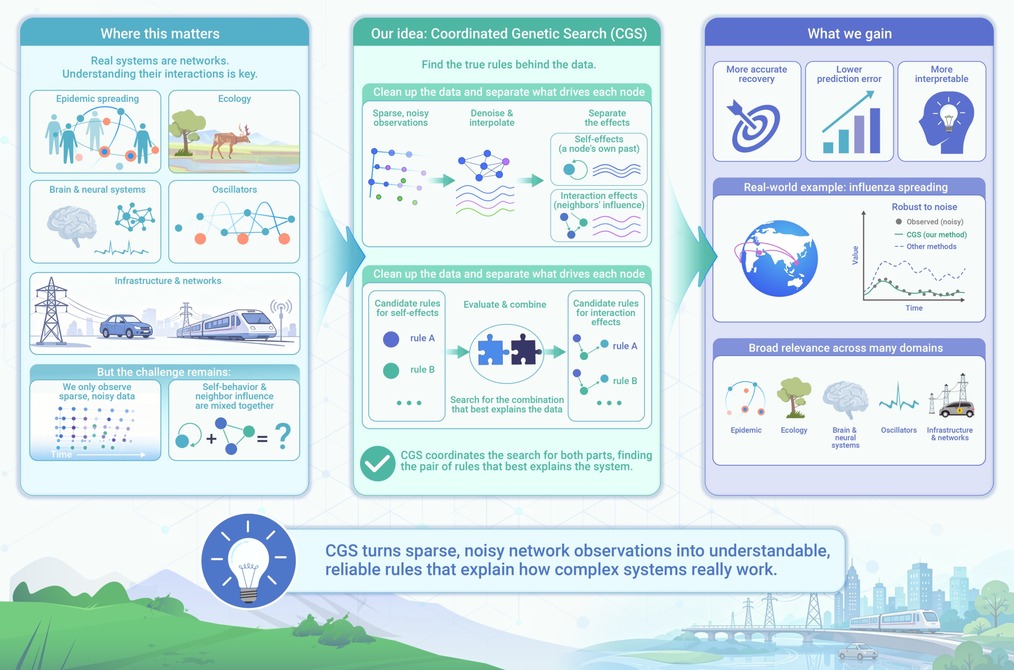
GRAPHICAL ABSTRACT
 DownLoad:
Full size image
DownLoad:
Full size image
-
PUBLIC SUMMARY
-
CGS discovers symbolic laws for network dynamics from sparse noisy data.
Neural ODE proxies denoise trajectories and separate node and edge effects.
Coordinated search reduces compensatory overfitting between dynamic components.
CGS shows strong synthetic recovery and provides an influenza case study.
-
-
ABSTRACT
Symbolic regression offers a route to mechanistic understanding of complex network dynamics, but existing methods often infer node and edge equations independently, allowing errors in one component to be compensated by the other. We present Coordinated Genetic Search (CGS), a framework for discovering governing equations from sparse and noisy network observations. CGS first trains a graph neural ordinary differential equation proxy with network inductive bias to disentangle node and edge effects and reconstruct denoised trajectories. It then co-evolves symbolic populations for node and edge dynamics, adaptively prioritizing the component that deviates most from its neural reference. This coordination is designed to reduce compensatory overfitting and improve identifiability. Across synthetic epidemic, ecological, neural, and oscillator systems on multiple graph topologies, CGS provides strong evidence of improved symbolic recovery and trajectory prediction relative to the tested baselines. On a real influenza A spreading network, where no ground-truth governing equation is available, CGS provides a proof-of-concept case study with physically plausible expressions and a modest reduction in normalized prediction error. -

-
REFERENCES
[1] Gerstner W., Kistler W. M., Naud R., et al. (2014). Neuronal dynamics: From single neurons to networks and models of cognition. (Cambridge University Press). [2] Gao J., Barzel B. and Barabási A. L. (2016). Universal resilience patterns in complex networks. Nature 530:307−12. DOI:10.1038/nature16948 [3] Bashan A., Gibson T. E., Friedman J., et al. (2016). Universality of human microbial dynamics. Nature 534:259−62. DOI:10.1038/nature18301 [4] Newman M., Barabási A. L. and Watts D. J. (2011). The structure and dynamics of networks. (Princeton University Press). [5] Kitsak M., Gallos L. K., Havlin S., et al. (2010). Identification of influential spreaders in complex networks. Nature Physics 6:888−93. DOI:10.1038/nphys1746 [6] Pastor-Satorras R. and Vespignani A. (2001). Epidemic spreading in scale-free networks. Physical Review Letters 86:3200. DOI:10.1103/PhysRevLett.86.3200 [7] Luo C., Lambiotte R. and Ji P. (2026). Temporal heterogeneity shapes diffusion dynamics in complex networks. Nature Communications 17:5601. DOI:10.1038/s41467-026-72161-w [8] Laurence E., Doyon N., Dubé L. J., et al. (2019). Spectral dimension reduction of complex dynamical networks. Physical Review X 9:011042. [9] Wilson H. R. and Cowan J. D. (1972). Excitatory and inhibitory interactions in localized populations of model neurons. Biophysical Journal 12:1−24. DOI:10.1016/s0006-3495(72)86068-5 [10] Zang C. and Wang F. (2020). Neural dynamics on complex networks. Proceedings of the 26th ACM SIGKDD International Conference on Knowledge Discovery & Data Mining (ACM): 892–902. [11] Murphy C., Laurence E. and Allard A. (2021). Deep learning of contagion dynamics on complex networks. Nature Communications 12:4720. DOI:10.1038/s41467-021-24732-2 [12] Gao T. T. and Yan G. (2022). Autonomous inference of complex network dynamics from incomplete and noisy data. Nature Computational Science 2:160−8. DOI:10.1038/s43588-022-00217-0 [13] Pastor-Satorras R., Castellano C., Van Mieghem P., et al. (2015). Epidemic processes in complex networks. Reviews of Modern Physics 87:925. DOI:10.1103/RevModPhys.87.925 [14] MacArthur R. (1970). Species packing and competitive equilibrium for many species. Theoretical Population Biology 1:1−11. DOI:10.1016/0040-5809(70)90039-0 [15] Kuramoto Y. (1984). Chemical Oscillations, Waves, and Turbulence. (Springer). [16] Gaucel S., Keijzer M., Lutton E., et al. (2014). Learning dynamical systems using standard symbolic regression. Genetic Programming: 17th European Conference, EuroGP 2014, Granada, Spain, April 23-25, 2014, Revised Selected Papers 17 (Springer): 25–36. [17] Kronberger G., Kammerer L. and Kommenda M. (2020). Identification of dynamical systems using symbolic regression. Computer Aided Systems Theory – EUROCAST 2019: 17th International Conference, Las Palmas de Gran Canaria, Spain, February 17–22, 2019, Revised Selected Papers, Part I 17 (Springer): 370–7. [18] Brunton S. L., Proctor J. L. and Kutz J. N. (2016). Discovering governing equations from data by sparse identification of nonlinear dynamical systems. Proceedings of the National Academy of Sciences 113:3932−7. DOI:10.1073/pnas.1517384113 [19] Qian Z., Kacprzyk K. and van der Schaar M. (2022). D-Code: Discovering closed-form ODEs from observed trajectories. International Conference on Learning Representations. [20] d’Ascoli S., Becker S., Schwaller P., et al. (2024). ODEFormer: Symbolic regression of dynamical systems with transformers. The Twelfth International Conference on Learning Representations. [21] Schmidt M. and Lipson H. (2009). Distilling free-form natural laws from experimental data. Science 324:81−5. DOI:10.1126/science.1165893 [22] Petersen B. K., Landajuela M., Mundhenk T. N., et al. (2019). Deep symbolic regression: Recovering mathematical expressions from data via risk-seeking policy gradients. arXiv preprint arXiv: 1912.04871. [23] Cranmer M., Sanchez Gonzalez A., Battaglia P., et al. (2020). Discovering symbolic models from deep learning with inductive biases. Advances in Neural Information Processing Systems 33:17429−42. [24] Shi H., Ding J., Cao Y., et al. (2023). Learning symbolic models for graph-structured physical mechanism. The Eleventh International Conference on Learning Representations. [25] Jing F., Zhang Z. K., Zhang Q., et al. (2026). Predictability of complex networks. Proceedings of the National Academy of Sciences 123:e2535161123. DOI:10.1073/pnas.2535161123 [26] Hu J., Cui J. and Yang B. (2025). Learning interpretable network dynamics via universal neural symbolic regression. Nature Communications 16:6226. DOI:10.1038/s41467-025-61575-7 [27] Yu Z., Ding J. and Li Y. (2026). Discovering network dynamics with neural symbolic regression. Nature Computational Science 6:156−68. DOI:10.1038/s43588-025-00893-8 [28] Liu B., Luo W., Li G., et al. (2023). Do we need an encoder-decoder to model dynamical systems on networks? arXiv preprint arXiv: 2305.12185. [29] Barzel B. and Barabási A. L. (2013). Universality in network dynamics. Nature Physics 9:673−81. DOI:10.1038/nphys2741 [30] Potter M. A. and De Jong K. A. (1994). A cooperative coevolutionary approach to function optimization. International Conference on Parallel Problem Solving from Nature (Springer): 249–57. [31] Erdős P. and Rényi A. (1959). On random graphs I. Publicationes Mathematicae Debrecen 6:290−7. [32] Barabási A. L. and Albert R. (1999). Emergence of scaling in random networks. Science 286:509−12. DOI:10.1126/science.286.5439.509 [33] Sauer T. (2011). Numerical solution of stochastic differential equations in finance. Handbook of Computational Finance (Springer), pp: 529–50. -
ABOUT THIS ARTICLE
Cite this article:
Qiu H., Liu S., Wu Y., et al. (2026). Coordinated discovery of mechanistic dynamics in complex networks. AI Plus 1:100006. https://doi.org/10.59717/ipj.aiplus.2026.100006
Welcome!
To request copyright permission to republish or share portions of our works, please visit Copyright Clearance Center's (CCC) Marketplace website at marketplace.copyright.com.
Export File
Citation
Qiu H., Liu S., Wu Y., et al. (2026). Coordinated discovery of mechanistic dynamics in complex networks. AI Plus 1:100006. https://doi.org/10.59717/ipj.aiplus.2026.100006

Format
Content

-
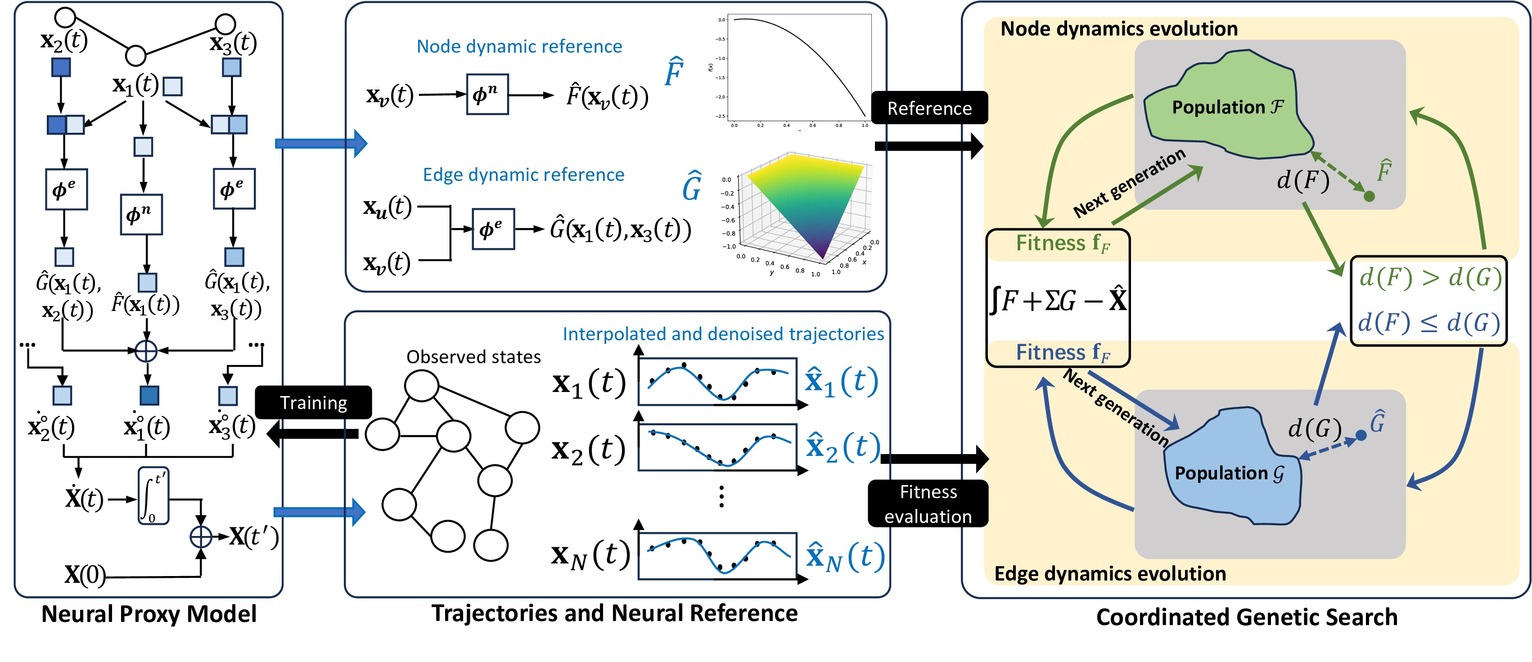
Figure 1.
Overview of Coordinated Genetic Search (CGS). A neural proxy model provides references (
$ \hat{F}, \hat{G} $ $ \hat{X} $ $ F^*, G^* $ -
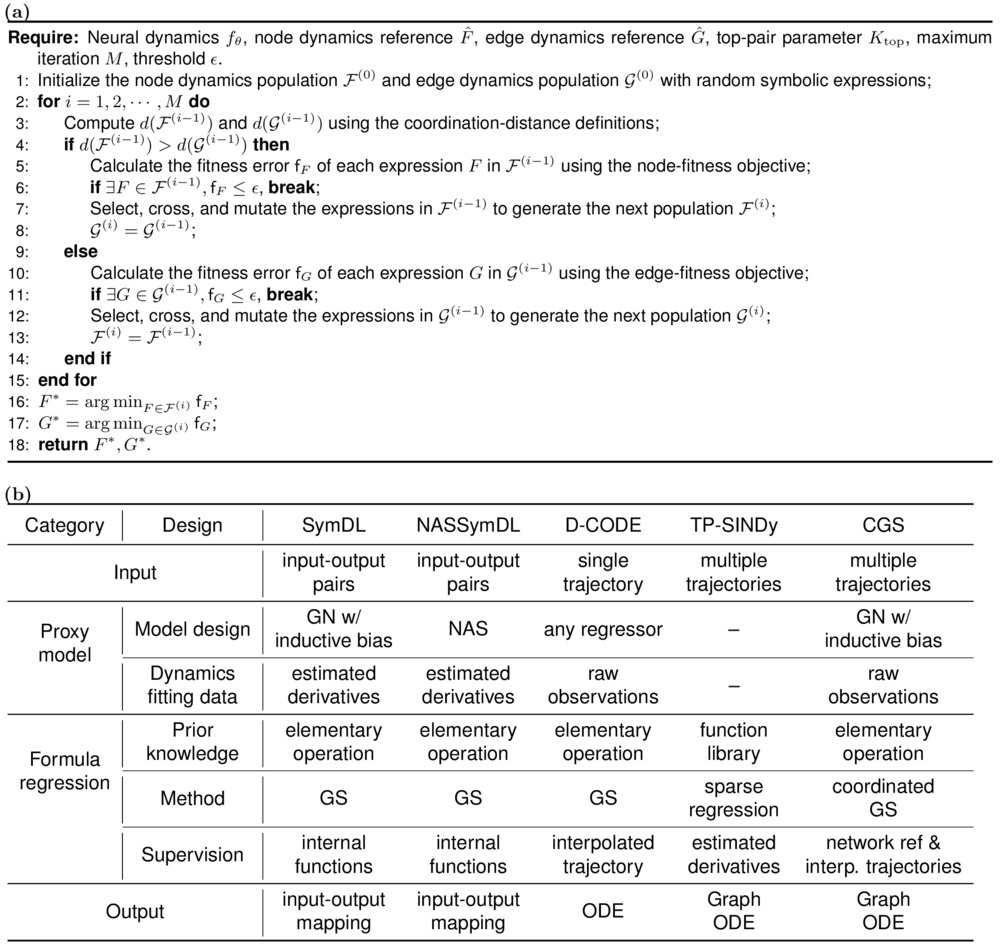
Figure 2.
(a) Algorithm for Coordinated Genetic Search for symbolic regression. (b) Comparison with different methods for symbolic regression. (GN: graph network, NAS: neural architecture search, GS: genetic search)
-
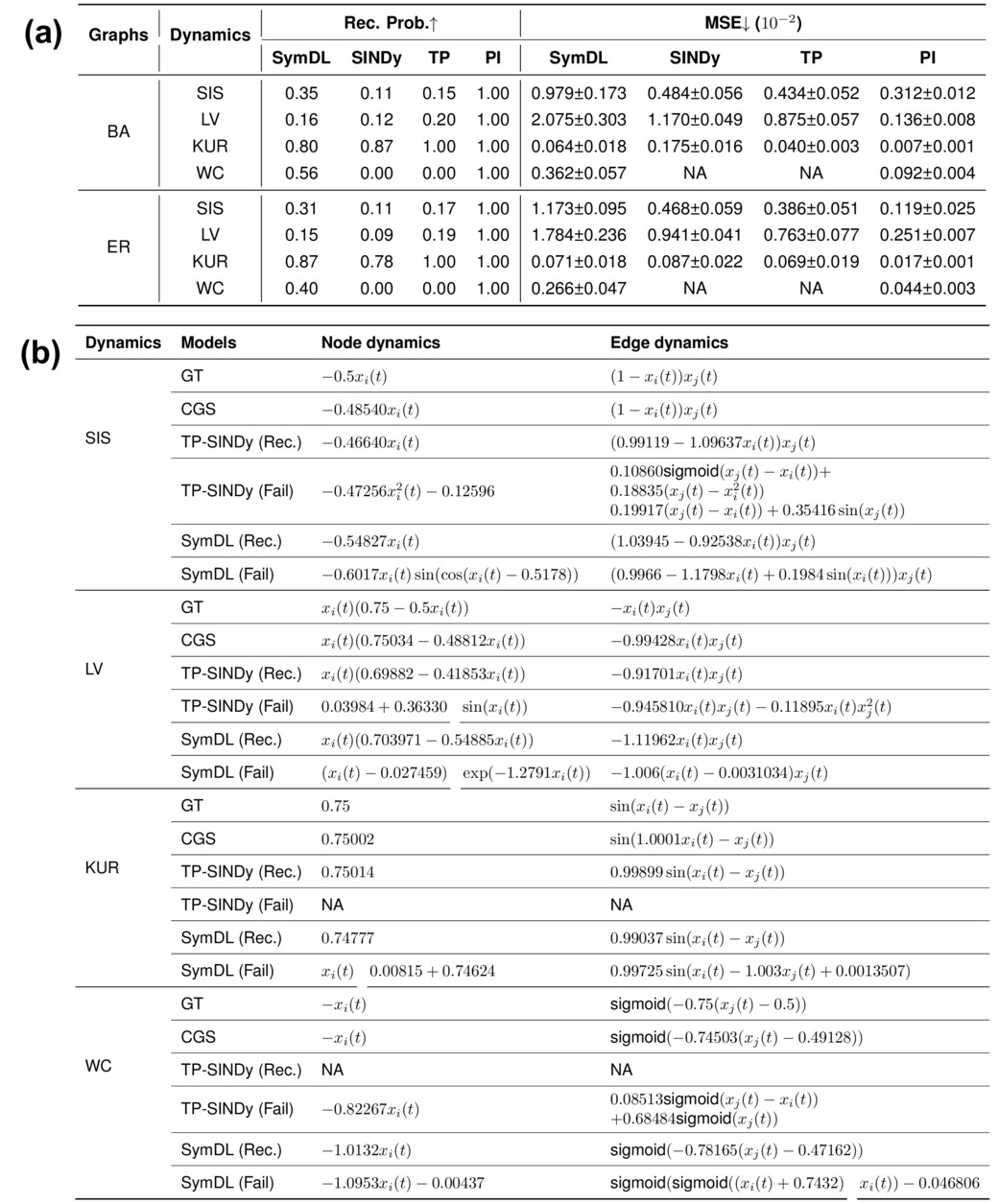
Figure 3.
(a) Performance comparison on synthetic datasets. MSE values are scaled by
$ 10^{-2} $ $ 10^{-2} $ -
Figure 4.
(a) Visualizing the predicted number of newly reported cases in two regions after transforming simulated normalized trajectories back to the raw case-count scale. (b) The symbolic expressions regressed by CGS, TP-SINDy, and SymDL on the influenza A dataset following the setup of 12. The expressions are defined on population-normalized case states, and edge summations use the normalized weighted aviation adjacency
$ \hat{A}_{ij} $ -
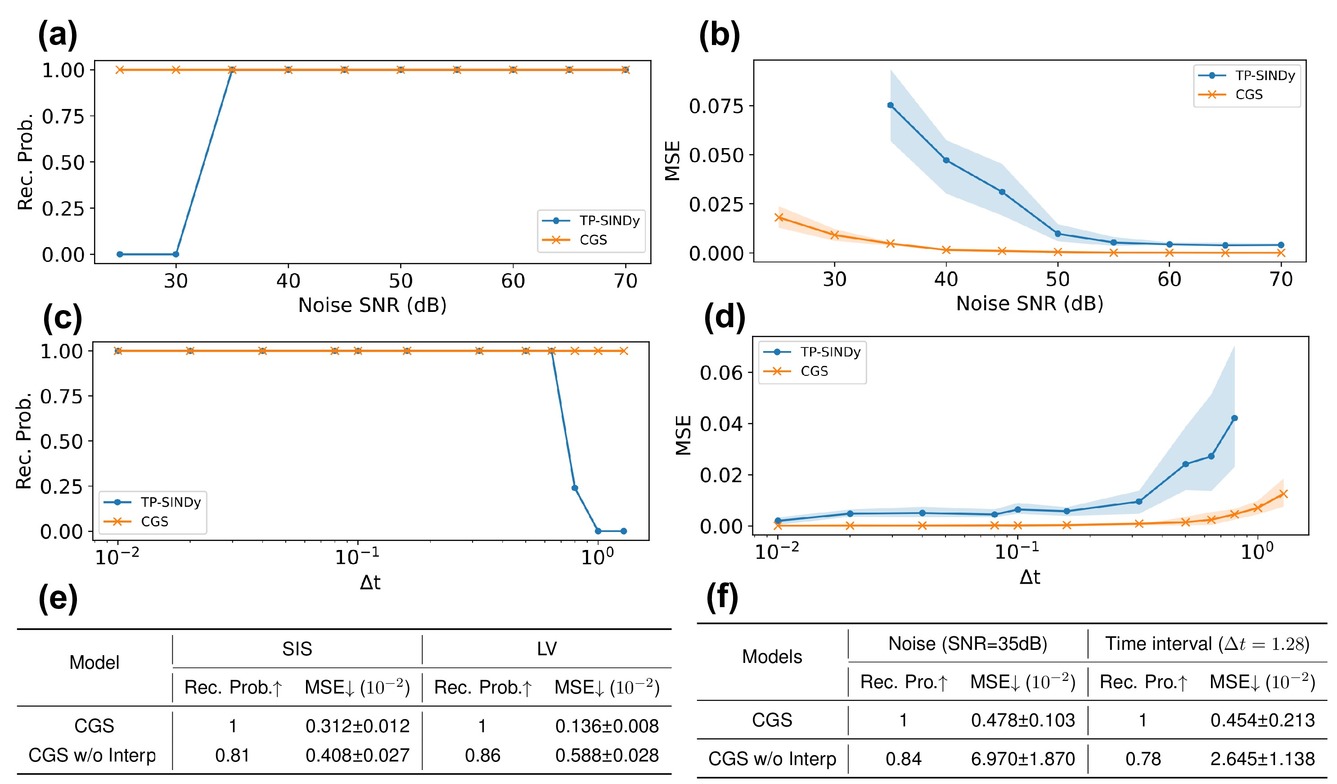
Figure 5.
Evaluation of robustness and the effect of denoised/interpolated trajectories. Shaded areas correspond to 95% confidence interval. (a) and (b) show the recovery probability and MSE when adding noise to observations. (c) and (d) show the recovery probability and MSE when increasing the time interval between observations. (e) Results for removing interpolated and denoised trajectories on SIS and LV dynamics in the BA graph. (f) Ablation variants compared with the full method on KUR dynamics in the BA graph.