
Near-Body Intelligence for Next Generation: Textiles Integrating Personal Thermal Management and Flexible Sensing
-

-
REFERENCES
[1] I.E.A. (2025). Energy Management for industry: Driving efficiency implementation. [2] Hoyt T., Arens E. and Zhang H. (2015). Extending air temperature setpoints: Simulated energy savings and design considerations for new and retrofit buildings. Build. Environ. 88:89−96. DOI:10.1016/j.buildenv.2014.09.010 [3] Kubicek J., Fiedorova K., Vilimek D., et al. (2022). Recent Trends, Construction, and Applications of Smart Textiles and Clothing for Monitoring of Health Activity: A Comprehensive Multidisciplinary Review. IEEE Rev. Biomed. Eng. 15:36−60. DOI:10.1109/rbme.2020.3043623 [4] Lee C., Tan J., Tan J.J., et al. (2025). Intelligent Thermochromic Heating E-Textile for Personalized Temperature Control in Healthcare. ACS Appl. Mater. Int. 17:5515−5526. DOI:10.1021/acsami.4c19174 [5] Liu S., Zhang W., He J., et al. (2024). Fabrication Techniques and Sensing Mechanisms of Textile-Based Strain Sensors: From Spatial 1D and 2D Perspectives. Adv. Fiber Mater. 6:36−67. DOI:10.1007/s42765-023-00338-9 -
ABOUT THIS ARTICLE
Cite this article:
Fu Y. and (2025). Near-Body Intelligence for Next Generation: Textiles Integrating Personal Thermal Management and Flexible Sensing. Energy Use 1:100016. https://doi.org/10.59717/ipj.energy-use.2025.100016
Welcome!
To request copyright permission to republish or share portions of our works, please visit Copyright Clearance Center's (CCC) Marketplace website at marketplace.copyright.com.
Export File
Citation
Fu Y. and (2025). Near-Body Intelligence for Next Generation: Textiles Integrating Personal Thermal Management and Flexible Sensing. Energy Use 1:100016. https://doi.org/10.59717/ipj.energy-use.2025.100016

Format
Content
 DownLoad:
-
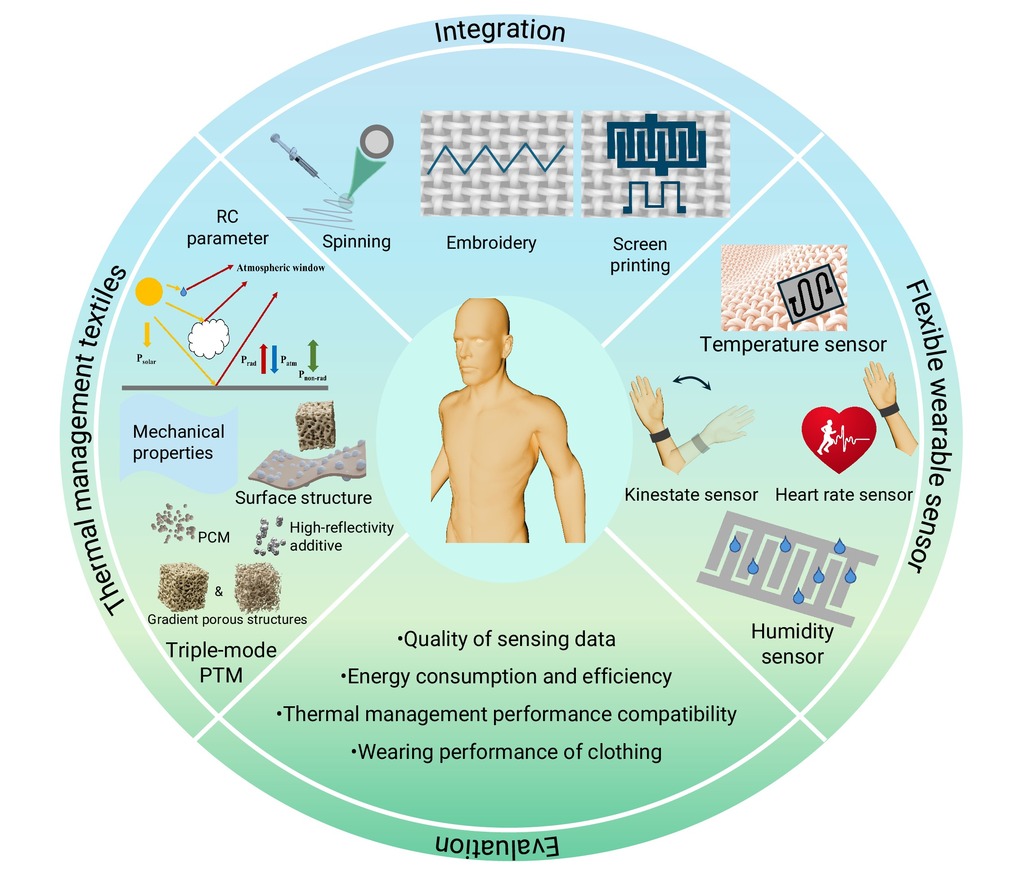
Figure 1.
Personal thermal management and flexible sensing and their integration and evaluation