
From Static to Adaptive: A Physics and Data Driven Virtual Testing Framework for Retro-Commissioning of HVAC Systems
-
GRAPHICAL ABSTRACT
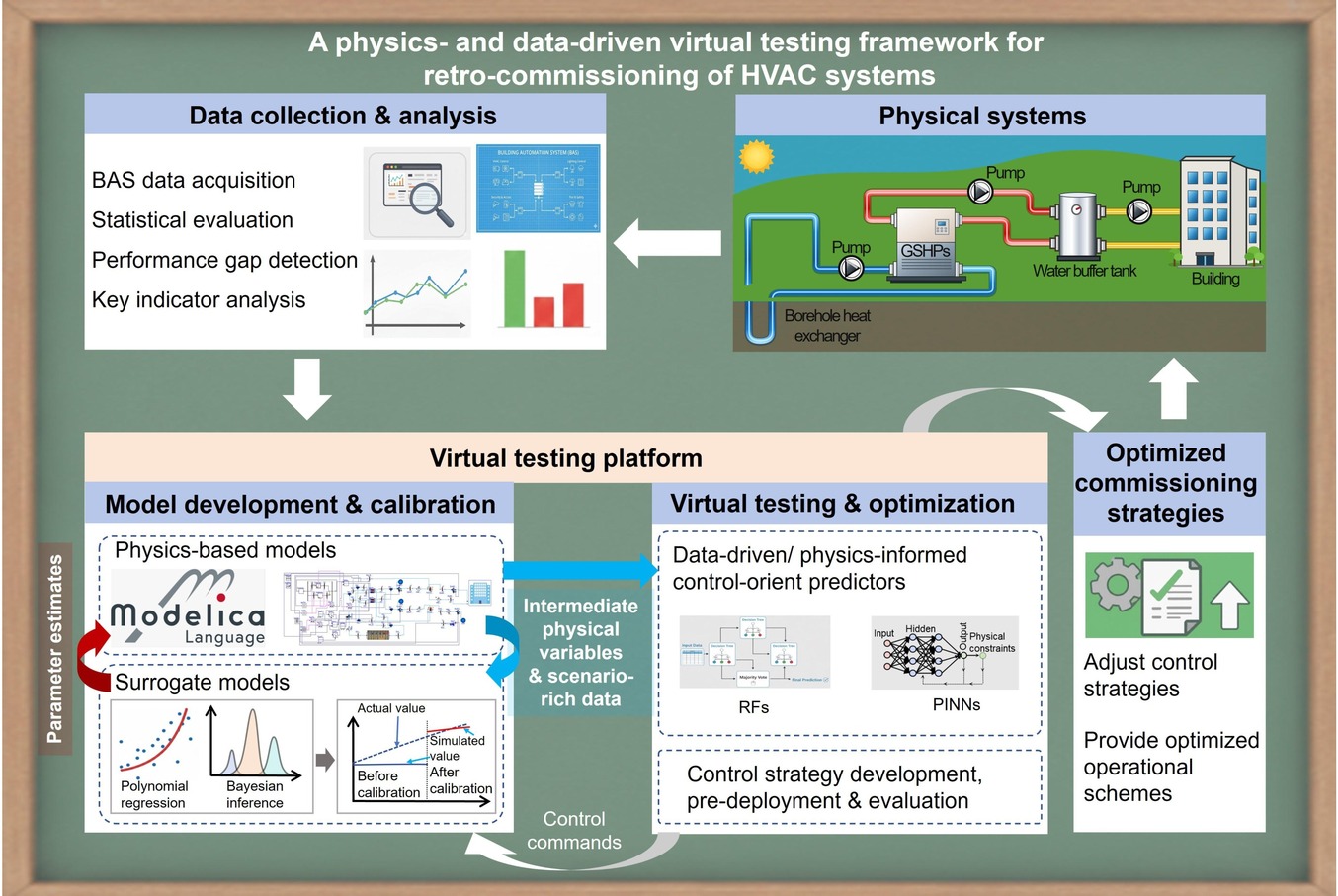
 DownLoad:
Full size image
DownLoad:
Full size image
-
PUBLIC SUMMARY
-
Calibrated physics-based model provides physical variables for control development.
Bayesian calibration updates the parameters of the physics-based model within the virtual testbed.
Optimized GSHP control cuts energy use by 16.1% and increases COP from 3.0 to 4.4.
Virtual evaluation indicates a 14.6% reduction in electricity costs without hardware changes.
-
-
ABSTRACT
Traditional one-time handover commissioning often fails to identify operational inefficiencies that emerge during long-term operation of heating, ventilation, and air-conditioning (HVAC) systems, while on-site commissioning remains labor-intensive and less adaptable to changing operating conditions. This study proposes a physics- and data-driven virtual testing framework to enable virtual retro-commissioning and adaptive control optimization. A calibrated Modelica-based system model is developed as a virtual testbed, where data-driven/physics-informed predictors are used to support unit operation optimization and preheating control. Physics-based representation provides scenario-rich simulations and intermediate physical variables, while the data-driven components translate these insights into fast, control-oriented predictors. The framework is demonstrated on an underperforming ground source heat pump (GSHP) system. Results show that the optimized control strategy reduces energy consumption by 16.1% while maintaining indoor thermal conditions comparable to those under the existing strategy, and increases the operational coefficient of performance (COP) from 3.0 to 4.4. Virtual evaluation over a representative 14-day winter period indicates a 14.6% reduction in electricity costs without hardware modifications. The proposed framework enables low-risk, model-based retro-commissioning and provides a practical pathway for adaptive performance optimization of existing HVAC systems.-
Keywords:
- retro-commissioning /
- control optimization /
- virtual testing /
- HVAC systems /
- model calibration.
-

-
REFERENCES
[1] International Energy Agency. (2025). Energy efficiency 2025: Buildings. IEA. https://www.iea.org/reports/energy-efficiency-2025/buildings [2] Pérez-Lombard L., Ortiz J. and Pout C. (2008). A review on buildings energy consumption information. Energy Build. 40:394−398. DOI:10.1016/j.enbuild.2007.03.007 [3] Wan K. K., Li D. H., Pan W., et al. (2012). Impact of climate change on building energy use in different climate zones and mitigation and adaptation implications. Appl. Energy 97:274−282. DOI:10.1016/j.apenergy.2011.11.048 [4] Li G., Wang C., Liu L., et al. (2024). Study on Sensor Fault-Tolerant Control for Central Air-Conditioning Systems Using Bayesian Inference with Data Increments. Sensors (Basel) 24:1150. DOI:10.3390/s24041150 [5] Mills E. (2011). Building commissioning: a golden opportunity for reducing energy costs and greenhouse gas emissions in the United States. Energy Effic. 4:145−173. DOI:10.1007/s12053-011-9116-8 [6] Crowe E., Mills E., Poeling T., et al. (2020). Building commissioning costs and savings across three decades and 1500 North American buildings. Energy and Buildings 227:110408. DOI:10.1016/j.enbuild.2020.110408 [7] Borgstein E. H., Lamberts R. and Hensen J. L. M. (2018). Mapping failures in energy and environmental performance of buildings. Energy Build. 158:476−485. DOI:10.1016/j.enbuild.2017.10.038 [8] Verhelst J., Van Ham G., Saelens D., et al. (2017). Model selection for continuous commissioning of HVAC-systems in office buildings: A review. Renew. Sustain. Energy Rev. 76:673−686. DOI:10.1002/er.4159 [9] Verhelst J., Van Ham G., Saelens D., et al. (2017). Model selection for continuous commissioning of HVAC-systems in office buildings: A review. Renew. Sustain. Energy Rev. 76:673−686. DOI:10.1016/j.rser.2017.01.119 [10] Taskgroup I. B. E. E. (2019). Building Energy Performance Gap Issues: An International Review. IPEEC Build. Energy Effic. Taskgroup: Paris, France. [11] Bockelmann F. and Fisch M. N. (2019). It works—Long-term performance measurement and optimization of six ground source heat pump systems in Germany. Energies 12:4691. DOI:10.3390/en12244691 [12] Ouabira M. M. (2025). Future of Commissioning. European J. Archit. Urban Plan. 4:13−21. DOI:10.24018/ejarch.2025.4.2.48 [13] Magni M., Ochs F., de Vries S., et al. (2021). Detailed cross comparison of building energy simulation tools results using a reference office building as a case study. Energy Build. 250. DOI:10.1016/j.enbuild.2021.111260 [14] Zare N., Saryazdi S. M. E., Bahman A. M., et al. (2023). Investigation of heating energy performance gap (EPG) in design and operation stages of residential buildings. Energy Build. 301:113747. DOI:10.1016/j.enbuild.2023.113747 [15] Martinez-Viol V., Urbano E. M., Delgado-Prieto M., et al. (2022). Automatic model calibration for coupled HVAC and building dynamics using Modelica and Bayesian optimization. Build. Environ. 226:109693. DOI:10.1016/j.buildenv.2022.109693 [16] Chen K., Zhu X., Anduv B., et al. (2022). Digital twins model and its updating method for heating, ventilation and air conditioning system using broad learning system algorithm. Energy 251:124040. DOI:10.1016/j.energy.2022.124040 [17] Ward R., Choudhary R., Gregory A., et al. (2021). Continuous calibration of a digital twin: Comparison of particle filter and Bayesian calibration approaches. Data-Centric Engineering 2:e15. DOI:10.1017/dce.2021.12 [18] Thelen A., Zhang X., Fink O., et al. (2022). A comprehensive review of digital twin — part 1: modeling and twinning enabling technologies. Struct. Multidis. Optim. 65. DOI:10.1007/s00158-022-03425-4 [19] Drgoňa J., Picard D. and Helsen L. (2020). Cloud-based implementation of white-box model predictive control for a GEOTABS office building: A field test demonstration. J. Process Control 88:63−77. DOI:10.1016/j.jprocont.2020.02.007 [20] Henze G. P., Kircher K. J. and Braun J. E. (2025). Why has advanced commercial HVAC control not yet achieved its promise. J. Build. Perform. Simul. 18:217−228. DOI:10.1080/19401493.2024.2429728 [21] Picard D., Drgoňa J., Kvasnica M., et al. (2017). Impact of the controller model complexity on model predictive control performance for buildings. Energy Build. 152:739−751. DOI:10.1016/j.enbuild.2017.07.027 [22] Blum D., Arroyo J., Huang S., et al. (2021). Building optimization testing framework (BOPTEST) for simulation-based benchmarking of control strategies in buildings. J. Build. Perform. Simul. 14:586−610. DOI:10.1080/19401493.2021.1986574 [23] Wang J., Li Y., Gao R. X., et al. (2022). Hybrid physics-based and data-driven models for smart manufacturing: Modelling, simulation, and explainability. J. Manufact. Sys. 63:381−391. DOI:10.1016/j.jmsy.2022.04.004 [24] Lu X., Fu Y. and O'Neill Z. (2023). Benchmarking high performance HVAC Rule-Based controls with advanced intelligent Controllers: A case study in a Multi-Zone system in Modelica. Energy Build. 284. DOI:10.1016/j.enbuild.2023.112854 [25] Hussien A., Khan W., Hussain A., et al. (2023). Predicting energy performances of buildings' envelope wall materials via the random forest algorithm. J. Build. Eng. 69:106263. DOI:10.1016/j.jobe.2023.106263 [26] Afram A., Janabi-Sharifi F., Fung A. S., et al. (2017). Artificial neural network (ANN) based model predictive control (MPC) and optimization of HVAC systems: A state of the art review and case study of a residential HVAC system. Energy Build. 141:96−113. DOI:10.1016/j.enbuild.2017.02.012 [27] Van Every P. M., Rodriguez M., Jones C. B., et al. (2017). Advanced detection of HVAC faults using unsupervised SVM novelty detection and Gaussian process models. Energy Build. 149:216−224. DOI:10.1016/j.enbuild.2017.05.053 [28] Villano F., Mauro G. M. and Pedace A. (2024). A review on machine/deep learning techniques applied to building energy simulation, optimization and management. Thermo 4:100−139. DOI:10.3390/thermo4010008 [29] Hong T., Wang Z., Luo X., et al. (2020). State-of-the-art on research and applications of machine learning in the building life cycle. Energy Build. 212:109831. DOI:10.1016/j.enbuild.2020.109831 [30] Wang X. and Dong B. (2023). Physics-informed hierarchical data-driven predictive control for building HVAC systems to achieve energy and health nexus. Energy Build. 291:113088. DOI:10.1016/j.enbuild.2023.113088 [31] Von Krannichfeldt L., Orehounig K. and Fink O. (2025). Combining physics-based and data-driven modeling for building energy systems. Appl. Energy 391:125853. DOI:10.1016/j.apenergy.2025.125853 [32] Nghiem T. X., Drgoňa J., Jones C., et al. (2023). Physics-informed machine learning for modeling and control of dynamical systems. arXiv preprint arXiv:2306.13867. DOI:https://doi.org/10.48550/arXiv.2306.13867 [33] Farkane A., Boutayeb M., Oudani M., et al. (2025). An Adaptive Physics-Informed Neural Network Observer for state estimation in nonlinear dynamical systems. Eng. Appl. Arti. Intel. 162. DOI:10.1016/j.engappai.2025.112655 [34] Campoy-Nieves A., Manjavacas A., Jiménez-Raboso J., et al. (2025). Sinergym – A virtual testbed for building energy optimization with Reinforcement Learning. Energy Build. 327:11. DOI:10.1016/j.enbuild.2024.115075 [35] Wu S., Zheng W., Wang Z., et al. (2025). AlphaDataCenterCooling: A virtual testbed for evaluating operational strategies in data center cooling plants. Appl. Energy 380. DOI:10.1016/j.apenergy.2024.125100 [36] Mohebi P., Liu Y., Xing S., et al. (2026). Stochastic model predictive control for building thermal management: A comparative analysis of scenario-based and tube-based approaches using the BOPTEST framework. Energy 351:140808. DOI:10.1016/j.energy.2026.140808 [37] Hekimoğlu M. B., Baghaee S., Büyüker A. İ., et al. (2025). IoT-Based Multi-Speed HVAC Control: Simulation Results and Testbed Development. 33rd Signal Proces. Commun. Appl. Conf. [38] Wongphong C., Wongta P. and Marurngsith W. (2026). A Co-Simulation Framework for Building Energy Management as a Testbed for Energy-Aware Data Movement Analysis. Proceed. Supercomput. Asia Int. Conf. High Perform. Comput. Asia Pacific Region Workshops. DOI:10.1016/j.enbuild.2020.109831 [39] Li H. and Hong T. (2025). A digital twin platform for building performance monitoring and optimization: Performance simulation and case studies. Build. Simul. 18:1561−1579. DOI:10.1007/s12273-025-1290-2 [40] Pop C. B., Chifu V. R., Cordea C., et al. (2021). Forecasting the Short-Term Energy Consumption Using Random Forests and Gradient Boosting. RoEduNet. [41] Ahmad M. W., Mourshed M. and Rezgui Y. (2017). Trees vs Neurons: Comparison between random forest and ANN for high-resolution prediction of building energy consumption. Energy Build. 147:77−89. DOI:10.1016/j.enbuild.2017.04.038 [42] Liang X., Liu Y., Chen S., et al. (2025). Physics-informed neural network for chiller plant optimal control with structure-type and trend-type prior knowledge. Appl. Energy 390. DOI:10.1016/j.apenergy.2025.125857 [43] Wetter M., Zuo W., Nouidui T. S., et al. (2013). Modelica Buildings library. J. Build. Perform. Simul. 7:253−270. DOI:10.1080/19401493.2013.765506 [44] Fouodo C. J., Kronziel L. L., König I. R., et al. (2023). Effect of hyperparameters on variable selection in random forests. arXiv preprint arXiv:2309.06943. DOI:10.48550/arXiv.2309.06943 [45] Hug S., Raue A., Hasenauer J., et al. (2013). High-dimensional Bayesian parameter estimation: case study for a model of JAK2/STAT5 signaling. Math Biosci 246:293−304. DOI:10.1016/j.mbs.2013.04.002 [46] Chow D. H. C. and Levermore G. J. (2010). The effects of future climate change on heating and cooling demands in office buildings in the UK. Build. Serv. Eng. Res. Tech. 31:307−323. DOI:10.1177/0143624410371284 [47] Dai Z., Zhang X., Liu J., et al. (2025). Energy-saving control strategy for the joint operation of multiple ground source heat pumps system based on TRNSYS: A research study. Case Stud. Therm. Eng. 67:105834. DOI:10.1016/j.csite.2025.105834 [48] Fang J., Yan C., Lu W., et al. (2025). Embedding physical neurons in physics-informed neural networks (EP-PINNs) for enhancing chiller performance prediction. Build. Simul. 18:1877−1901. DOI:10.1007/s12273-025-1293-z [49] Guideline A. (2014). Measurement of energy, demand, and water savings. ASHRAE guidel 4:1−150. DOI:10.1177/0143624410371284 -
ABOUT THIS ARTICLE
Cite this article:
Fang J., Choudhary R., Goyal A., et al. (2026). From Static to Adaptive: A Physics and Data Driven Virtual Testing Framework for Retro-Commissioning of HVAC Systems. Energy Use 2:100039. https://doi.org/10.59717/ipj.energy-use.2026.100039
Welcome!
To request copyright permission to republish or share portions of our works, please visit Copyright Clearance Center's (CCC) Marketplace website at marketplace.copyright.com.
Export File
Citation
Fang J., Choudhary R., Goyal A., et al. (2026). From Static to Adaptive: A Physics and Data Driven Virtual Testing Framework for Retro-Commissioning of HVAC Systems. Energy Use 2:100039. https://doi.org/10.59717/ipj.energy-use.2026.100039

Format
Content
-
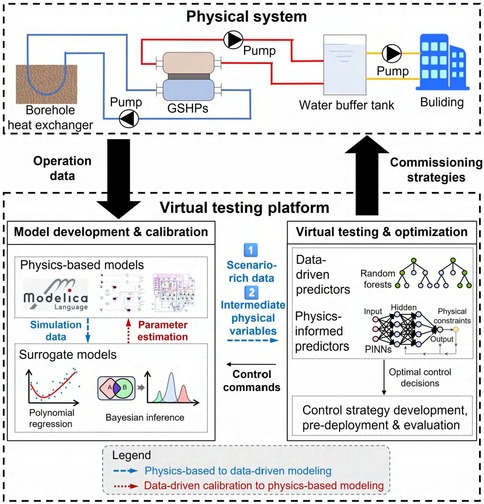
Figure 1.
Proposed virtual testing framework for retro-commissioning.
-
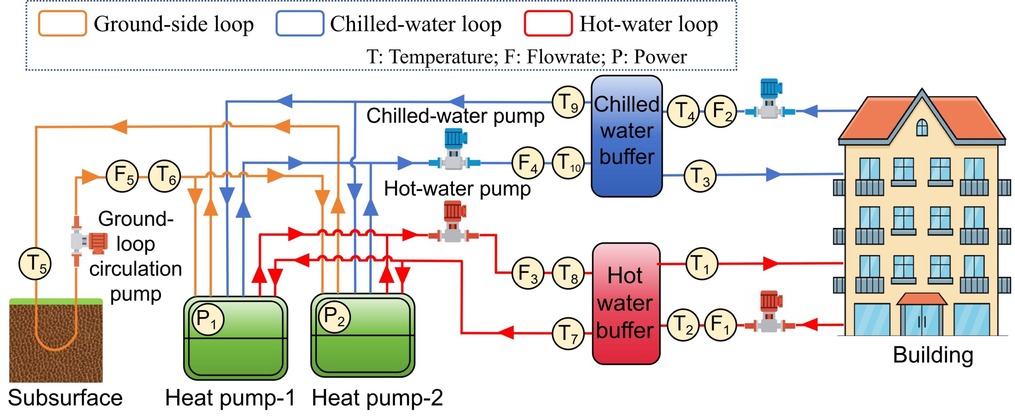
Figure 2.
Schematic diagram of the GSHP system.
-
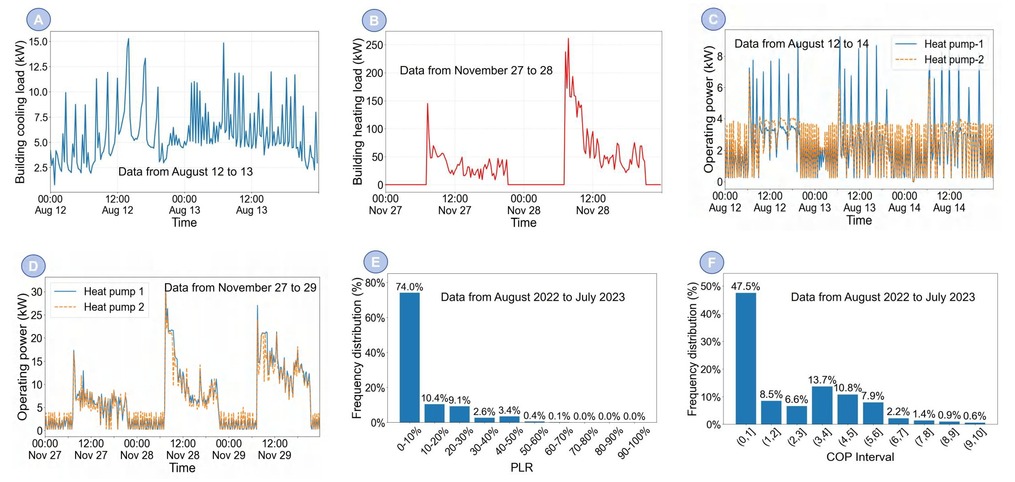
Figure 3.
Operating characteristics and performance distribution of the GSHP system.
-
Figure 4.
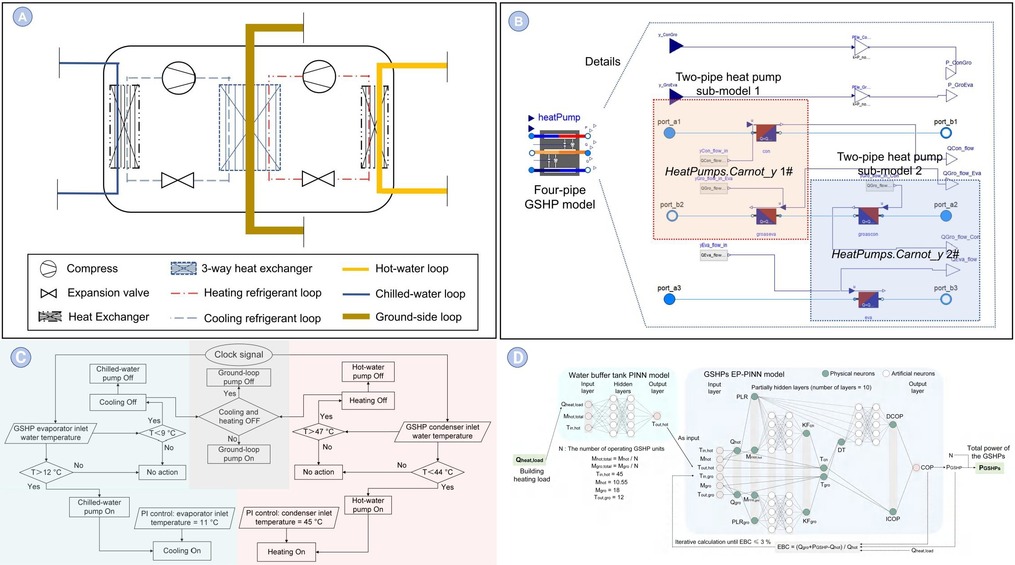
(A) Schematic of the four-pipe GSHP and (B) its equivalent. (C) Modelica-based model Flowchart of the existing control logic for the GSHP system. (D) Coupled physics-informed predictors for buffer-tank and GSHP.
-
Figure 5.
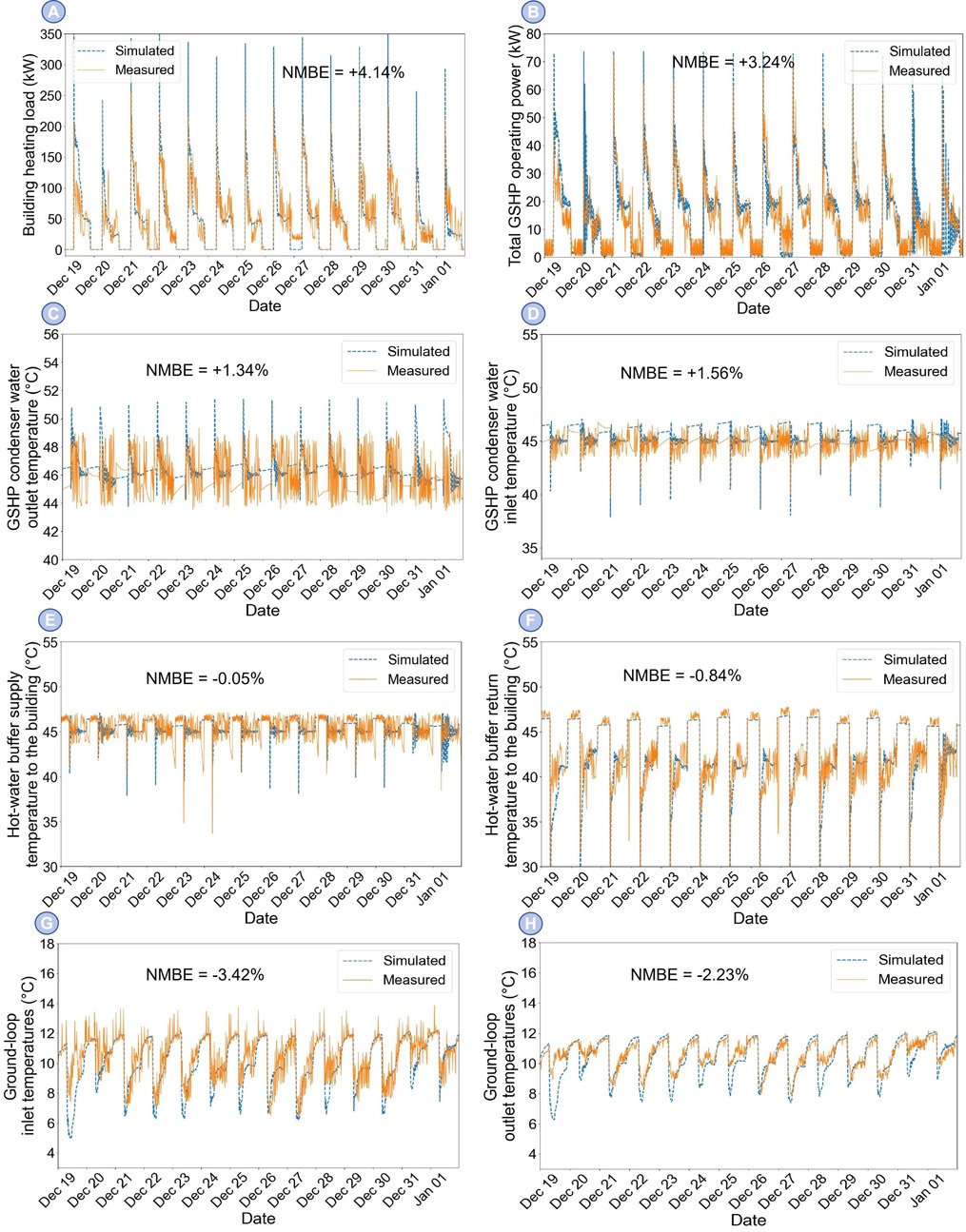
Validation of key system variables.
-
Figure 6.
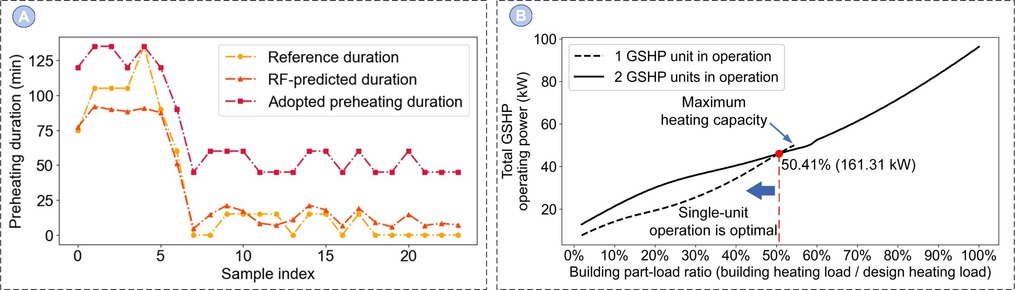
Coupled physics-informed predictors for buffer-tank and GSHP
-
Figure 7.
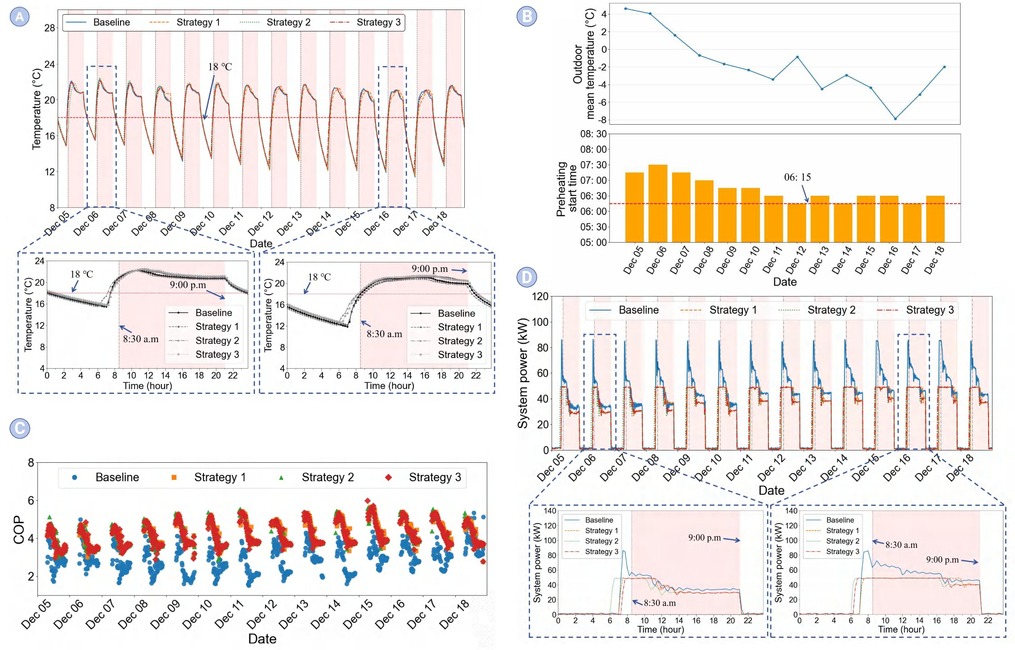
Comparison of (A) indoor temperature and (B) preheating start time distributions under different strategies. Comparison of (A) COP and (B) system power under different strategies.