
Sustainable Working Fluid Optimization for EORC-CCHP Systems: Low-GWP Mixtures, Thermodynamic Performance, and Exergy Analysis
-
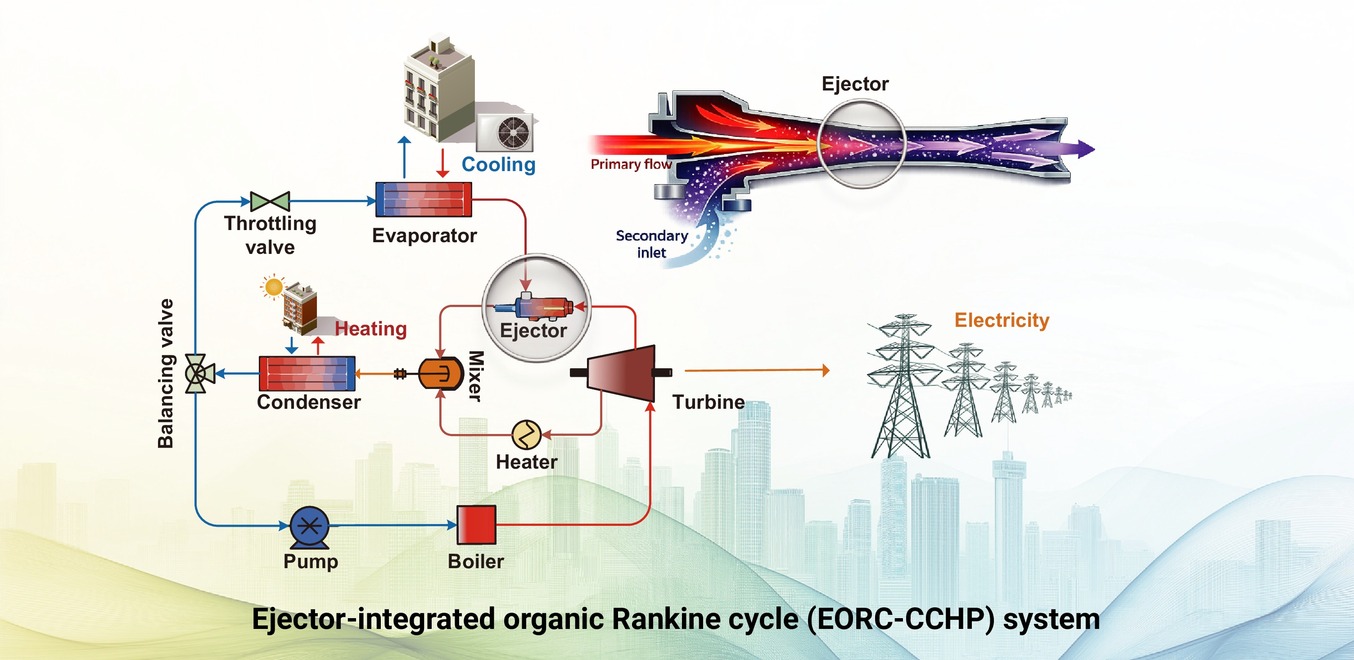
GRAPHICAL ABSTRACT
 DownLoad:
Full size image
DownLoad:
Full size image
-
PUBLIC SUMMARY
-
Proposed an ejector-integrated organic Rankine cycle (EORC-CCHP) system for efficient low-grade thermal energy use.
Developed a framework combining refrigerant selection and thermodynamic optimization with a focus on sustainability.
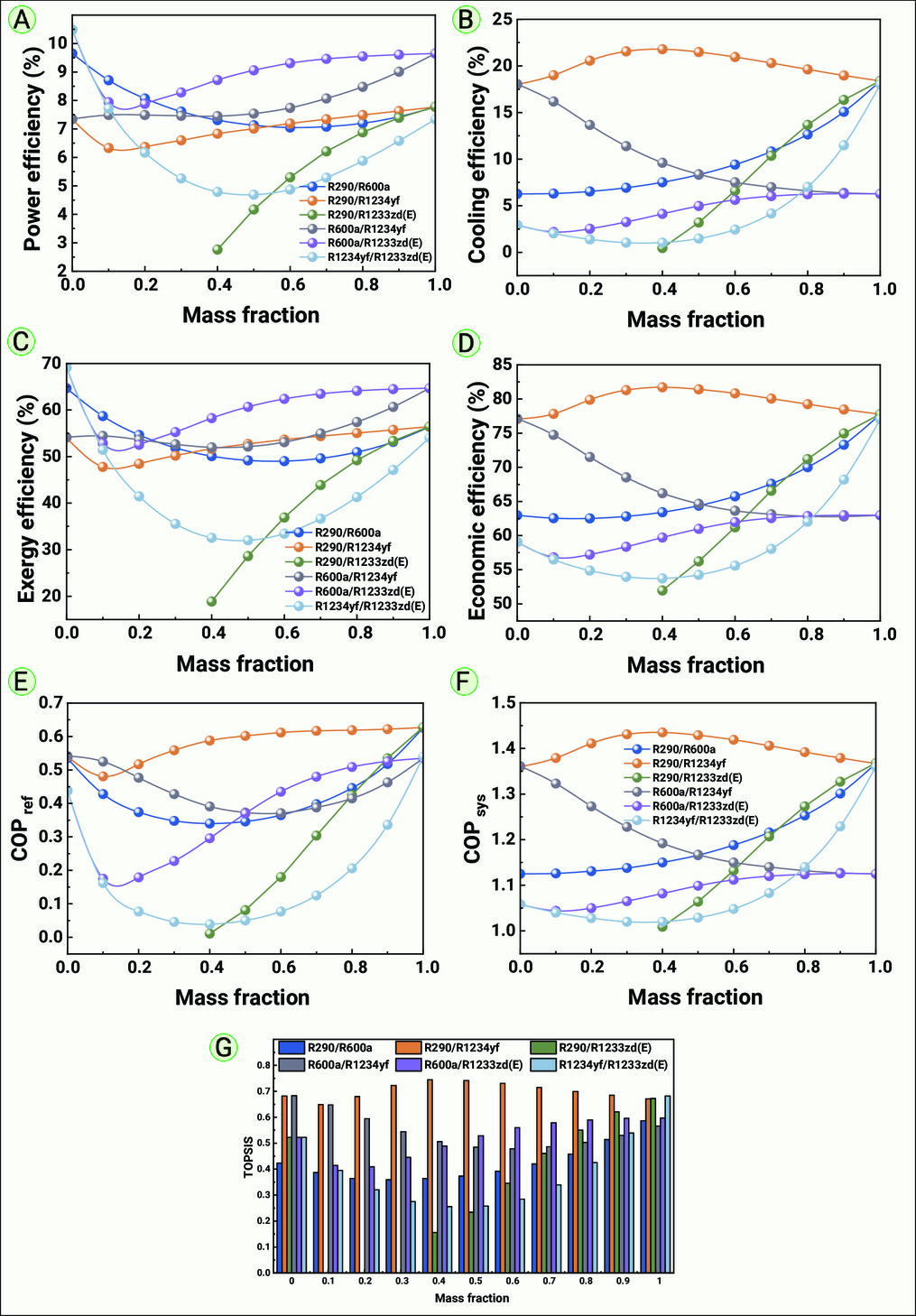
Identified R290/R1234yf as the optimal fluid, achieving a COPsys of 1.435.
Parametric analysis revealed trade-offs in power and cooling outputs.
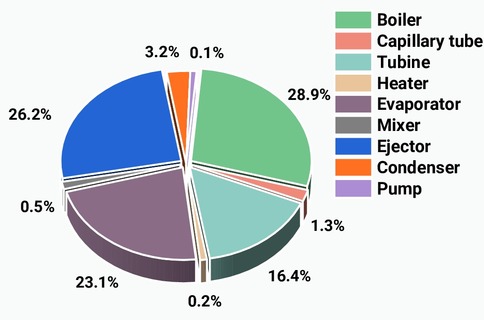
Exergy analysis highlighted boiler and ejector as key areas for performance improvement.
-
-
ABSTRACT
Sustainable utilization of low-grade thermal energy is essential for advancing low-carbon distributed energy systems. This study proposes an ejector-integrated organic Rankine cycle combined cooling, heating and power (EORC-CCHP) system, in which ejector-based internal energy cascading is employed to reduce throttling losses and enhance system performance under low-temperature heat sources. A systematic framework integrating environmentally sustainable refrigerant selection and thermodynamic optimization is developed. Candidate working fluids, including R290, R600a, R1234yf, R1233zd(E), and their mixtures, are first screened from an environment perspective using total equivalent warming impact (TEWI) and life-cycle assessment (LCA). A comprehensive thermodynamic model is then established, and a multi-criteria decision-making approach based on TOPSIS is applied to assess system performance across multiple indicators. The results identify the R290/R1234yf mixture as the optimal working fluid, achieving a maximum closeness coefficient of 0.745 at an R290 mass fraction of 0.4, corresponding to a system coefficient of performance (COPsys) of 1.435. Parametric analysis reveals that system performance is governed by coupled trade-offs among operating parameters: increasing boiler temperature enhances power output but introduces additional thermodynamic irreversibility, while variations in mass flow rate and ejector geometry redistribute energy utilization between power and cooling outputs. Exergy analysis shows that irreversibility is dominated by the boiler and ejector, which together account for the majority of exergy destruction, identifying them as key targets for performance improvement. This work demonstrates that the synergistic design of low-GWP refrigerant mixtures and ejector-enhanced thermodynamic cycles provides an effective pathway for improving the efficiency and sustainability of CCHP systems utilizing low-grade thermal energy. -

-
REFERENCES
[1] Liu Y., Han B., Jiang CQ, et al. (2024). Uncovering the role of urban green infrastructure in carbon neutrality: A novel pathway from the urban green infrastructure and cooling power saving. J. Clean. Produc. 452. DOI:10.1016/j.jclepro.2024.142193 [2] Lalau Y., Al Asmi I., Olives R, et al. (2022). Energy analysis and life cycle assessment of a thermal energy storage unit involving conventional or recycled storage materials and devoted to industrial waste heat valorisation. J. Clean. Product. 330. DOI:10.1016/j.jclepro.2021.129950 [3] Huang S., Li J., Bai Z, et al. (2024). Assessment of the effect of heat storage on the production of clean geothermal energy using the medium and deep U-type borehole heat exchanger system. J. Clean. Product. 447. DOI:10.1016/j.jclepro.2024.141471 [4] Keskin I. and Soykan G. (2023). Distribution grid electrical performance and emission analysis of combined cooling, heating and power (CCHP)-photovoltaic (PV)-based data center and residential customers. J. Clean. Product. 414. DOI:10.1016/j.jclepro.2023.137448 [5] Norani M. and Deymi-Dashtebayaz M. (2022). Energy, exergy and exergoeconomic optimization of a proposed CCHP configuration under two different operating scenarios in a data center: Case study. J. Clean. Product. 342. DOI:10.1016/j.jclepro.2022.130971 [6] Hung TC., Shai TY. and Wang SK. (1997). A review of organic rankine cycles (ORCs) for the recovery of low-grade waste heat. Energy 22:661−667. DOI:10.1016/S0360-5442(96)00165-X [7] Bao J. and Zhao L. (2013). A review of working fluid and expander selections for organic Rankine cycle. Renew. Sustain. Energy Rev. 24:325−342. DOI:10.1016/j.rser.2013.03.040 [8] Wu D., Han S., Liu Z, et al. (2025). Multi-time-scale Optimized Operation Method for Integrated Energy Systems Considering Equipment Dynamic Performance. Energy Use 1(1). DOI:10.59717/ipj.energy-use.2025.100012 [9] Jafary S., Khalilarya S., Shawabkeh A, et al. (2021). A complete energetic and exergetic analysis of a solar powered trigeneration system with two novel organic Rankine cycle (ORC) configurations. J. Clean. Product. 281. DOI:10.1016/j.jclepro.2020.124552 [10] Dai Y., Wang J. and Gao L. (2009). Exergy analysis, parametric analysis and optimization for a novel combined power and ejector refrigeration cycle. Appl. Therm. Eng. 29:1983−1990. DOI:10.1016/j.applthermaleng.2008.09.016 [11] Wu J., Liang Y., Sun Z, et al. (2024). Dynamic analysis and control strategy of ORC coupled ejector expansion refrigeration cycle driven by geothermal water. J. Clean. Product. 445. DOI:10.1016/j.jclepro.2024.141309 [12] Yu W., Wang H. and Ge Z. (2021). Comprehensive analysis of a novel power and cooling cogeneration system based on organic Rankine cycle and ejector refrigeration cycle. Energy Conver. Manage. 232. DOI:10.1016/j.enconman.2021.113898 [13] Tang Z., Wu C., Liu C, et al. (2021). Thermodynamic analysis and comparison of a novel dual-ejector based organic flash combined power and refrigeration cycle driven by the low-grade heat source. Energy Conver. Manage. 239. DOI:10.1016/j.enconman.2021.114205 [14] Du Y-D., Li M-J. and Li H-Z. (2025). Thermodynamic and environmental performance assessment of an ejector-based organic Rankine cycle coupled with chemical looping combustion for combined cooling and power. Energy 336. DOI:10.1016/j.energy.2025.138451 [15] Niu J., Dong L., Wang J, et al. (2026). Optimization of system layout and working fluid selection based on genetic algorithm to improve Carnot battery performance. Energy Conver. Manage. 348. DOI:10.1016/j.enconman.2025.120705. [16] Zheng B. and Weng YW. (2010). A combined power and ejector refrigeration cycle for low temperature heat sources. Solar Energy 84:784−791. DOI:10.1016/j.solener.2010.02.001 [17] Sarkar J. (2015). Review and future trends of supercritical CO2 Rankine cycle for low-grade heat conversion. Renew. Sustain. Energy Rev. 48:434-451. hDOI:10.1016/j.rser.2015.04.039 [18] McLinden MO., Kazakov AF., Steven Brown J, et al. (2014). A thermodynamic analysis of refrigerants: Possibilities and tradeoffs for Low-GWP refrigerants. International J. Refrig. 38:80−92. DOI:10.1016/j.ijrefrig.2013.09.032 [19] Invernizzi CM., Iora P., Preißinger M, et al. (2016). HFOs as substitute for R-134a as working fluids in ORC power plants: A thermodynamic assessment and thermal stability analysis. Appl. Therm. Eng. 103:790−797. DOI:10.1016/j.applthermaleng.2016.04.101 [20] Palm B. (2008). Hydrocarbons as refrigerants in small heat pump and refrigeration systems – A review. Int. J. Refrig. 31:552−563. DOI:10.1016/j.ijrefrig.2007.11.016 [21] Zhang Y., Song Y., Liu M, et al. (2025). The Innovative Application and Development Trend of CO<sub>2</sub> Thermodynamic Cycle Technology in the New Energy Structure system. Energy Use, 1(2). DOI:10.59717/ipj.energy-use.2025.100028. [22] Pan D. and Gholami Farkoush S. (2023). Comprehensive analysis and multi-objective optimization of power and cooling production system based on a flash-binary geothermal system. Appl. Therm. Eng. 229. DOI:10.1016/j.applthermaleng.2023.120398 [23] Mortazavi H., Beni HM., Nadooshan AA, et al. (2024). 4E analysis and triple objective NSGA-II optimization of a novel solar-driven combined ejector-enhanced power and two-stage cooling (EORC-TCRC) system. Energy 294. DOI:10.1016/j.energy.2024.130803 [24] Pazuki M-M., Kolahi M-R., Ebadollahi M, et al. (2024). Enhancing efficiency in an innovative geothermal poly-generation system for electricity, cooling, and freshwater production through integrated multi-objective optimization: A holistic approach to energy, exergy, and enviroeconomic effects. Energy 313. DOI:10.1016/j.energy.2024.133862 [25] Yang T., Siepmann JI. and Wu J. (2021). Phase Equilibria of Difluoromethane (R32), 1,1,1,2-Tetrafluoroethane (R134a), and trans-1,3,3,3-Tetrafluoro-1-propene (R1234ze(E)) Probed by Experimental Measurements and Monte Carlo Simulations. Ind. Eng. Chem. Res. 60:739−752. DOI:10.1021/acs.iecr.0c05442 [26] Yaïci W. and Longo M. (2025). Ejector-enhanced air-source heat pump systems using ultra-low-GWP zeotropic mixtures in cold climates. Energy 328. DOI:10.1016/j.energy.2025.136492 [27] Eyerer S., Wieland C., Vandersickel A, et al. (2016). Experimental study of an ORC (Organic Rankine Cycle) and analysis of R1233zd-E as a drop-in replacement for R245fa for low temperature heat utilization. Energy 103:660−671. DOI:10.1016/j.energy.2016.03.034 [28] Yang T., Hu X., Meng X, et al. (2020). Vapour-liquid equilibria for the binary systems of pentafluoroethane {(R125) + 2,3,3,3-tetrafluoroprop-1-ene (R1234yf)} and {trans-1,3,3,3-tetrafluoropropene R1234ze(E)}. J. Chem. Thermo. 150. DOI:10.1016/j.jct.2020.106222 [29] Andrade A., Zapata-Mina J. and Restrepo A. (2024). Exergy and environmental assessment of R-290 as a substitute of R-410A of room air conditioner variable type based on LCCP and TEWI approaches. Res. Eng. 21. DOI:10.1016/j.rineng.2024.101806. [30] Suresh R., Saladi JK. and Datta SP. (2025). Energy, exergy and environmental life cycle assessment on the valorization of an ejector integrated CCHP system with six sustainable refrigerants. Energy 317. DOI:10.1016/j.energy.2025.134664 [31] Wang J., Yang Y., Mao T, et al. (2015). Life cycle assessment (LCA) optimization of solar-assisted hybrid CCHP system. Appl. Energy 146:38−52. DOI:10.1016/j.apenergy.2015.02.056 [32] Liu C., He C., Gao H, et al. (2013). The environmental impact of organic Rankine cycle for waste heat recovery through life-cycle assessment. Energy 56:144−154. DOI:10.1016/j.energy.2013.04.045 [33] Guo H., Wang H., He W, et al. (2025). C-P Diagram: A new thermodynamic analysis tool characterizing thermal cycles through geometric symmetry. Innov. Energy 2. DOI:10.59717/j.xinn-energy.2025.100117. [34] Suresh R. and Datta SP. (2022). Drop-in Replacement of Conventional Automotive Refrigeration System to Hybrid-Ejector System with Environment-Friendly Refrigerants. Energy Conver. Manag. 266. DOI:10.1016/j.enconman.2022.115819 [35] Wang J., Dai Y. and Sun Z. (2009). A theoretical study on a novel combined power and ejector refrigeration cycle. Int. J. Refrig. 32:1186−1194. DOI:10.1016/j.ijrefrig.2009.01.021 -
ABOUT THIS ARTICLE
Cite this article:
Yang T., Yao J., Li X., et al. (2026). Sustainable Working Fluid Optimization for EORC-CCHP Systems: Low-GWP Mixtures, Thermodynamic Performance, and Exergy Analysis. Energy Use 2:100045. https://doi.org/10.59717/ipj.energy-use.2025.100045
Welcome!
To request copyright permission to republish or share portions of our works, please visit Copyright Clearance Center's (CCC) Marketplace website at marketplace.copyright.com.
Export File
Citation
Yang T., Yao J., Li X., et al. (2026). Sustainable Working Fluid Optimization for EORC-CCHP Systems: Low-GWP Mixtures, Thermodynamic Performance, and Exergy Analysis. Energy Use 2:100045. https://doi.org/10.59717/ipj.energy-use.2025.100045

Format
Content
-
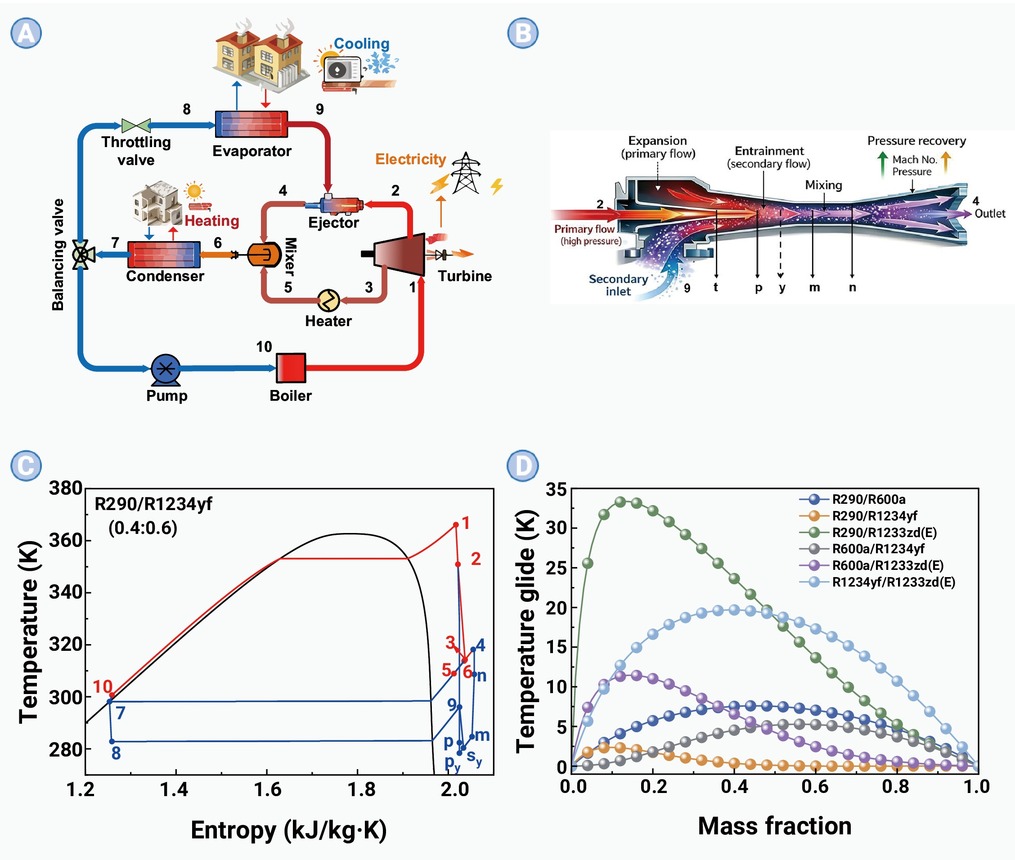
Figure 1.
System parameter configuration diagram (A) Schematic of the EORC-CCHP system; (B) Structure diagram of the ejector; (C) T-s diagram of R290/R1234yf; (D) Temperature glide of different refrigerant mixtures.
-
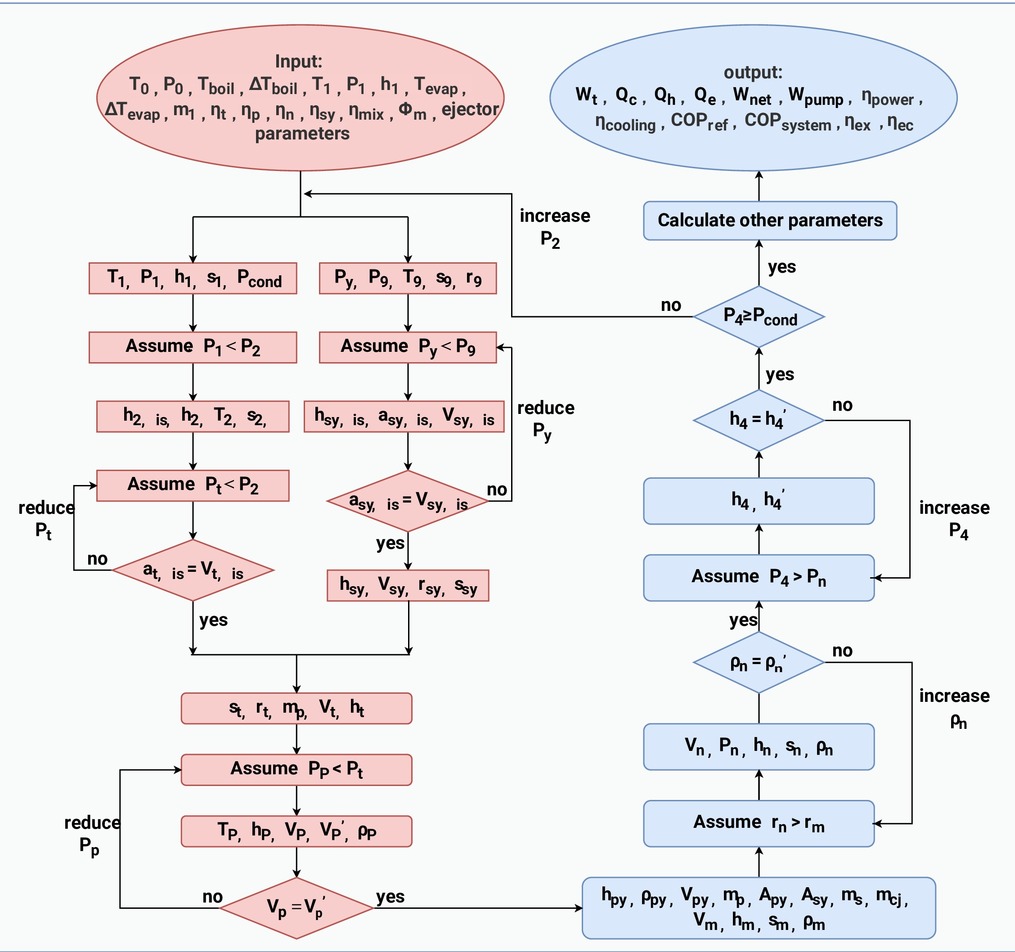
Figure 2.
Schematic diagram of the EORC-CCHP system modeling process.
-
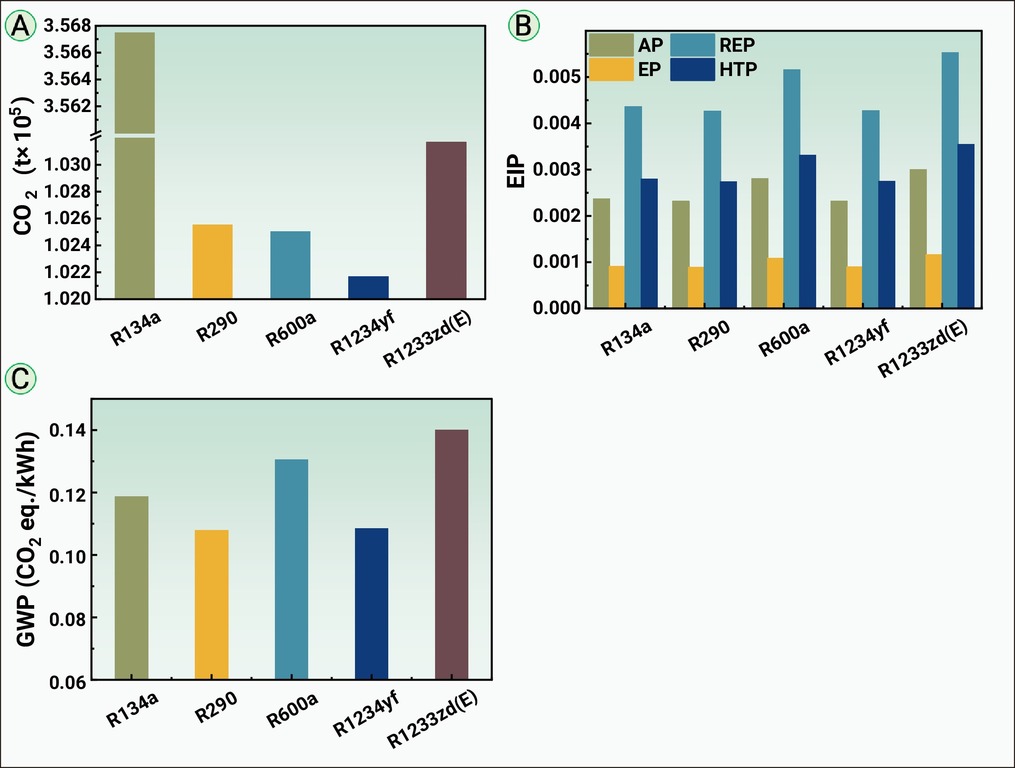
Figure 3.
Environmental impact assessment of refrigerants (A) comparison of TEWI, (B) EIP and (C) GWP.
-
Figure 4.
Effect of refrigerant composition on (A) power efficiency, (B) cooling efficiency, (C) exergy efficiency, (D) economic efficiency, (E) COPref and (F) COPsys and (G) TOPSIS analysis.
-
Figure 5.
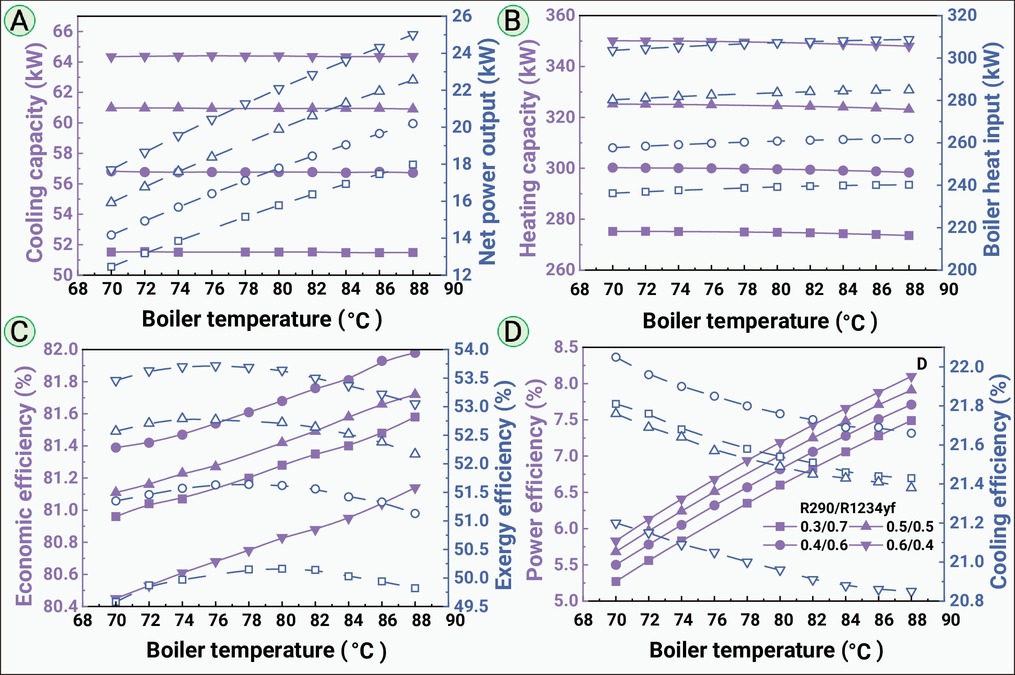
Effect of boiler temperature on the (A) cooling capacity and net power output, (B) heating capacity and boiler heat input, (C) economic efficiency and exergy efficiency, and (D) power efficiency and cooling efficiency.
-
Figure 6.
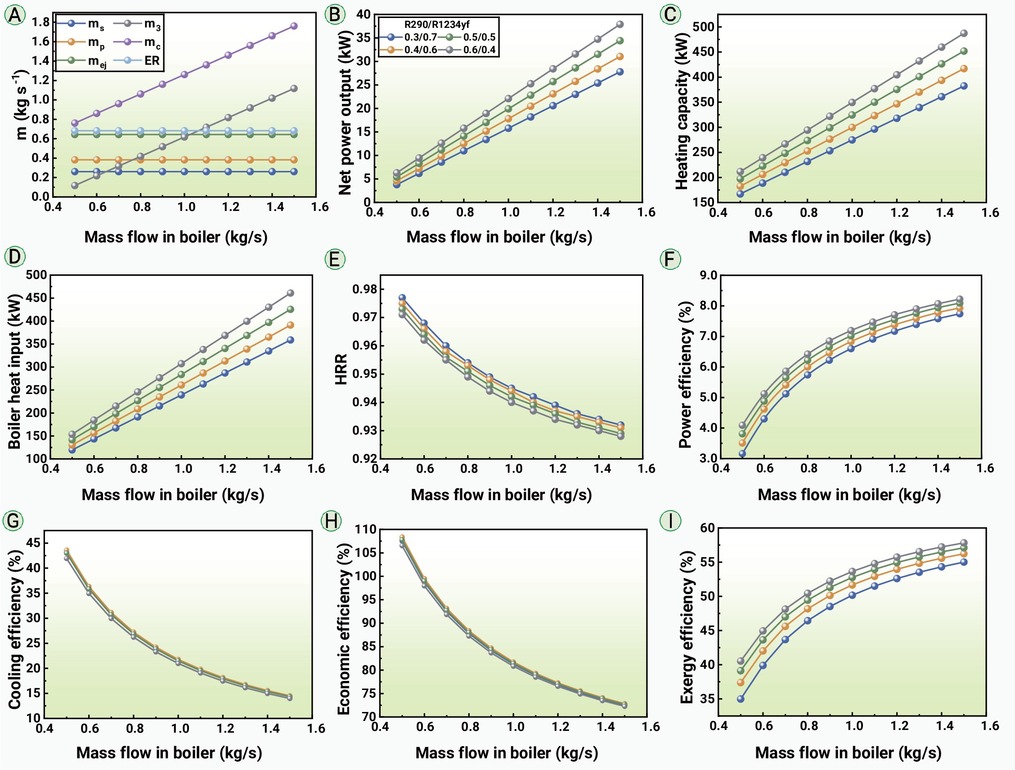
Influence of mass flow in the boiler on different parameters of the system.
-
Figure 7.
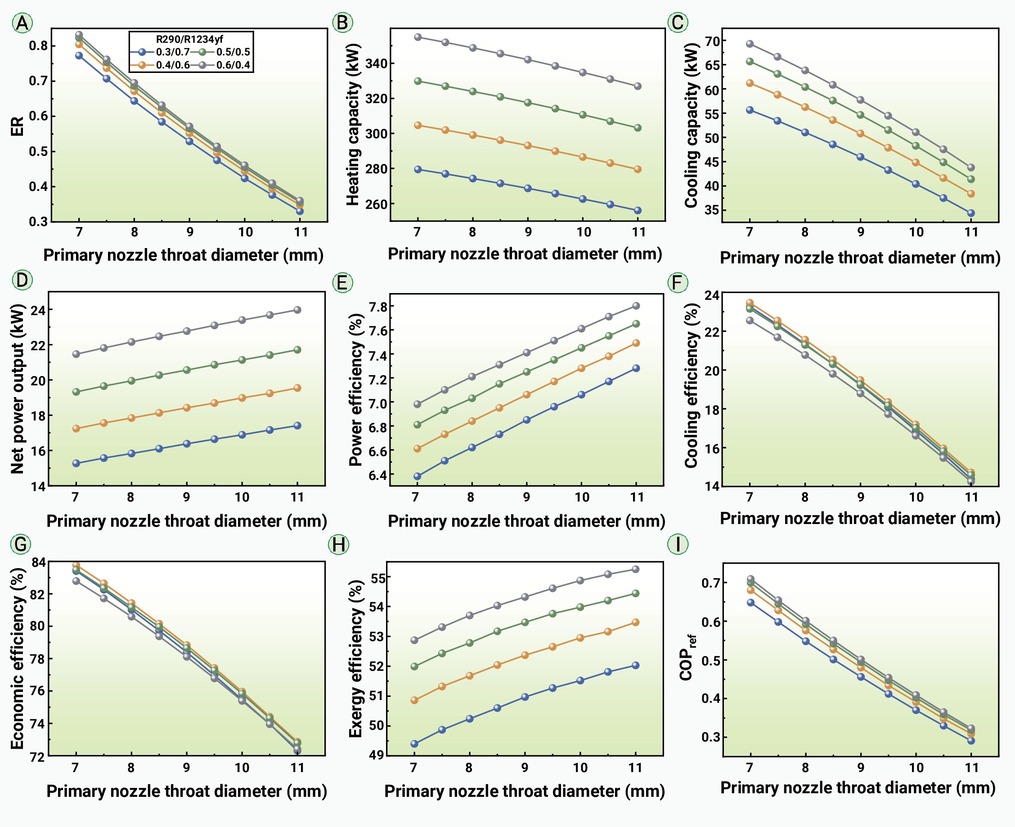
Influence of the throat diameter of the main nozzle on different parameters of the system.
-
Figure 8.
Exergy destruction proportion of each system component.