
Optimizing Urban Morphology for Net-Zero Energy Districts: A Data-Driven Planning Framework
-
GRAPHICAL ABSTRACT
 DownLoad:
Full size image
DownLoad:
Full size image
-
PUBLIC SUMMARY
-
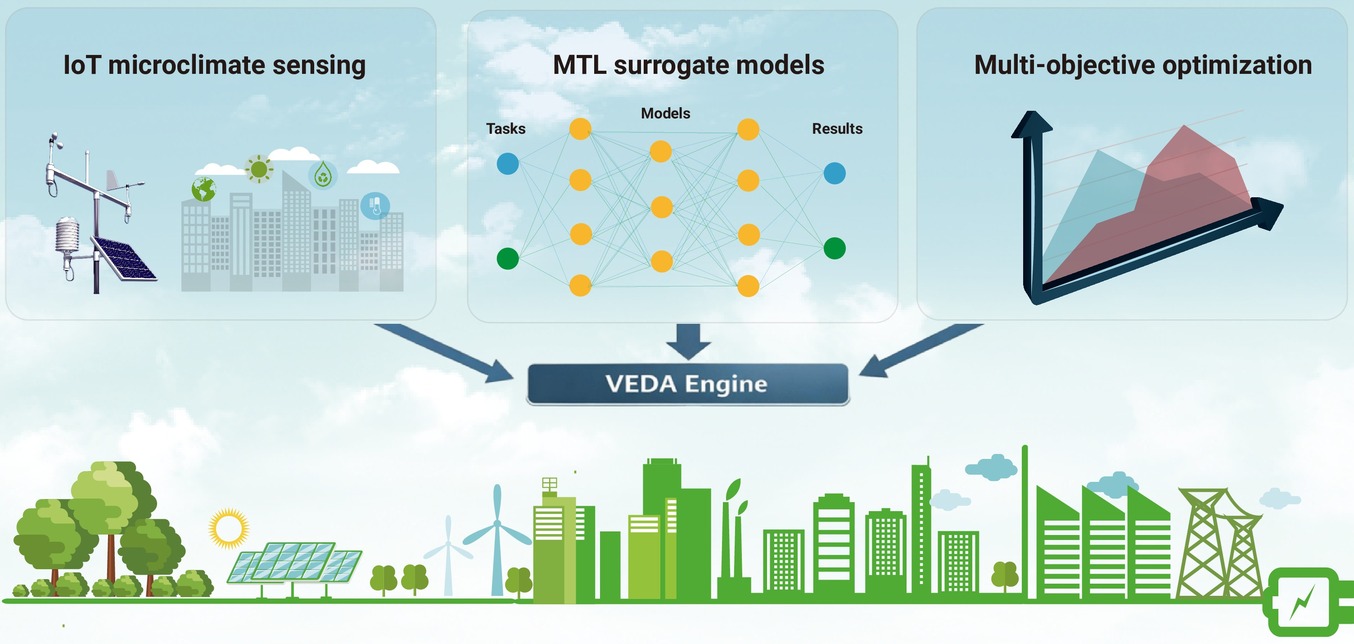
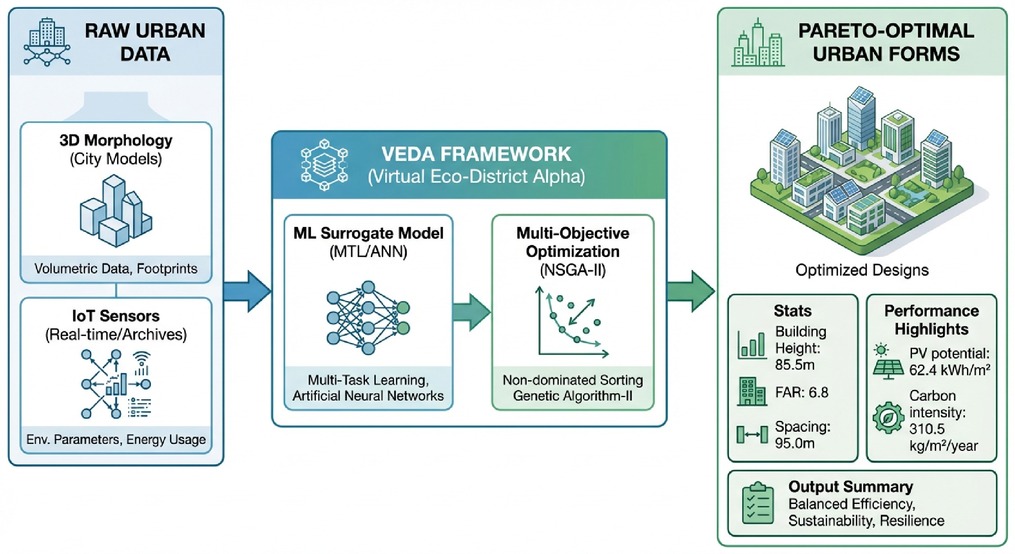
Introduced the Virtual Eco-District Alpha (VEDA) framework, integrating IoT microclimatic sensing, MTL surrogate models, and multi-objective optimization to optimize NZEDs.
Evaluated the VEDA framework on a high-density testbed, resolving the conflict between building density and renewable penetration.
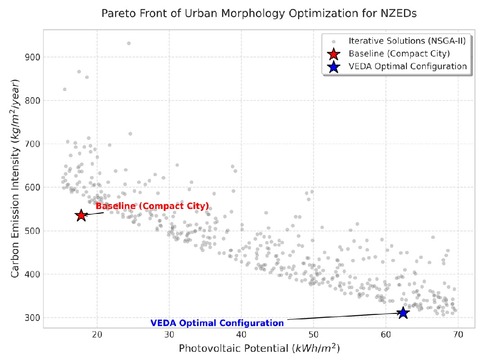
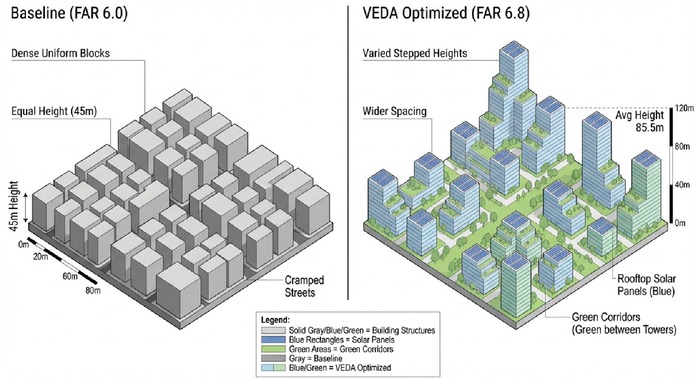
Optimized morphology with a building height of 85.5m, FAR of 6.8, photovoltaic potential of 62.4 kWh/m², and reduced carbon intensity to 310.5 kg/m²/year.
VEDA provides a scalable decision-support system for urban planners to navigate net-zero transition challenges in complex metropolitan environments.
-
-
ABSTRACT
The transition to carbon neutrality requires a shift from singular building-level interventions to systemic Net-Zero Energy Districts (NZEDs). However, optimizing urban morphology for such districts is frequently hindered by simulation-driven paradigms that rely on static meteorological assumptions and fail to resolve the high-density renewable potential. This paper introduces the Virtual Eco-District Alpha (VEDA) framework, a truly data-driven paradigm integrating IoT microclimatic sensing, multi-task learning (MTL) surrogate models, and multi-objective optimization. We evaluate the framework using a high-density testbed, demonstrating that the VEDA engine identifies Pareto-optimal configurations that resolve the conflict between building density and renewable penetration. Our results reveal an optimized morphology with a building height of 85.5 m and a floor area ratio (FAR) of 6.8, achieving a photovoltaic potential of 62.4 kWh/m2 and a carbon intensity reduction to 310.5 kg/m2/year. The framework provides a scalable decision-support system for urban planners seeking to navigate the structural boundaries of net-zero transition in complex metropolitan environments. -

-
REFERENCES
[1] Abdulrahman H.A., Shen J., Smith J.M., et al. (2025). A Data-Driven Smart District Toward Net Zero Using Generative Design and Urban Digital Twins: A Use Case of Nihonbashi, Tokyo. Int. Arch. Photogram. Remote Sen. Spatial Inform. Sci. XLVIII-4/W16-2025:1–8. DOI:10.5194/isprs-archives-xlviii-4-w16-2025-1-2025 [2] Bian C., Hu P., Li C., et al. (2025). Balancing Solar Energy, Thermal Comfort, and Emissions: A Data-Driven Urban Morphology Optimization Approach. Energies 18:3421. DOI:10.3390/en18133421 [3] Bibri S. (2021). Eco-Districts and Data-Driven Smart Eco-Cities: Emerging Approaches to Strategic Planning by Design and Spatial Scaling and Evaluation by Technology. Land Use Policy (ahead of print). DOI:10.1016/j.landusepol.2021.105830 [4] Charan T. Mackey V.C., Irani A., et al. (2021). Integration of Open-Source URBANopt and Dragonfly Energy Modeling Capabilities into Practitioner Workflows for District-Scale Planning and Design. Energies 14:5931. DOI:10.3390/en14185931 [5] Komninos N. (2022). Net Zero Energy Districts: Connected Intelligence for Carbon-Neutral Cities. Land 11:210. DOI:10.3390/land11020210 [6] Li F., Schell K., Yang H., et al. (2022). Infomorphism: An Urban Planning Framework for Local Renewable Energy Integration. ASHRAE/IBPSA-USA Build. Simul. Conf. DOI:10.26868/25746308.2022.c024 [7] Liu K., Xu X., Huang W., et al. (2023). A Multi-Objective Optimization Framework for Designing Urban Block Forms Considering Daylight, Energy Consumption, and Photovoltaic Energy Potential. Build. Environ. (ahead of print). DOI:10.1016/j.buildenv.2023.110585 [8] Liu K., Xu X., Zhang R., et al. (2022). Impact of Urban Form on Building Energy Consumption and Solar Energy Potential: A Case Study of Residential Blocks in Jianhu, China. Energy Build. (ahead of print). DOI:10.1016/j.enbuild.2022.112727 [9] Samadzadegan B., Abolhassani S.S., Dabirian S., et al. (2021). Novel Energy System Design Workflow for Zero-Carbon Energy District Development. Front. Sustain. Cities (ahead of print). DOI:10.3389/frsc.2021.662822 -
ABOUT THIS ARTICLE
Cite this article:
Wang D., Zhou Y., Zheng X., et al. (2026). Optimizing Urban Morphology for Net-Zero Energy Districts: A Data-Driven Planning Framework. Energy Use 2:100040. https://doi.org/10.59717/ipj.energy-use.2026.100040
Welcome!
To request copyright permission to republish or share portions of our works, please visit Copyright Clearance Center's (CCC) Marketplace website at marketplace.copyright.com.
Export File
Citation
Wang D., Zhou Y., Zheng X., et al. (2026). Optimizing Urban Morphology for Net-Zero Energy Districts: A Data-Driven Planning Framework. Energy Use 2:100040. https://doi.org/10.59717/ipj.energy-use.2026.100040

Format
Content
-
Figure 1.
The VEDA (Virtual Eco-District Alpha) Planning Framework: Integrating IoT-calibrated microclimatic sensing, multi-task surrogate modeling, and multi-objective NSGA-II optimization for Net-Zero Energy Districts.
-
Figure 2.
Pareto frontier of the NSGA-II optimization, illustrating the trade-off between photovoltaic generation and carbon emission intensity for high-density urban morphologies.
-
Figure 3.
Isometric architectural comparison between the uniform compact city baseline and the VEDA-optimized eco-district, highlighting stepped height variations, widened spacing, and integrated green infrastructure.
-
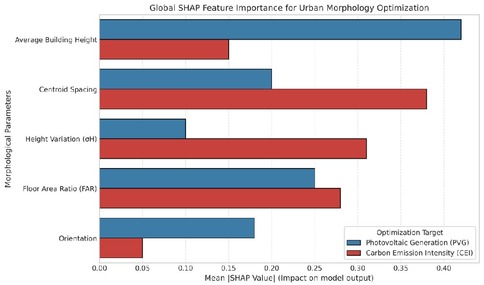
Figure 4.
Global SHAP feature importance evaluating the varying impact weights of morphological parameters on Photovoltaic Generation (PVG) and Carbon Emission Intensity (CEI).