
Accelerating net-zero future via fluid dynamics and chemical kinetics
-
ABSTRACT
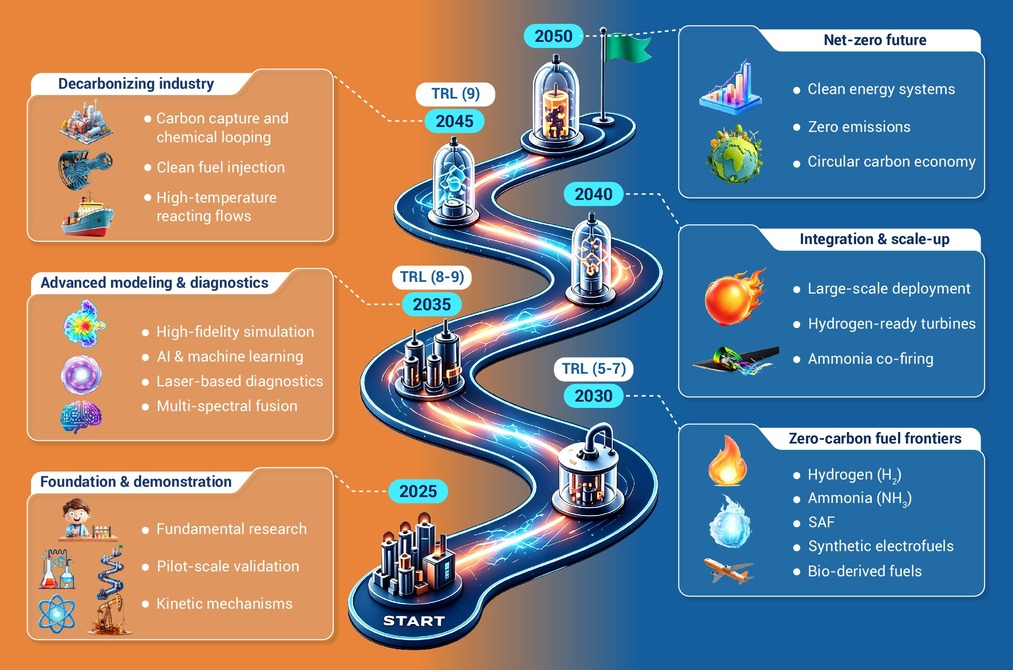
The transition toward net-zero emissions requires a fundamental transformation of chemically reacting flow systems across energy generation, transportation, and industrial sectors. Conventional fossil-fuel combustion has supported global industrialization for more than a century. However, its associated greenhouse gas emissions, pollutant formation, and resources depletion have intensified the urgency for sustainable alternatives. This roadmap presents an integrated perspective on the role of fluid dynamics, combustion chemistry, advanced diagnostics, and intelligent modeling in enabling the low-carbon energy transition. Particular emphasis is placed on hydrogen, ammonia and sustainable aviation fuels as emerging energy carriers capable of supporting deep decarbonization pathways. It further discusses how high-fidelity simulations, laser diagnostics, and machine learning are revolutionizing the knowledge and control of reactive flow under realistic operational circumstances. In contrast to these, scalable industrial decarbonization solutions like carbon capture, chemical looping combustion, and oxygen-carrier technologies are also discussed for the reduction of emissions from hard-to-abate sectors. A comprehensive path connecting basic kinetics, multiscale transport phenomena, digital intelligence and industrial implementation from 2025 to 2050 was proposed. The net-zero future will not only depend on alternate clean fuels, but also on developments in turbulence-chemistry interaction, reaction mechanism development, reactor design, and integrated system optimization. The study presented is consistent with the net-zero objective and indicates key research priorities essential to achieve dependable, economically viable, and ecologically sustainable reacting-flow systems. -

-
REFERENCES
[1] Kohse-Höinghaus K. (2023). Combustion, chemistry, and carbon neutrality. Chem. Rev. 123:5139−5219. DOI:10.1021/acs.chemrev.2c00828 [2] Wang Z., He S., Li Y. and Li S. (2026). Carbon capture using chemical absorption: Absorbent intergenerational evolution, process innovation, and large-scale application. The Innovation 7:101250. DOI:10.1016/j.xinn.2025.101250 [3] Ouyang Z., Jackson R.B., Saunois M. et al. (2025). The global hydrogen budget. Nature 648:616−624. DOI:10.1038/s41586-025-09806-1 [4] MacFarlane D.R., Cherepanov P.V., Choi J., et al. (2020). A Roadmap to the ammonia economy. Joule 4:1186−1205. DOI:10.1016/j.joule.2020.04.004 [5] Mansy A.E., Daniel S., Fonzeu Monguen C.K., et al. (2025). Catalytic production of aviation jet biofuels from biomass: a review. Environ. Chem. Lett. 23:419−461. DOI:10.1007/s10311-024-01806-3 [6] Xu X., Zhang X., Zou Y., et al. (2025). Integrated carbon and nitrogen management for cost-effective environmental policies in China. Science 388:1098−1103. DOI:10.1126/science.ads4105 [7] Xia S., Yang Y. and Poon J.P.H. (2025). Ensuring a carbon-neutral future for artificial intelligence. The Innovation Energy 2:100071. DOI:10.59717/j.xinn-energy.2024.100071 [8] McJeon H. and Ou Y. (2026). Thirty-six solutions to stabilize Earth’s climate. Science 391:991−992. DOI:10.1126/science.aed5212 [9] Gomes R.J., Li J., Xu J., et al. (2026). Reactive CO2 capture via controlled amine speciation in non-aqueous electrolytes. Nat. Energy 5:756−766. DOI:10.1038/s41560-026-02035-4 [10] Liu J., Gui X., Zhou W., et al. (2026). Flame-synthesized LaMnO3 as a high-efficiency oxygen carrier for methane chemical looping combustion: Structure-activity relationship and reaction pathways. Chem. Eng. J. 534:175005. DOI:10.1016/j.cej.2026.175005 -
ABOUT THIS ARTICLE
Cite this article:
Mansy A. E. and Tian Z. (2026). Accelerating net-zero future via fluid dynamics and chemical kinetics. The Innovation Reviews 1:100007. https://doi.org/10.59717/j.tirv.2026.100007
Welcome!
To request copyright permission to republish or share portions of our works, please visit Copyright Clearance Center's (CCC) Marketplace website at marketplace.copyright.com.
Export File
Citation
Mansy A. E. and Tian Z. (2026). Accelerating net-zero future via fluid dynamics and chemical kinetics. The Innovation Reviews 1:100007. https://doi.org/10.59717/j.tirv.2026.100007

Format
Content
 DownLoad:
-
Figure 1.
Roadmap to accelerate net-zero emissions with fluid dynamics, chemical kinetics, and intelligent reacting-flow technologies, 2025–2050
