
Tissue-specific cancer evolution: Deciphering deterministic rules to shape precision medicine
-

-
REFERENCES
[1] Mueller, S., de Andrade Krätzig, N., Tschurtschenthaler, M., et al. (2026). A disease model resource reveals core principles of tissue-specific cancer evolution. Nature. DOI: 10.1038/s41586-026-10187-2. [2] Juul, N.H., Yoon, J.K., Martinez, M.C., et al. (2023). KRAS(G12D) drives lepidic adenocarcinoma through stem-cell reprogramming. Nature 619(7971):860−867. DOI:10.1038/s41586-023-06324-w [3] Costa, B., Fletcher, M.N.C., Boskovic, P., et al. (2021). A Set of Cell Lines Derived from a Genetic Murine Glioblastoma Model Recapitulates Molecular and Morphological Characteristics of Human Tumors. Cancers (Basel) 13(2). DOI: 10.3390/cancers13020230. -
ABOUT THIS ARTICLE
Cite this article:
Chen Y. and Yang C. (2026). Tissue-specific cancer evolution: Deciphering deterministic rules to shape precision medicine. The Innovation Drug Discovery 1:100014. https://doi.org/10.59717/j.xinn-drugdisc.2026.100014
Welcome!
To request copyright permission to republish or share portions of our works, please visit Copyright Clearance Center's (CCC) Marketplace website at marketplace.copyright.com.
Export File
Citation
Chen Y. and Yang C. (2026). Tissue-specific cancer evolution: Deciphering deterministic rules to shape precision medicine. The Innovation Drug Discovery 1:100014. https://doi.org/10.59717/j.xinn-drugdisc.2026.100014

Format
Content
 DownLoad:
-
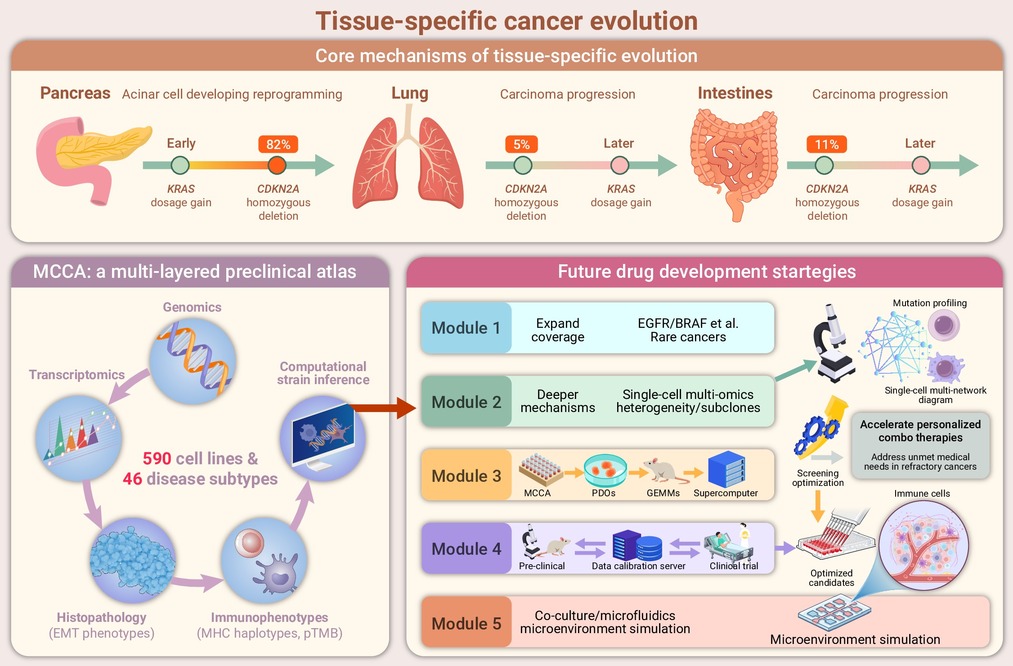
Figure 1.
A framework for tissue-specific cancer evolution and drug development based on the MCCA
