
Decoding the PTEN paradox: Non-canonical PI3Kβ signaling opens new therapeutic avenues
-

-
REFERENCES
[1] Jia S., Liu Z., Zhang S., et al. (2008). Essential roles of PI(3)K–p110β in cell growth, metabolism and tumorigenesis. Nature 454:776−779. DOI:10.1038/nature07091 [2] Bergholz J. S., Wang Q., Wang Q., et al. (2023). PI3Kβ controls immune evasion in PTEN-deficient breast tumours. Nature 617:139−146. DOI:10.1038/s41586-023-05940-w [3] Tang S., Zhou Q., Bergholz J. S., et al. (2026). PTEN Loss Promotes PI3Kβ Phosphorylation and EPHA2/SRC/p-PI3KβY962 Complex Assembly to Drive Tumorigenesis. Cancer Discovery 16:521−540. DOI:10.1158/2159-8290.Cd-25-1126 [4] Klebba J. E., Roy N., Bernard S. M., et al. (2025). Covalent inhibitors of the PI3Kα RAS binding domain impair tumor growth driven by RAS and HER2. Science 390:702−709. DOI:10.1126/science.adv2684 [5] He X., Chen D., Liu G., et al. (2025). PI3Kβ functions as a protein kinase to promote cellular protein O-GlcNAcylation and acetyl-CoA production for tumor growth. Molecular Cell 85:1411−1425.e1418. DOI:10.1016/j.molcel.2025.02.024 -
ABOUT THIS ARTICLE
Cite this article:
Zhang J., Wang J., Li K., et al. (2026). Decoding the PTEN paradox: Non-canonical PI3Kβ signaling opens new therapeutic avenues. The Innovation Drug Discovery 1:100015. https://doi.org/10.59717/j.xinn-drugdisc.2026.100015
Welcome!
To request copyright permission to republish or share portions of our works, please visit Copyright Clearance Center's (CCC) Marketplace website at marketplace.copyright.com.
Export File
Citation
Zhang J., Wang J., Li K., et al. (2026). Decoding the PTEN paradox: Non-canonical PI3Kβ signaling opens new therapeutic avenues. The Innovation Drug Discovery 1:100015. https://doi.org/10.59717/j.xinn-drugdisc.2026.100015

Format
Content
 DownLoad:
-
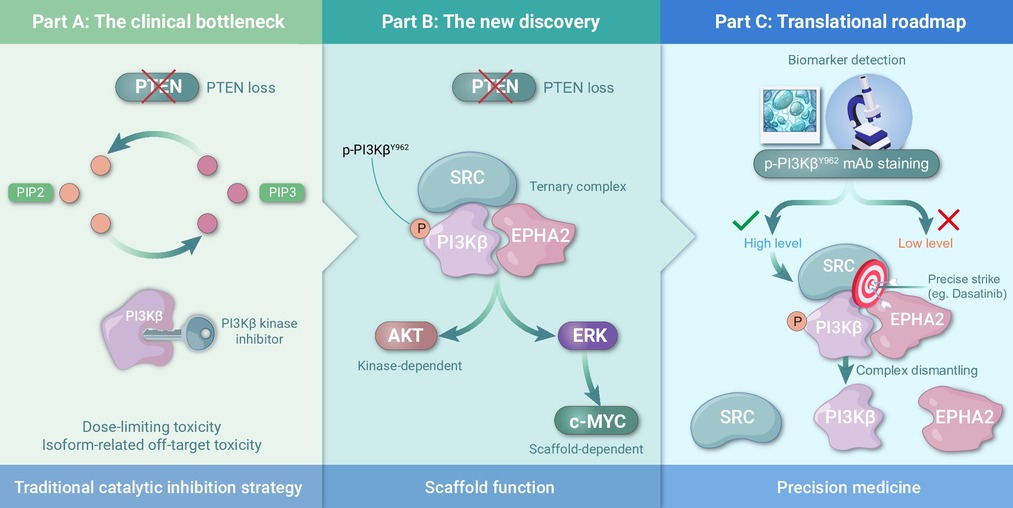
Figure 1.
From PI3Kβ kinase activity blockade to state-selective PI3Kβ inhibition in PTEN-deficient tumors
