
A thermoacoustically-driven liquid metal magnetohydrodynamic generation system with a thermal efficiency of 11%
-
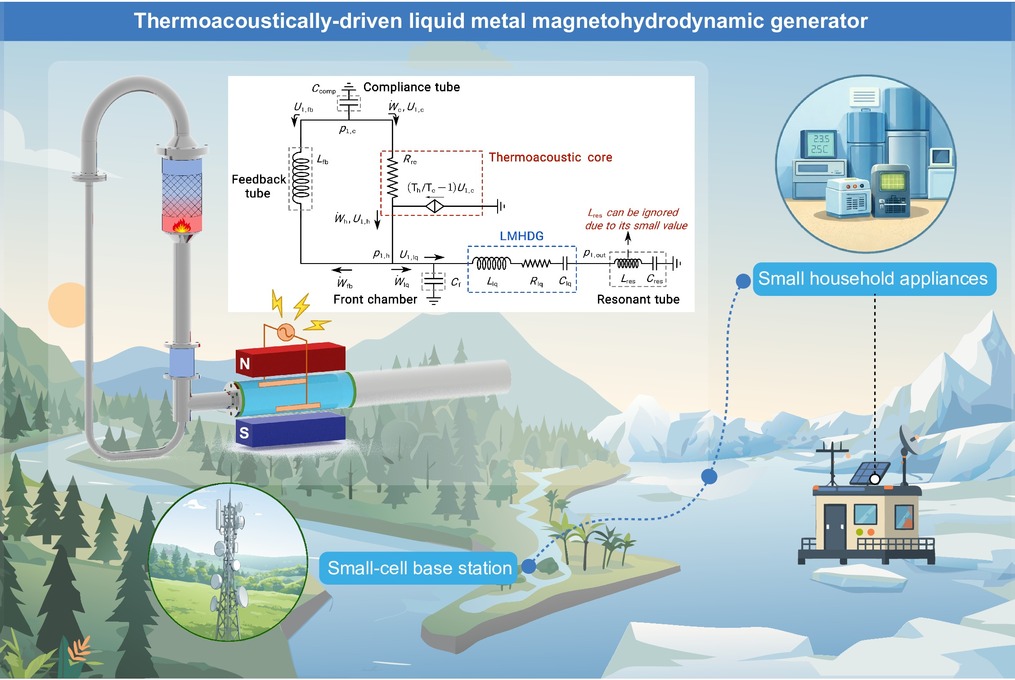
GRAPHICAL ABSTRACT
 DownLoad:
Full size image
DownLoad:
Full size image
-
PUBLIC SUMMARY
-
Developed an efficient thermoacoustic generator with high reliability due to the absence of mechanical moving components.
Achieved a record thermal efficiency of 11.0%.
This efficiency improves almost one order of magnitude compared to previously reported values, exceeding that of typical thermoelectric generators.
-
-
ABSTRACT
Thermoacoustically-driven liquid metal magnetohydrodynamic generator (TLMHDG) is promising for reliable power generation, but its potential is limited by poor thermal efficiency due to improper acoustic matching. Here we developed an efficient TLMHDG by integrating a liquid metal magnetohydrodynamic generator into the linear gaseous resonator of a Backhaus-Swift engine, where the acoustic field is relatively robust. In experiments, a thermal efficiency of 11.0% and an average electrical power output of 13.5 W are achieved, at a heating temperature of 885 K. These results show an improvement of almost one order of magnitude in thermal efficiency and a onefold increase in power output compared to previously reported. This work underscores the potential of TLMHDG for efficient and reliable power generation. -

-
REFERENCES
[1] Muser T., Krymova E., Morabito A., et al. (2025). Fatigue damage reduction in hydropower startups with machine learning. Nat. Commun. 16. DOI:10.1038/s41467-025-58229-z [2] Omidi M., Liu S.-J., Mohtaram S., et al. (2019). Improving Centrifugal Compressor Performance by Optimizing the Design of Impellers Using Genetic Algorithm and Computational Fluid Dynamics Methods. Sustainability. 11. DOI: 10.3390/su11195409 [3] Zhu J., Shen X., Ding J., et al. (2024). Revealing the phonon properties for thermoelectric materials by neutron scattering. Innov. Energy 1:100049. DOI:10.59717/j.xinn-energy.2024.100049 [4] Che L., Li N., Wei W., et al. (2025). Day-Night energy harvesting: Photovoltaics-driven moisture evaporation and absorption for simultaneous 24-hour power and dehumidification. Innov. Energy 2:100078. DOI:10.59717/j.xinn-energy.2025.100078 [5] Tang H., Liang Y., Liu C., et al. (2022). A solution-processed n-type conducting polymer with ultrahigh conductivity. Nature 611:271−277. DOI:10.1038/s41586-022-05295-8 [6] Shi X., Song S., Gao G., et al. (2024). Global band convergence design for high-performance thermoelectric power generation in Zintls. Science 384:757−762. DOI. DOI:10.1126/science.adn7265 [7] Liu X., Chen H., Huang J., et al. (2023). High-performance thermomagnetic generator controlled by a magnetocaloric switch. Nat. Commun. 14. DOI:10.1038/s41467-023-40634-x [8] Shen J., Huang X., Dai Y., et al. (2024). N-type and P-type series integrated hydrogel thermoelectric cells for low-grade heat harvesting. Nat. Commun. 15. DOI:10.1038/s41467-024-53660-0 [9] Campbell M. F., Celenza T. J., Schmitt F., et al. (2021). Progress Toward High Power Output in Thermionic Energy Converters. Adv. Sci. 8. DOI:10.1002/advs.202003812 [10] LaPotin A., Schulte K. L., Steiner M. A., et al. (2022). Thermophotovoltaic efficiency of 40%. Nature 604:287−291. DOI:10.1038/s41586-022-04473-y [11] Thring M. W. (1965). Magnetohydrodynamic Power Generation. Nature 208:966−967. DOI:10.1038/208966a0 [12] Li K., Li C., Mohtaram S., et al. (2025). Experimental and numerical study on scroll compressor under different profile correction and discharge ports shapes. Int. J. Refrig. 169:241−253. DOI:10.1016/j.ijrefrig.2024.10.007 [13] Omidi M., Mohtaram S. and Omidi A. (2021). Simulation-based Design Optimization of Centrifugal Compressor, Using Computational Fluid Dynamics Methods. Academia Lett. 767. DOI:10.20935/AL767 [14] Harada N., Kizuka N., Okamura T., et al. (1995). Improvement of enthalpy extraction over 30% using a disk MHD generator with inlet swirl. Energy Convers. Manage. 36:355−364. DOI:10.1016/0196-8904(95)98900-8 [15] Harada N. and Tsunoda K. (1998). Study of a disk MHD generator for nonequilibrium plasma generator (NPG) system. Energy Convers. Manage. 39:493−503. DOI:10.1016/s0196-8904(96)00232-4 [16] Omidi M., Liu Y., Mohtaram S., et al. (2022). Investigating on performance parameters and flow field of centrifugal compressor based on the splitter blade leading edge’s location effect. J. Mech. Sci. Technol. 36:4015−4020. DOI:10.1007/s12206-022-0722-5 [17] Li K., Hu J., Li C., et al. (2024). Refined one-dimensional modeling and experimental validation of scroll compressor with vapor injection for electric vehicles. Int. J. Refrig. 168:469−483. DOI:10.1016/j.ijrefrig.2024.09.007 [18] Sawhney B. K. and Verma S. S. (1989). Suitability of Indian coal for coal-fired MHD generators. IEEE Trans. Plasma Sci. 17:839−840. DOI:10.1109/27.41214 [19] Mohtaram S., Chen W., Zargar T., et al. (2017). Energy-exergy analysis of compressor pressure ratio effects on thermodynamic performance of ammonia water combined cycle. Energy Convers. Manage. 134:77−87. DOI:10.1016/j.enconman.2016.12.024 [20] Wang T. C. and Dudzinsky S. J. (1967). Theoretical and experimental study of a liquid metal MHD induction generator. AIAA Journal 5:107−112. DOI:10.2514/3.3915 [21] Sense K. A. and Gelb G. H. (1967). Cycle analyses for liquid-metal power conversion systems using a bifluid MHD GENERATOR. AIAA Journal 5:1818−1822. DOI:10.2514/3.4310 [22] Peng Y., Lin Z., Zhao L., et al. (2008). Analysis of Liquid Metal MHD Wave Energy Direct Conversion System. The Eighteenth International Offshore and Polar Engineering Conference. [23] Liu B., Li J., Peng Y., et al. (2015). Experimental and numerical investigation of Magnetohydrodynamic generator for wave energy. JOWE 2:21−27. [24] Domínguez-Lozoya J. C., Cuevas S., Domínguez D. R., et al. (2021). Laboratory Characterization of a Liquid Metal MHD Generator for Ocean Wave Energy Conversion. Sustainability 13. DOI:10.3390/su13094641 [25] Swift G. W. (1988). A liquid-metal magnetohydrodynamic acoustic transducer. J. Acoust Soc. Am. 83:350−361. DOI:10.1121/1.396445 [26] Zhu S., Wang T., Jiang C., et al. (2023). Experimental and numerical study of a liquid metal magnetohydrodynamic generator for thermoacoustic power generation. Appl. Energy 348:121453. DOI:10.1016/j.apenergy.2023.121453 [27] Huang J., Yang R., Yang Y., et al. (2023). Generalized thermoacoustic heat engines with unconventional working substances: A review. Appl. Energy 347:121447. DOI:10.1016/j.apenergy.2023.121447 [28] Xiao L., Luo K., Wu Z., et al. (2024). Sustainable heat-driven sound cooler with super-high efficiency. Innov. Energy 1:100027. DOI:10.59717/j.xinn-energy.2024.100027 [29] Swift G. W., Migliori A., Hofler T., et al. (1985). Theory and calculations for an intrinsically irreversible acoustic prime mover using liquid sodium as primary working fluid. J. Acoust Soc. Am. 78:767−781. DOI:10.1121/1.392447 [30] Migliori A. and Swift G. W. (1988). Liquid-sodium thermoacoustic engine. Appl. Phys. Lett. 53:355−357. DOI:10.1063/1.99913 [31] Garrett S. L. and Gabrielson T. B. (1991). Magnetohydrodynamic and Thermoacoustic Mechanisms for Generation of Sound in Seawater. In B.F. Hamonic, J.-N. Decarpigny, and O.B. Wilson, eds. Power Transducers for Sonics and Ultrasonics. (Springer Berlin Heidelberg), pp: 162–177. [32] Zhu S., Yu G., Jiang C., et al. (2022). A novel thermoacoustically-driven liquid metal magnetohydrodynamic generator for future space power applications. Energy Convers. Manage. 258:115503. DOI:10.1016/j.enconman.2022.115503 [33] Mohtaram S., Wu W., Aryanfar Y., et al. (2022). Introducing and assessment of a new wind and solar-based diversified energy production system intergrading single-effect absorption refrigeration, ORC, and SRC cycles. Renew. Energy 199:179−191. DOI:10.1016/j.renene.2022.08.069 [34] Li X., Mohtaram S., Keçebaş A., et al. (2025). Thermodynamic analysis and optimization of an optimized geothermal-driven quadruple-production system for sustainable power, heat, freshwater, and hydrogen production. Renew. Energy 245:122847. DOI:10.1016/j.renene.2025.122847 [35] European Commission. (2014). Final report summary - MEGAHIT (megawatt highly efficient technologies for space power and propulsion systems for long-duration exploration missions). https://cordis.europa.eu/project/id/313096/reporting/es [36] Brekis A., Freibergs J., Gailītis A., et al. (2017). New Experimental Results from Testing "Space Trips" Facility of Thermoacoustic System Coupled with Magnetohydrodynamic Generator. VIII International Scientific Colloquium "Modelling for Materials Processing". [37] Brekis A., Alemany A., Alemany O., et al. (2021). Space Thermoacoustic Radioisotopic Power System, SpaceTRIPS: The Magnetohydrodynamic Generator. Sustainability 13. DOI:10.3390/su132313498 [38] Elakrout O., Ghriss O., Bouabidi A., et al. (2024). Investigative analysis of the influence of diverse fin configurations on the performance of a dual pass solar air collector. Therm. Sci. Eng. Prog. 50:102545. DOI:10.1016/j.tsep.2024.102545 [39] Mohtaram S., Sun Y., Sun H., et al. (2021). A comprehensive design, optimization and development methodology of a wasted heat recovery boiler using serrated fins and extensive surface in a bulky CCPP. Case. Stud. Therm. Eng. 23:100808. DOI:10.1016/j.csite.2020.100808 [40] Backhaus S. and Swift G. W. (1999). A thermoacoustic Stirling heat engine. Nature 399:335−338. DOI:10.1038/20624 [41] Backhaus S. and Swift G. W. (2000). A thermoacoustic-Stirling heat engine: Detailed study. J. Acoust Soc. Am. 107:3148−3166. DOI:10.1121/1.429343 [42] Tang K., Lei T., Jin T., et al. (2009). A standing-wave thermoacoustic engine with gas-liquid coupling oscillation. Appl. Phys. Lett. 94:254101. DOI:10.1063/1.3157920 [43] Swift, G.W. (2017). Thermoacoustics: A Unifying Perspective for Some Engines and Refrigerators. Springer. DOI:10.1007/978-3-319-66933-5 [44] Wang H., Zhang L., Yu G., et al. (2019). A looped heat-driven thermoacoustic refrigeration system with direct-coupling configuration for room temperature cooling. Sci. Bull. 64:8−10. DOI:10.1016/j.scib.2018.12.007 [45] Jiang C., Wang T., Zhu S., et al. (2023). A method to optimize the external magnetic field to suppress the end current in liquid metal magnetohydrodynamic generators. Energy 282:128251. DOI:10.1016/j.energy.2023.128251 [46] Yang R., Wang J., Wu Z., et al. (2023). Performance analysis of thermoacoustic plasma MHD generation. Energy 263:125647. DOI:10.1016/j.energy.2022.125647 [47] Tijani M. E. H. and Spoelstra S. (2011). A high performance thermoacoustic engine. J. Appl. Phys. 110:093519. DOI:10.1063/1.3658872 [48] Wang K., Sun D., Zhang J., et al. (2016). An acoustically matched traveling-wave thermoacoustic generator achieving 750 W electric power. Energy 103:313−321. DOI:10.1016/j.energy.2016.03.001 [49] Blanc N., Yang R., Ramon G. Z., et al. (2023). Thermoacoustic engines with near-critical working fluids. Appl. Therm. Eng. 231:120845. DOI:10.1016/j.applthermaleng.2023.120845 [50] Brekis A. (2019). Space Thermo Acoustic Radio-Isotopic Power System: Space TRIPS. MHD 55:5−14. DOI:10.22364/mhd.55.1-2.1 [51] Datas A. and Martí A. (2017). Thermophotovoltaic energy in space applications: Review and future potential. Sol. Energy Mater. Sol. Cells 161:285−296. DOI:10.1016/j.solmat.2016.12.007 [52] Jia B., Wu D., Xie L., et al. (2024). Pseudo-nanostructure and trapped-hole release induce high thermoelectric performance in PbTe. Science 384:81−86. DOI:10.1126/science.adj8175 -
ABOUT THIS ARTICLE
Cite this article:
Chen H., Yang Y., Wu T., et al. (2026). A thermoacoustically-driven liquid metal magnetohydrodynamic generation system with a thermal efficiency of 11%. The Innovation Energy 3:100139. https://doi.org/10.59717/j.xinn-energy.2026.100139
Welcome!
To request copyright permission to republish or share portions of our works, please visit Copyright Clearance Center's (CCC) Marketplace website at marketplace.copyright.com.
Article Metrics
Relative Articles
Cited by
Export File
Citation
Chen H., Yang Y., Wu T., et al. (2026). A thermoacoustically-driven liquid metal magnetohydrodynamic generation system with a thermal efficiency of 11%. The Innovation Energy 3:100139. https://doi.org/10.59717/j.xinn-energy.2026.100139

Format
Content
-
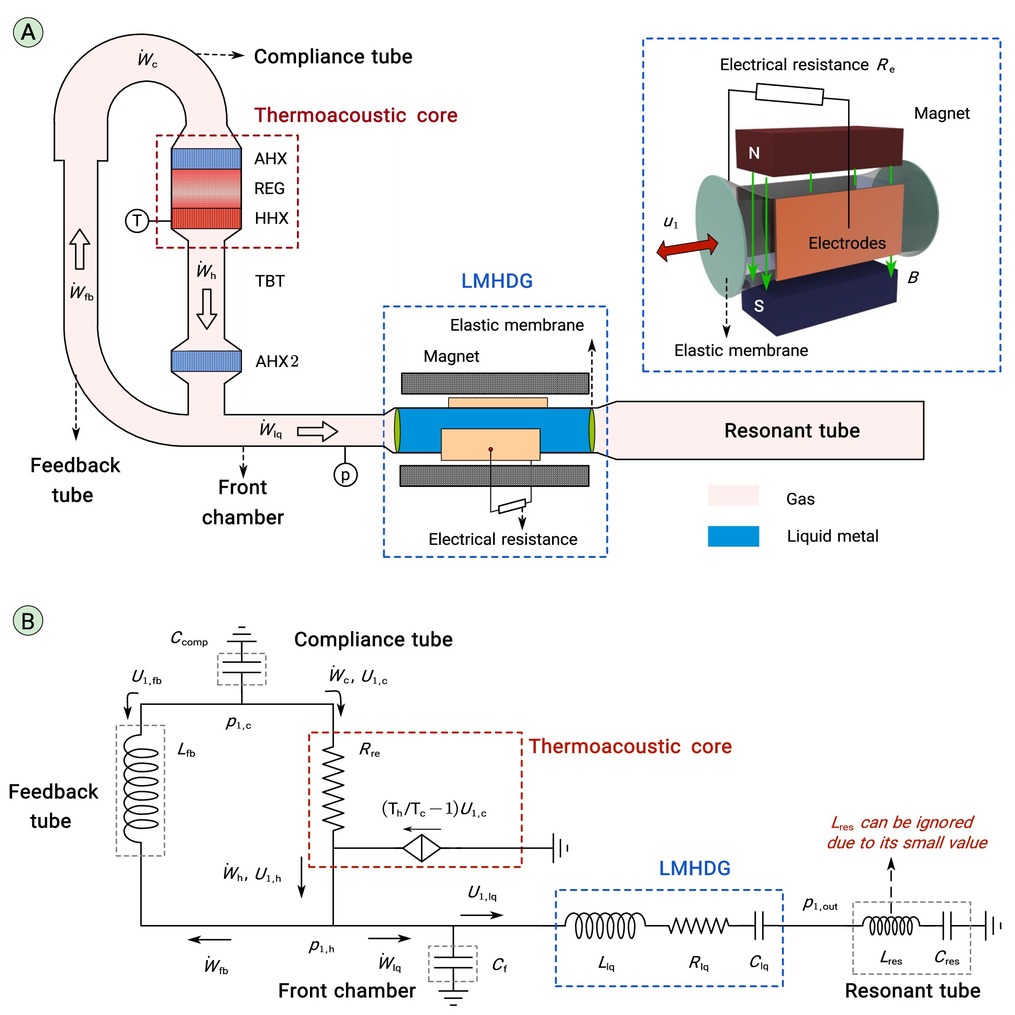
Figure 1.
(A) System structure of the TLMHDG. T-type K thermocouple, p-pressure sensor, AHX-ambient heat exchanger, REG-regenerator, HHX-hot heat exchanger, TBT-thermal buffer tube, AHX2-secondary ambient heat exchanger. (B) Diagram of the lumped-element model of the TLMHDG.
$ \dot{\boldsymbol{W}} $ -
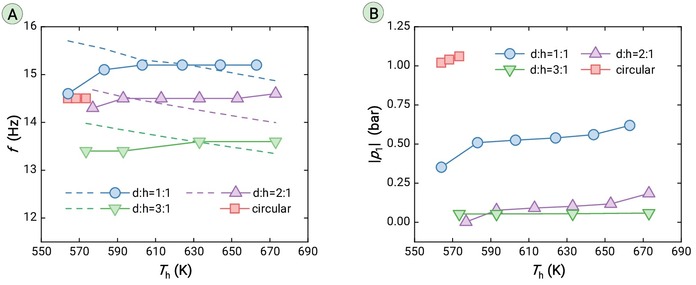
Figure 2.
The effects of the cross section of the liquid metal channel on (A) Resonant frequency f and (B) Pressure amplitude ∣p1∣, where the dashed lines indicate calculated results, while the dots correspond to experimental data. pm=2.0 MPa.
-
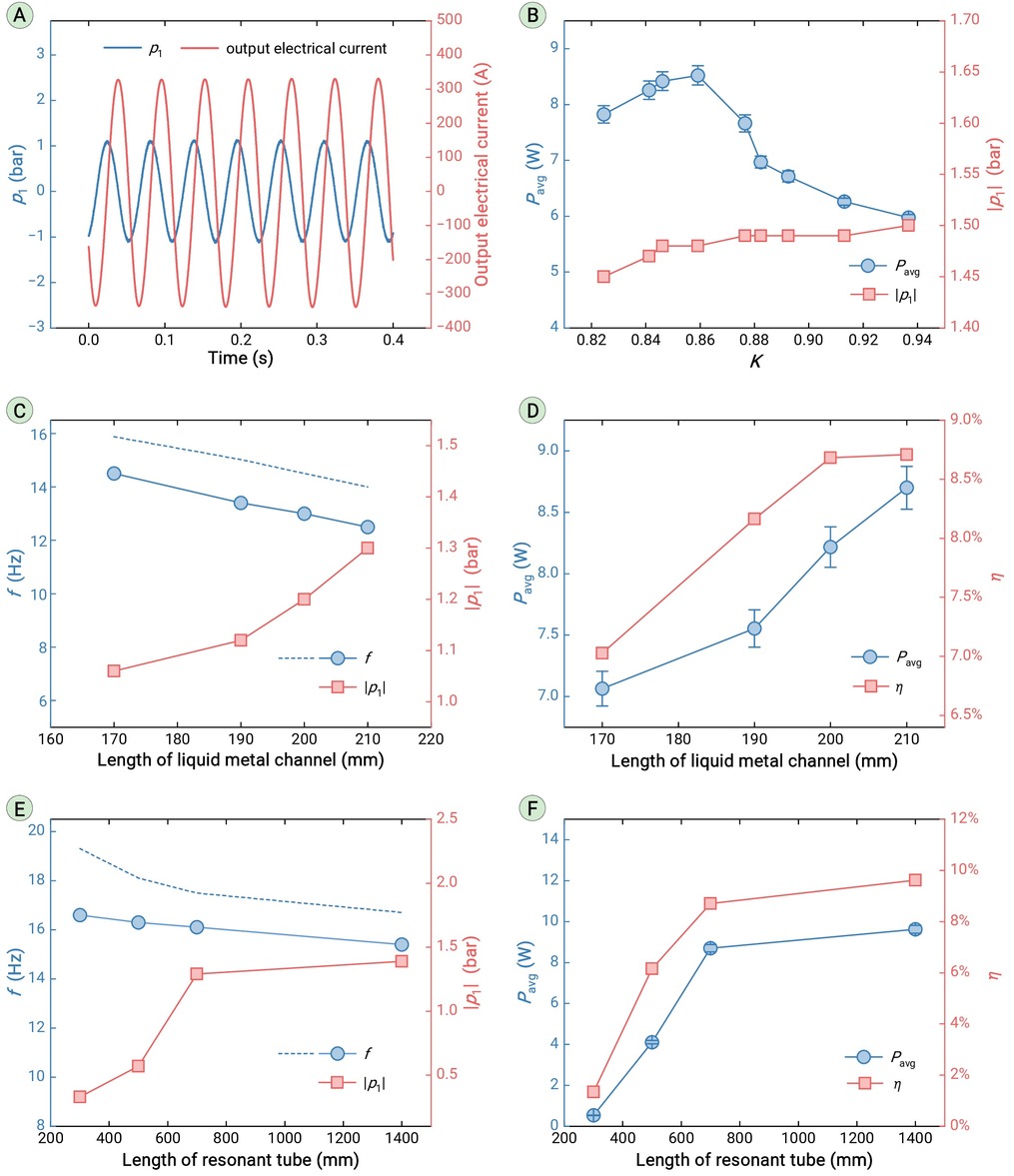
Figure 3.
Output characteristics of TLMHDG
-
Figure 4.
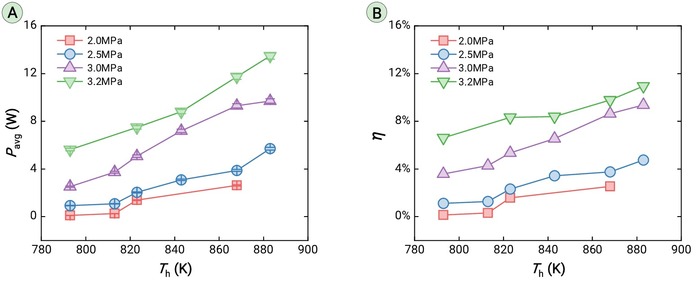
The effects of the mean pressure on (A) Average electrical power output Pavg; (B) Thermal efficiency η , where the length of liquid metal channel is 210 mm and the length of resonant tube is
1400 mm, with K being optimized for highest Pavg. -
Figure 5.
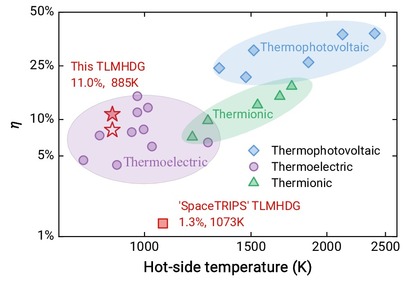
Comparison of thermal efficiency η of TLMHDG in this study with the typical efficiencies of other no-moving-parts technologies, where the solid pentagram is the thermal efficiency when both the heat leakage of the thermal insulation material and internal heat conduction are ignored, while the hollow pentagram is the thermal efficiency when only the heat leakage of the thermal insulation material is ignored. See Heat leakage analysis and Table S5 in the Supplementary Information for detailed derivation.
