
An integrated elastocaloric refrigerator for subzero operation at −60 °C
-
GRAPHICAL ABSTRACT
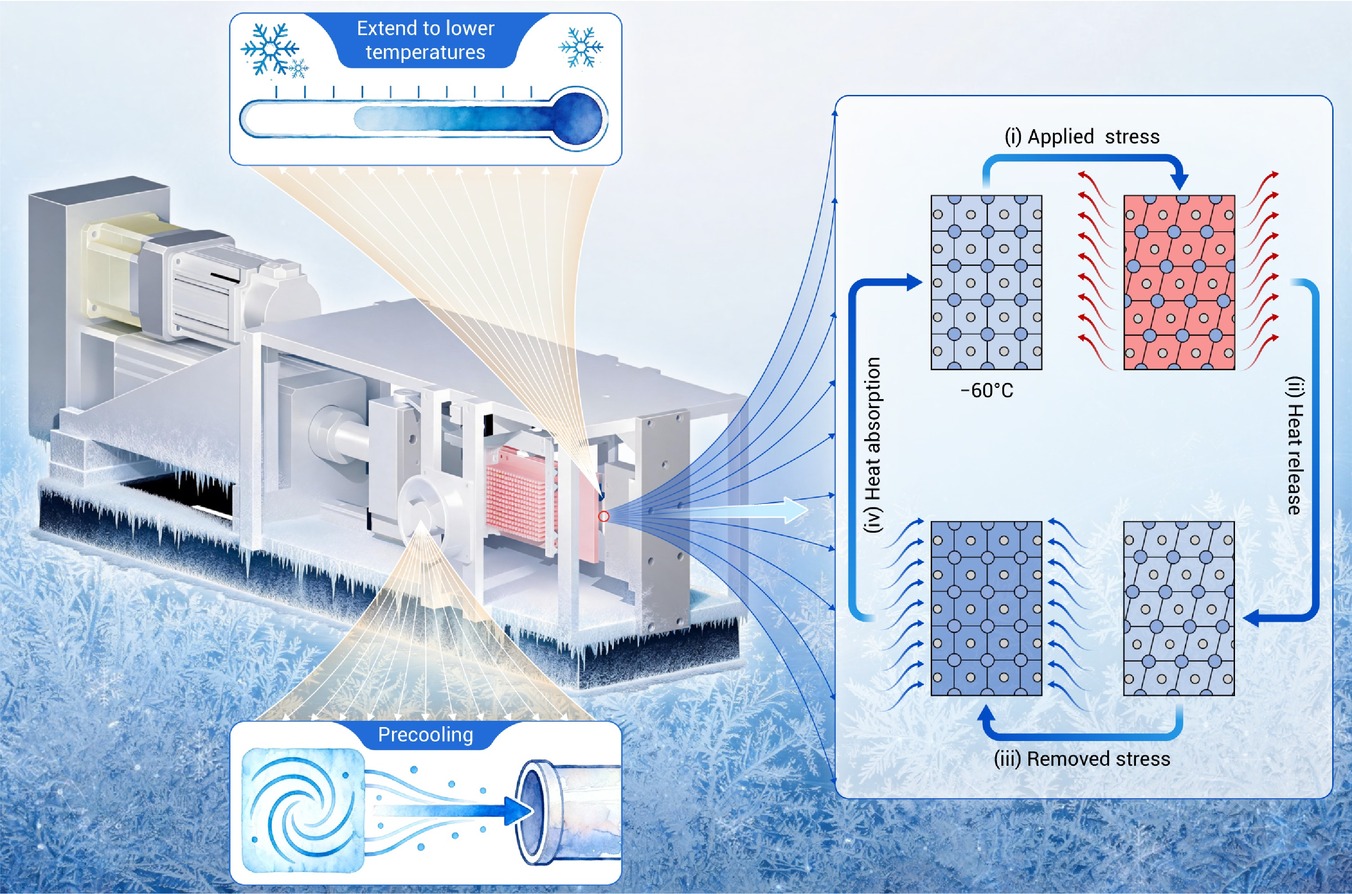
 DownLoad:
Full size image
DownLoad:
Full size image
-
PUBLIC SUMMARY
-
The first elastocaloric refrigerator capable of stable operation at −60 °C is developed.
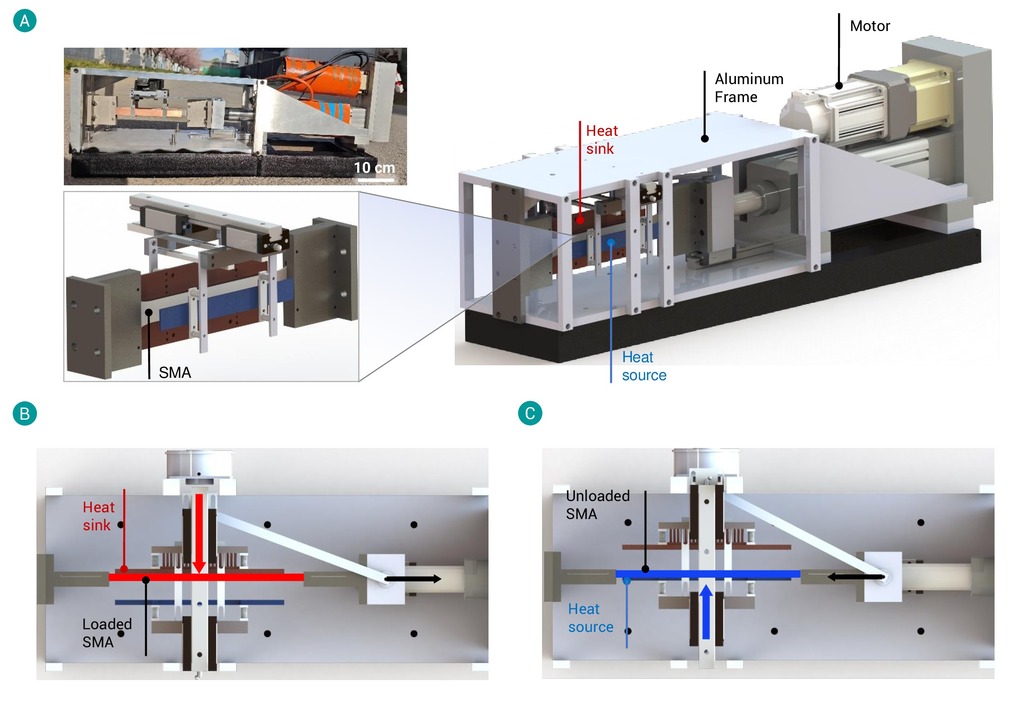
A compact refrigeration architecture is proposed by integrating a single power source, a linkage mechanism, and solid–solid contact heat transfer.
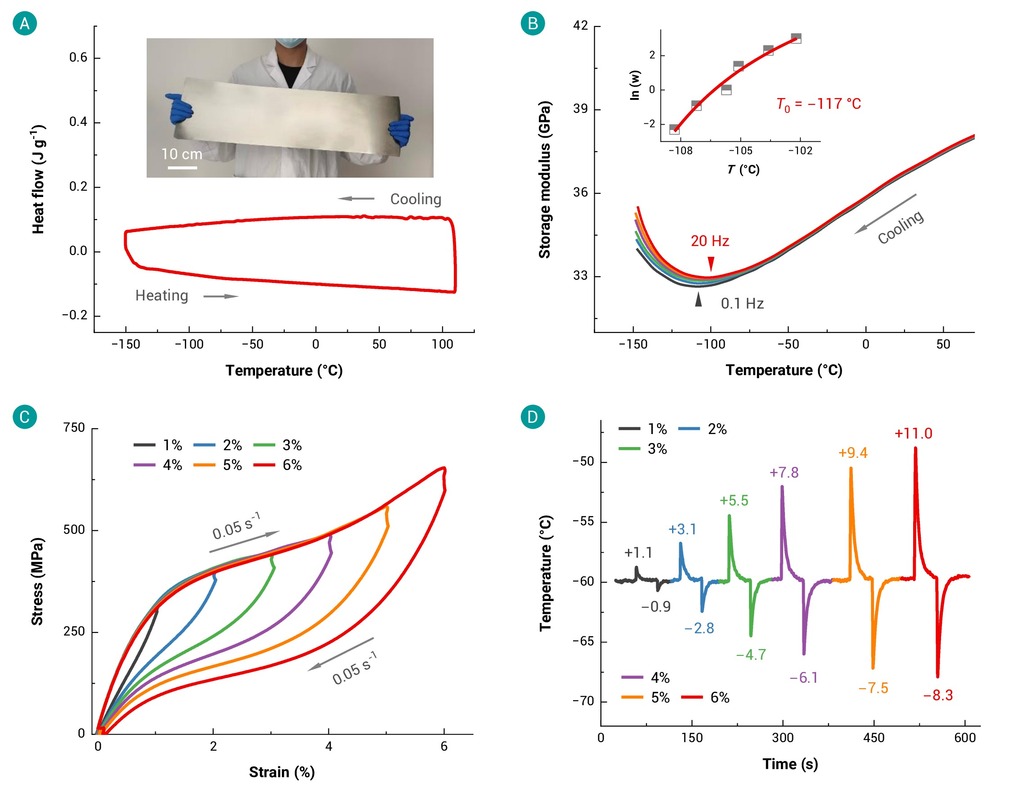
A TiNiCuNb shape-memory alloy tailored for low-temperature superelasticity and elastocaloric response enables efficient subzero cooling.
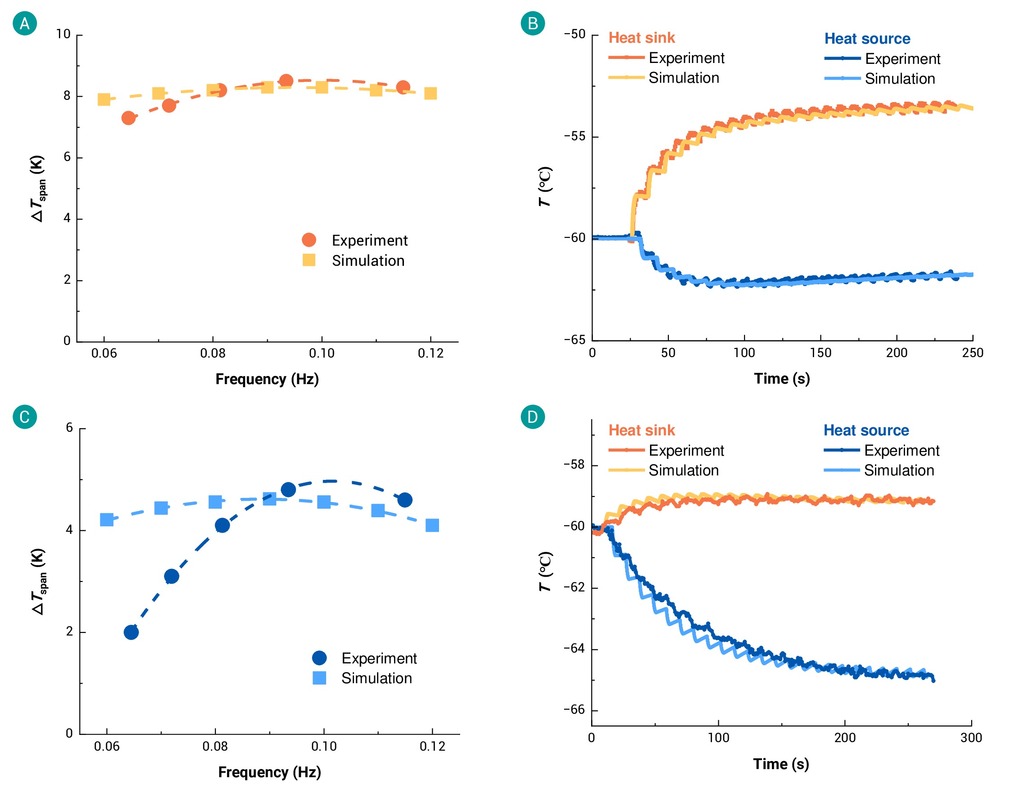
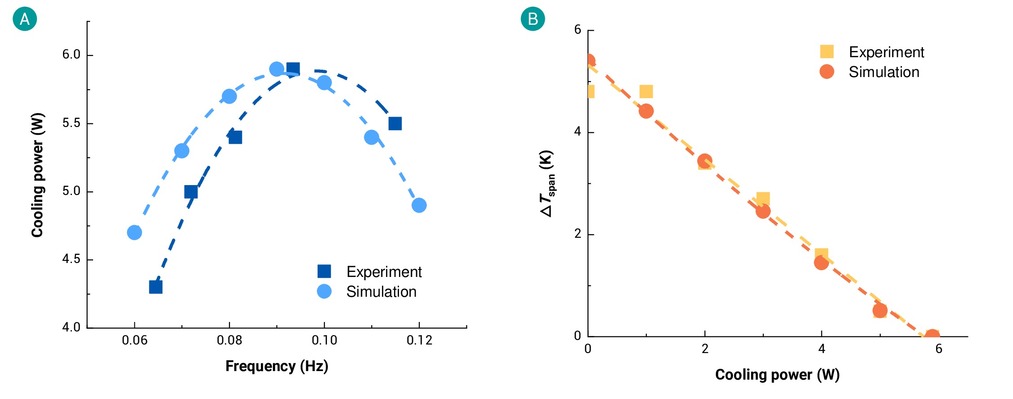
The refrigerator achieves a maximum temperature span of 8.5 K, a maximum pull-down temperature of 4.8 K, and a maximum cooling power of 5.9 W.
This work demonstrates the feasibility of elastocaloric refrigeration in a precooled low-temperature regime.
-
-
ABSTRACT
Elastocaloric cooling is considered a leading alternative to traditional vapor-compression refrigeration. While current research has primarily focused on room-temperature applications, elastocaloric technology holds significant potential for low-temperature solid-state refrigeration. This study develops the first elastocaloric refrigerator operating below −60 °C. The refrigerator features a compact design driven by a single power source that manages the loading and unloading of shape memory alloy ribbon. A synchronized linkage mechanism regulates contact between the ribbon and the heat source/sink, facilitating efficient solid–solid contact heat transfer. By employing a TiNiCuNb quaternary alloy specifically designed for low-temperature superelasticity and elastocaloric response, with the ambient environment precooled from room temperature to −60 °C in an environmental simulation chamber, the system achieves a temperature span of 8.5 K under adiabatic conditions and a pull-down temperature of 4.8 K when rejecting heat at −60 °C, with a maximum cooling power of 5.9 W at zero temperature span. These mechanical innovations demonstrate the viability of elastocaloric cooling at low temperatures, offering valuable insights for future advancements in elastocaloric refrigeration technology.-
Keywords:
- Solid-state cooling /
- Elastocaloric /
- Refrigeration /
- Shape-memory alloy /
- Integrated structure.
-

-
REFERENCES
[1] Abas N., Kalair A. R., Khan N., et al. (2018). Natural and synthetic refrigerants, global warming: A review. Renewable and Sustainable Energy Reviews 90:557–569. DOI:https://doi.org/10.1016/j.rser.2018.03.099 [2] Esper J., Torbenson M. and Büntgen U. (2024). 2023 summer warmth unparalleled over the past 2,000 years. Nature 631:94−97. DOI:10.1038/s41586-024-07512-y [3] Garimella S., Lockyear K., Pharis D., et al. (2022). Realistic pathways to decarbonization of building energy systems. Joule 6:956–971. DOI:https://doi.org/10.1016/j.joule.2022.04.003 [4] Ghaddar N., Kishore R. A., Menberg K., et al. (2024). Sustainable cooling solutions. One Earth 7:1315–1319. DOI:https://doi.org/10.1016/j.oneear.2024.07.018 [5] Greco A., Aprea C., Maiorino A., et al. (2019). A review of the state of the art of solid-state caloric cooling processes at room-temperature before 2019. International Journal of Refrigeration 106:66–88. DOI:https://doi.org/10.1016/j.ijrefrig.2019.06.034. [6] Qian S., Catalini D., Muehlbauer J., et al. (2023). High-performance multimode elastocaloric cooling system. Science 380:722−727. DOI:10.1126/science.adg7043 [7] Zhou G., Zhang L., Li Z., et al. (2025). Achieving kilowatt-scale elastocaloric cooling by a multi-cell architecture. Nature 639:87−92. DOI:10.1038/s41586-024-08549-9 [8] Yao S., Dang P., Li Y., et al. (2024). Efficient roller-driven elastocaloric refrigerator. Nat Commun 15:7203. DOI:10.1038/s41467-024-51632-y [9] Zhou G., Li Z., Wang Q., et al. (2024). A multi-material cascade elastocaloric cooling device for large temperature lift. Nature Energy 9:862−870. DOI:10.1038/s41560-024-01537-3 [10] Wang Y., Liu Y., Xu S., et al. (2023). Towards practical elastocaloric cooling. Communications Engineering 2:79. DOI:10.1038/s44172-023-00129-5 [11] Li L., He S., Xiao F., et al. (2025). Cooling innovations: Elastocaloric shape memory alloys, manufacturing, simulation, and refrigerator. Progress in Materials Science 153:101477. DOI:https://doi.org/10.1016/j.pmatsci.2025.101477 [12] MAÑOSA L., PLANES A., VIVES E., et al. (2009). THE USE OF SHAPE-MEMORY ALLOYS FOR MECHANICAL REFRIGERATION. Functional Materials Letters 02:73−78. DOI:10.1142/s1793604709000594 [13] Ahčin Ž., Dall’Olio S., Žerovnik A., et al. (2022). High-performance cooling and heat pumping based on fatigue-resistant elastocaloric effect in compression. Joule 6:2338–2357. DOI:https://doi.org/10.1016/j.joule.2022.08.011. [14] Bachmann N., Fitger A., Maier L. M., et al. (2021). Long-term stable compressive elastocaloric cooling system with latent heat transfer. Communications Physics 4:194. DOI:10.1038/s42005-021-00697-y [15] Ianniciello L., Bartholomé K., Fitger A., et al. (2022). Long life elastocaloric regenerator operating under compression. Applied Thermal Engineering 202:117838. DOI:https://doi.org/10.1016/j.applthermaleng.2021.117838 [16] Dong X., Jiang X. and Li P. (2025). An efficient low-grade thermal energy dual-driven elastocaloric cooling system: Thermodynamic cycle analysis, economic and sustainability assessment. Energy Conversion and Management 324:119310. DOI:https://doi.org/10.1016/j.enconman.2024.119310 [17] Qian S., Wang Y., Yuan L., et al. (2019). A heat driven elastocaloric cooling system. Energy 182:881−899. DOI:10.1016/j.energy.2019.06.094 [18] Zhang J., Zhu Y., Cheng S., et al. (2022). Enhancing cooling performance of NiTi elastocaloric tube refrigerant via internal grooving. Applied Thermal Engineering 213:118657. DOI:https://doi.org/10.1016/j.applthermaleng.2022.118657. [19] Qian S., Geng Y., Wang Y., et al. (2016). Design of a hydraulically driven compressive elastocaloric cooling system. Science and Technology for the Built Environment 22:500−506. DOI:10.1080/23744731.2016.1171630 [20] Emaikwu N., Catalini D., Muehlbauer J., et al. (2023). Experimental investigation of a staggered-tube active elastocaloric regenerator. International Journal of Refrigeration 153:370–377. DOI:https://doi.org/10.1016/j.ijrefrig.2022.09.006. [21] Snodgrass R. and Erickson D. (2019). A multistage elastocaloric refrigerator and heat pump with 28 K temperature span. Scientific Reports 9:18532. DOI:10.1038/s41598-019-54411-8 [22] Sebald G., Lombardi G., Coativy G., et al. (2023). High-performance polymer-based regenerative elastocaloric cooler. Applied Thermal Engineering 223:120016. DOI:https://doi.org/10.1016/j.applthermaleng.2023.120016 [23] Zhang S., Yang Q., Li C., et al. (2022). Solid-state cooling by elastocaloric polymer with uniform chain-lengths. Nature Communications 13:9. DOI:10.1038/s41467-021-27746-y [24] Li X., Cheng S. and Sun Q. (2022). A compact NiTi elastocaloric air cooler with low force bending actuation. Applied Thermal Engineering 215:118942. DOI:https://doi.org/10.1016/j.applthermaleng.2022.118942. [25] Li X., Hua P. and Sun Q. (2023). Continuous and efficient elastocaloric air cooling by coil-bending. Nature Communications 14:7982. DOI:10.1038/s41467-023-43611-6 [26] Czernuszewicz A., Griffith L., Slaughter J., et al. (2020). Low-force compressive and tensile actuation for elastocaloric heat pumps. Applied Materials Today 19:100557. DOI:https://doi.org/10.1016/j.apmt.2020.100557 [27] Tušek J., Engelbrecht K., Eriksen D., et al. (2016). A regenerative elastocaloric heat pump. Nature Energy 1:16134. DOI:10.1038/nenergy.2016.134 [28] Engelbrecht K., Tušek J., Eriksen D., et al. (2017). A regenerative elastocaloric device: experimental results. Journal of Physics D: Applied Physics 50:424006. DOI:10.1088/1361-6463/aa8656 [29] Ossmer H., Miyazaki S. and Kohl M. (2015). Elastocaloric heat pumping using a shape memory alloy foil device. 2015 Transducers - 2015 18th International Conference on Solid-State Sensors, Actuators and Microsystems (TRANSDUCERS). [30] Bruederlin F., Ossmer H., Wendler F., et al. (2017). SMA foil-based elastocaloric cooling: from material behavior to device engineering. Journal of Physics D: Applied Physics 50:424003. DOI:10.1088/1361-6463/aa87a2 [31] Ulpiani G., Bruederlin F., Weidemann R., et al. (2020). Upscaling of SMA film-based elastocaloric cooling. Applied Thermal Engineering 180:115867. DOI:https://doi.org/10.1016/j.applthermaleng.2020.115867. [32] Schmidt M., Schütze A. and Seelecke S. (2015). Scientific test setup for investigation of shape memory alloy based elastocaloric cooling processes. International Journal of Refrigeration 54:88–97. DOI:https://doi.org/10.1016/j.ijrefrig.2015.03.001 [33] Zhou G., Li Z., Deng Z., et al. (2026). Sub-zero Celsius elastocaloric cooling via low-transition-temperature alloys. Nature 649:879−884. DOI:10.1038/s41586-025-09946-4 [34] Saeed M. Z., Contiero L., Blust S., et al. (2023). Ultra-Low-Temperature Refrigeration Systems: A Review and Performance Comparison of Refrigerants and Configurations. Energies 16:7274. DOI:10.3390/en16217274 [35] Engelbrecht K. (2019). Future prospects for elastocaloric devices. Journal of Physics: Energy 1:021001. DOI:10.1088/2515-7655/ab1573 [36] Dang P., Zhou Y., Pang J., et al. (2023). Achieving stable actuation response and elastocaloric effect in a nanocrystalline Ti50Ni40Cu10 alloy. Scripta Materialia 226:115263. DOI:https://doi.org/10.1016/j.scriptamat.2022.115263 [37] Chen Y., Wang Y., Sun W., et al. (2022). A compact elastocaloric refrigerator. The Innovation 3:100205. DOI:10.1016/j.xinn.2022.100205 [38] Lin H., Ren S., Dang P., et al. (2023). Strain glass in Ti50-x-yNi50+yNby alloys exhibiting a boson peak glassy anomaly. Scripta Materialia 224:115118. DOI:https://doi.org/10.1016/j.scriptamat.2022.115118 [39] Dang P., Ye F., Zhou Y., et al. (2022). Low-fatigue and large room-temperature elastocaloric effect in a bulk Ti49.2Ni40.8Cu10 alloy. Acta Materialia 229:117802. DOI:https://doi.org/10.1016/j.actamat.2022.117802 [40] Dang P., Chen Y., Gu W., et al. Design of a Superelastic Alloy Uniting Large Functional Response and Exceptional Cyclic Stability. Advanced Functional Materials n/a:e20629. DOI:https://doi.org/10.1002/adfm.202520629 [41] Sarkar S., Ren X. and Otsuka K. (2005). Evidence for Strain Glass in the Ferroelastic-Martensitic System Ti50-xNi50+x. Physical Review Letters 95:205702. DOI:10.1103/PhysRevLett.95.205702 [42] Wang D., Ji Y., Ren X., et al. (2022). Strain Glass State, Strain Glass Transition, and Controlled Strain Release. Annual Review of Materials Research 52:159–187. DOI:https://doi.org/10.1146/annurev-matsci-081720-091919 [43] Dang P., Zhang L., Zhou Y., et al. (2023). Cryogenic superelasticity and elastocaloric effect in a nanostructured Ti-Ni-Co alloy. Scripta Materialia 236:115638. DOI:https://doi.org/10.1016/j.scriptamat.2023.115638 [44] Tušek J., Žerovnik A., Čebron M., et al. (2018). Elastocaloric effect vs fatigue life: Exploring the durability limits of Ni-Ti plates under pre-strain conditions for elastocaloric cooling. Acta Materialia 150:295–307. DOI:https://doi.org/10.1016/j.actamat.2018.03.032 [45] Imran M. and Zhang X. (2020). Recent developments on the cyclic stability in elastocaloric materials. Materials & Design 195:109030. DOI:https://doi.org/10.1016/j.matdes.2020.109030 [46] Porenta L., Kabirifar P., Žerovnik A., et al. (2020). Thin-walled Ni-Ti tubes under compression: ideal candidates for efficient and fatigue-resistant elastocaloric cooling. Appl. Mater. Today 20:100712. DOI:10.1016/j.apmt.2020.100712 [47] Cui J., Wu Y., Muehlbauer J., et al. (2012). Demonstration of high efficiency elastocaloric cooling with large ΔT using NiTi wires. Applied Physics Letters 101. DOI:10.1063/1.4746257 -
ABOUT THIS ARTICLE
Cite this article:
Xue L., Dang P., Wang K., et al. (2026). An integrated elastocaloric refrigerator for subzero operation at −60 °C. The Innovation Energy 3:100167. https://doi.org/10.59717/j.xinn-energy.2026.100167
Welcome!
To request copyright permission to republish or share portions of our works, please visit Copyright Clearance Center's (CCC) Marketplace website at marketplace.copyright.com.
Export File
Citation
Xue L., Dang P., Wang K., et al. (2026). An integrated elastocaloric refrigerator for subzero operation at −60 °C. The Innovation Energy 3:100167. https://doi.org/10.59717/j.xinn-energy.2026.100167

Format
Content
-
Figure 1.
Schematic illustration of the low-temperature eC refrigerator
-
Figure 2.
Performance of the designed kilogram-level TiNiCuNb ribbon
-
Figure 3.
Performance of the low-temperature eC refrigerator
-
Figure 4.
Performance of the low-temperature eC refrigerator
