
An LLM-driven automated framework for carbon price factor decomposition: Design, validation, and evidence from China’s emissions trading markets
-
GRAPHICAL ABSTRACT

 DownLoad:
Full size image
-
PUBLIC SUMMARY
-
AutoCarbonVAR: LLM-driven framework automating carbon price factor decomposition via plain-language queries.
Validated on Hubei & national ETS daily data (Q4 2022–Q4 2023), matching expert analysis.
Exchange rate shocks are the largest external contributor to carbon price variance in both markets.
External factors explain only ~5.5% of variance, far below EU ETS, reflecting China's regulated coal pricing.
Results confirm framework validity and highlight market structure's role in carbon price formation.
-
-
ABSTRACT
Accurate decomposition of the factors driving carbon allowance prices is important for climate policy design and energy-sector risk management, but the standard VAR-based workflow requires a sequence of expert decisions that limits its accessibility. This paper proposes and validates AutoCarbonVAR, an LLM-driven framework that automates carbon price factor decomposition through plain-language queries. The system combines LLM-based reasoning with data preprocessing, VAR estimation, impulse response analysis, and forecast error variance decomposition to generate reproducible analytical outputs for non-specialist users. The framework is validated using daily data from two contrasting Chinese carbon markets, the Hubei pilot ETS and the national power-sector ETS, over Q4 2022–Q4 2023. Using exchange rate, energy, macroeconomic, and environmental variables, AutoCarbonVAR successfully handled mixed integration orders, selected appropriate lag structures, and produced results consistent with expert-led analysis. Empirically, exchange rate shocks emerge as the largest external contributor to carbon price variance in both markets, while environmental, energy, and macroeconomic effects differ across the Hubei and national ETS. External factors jointly explain about 5.5% of carbon price variance, well below typical EU ETS evidence, highlighting the constraining roles of regulated coal pricing and limited fuel-switching flexibility in China’s power sector. The results demonstrate both the analytical validity of the framework and the importance of market structure in shaping carbon price formation. -

-
REFERENCES
[1] Ellerman A.D. and Buchner B.K. (2007). The European Union Emissions Trading Scheme: Origins, Allocation, and Early Results. Rev. Environ. Econ. Policy 1:66−87. DOI:10.1093/reep/rem003 [2] Grubb M., Laing T., Counsell T., et al. (2011). Global carbon mechanisms: lessons and implications. Clim. Change 104:539−573. DOI:10.1007/s10584-009-9791-z [3] Zhang X., Yu R. and Karplus V.J. (2025). The development of China's national carbon market: An overview. Energy Clim. Manag. 1:9400015. DOI:10.26599/ECM.2025.9400015 [4] Feng Z.H., Wei Y.M. and Wang K. (2012). Estimating risk for the carbon market via extreme value theory: An empirical analysis of the EU ETS. Appl. Energy 99:97−98. DOI:10.1016/j.apenergy.2012.01.070 [5] Jin J., Han L., Wu L., et al. (2020). The hedging effect of green bonds on carbon market risk. Int. Rev. Financ. Anal. 71:101509. DOI:10.1016/j.irfa.2020.101509 [6] Leitao J., Ferreira J. and Santibanez-Gonzalez E. (2021). Green bonds, sustainable development and environmental policy in the European Union carbon market. Bus. Strat. Environ. 30:2077−2090. DOI:10.1002/bse.2733 [7] Alberola E., Chevallier J. and Cheze B. (2008). The EU emissions trading scheme: The effects of industrial production and CO2 emissions on carbon prices. Econ. Int. 116:93−125. DOI:10.3917/ecoi.116.0093 [8] Alberola E., Chevallier J. and Cheze B. (2009). Emissions compliance and carbon prices under the EU ETS: a country specific analysis of industrial sectors. J. Policy Model. 31:446−462. DOI:10.1016/j.jpolmod.2008.12.004 [9] Bredin D. and Muckley C. (2011). An emerging equilibrium in the EU emissions trading scheme. Energy Econ. 33:353−362. DOI:10.1016/j.eneco.2010.06.009 [10] Zhang J. (2016). Research on the dynamic relationship between China's carbon emission rights price and PMI. Price Theory Pract. 06:72–75. (In Chinese). [11] Zhao L. and Hu C. (2016). Research on influencing factors of carbon emission trading prices in China: Empirical analysis based on structural equation model. Price Theory Pract. 07:101–104. (In Chinese). [12] Zhou J., Liu Y. and Han B. (2016). Research on carbon quota price formation and its influencing factors in China: Empirical analysis based on VAR model. Econ. Theory Pract. 5:85–88. (In Chinese). [13] Ma H. and Zhao J. (2016). Empirical analysis of factors affecting carbon emission trading prices: Based on Beijing carbon emission trading data. Financ. Account. Mon. 29:22–26. (In Chinese). [14] Zeng S., Nan X., Liu C., et al. (2017). The response of the Beijing carbon emissions allowance price (BJC) to macroeconomic and energy price indices. Energy Policy 106:111−121. DOI:10.1016/j.enpol.2017.03.046 [15] Azomahou T., Laisney F. and Van P.N. (2006). Economic development and CO2 emissions: A nonparametric panel approach. J. Public Econ. 90:1347−1363. DOI:10.1016/j.jpubeco.2005.09.005 [16] Wang Z. and Hu Y. (2018). Analysis of influencing factors of carbon emission trading prices in China. Ind. Technol. Econ. 2:128−136. DOI:10.24294/jipd.v8i9.5607 [17] Lu J. (2019). Research on driving factors and management system of carbon emission trading price in China. Ph.D. Thesis, Jilin University, Changchun, China. [18] Tan X. and Wang X. (2017). Dependence changes between the carbon price and its fundamentals: A quantile regression approach. Appl. Energy 190:306−325. DOI:10.1016/j.apenergy.2016.12.116 [19] Kim H.S. and Koo W.W. (2010). Factors affecting the carbon allowance market in the US. Energy Policy 38:1879−1884. DOI:10.1016/j.enpol.2009.11.066 [20] Keppler J.H. and Mansanet-Bataller M. (2010). Causalities between CO2, electricity, and other energy variables during phase I and phase II of the EU ETS. Energy Policy 38:3329−3341. DOI:10.1016/j.enpol.2010.02.004 [21] Creti A., Jouvet P.A. and Mignon V. (2012). Carbon Price Drivers: Phase I Versus Phase II Equilibrium. Energy Econ. 34:327−334. DOI:10.1016/j.eneco.2011.11.001 [22] Guo W. (2015). Research on influencing factors of regional carbon emission rights prices in China — Based on adaptive Lasso method. China Popul. Resour. Environ. 25:305–310. (In Chinese). [23] Yi L., Yang L., Li C., et al. (2017). Research on EU carbon price influencing factors and its enlightenment to China. China Popul. Resour. Environ. 27:42–48. (In Chinese). [24] Zhou T. and Xu R. (2016). Formation and volatility characteristics of China's carbon emission trading prices — Based on data from Shenzhen carbon emission trading exchange. Financ. Dev. Res. 1:16–25. (In Chinese). [25] Zhou K. and Li Y. (2019). Influencing factors and fluctuation characteristics of China's carbon emission trading price. Physica A 524:459−474. DOI:10.1016/j.physa.2019.04.249 [26] Li F., Jiang H. and Xu Z. (2020). Influencing factors and structural breakpoints of carbon emission trading prices — Based on data from Hubei Carbon Emission Trading Exchange. J. Shandong Technol. Bus. Univ. 34:71–78. (In Chinese). [27] Fan Y. (2017). Analysis of influencing factors of carbon emission trading prices in China's carbon financial market. M.Sc. Thesis, Shanxi University of Finance and Economics, Taiyuan, China. [28] Liu J., Yang F. and Li Y. (2020). Research on long-term factors affecting carbon emission trading price fluctuations in China. Stat. Theory Pract. 03:11–16. (In Chinese). [29] Balcilar M., Demirer R., Hammoudeh S., et al. (2016). Risk spillovers across the energy and carbon markets and hedging strategies for carbon risk. Energy Econ. 54:159−172. DOI:10.1016/j.eneco.2015.11.003 [30] Lv J., Yang H. and Guo Z. (2019). Research on the impact effect of RMB exchange rate on carbon price in various regions of China: Based on VAR model. Price Mon. 06:77–84. (In Chinese). [31] Dao W. (2019). Analysis of influencing factors of China's carbon financial trading price based on VAR model. M.Sc. Thesis, Henan University, Kaifeng, China. [32] Maciejowski J. and Leonelli M. (2026). Uncovering drivers of EU carbon futures with Bayesian networks. Applied Energy 403:127034. DOI:10.1016/j.apenergy.2025.127034 [33] Chen Q. (2025). Exploring the Factors Affecting China's Carbon Trading Prices. MSc Dissertation, University of Bristol, Bristol, UK. [34] Mansanet-Bataller M., Pardo A. and Valor E. (2009). CO2 Prices, Energy and Weather. Energy J. 28:73−92. DOI:jstor.org/stable/41323110. DOI:10.2139/ssrn.913964 [35] Aatola P., Ollikainen M. and Toppinen A. (2013). Impact of the carbon price on the integrating European electricity market. Energy Policy 61:1236−1251. DOI:10.1016/j.enpol.2013.06.036 [36] Salvagnin C., Glielmo A., De Giuli M.E., et al. (2024). Investigating the price determinants of the European Emission Trading System: a non-parametric approach. Quantitative Finance 24:1529−1544. DOI:10.1080/14697688.2024.2407895 [37] Maciejowski J. and Leonelli M. (2026). Tail dependence in EU carbon markets: Graphical models of extremes for EUA futures. arXiv preprint. DOI:10.48550/arXiv.2606.17723 -
ABOUT THIS ARTICLE
Cite this article:
Ji Y., Li T. and Liu M. (2026). An LLM-driven automated framework for carbon price factor decomposition: Design, validation, and evidence from China’s emissions trading markets. The Innovation Energy 3:100188. https://doi.org/10.59717/j.xinn-energy.2026.100188
Welcome!
To request copyright permission to republish or share portions of our works, please visit Copyright Clearance Center's (CCC) Marketplace website at marketplace.copyright.com.
Export File
Citation
Ji Y., Li T. and Liu M. (2026). An LLM-driven automated framework for carbon price factor decomposition: Design, validation, and evidence from China’s emissions trading markets. The Innovation Energy 3:100188. https://doi.org/10.59717/j.xinn-energy.2026.100188

Format
Content
-
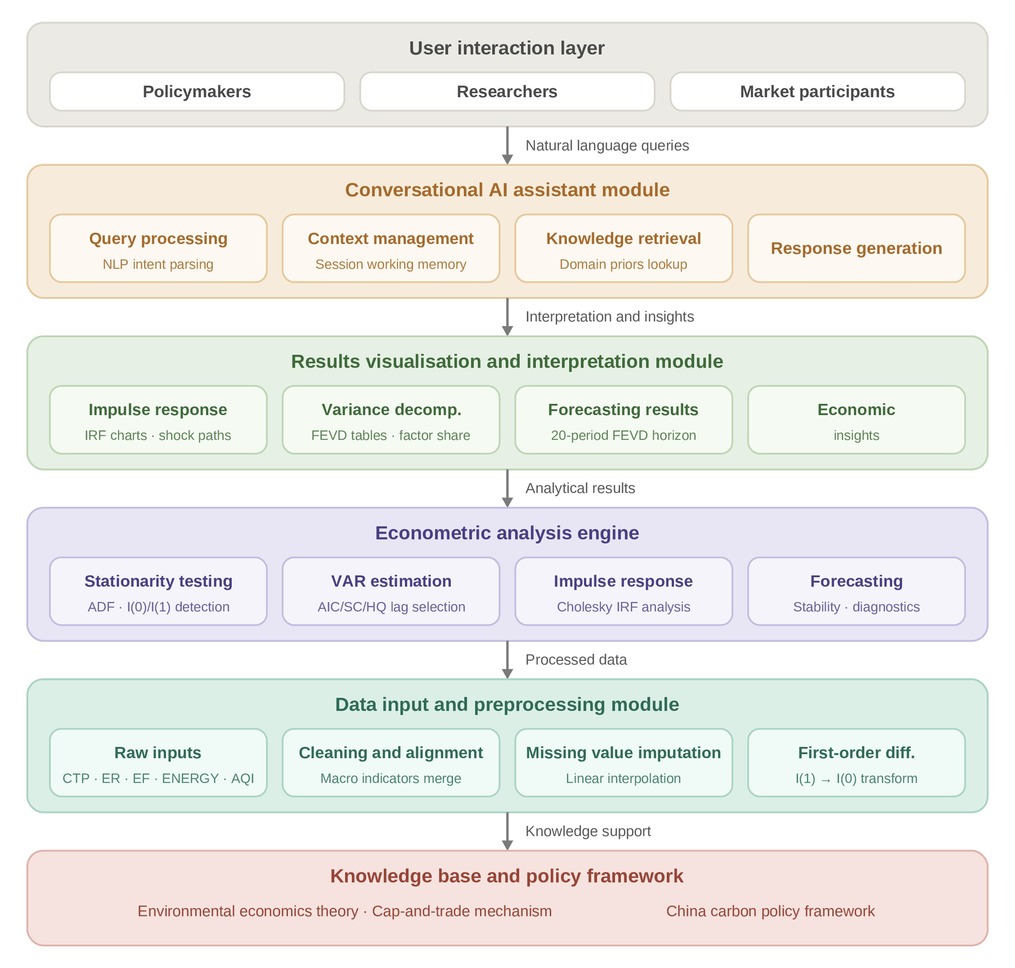
Figure 1.
Functional module architecture of the AutoCarbonVAR framework for carbon price factor analysis
-
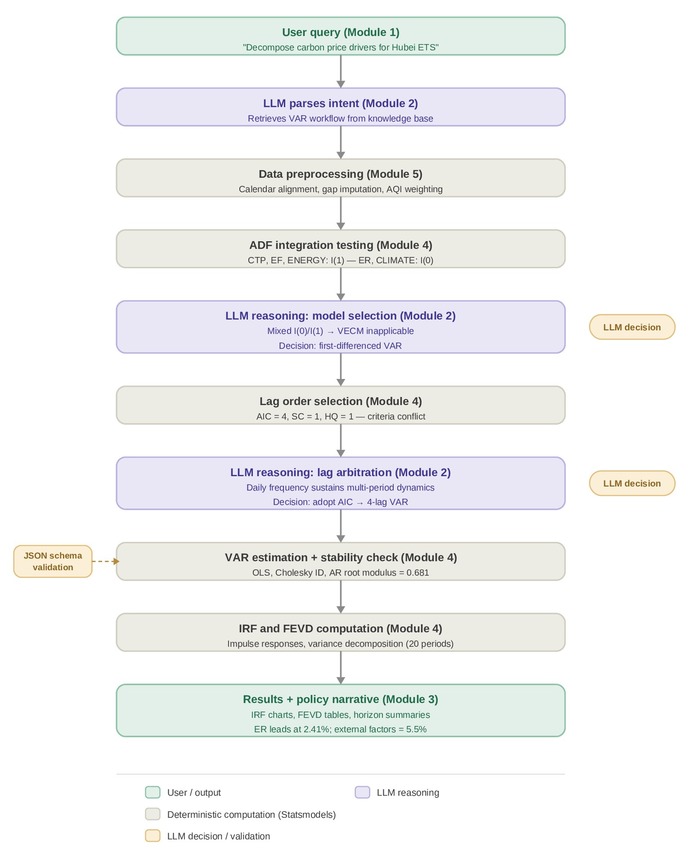
Figure 2.
Schematic example of a complete user interaction in AutoCarbonVAR: from plain-language query to econometric output and policy narrative.
-
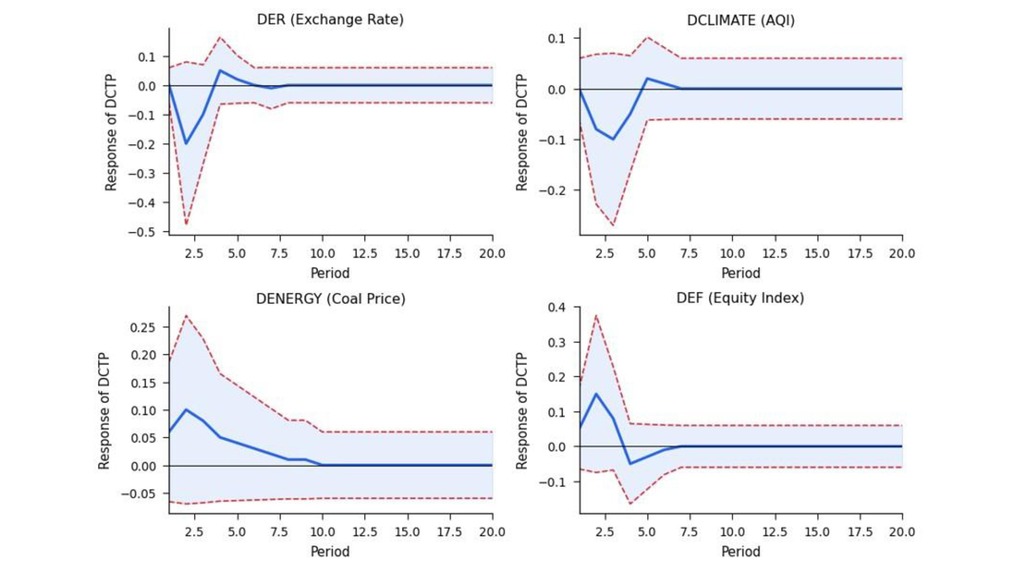
Figure 3.
Impulse response functions of DCTP to factor shocks – Hubei Province (lag-4 ΔVAR, Cholesky identification). Solid lines = point estimates; dashed lines = ±2 S.E. confidence bands. Horizontal axis = periods (days); vertical axis = DCTP response to a one-standard-deviation shock.
-
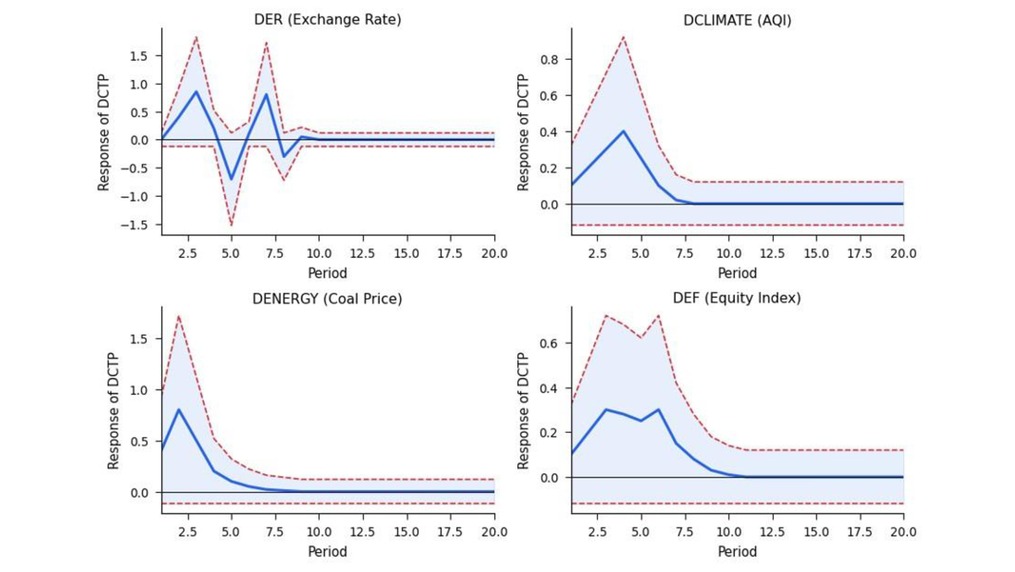
Figure 4.
Impulse response functions of DCTP to factor shocks – national market (lag-5 ΔVAR). Layout and notation identical to Figure 2.
