
On Indian summer monsoon droughts and teleconnections over the past millennium
-
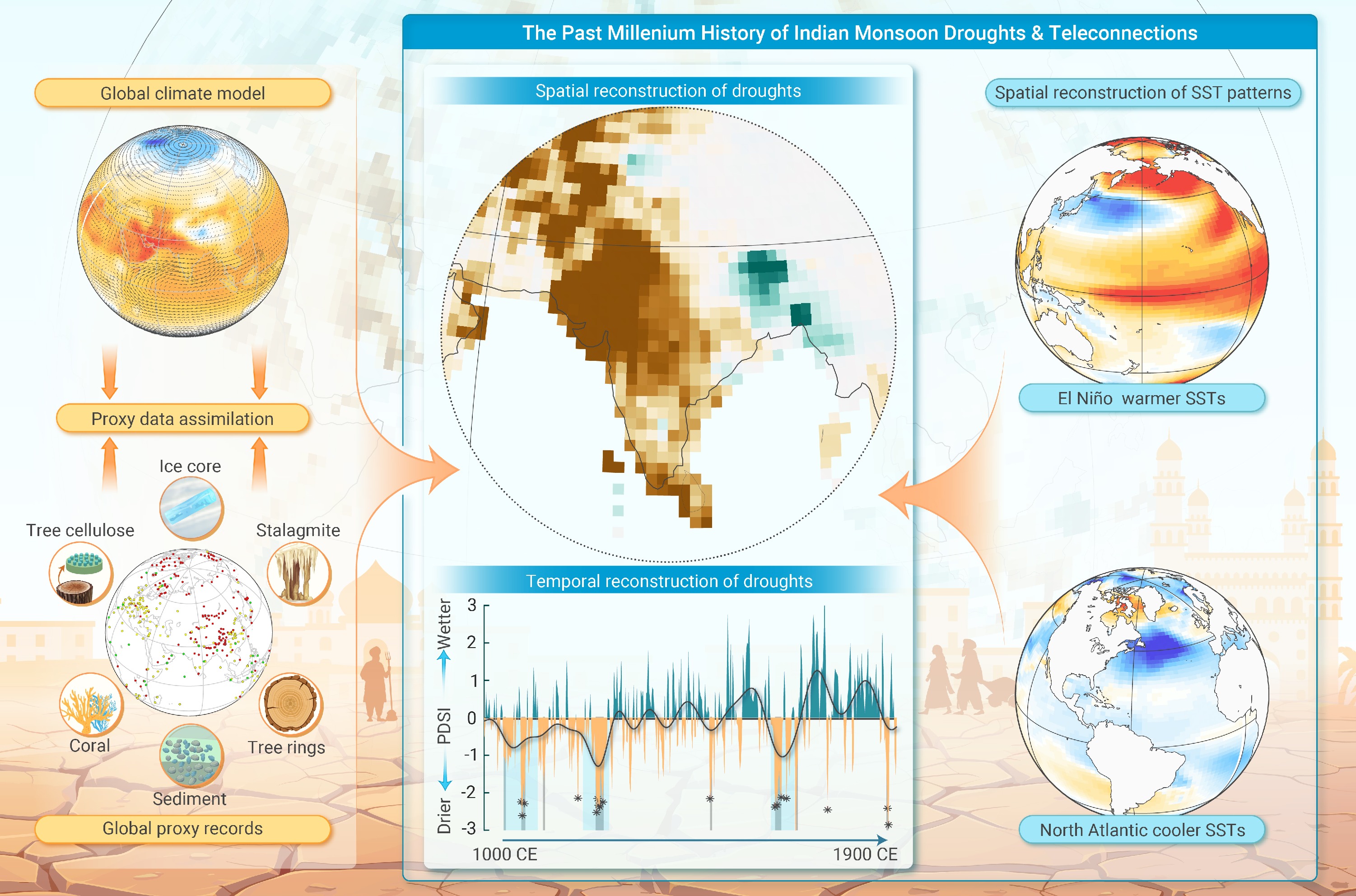
GRAPHICAL ABSTRACT
 DownLoad:
Full size image
DownLoad:
Full size image
-
PUBLIC SUMMARY
-
We present a data assimilation-based reconstruction of the Indian Monsoon droughts over the past millennium.
Our reconstruction reveals several “black swans” droughts—rare events with significant societal impacts.
The El Nio-drought association was highly variable over the past centuries.
Cool extratropical North Atlantic sea surface temperatures are a plausible driver of monsoon droughts.
-
-
ABSTRACT
Historical documentary accounts from the Indian subcontinent document several decade-to-multidecade clusters of severe Indian summer monsoon (ISM) droughts over the past millennium. Many of these putative droughts have no counterparts in the instrumental period. An objective assessment of the severity and frequency of these droughts and their teleconnections to other parts of the climate system remains uncertain. Here, we use the Paleo Hydrodynamics Data Assimilation (PHYDA) product to address this gap. PHYDA reproduces historical intervals of increased drought frequency with high fidelity and reveals multiple instances of multi-year “black swan” droughts— rare, severe events with significant societal impacts that are consistent with historical accounts. We find that droughts, as well as extended periods of dryness, occurred under both El Niño and non-El Niño conditions, with El Niño explaining ~ 49% of all drought instances. A large number (~42%) of non-El Niño type droughts were forced by cooler extratropical SST anomalies in the North Atlantic region. While El Niño was an important driver, its association with droughts varied considerably, accounting for between 15-80% of droughts depending on the century. The PHYDA’s millennial-length perspective supports expanding the El Niño-centric paradigm of droughts into a framework that includes extratropical teleconnections. -

-
REFERENCES
[1] Parthasarathy B., Munot A.A. and Kothawale D.R. (1994). All-India monthly and seasonal rainfall series: 1871–1993. Theor. Appl. Climatol. 49 :217-224. DOI:10.1007/BF00867461 [2] Loveday A. (1914). The history and economics of Indian famines. Nature 93 :530. DOI:10.1038/093530b0. [3] Whetton P. and Rutherfurd I. (1994). Historical ENSO teleconnections in the Eastern Hemisphere. Clim. Change 28 :221-253. DOI:10.1007/BF01104135 [4] Grove R.H. and Chappell J. (2000). El Niño history and crisis: Studies from the Asia-Pacific region (White Horse Press Cambridge UK). [5] Thompson L.G., Yao T., Mosley-Thompson E., et al., (2000). A high-resolution millennial record of the South Asian monsoon from Himalayan ice cores. Science 289 :1916-1919. DOI:10.1126/science.289.5486.1916 [6] Sinha A., Stott L., Berkelhammer M., et al. (2011). A global context for megadroughts in monsoon Asia during the past millennium. Quat. Sci. Rev. 30:47−62. DOI:10.1016/j.quascirev.2010.10.005 [7] Sinha A., Kathayat G., Cheng H., et al. (2015). Trends and oscillations in the Indian summer monsoon rainfall over the last two millennia. Nat. Commun. 6: 6309. DOI:10.1038/ncomms7309 [8] Kathayat G., Sinha A., Breitenbach S.F., et al. (2022). Protracted Indian monsoon droughts of the past millennium and their societal impacts. Proc. Natl. Acad. Sci. USA 119:e2207487119. DOI:10.1073/pnas.2207487119 [9] Burns S.J., Fleitmann D., Mudelsee M., et al.(2002). A 780‐year annually resolved record of Indian Ocean monsoon precipitation from a speleothem from south Oman. J. Geophys. Res. Atmos 107 :ACL 9-1-9-9. DOI:10.1029/2001JD001281 [10] Shi F., Fang K., Xu C., and et al. (2017). Interannual to centennial variability of the South Asian summer monsoon over the past millennium. Clim. Dyn. 49:2803−2814. DOI:10.1007/s00382-016-3493-9 [11] Cook E.R., Anchukaitis K.J., Buckley B.M., et al. (2010). Asian monsoon failure and megadrought during the last millennium. Science 328:486−489. DOI:10.1126/science.1185188 [12] Shi H., Wang B., Cook E.R., et al. (2018). Asian summer precipitation over the past 544 years reconstructed by merging tree rings and historical documentary records. J. Climate 31:7845−7861. DOI:10.1175/JCLI-D-18-0003.1 [13] Feng S., Hu Q., Wu Q., et al. (2013). A gridded reconstruction of warm season precipitation for Asia spanning the past half millennium. J. Climate 26:2192−2204. DOI:10.1175/JCLI-D-12-00099.1 [14] Ropelewski C.F. and Halpert M.S. (1987). Global and regional scale precipitation patterns associated with the El Niño/Southern Oscillation. Mon. Weather Rev. 115 :1606-1626. DOI:10.1175/1520-0493(1987)115<1606:GARSPP>2.0.CO;2 [15] Kumar K.K., Rajagopalan B., Hoerling M., et al. (2006). Unraveling the mystery of Indian monsoon failure during El Niño. Science 314:115−119. DOI:10.1126/science.1131152 [16] Krishnamurthy V. and Goswami B.N. (2000). Indian monsoon–ENSO relationship on interdecadal timescale. J. Climate 13 :579–595. DOI:10.1175/1520-0442(2000)013<0579:IMEROI>2.0.CO;2 [17] Goswami B.N. (1998). Interanxxnual variation of Indian summer monsoon in a GCM: External conditions versus internal feedbacks. J. Climate 11 :501–522. DOI:10.1175/1520-0442(1998)011<0501:IVOISM>2.0.CO;2 [18] Slingo J.M. and Annamalai H. (2000).1997: The El Niño of the century and the response of the Indian summer monsoon. Mon. Weather Rev. 128 :1778-1797. DOI:10.1175/1520-0493(2000)128<1778:TENOOT>2.0.CO;2 [19] Varikoden H., Revadekar J.V., Choudhary Y., et al. (2015). Droughts of Indian summer monsoon associated with El Niño and Non‐El Niño years. Int. J. Climatol. 35:1916−1925. DOI:10.1002/joc.4097 [20] Rajeevan M., Gadgil S., Bhate J. (2010). Active and break spells of the Indian summer monsoon. J. Earth Syst. Sci. 119 :229-247. DOI:10.1007/s12040-010-0019-4 [21] Goswami B.N. and Ajaya Mohan R.S. (2001). Intraseasonal oscillations and interannual variability of the Indian summer monsoon. J. Climate 14 :1180–1198. DOI:10.1175/1520-0442(2001)014<1180:IOAIVO>2.0.CO;2 [22] Hoyos C.D. and Webster P.J. (2007). The role of intraseasonal variability in the nature of Asian monsoon precipitation. J. Climate 20 :4402-4424. DOI:10.1175/JCLI4252.1 [23] Joseph S., Sahai A.K. and Goswami B.N. (2009). Eastward propagating MJO during boreal summer and Indian monsoon droughts. Clim. Dyn. 32 :1139–1153. DOI:10.1007/s00382-008-0412-8 [24] Neena J.M., Suhas E. and Goswami B.N. (2011). Leading role of internal dynamics in the 2009 Indian summer monsoon drought. J. Geophys. Res. Atmos. 116 :D13103. DOI:10.1029/2010JD015328 [25] Joseph S., Sahai A.K., Chattopadhyay R., et al. (2011). Can El Niño–Southern Oscillation (ENSO) events modulate intraseasonal oscillations of Indian summer monsoon. J. Geophys. Res. Atoms. 116:D20. DOI:10.1029/2010JD015510 [26] Sperber K.R., Slingo J.M. and Annamalai H. (2000). Predictability and the relationship between subseasonal and interannual variability during the Asian summer monsoon. Q. J. Roy Meteor. Soc. 126 :2545-2574. DOI:10.1002/qj.49712656810 [27] Borah P.J., Venugopal V., Sukhatme J., et al. (2020). Indian monsoon derailed by a North Atlantic wavetrain. Science 370:1335−1338. DOI:10.1126/science.aay6043 [28] Goswami B.N., Chakraborty D., Rajesh P.V., et al. (2022). Predictability of South-Asian monsoon rainfall beyond the legacy of Tropical Ocean Global Atmosphere program (TOGA). NPJ. Clim. Atmos. Sci. 5:58. DOI:10.1038/s41612-022-00281-3 [29] Rajesh P.V. and Goswami B.N. (2020). Four-dimensional structure and sub-seasonal regulation of the Indian summer monsoon multi-decadal mode. Clim. Dyn. 55 :2645-2666. DOI:10.1007/s00382-020-05407-y [30] Chattopadhyay R., Phani R., Sabeerali C.T., et al. (2015). Influence of extratropical sea‐surface temperature on the Indian summer monsoon: An unexplored source of seasonal predictability. Q. J. Roy. Meteor. Soc. 141:2760−2775. DOI:10.1002/qj.2562 [31] Saji N., Goswami B.N., Vinayachandran P., et al. (1999). A dipole mode in the tropical Indian Ocean. Nature 401:360−363. DOI:10.1038/43854 [32] Krishnan R. and Sugi M. (2003). Pacific decadal oscillation and variability of the Indian summer monsoon rainfall. Clim. Dyn. 21 :233-242. DOI:10.1007/s00382-003-0330-8 [33] Yadav R.K., Srinivas G., and Chowdary J.S. (2018). Atlantic Niño modulation of the Indian summer monsoon through Asian jet. NPJ. Clim. Atmos. Sci. 1 :23. DOI:10.1038/s41612-018-0029-5 [34] Krishnamurthy L. and Krishnamurthy V. (2016). Teleconnections of Indian monsoon rainfall with AMO and Atlantic tripole. Clim. Dyn. 46 :2269–2285. DOI:10.1007/s00382-015-2701-3 [35] Steiger N.J., Smerdon J.E., Cook E.R., et al. (2018). A reconstruction of global hydroclimate and dynamical variables over the Common Era. Sci. Data 5:1−15. DOI:10.1038/sdata.2018.86 [36] Otto-Bliesner B.L., Brady E.C., Fasullo J., et al. (2016). Climate variability and change since 850 CE: An ensemble approach with the Community Earth System Model. Bull. Am. Meteorol. Soc. 97:735−754. DOI:10.1175/BAMS-D-14-00233.1 [37] Bretherton C.S., Smith C., and Wallace J.M. (1992). An intercomparison of “Methods” for finding coupled patterns in climate data. J. Climate 5 :541–560. DOI:10.1175/1520-0442(1992)005<0541:AIOMFF>2.0.CO;2 [38] Steiger N.J., Smerdon J.E., Cook B.I., et al. (2019). Oceanic and radiative forcing of medieval megadroughts in the American Southwest. Sci. Adv. 5:eaax0087. DOI:10.1126/sciadv.aax0087 [39] Steiger N.J., Smerdon J.E., Seager R., et al. (2021). ENSO-driven coupled megadroughts in North and South America over the last millennium. Nat. Geosci. 14:739−744. DOI:10.1038/s41561-021-00819-9 [40] Tardif R., Hakim G.J., Perkins W.A., et al. (2019). Last Millennium Reanalysis with an expanded proxy database and seasonal proxy modeling. Clim. Past 15:1251−1273. DOI:10.5194/cp-15-1251-2019 [41] Baek S.H., Steiger N.J., Smerdon J.E. et al. (2019). Oceanic drivers of widespread summer droughts in the United States over the Common Era. Geophys. Res. Lett. 46:8271−8280. DOI:10.1029/2019GL082838 [42] van der Schrier G., Barichivich J., Briffa K.R., et al. (2013). A scPDSI-based global data set of dry and wet spells for 1901–2009. J. Geophys. Res-Atoms 118:4025−4048. DOI:10.1002/jgrd.50355 [43] Dai A. (2011). Characteristics and trends in various forms of the Palmer drought severity index during 1900–2008. J. Geophys. Res. 116 :D12115. DOI:10.1029/2010JD015541 [44] Fairchild I. J. and Baker A. (2012). Speleothem science: From process to past environments (Wiley-Blackwell). DOI:10.1002/9781444361094 [45] Kohonen T. (1998). The self-organizing map. Neurocomputing 21 :1–6. DOI:10.1016/S0925-2312(98)00030-7 [46] Yang X. and Huang P. (2021). Restored relationship between ENSO and Indian summer monsoon rainfall around 1999/2000. The Innovation 2 :100102. DOI:10.1016/j.xinn.2021.100102 [47] Gershunov A., Schneider N., and Barnett T. (2001). Low-frequency modulation of the ENSO–Indian monsoon rainfall relationship: Signal or noise? J. Climate 14 :2486–2492. DOI:10.1175/1520-0442(2001)014<2486:LFMOTE>2.0.CO;2 [48] Yun K.S. and Timmermann A. (2018). Decadal monsoon-ENSO relationships reexamined. Geophys. Res. Lett. 45 :2014-2021. DOI:10.1002/2017GL076912 [49] Goswami B.N., Madhusoodanan M.S. Neema C.P., et al. (2006). A physical mechanism for North Atlantic SST influence on the Indian summer monsoon. Geophys. Res. Lett. 33:L02706. DOI:10.1029/2005GL024803 [50] Zhang R. and Delworth T.L. (2006). Impact of Atlantic multidecadal oscillations on India/Sahel rainfall and Atlantic hurricanes. Geophys. Res. Lett. 33 :L17712. DOI:10.1029/2006GL026267 [51] Burns S.J., Fleitmann D., Matter A., et al. (2003). Indian Ocean climate and an absolute chronology over Dansgaard/Oeschger events 9 to 13. Science 301:1365−1367. DOI:10.1126/science.1086227 [52] Gupta A.K., Anderson D.M., and Overpeck J.T. (2003). Abrupt changes in the Asian southwest monsoon during the Holocene and their links to the North Atlantic Ocean. Nature 421 :354–357. DOI:10.1038/nature01340 [53] Zhang X., Jia L. and Jia W. (2016). Centennial-scale teleconnection between North Atlantic sea surface temperatures and the Indian summer monsoon during the Holocene. Clim. Dyn. 46 :3323-3336. DOI:10.1007/s00382-015-2771-2 [54] Fan M. and Schneider E.K. (2012). Observed decadal North Atlantic tripole SST variability. Part I: Weather noise forcing and coupled response. J. Atmos. Sci. 69 :35-50. DOI:10.1175/JAS-D-11-018.1 [55] Dong B.W. and Sutton R.T. (2002). Adjustment of the coupled ocean–atmosphere system to a sudden change in the thermohaline circulation. Geophys. Res. Lett. 29 :18-1-18-4. DOI:10.1029/2002GL015229 [56] Krishnan R., Ramesh K.V., Samala B.K., et al. (2006). Indian Ocean‐monsoon coupled interactions and impending monsoon droughts. Geophys. Res. Lett. 33:L08711. DOI:10.1029/2006GL025811 [57] Shi Z., Xu T. and Wang H. (2016). Sensitivity of Asian climate change to radiative forcing during the last millennium in a multi-model analysis. Glob. Planet. Change 139 :195-210. DOI:10.1016/j.gloplacha.2016.02.007 [58] Zhao Y. and Nigam S. (2015). The Indian Ocean dipole: A monopole in SST. J. Climate 28 :3-19. DOI:10.1175/JCLI-D-14-00047.1 [59] Izumo T., Vialard J., Lengaigne M., et al.(2010) Influence of the state of the Indian Ocean Dipole on the following year’s El Niño. Nat. Geosci. 3 :168-172. DOI:10.1038/ngeo760 [60] Taleb N.N. (2007). Black swans and the domains of statistics. Am. Stat. 61 :198-200. DOI:10.1198/000313007X219996 [61] Danvers F.C. (1877). A century of famine. British Library India Office Records V/27/830/15) pp.600. [62] Damodaran V., Allan R. Ogilvie A.E., et al.(2018). The 1780s: Global climate anomalies floods droughts and famines. White S., Pfister C. and Mauelshagen F. (eds). The palgrave handbook of climate history (Palgrave Macmillan), pp:517–550. DOI:10.1057/978-1-137-43020-5_34 [63] Grove R. (2002). El Niño chronology and the history of socio-economic and agrarian crisis in south and southeast Asia 1250-1900. Abrol Y. P., Sangwan S. and Tiwari M. K. (eds). Land use-historical perspectives: Focus on Indo-gangetic plains (Allied Publishers). https://books.google.com.au/books?hl=en&lr=&id=oNpXmQb0gv0C&oi=fnd &pg=PR7&ots=G1fKp5nlzJ&sig=t6_-0zB3EyxrCraqP0ACPHq_QZI&redir_esc =y#v=onepage&q&f=false [64] Lee C.W., Tseng Y.H., Sui C.H., et al. (2020). Characteristics of the prolonged El Niño events during 1960–2020. Geophys. Res. Lett. 47:e2020GL088345. DOI:10.1029/2020GL088345 [65] Allan R.J., Gergis J. and D’Arrigo R.D. (2020). Placing the AD 2014–2016 ‘protracted’El Niño episode into a long-term context. Holocene 30 :90-105. DOI:10.1177/0959683619875788 [66] Charney J.G. and Shukla J. (1981). Predictability of Monsoons. Lighthill J. and Pearce R.P. (eds). Monsoon dynamics (Cambridge University Press), pp. 99-110. DOI:10.1017/CBO9780511897580.009 [67] Turner A.G. and Annamalai H. (2012). Climate change and the South Asian summer monsoon. Nat. Clim. Chang. 2 :587-595. DOI:10.1038/nclimate1495 [68] Goswami B.N. and Shukla J. (1991). Predictability of a coupled ocean-atmosphere model. J. Climate. 4 :3–22. DOI:10.1175/1520-0442(1991)004<0766:POACOM>2.0.CO;2 [69] Huang B., Banzon V.F., Freeman E., et al.(2015). Extended reconstructed sea surface temperature version 4 (ERSST. v4). Part I: Upgrades and intercomparisons. J. Climate 28 :911-930. DOI:10.1175/JCLI-D-14-00006.1 [70] Harris I., Osborn T.J., Jones P., et al. (2020). Version 4 of the CRU TS monthly high-resolution gridded multivariate climate dataset. Sci. Data. 7:109. DOI:10.1038/s41597-020-0453-3 [71] Rajeevan M., Bhate J., Kale J.D., et al. (2006). A High resolution daily gridded rainfall data for the Indian region: Analysis of break and active monsoon spells. Curr. Sci. 91:296−306. -
ABOUT THIS ARTICLE
Cite this article:
Sinha A., Steiger N. J., Tan L., et al. (2025). On Indian summer monsoon droughts and teleconnections over the past millennium. The Innovation Geoscience 3:100108. https://doi.org/10.59717/j.xinn-geo.2024.100108
Welcome!
To request copyright permission to republish or share portions of our works, please visit Copyright Clearance Center's (CCC) Marketplace website at marketplace.copyright.com.
Article Metrics
Relative Articles
Cited by
Export File
Citation
Sinha A., Steiger N. J., Tan L., et al. (2025). On Indian summer monsoon droughts and teleconnections over the past millennium. The Innovation Geoscience 3:100108. https://doi.org/10.59717/j.xinn-geo.2024.100108

Format
Content
-
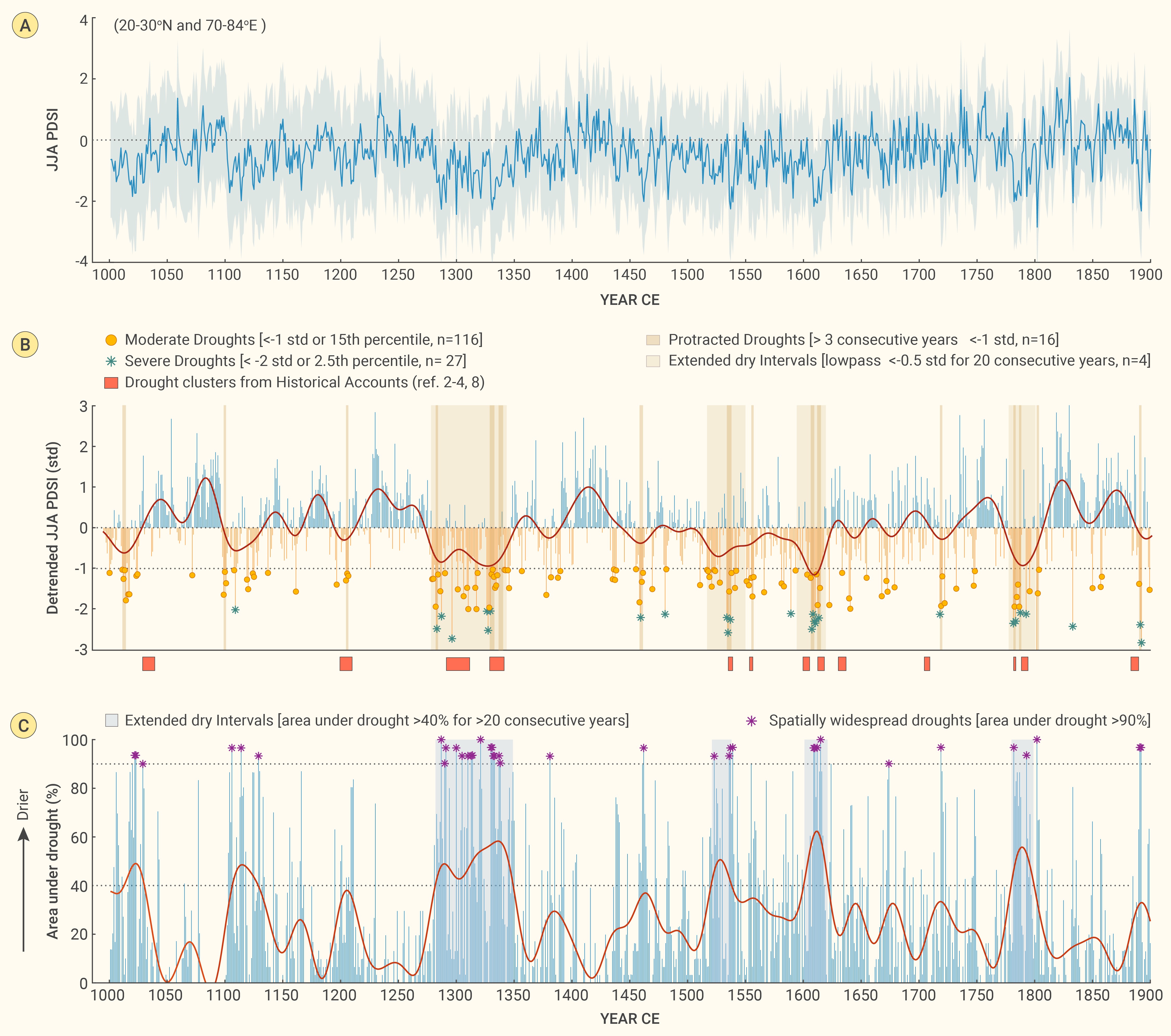
Figure 1.
PHYDA PDSI index and droughts
-
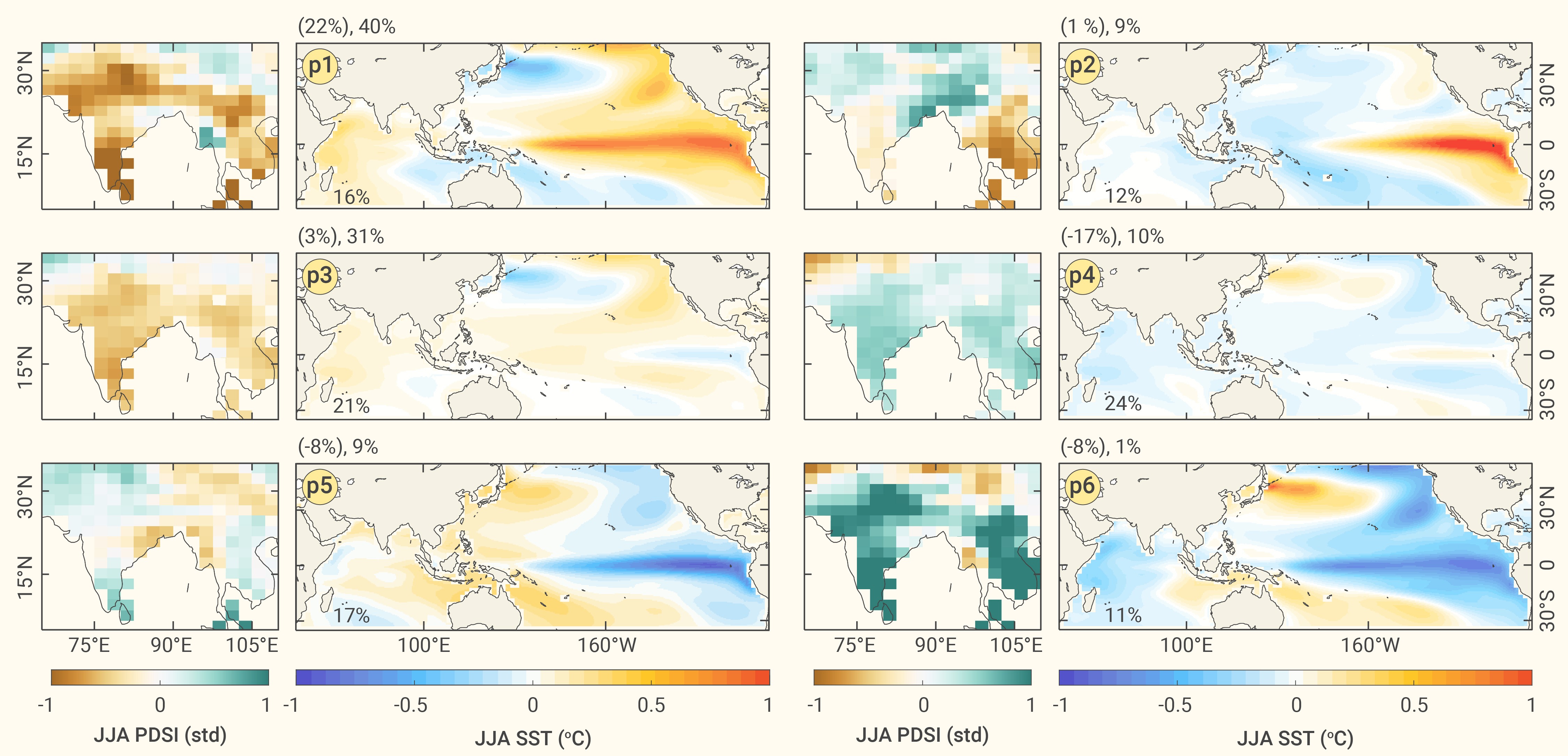
Figure 2.
SOM analysis of dominant modes of SST variability and corresponding hydroclimate states focused over the tropical Pacific
-
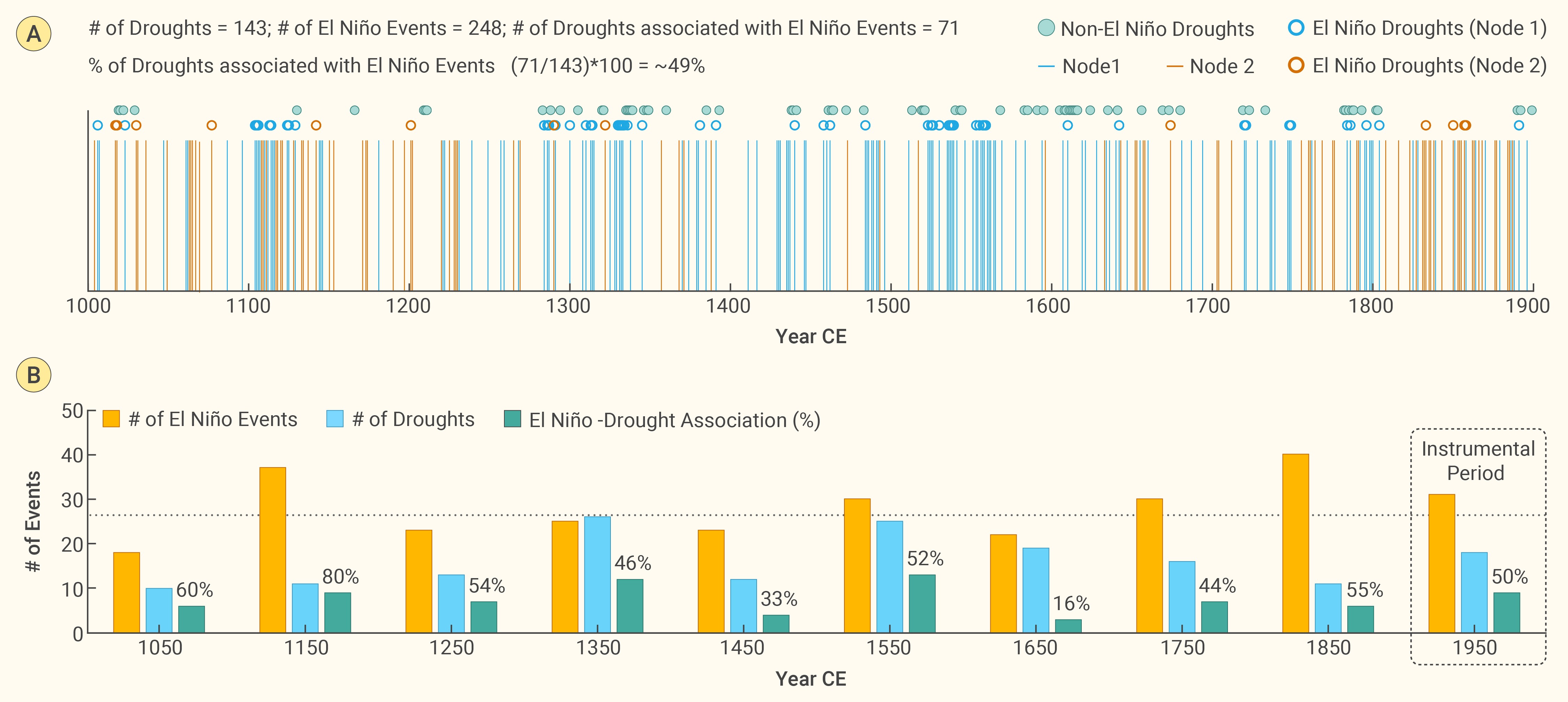
Figure 3.
Temporal evolution of El Niño events, droughts, and El Niño-drought relationship
-
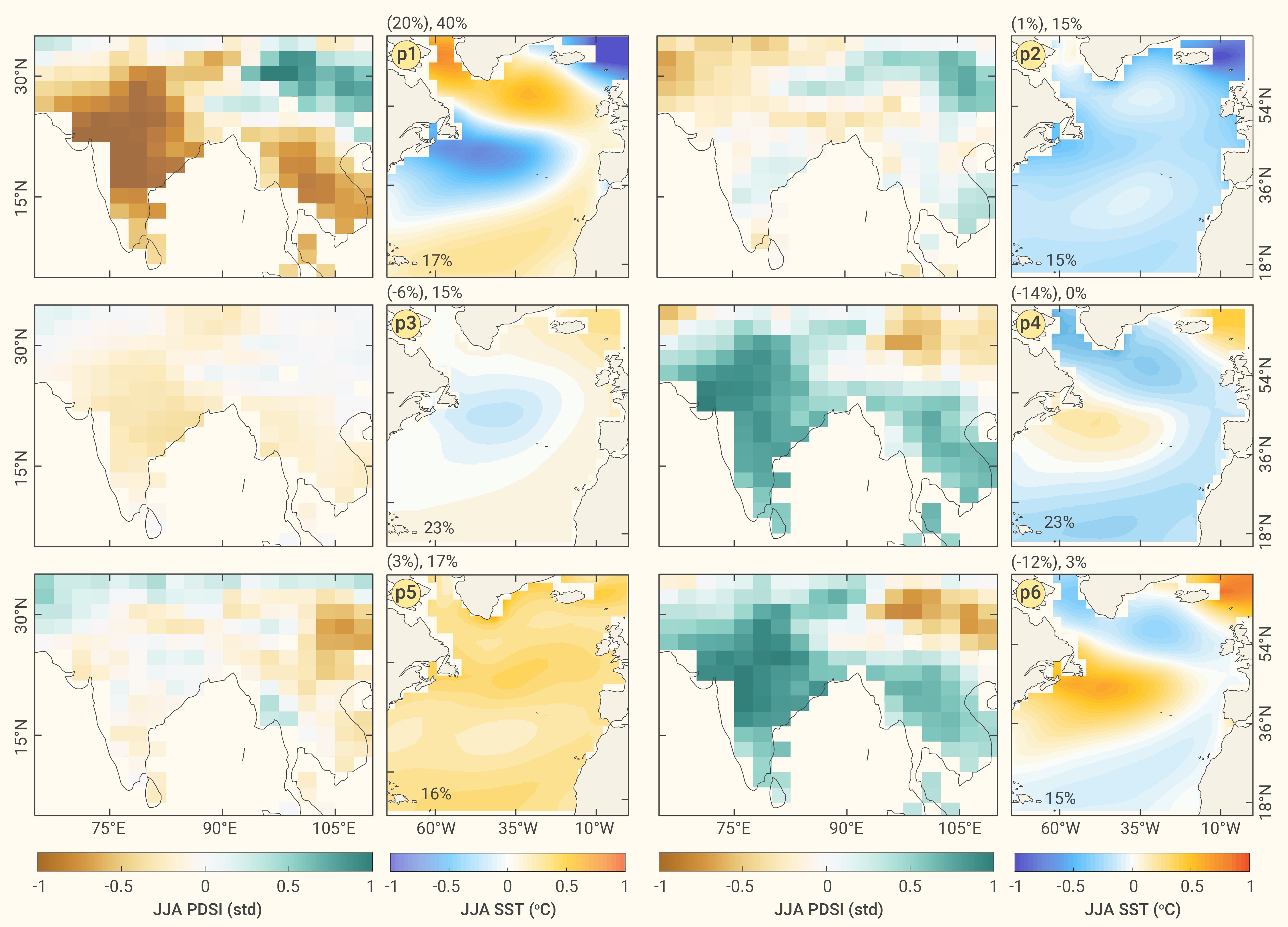
Figure 4.
SOM analysis of dominant modes of SST variability and corresponding hydroclimate states focused over the North Atlantic
-
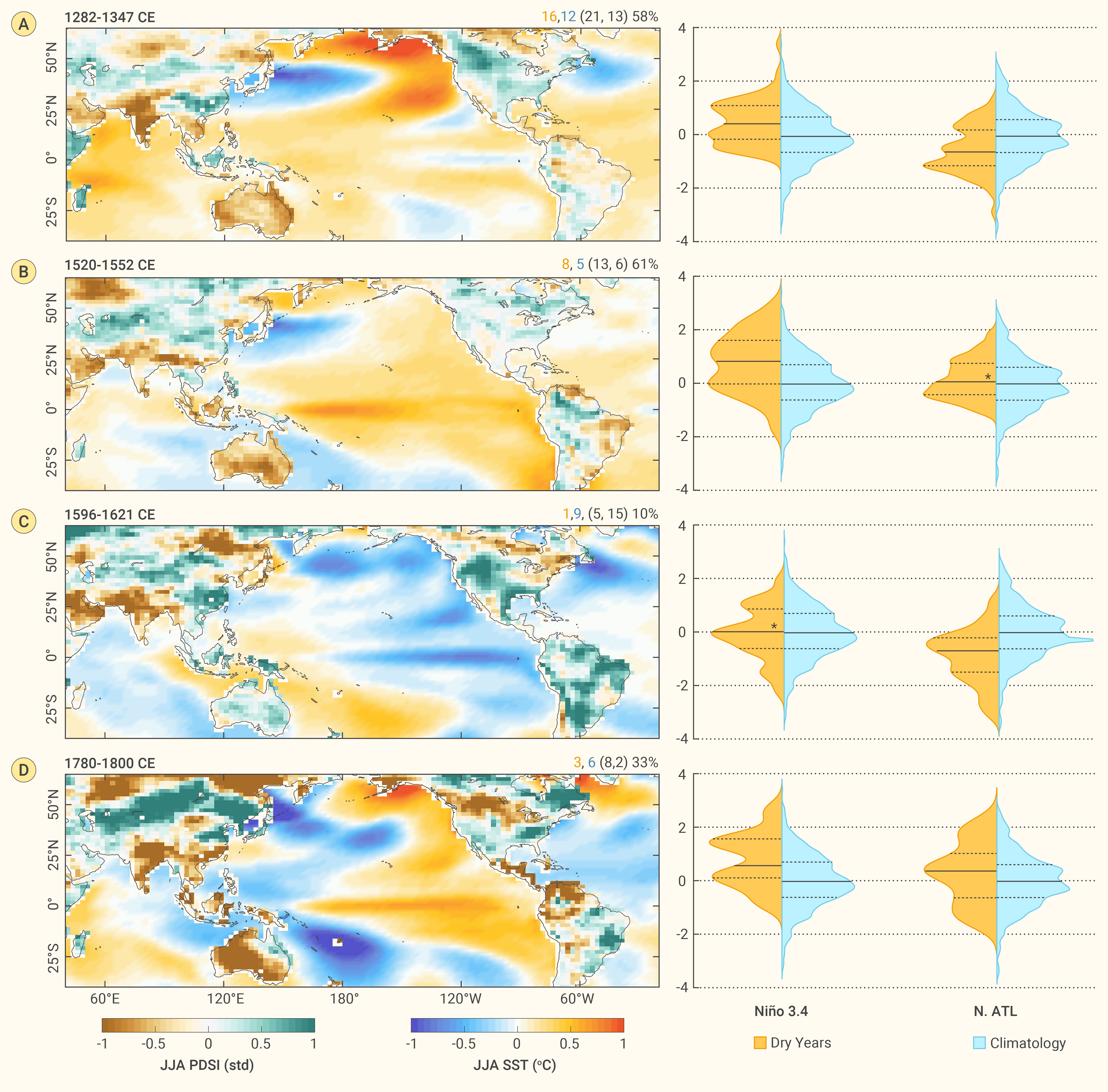
Figure 5.
Anomalies and distributions during multidecadal periods of drier conditions
