
Carbon-negative transition by utilizing overlooked carbon in waste landfills
-
GRAPHICAL ABSTRACT
 DownLoad:
Full size image
DownLoad:
Full size image
-
PUBLIC SUMMARY
-
A new model offers insights into landfill carbon stock accounting.
The carbon stock from landfills at the prefecture-level in China is estimated from 2001 to 2020.
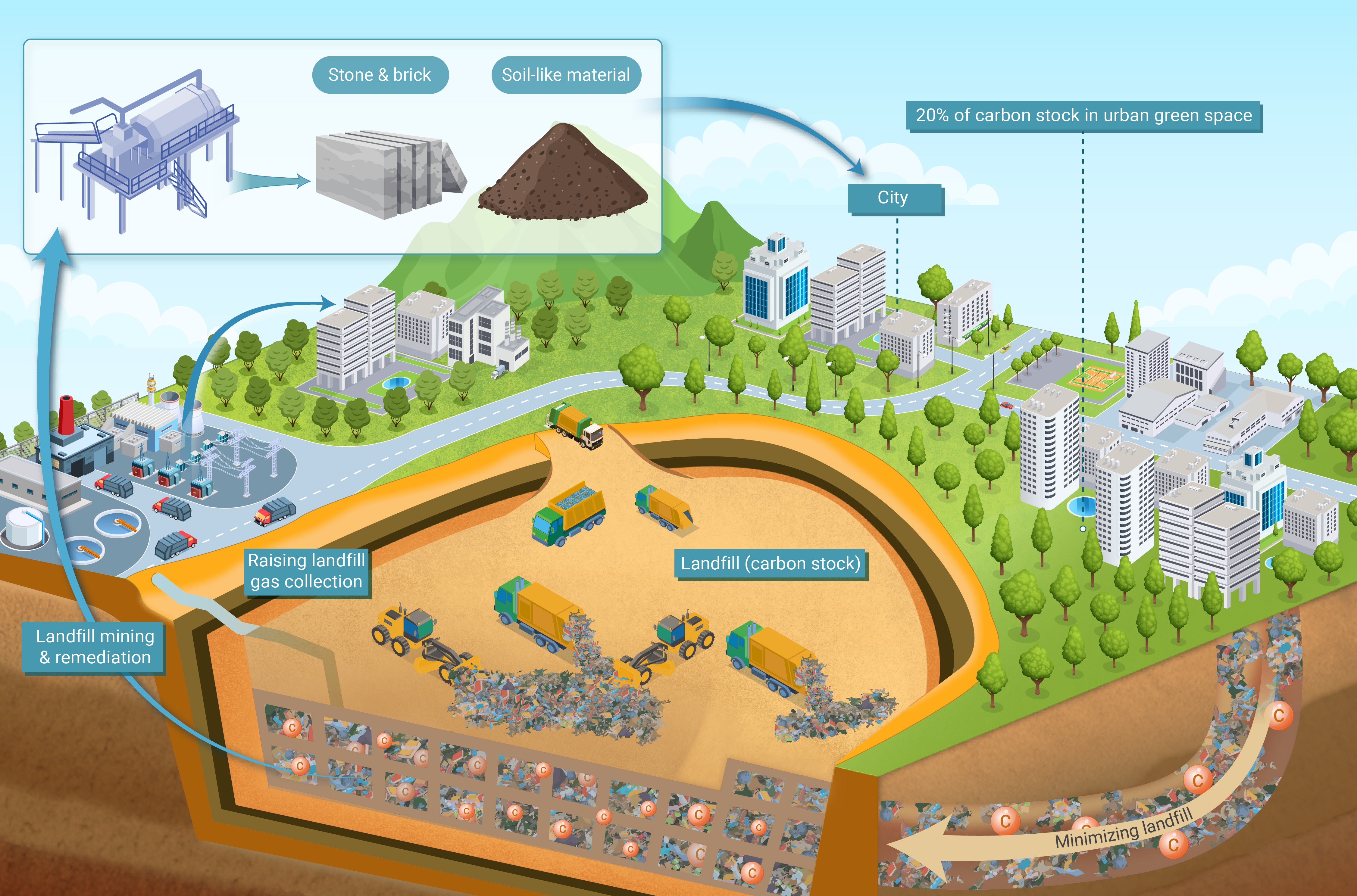
The carbon stock in landfills holds substantial resource potential and environmental impact.
Landfill mining and in-situ restoration could transform landfills into carbon-negative sectors.
-
-
ABSTRACT
Landfills play a crucial role in urban climate solutions, as the decomposition of their “hidden” carbon stock contributes to 8.8% of global methane emissions. While controlling landfill gas emissions is the most commonly used intervention, a systematic approach to manage the carbon cycle in landfills remains elusive. In this study, we developed a quantitative solid-water-gas coupling model to estimate the carbon stock in landfills across 346 cities in China. Our findings reveal a standing landfill carbon stock 506.3 ± 4.2 Tg, which could potentially substitute for 20% of soil organic carbon in green spaces and 1 year of residential electricity consumption of cities. Our scenario analyses show that by implementing a life-cycle package of interventions (incl., input minimization, stock utilization, and leakage reduction), the total carbon stock in landfills could be reduced to 230.1 Tg with a negative annual carbon emission (-57.1 Tg CO2 eq/year) reached by 2030. These interventions could cumulativly cut greenhouse gas (GHG) by 753.3 Tg, representing 62.2% of the landfill-related GHG emissions and 2.0% of China’s carbon debt towards the 1.5°C warming targets. Landfill mining contributes 52.3% of these reductions, while in-situ aerobic restoration accounts for 14.4%, positioning landfills as a potential carbon-negative sector that can drive cities towards carbon-neutrality.-
Keywords:
- landfill /
- carbon stock /
- greenhouse gases /
- municipal solid waste /
- city /
- scenarios
-

-
REFERENCES
[1] Lu M., Zhou C., Wang C., et al. (2024). Worldwide scaling of waste generation in urban systems. Nat. Cities 1:126−135. DOI:10.1038/s44284-023-00021-5 [2] Churkina G., Brown D., and Keoleian G. (2010). Carbon stored in human settlements: the conterminous United States. Global Change Biol. 16:135−143. DOI:10.1111/j.1365-2486.2009.02002.x [3] Ge S. and Zhao S. (2017). Organic carbon storage change in China's urban landfills from 1978-2014. Environ. Res. Lett. 12: 104013. DOI:10.1088/1748-9326/aa81df [4] Stubbins A., Law K., Munoz S., et al. (2021). Plastics in the Earth system. Science 373:51−55. DOI:10.1126/science.abb0354 [5] Zhang Y., Yang Z. and Yu X. (2015). Urban metabolism: A review of current knowledge and directions for future study. Environ. Sci. Technol. 49:11247−11263. DOI:10.1021/acs.est.5b03060 [6] Cao Z., Myers R., Lupton R., et al. (2020). The sponge effect and carbon emission mitigation potentials of the global cement cycle. Nat. Commun. 11: 3777. DOI:10.1038/s41467-020-17583-w [7] Fei X., Fang M. and Wang Y. (2021). Climate change affects land-disposed waste. Nat. Clim. Change 11:1004−1005. DOI:10.1038/s41558-021-01220-5 [8] Climate trace-independent greenhouse gas emissions tracking. (2022) https://climatetrace.org/ [9] Duren R., Thorpe A., Foster K., et al. (2019). California's methane super-emitters. Nature 575:180−184. DOI:10.1038/s41586-019-1720-3 [10] McKeever J., Jervis D., Mahapatra G., et al. (2022). Using satellites to uncover large methane emissions from landfills. Sci. Adv. 8 :eabn9683. DOI:10.1126/sciadv.abn9683 [11] Etienne R. and Kathryn M. (2022). Looking ahead to COP27—from climate pledges to action: The Global Methane Pledge—opportunities and risks. WIDER Working Paper 2022/131. DOI:10.35188/UNU-WIDER/2022/264-5 [12] Bihalowicz J., Rogula-Kozlowska W. and Krasuski A. (2021). Contribution of landfill fires to air pollution - An assessment methodology. Waste Manage. 125:182−191. DOI:10.1016/j.wasman.2021.02.046 [13] Kaza S., Yao L., Bhada-Tata P., et al. (2018). What a waste 2.0: A global snapshot of solid waste management to 2050. (World Bank Publications [14] He P., Chen L., Shao L., et al. (2019). Municipal solid waste (MSW) landfill: A source of microplastics. -Evidence of microplastics in landfill leachate. Water Res. 159:38−45. DOI:10.1016/j.watres.2019.04.060 [15] Waste management-a man made disaster (Society of Biological Sciences and Rural Development 2020), https://www.researchgate.net/publication/342588994_WASTE_MANAGEMENT-A_MAN_MADE_DISASTER_1_2 [16] Cai B., Lou Z., Wang J., et al. (2018). CH4 mitigation potentials from China landfills and related environmental co-benefits. Sci. Adv. 4 :eaar8400. DOI:10.1126/sciadv.aar8400 [17] Chandel M. K., Kwok G., Jackson R. B., et al. (2012). The potential of waste-to-energy in reducing GHG emissions. Carbon Manag. 3:133−144. DOI:10.4155/cmt.12.11 [18] Mian M. M., Zeng X., Bin Nasry A. A. N., et al. (2017). Municipal solid waste management in China: A comparative analysis. J. Mater. Cycles. Waste 19:1127−1135. DOI:10.1007/s10163-016-0509-9 [19] Welford M. R. and Yarbrough R. A. (2021). Urbanization. Welford M. R. and Yarbrough R. A. (eds). Human-environment interactions: An introduction (Springer International Publishing: Cham), pp 193-214. DOI:10.1007/978-3-030-56032-4_8 [20] Stegmann P., Daioglou V., Londo M., et al. (2022). Plastic futures and their CO2 emissions. Nature 612:272−276. DOI:10.1038/s41586-022-05422-5 [21] Scharff H. (2014). Landfill reduction experience in The Netherlands. Waste Manage. 34:2218−2224. DOI:10.1016/j.wasman.2014.05.019 [22] Wang Y., Levis J. and Barlaz M. (2020). An assessment of the dynamic global warming impact associated with long-term emissions from landfills. Environ. Sci. Technol. 54:1304−1313. DOI:10.1021/acs.est.9b04066 [23] Powell J., Townsend T. and Zimmerman J. (2016). Estimates of solid waste disposal rates and reduction targets for landfill gas emissions. Nat. Clim. Change 6:162−165. DOI:10.1038/nclimate2804 [24] Laner D., Cencic O., Svensson N., et al. (2016). Quantitative analysis of critical factors for the climate impact of landfill mining. Environ. Sci. Technol. 50:6882−6891. DOI:10.1021/acs.est.6b01275 [25] Fei X., Guo Y., Wang Y., et al. (2022). The long-term fates of land-disposed plastic waste. Nat. Rev. Earth Env. 3:733−735. DOI:10.1038/s43017-022-00354-0 [26] Burnside W. (2018). Landfill mining. Nat. Sustain. 1:156−156. DOI:10.1038/s41893-018-0058-4 [27] Brandstatter C., Laner D. and Fellner J. (2015). Carbon pools and flows during lab-scale degradation of old landfilled waste under different oxygen and water regimes. Waste Manage. 40:100−111. DOI:10.1016/j.wasman.2015.03.011 [28] Zhou C., Huang H., Cao A., et al. (2015). Modeling the carbon cycle of the municipal solid waste management system for urban metabolism. Ecol. Model. 318:150−156. DOI:10.1016/j.ecolmodel.2014.11.027 [29] Schiller G., Muller F. and Ortlepp R. (2017). Mapping the anthropogenic stock in Germany: Metabolic evidence for a circular economy. Resour. Conserv. Recy. 123:93−107. DOI:10.1016/j.resconrec.2016.08.007 [30] Ma S., Zhou C., Chi C., et al. (2020). Estimating physical composition of municipal solid waste in China by applying artificial neural network method. Environ. Sci. Technol. 54:9609−9617. DOI:10.1021/acs.est.0c01802 [31] Zhou C., Ma S., Yu X., et al. (2022). A comparison study of bottom‐up and top‐down methods for analyzing the physical composition of municipal solid waste. J. Ind. Ecol. 26 :240-251. DOI:10.1111/jiec.13128 [32] Ministry of housing and urban-rural development of the people’s republic of China. China Urban-Rural Construction Statistical Yearbook (2001-2020 [33] Cai B., Liu J., Zeng X., et al. (2013). Estimation of CH4 emissions from landfills in China based on point emissions sources. Adv. Clim. Chang. Res. 9:406−413. DOI:10.3969/j.issn.1673-1719.2013.06.003 [34] Fei F., Wen Z. and De Clercq D. (2019). Spatio-temporal estimation of landfill gas energy potential: A case study in China. Renew. Sust. Energ. Rev. 103:217−226. DOI:10.1016/j.rser.2018.12.036 [35] Cai B., Wang J., Long Y., et al. (2015). Evaluating the impact of odors from the 1955 landfills in China using a bottom-up approach. J. Environ. Manage. 164:206−214. DOI:10.1016/j.jenvman.2015.09.009 [36] Janssens-Maenhout G., Crippa M., Guizzardi D., et al. (2019). EDGAR v4.3.2 Global Atlas of the three major greenhouse gas emissions for the period 1970-2012. Earth Syst. Sci. Data 11 :959-1002. DOI:10.5194/essd-11-959-2019 [37] Nie Y. (2013). Handbook on solid waste management and technology (Chemical Industry Press [38] Porter S., Reay D., Higgins P., et al. (2016). A half-century of production-phase greenhouse gas emissions from food loss & waste in the global food supply chain. Sci. Total Environ. 571:721−729. DOI:10.1016/j.scitotenv.2016.07.041 [39] National earth system science data center-soil subcenter. (2022). National Science & Technology Infrastructure [40] De Sousa L., Poggio L., Batjes N., et al. (2020). SoilGrids 2.0: Producing soil information for the globe with quantified spatial uncertainty. SOIL 7 :217–240. DOI:10.5194/soil-7-217-2021 [41] Chhay L., Reyad M., Suy R., et al. (2018). Municipal solid waste generation in China: Influencing factor analysis and multi-model forecasting. J. Mater. Cycles Waste 20:1761−1770. DOI:10.1007/s10163-018-0743-4 [42] Achievements of municipal solid waste sorting in Beijing for half a year: the separation rate of kitchen waste increased by 12 times. (2020). http://www.beijing.gov.cn/ywdt/gzdt/202011/t20201104_2128285.html [43] Li Y., Jin Y., Borrion A., et al. (2019). Current status of food waste generation and management in China. Bioresource Technol. 273:654−665. DOI:10.1016/j.biortech.2018.10.083 [44] Winterstetter A., Wille E., Nagels P., et al. (2018). Decision making guidelines for mining historic landfill sites in Flanders. Waste Manage. 77:225−237. DOI:10.1016/j.wasman.2018.03.049 [45] International Energy Agency. (2020). World Energy Outlook 2020 [46] Liu F., Wu H., Zhao Y., et al. Mapping high resolution national soil information grids of China. Sci. Bull. 67 :328-340. DOI:10.1016/j.scib.2021.10.013 [47] Zhiyan consulting. (2022). In-depth analysis and investment scale forecast report of China Plastic Products Industry market in 2022-2028 [48] China Packaging Federation. (2022). Market research report: Status quo of China plastic packaging market in 2022 [49] Ghinea C., Drăgoi E. N., Comăniţă E., et al. (2016). Forecasting municipal solid waste generation using prognostic tools and regression analysis. J. Environ. Manage. 182:80−93. DOI:10.1016/j.jenvman.2016.07.026 [50] Gu B., Tang X., Liu L., et al. (2021). The recyclable waste recycling potential towards zero waste cities - A comparison of three cities in China. J. Clean. Prod. 295 : DOI:10.1016/j.jclepro.2021.126358 [51] National development and reform commission ministry of housing and urban-rural development of the people’s republic of China (2020). The 14th five-year plan for the development of municipal solid waste classification and treatment facilities [52] United Nations Environment Programme. (2021). Emissions Gap Report 2021 [53] Zheng J., Duan H., Zhou S., et al. (2021). Limiting global warming to below 1.5°C from 2°C: An energy-system-based multi-model analysis for China. Energ. Econ. 100 :105355. DOI:10.1016/j.eneco.2021.105355 [54] Jones P. T., Geysen D., Tielemans Y., et al. (2013). Enhanced landfill mining in view of multiple resource recovery: A critical review. J. Clean. Prod. 55:45−55. DOI:10.1016/j.jclepro.2012.05.021 [55] Krook J., Svensson N. and Eklund M. (2012). Landfill mining: A critical review of two decades of research. Waste Manage. 32:513−520. DOI:10.1016/j.wasman.2011.10.015 [56] Ministry of ecology and environment of the people's republic of China (2023). The people’s republic of China fourth national communication on climate change [57] Weng Y., Fujiwara T., Houng H., et al. (2015). Management of landfill reclamation with regard to biodiversity preservation global warming mitigation and landfill mining: experiences from the Asia-Pacific region. J. Clean. Prod. 104:364−373. DOI:10.1016/j.jclepro.2015.05.014 [58] Zari M., Smith R., Wright C., et al. (2022). Health and environmental impact assessment of landfill mining activities: A case study in Norfolk UK. Heliyon 8 :DOI:10.1016/j.heliyon.2022.e11594 [59] Yablonovitch E., Deckman H. (2023). Scalable economical and stable sequestration of agricultural fixed carbon. P. Natl. Acad. Sci. USA 120:e2217695120. DOI:10.1073/pnas.2217695120 -
ABOUT THIS ARTICLE
Cite this article:
Ma S., Lu M., Yang G., et al. (2025). Carbon-negative transition by utilizing overlooked carbon in waste landfills. The Innovation Geoscience 3:100109. https://doi.org/10.59717/j.xinn-geo.2024.100109
Welcome!
To request copyright permission to republish or share portions of our works, please visit Copyright Clearance Center's (CCC) Marketplace website at marketplace.copyright.com.

Article Metrics
Relative Articles
Cited by
Export File
Citation
Ma S., Lu M., Yang G., et al. (2025). Carbon-negative transition by utilizing overlooked carbon in waste landfills. The Innovation Geoscience 3:100109. https://doi.org/10.59717/j.xinn-geo.2024.100109

Format
Content


-
Figure 1.
Framework of the landfill organic carbon stock estimation and management.
-
Figure 2.
Cumulative organic carbon stocks in landfills in China (2001-2020)
-
Figure 3.
The spatial distribution of cumulative organic carbon stocks in landfills in China
-
Figure 4.
Benefits and environmental costs of organic carbon stock in landfills in each region of China
-
Figure 5.
Scenario analysis of cumulative organic carbon stock from landfills in China from 2001 to 2030
-
Figure 6.
Scenario analysis of cumulative GHG reduction from landfills in China from 2001 to 2030
-
Figure 7.
The cost-benefit analysis of the landfill-remediation scenario
