
Cenozoic destruction of eastern North China Craton evidenced by seismically imaged lithosphere delamination and Nd isotopes
-
GRAPHICAL ABSTRACT

 DownLoad:
Full size image
DownLoad:
Full size image
-
PUBLIC SUMMARY
-
High-velocity bodies in the asthenosphere of eastern North China Craton (NCC) were revealed.
The imaged high-velocity bodies are likely delaminated lithospheric blocks occurring in the Cenozoic.
The lithosphere beneath the NCC continued to undergo destruction in the post-Mesozoic period.
-
-
ABSTRACT
The North China Craton (NCC), once stable during the Precambrian, lost its stable craton characteristics in the Mesozoic. However, its post-Mesozoic evolution remains poorly constrained. Here, we have determined a high-resolution velocity model of the NCC lithosphere by joint inversion of body wave arrival times, surface wave dispersion data and receiver functions. Our velocity model reveals pronounced lithospheric thinning in the eastern NCC (~60–70 km), contrasting with the ~120 km-thick lithosphere beneath the western NCC (primarily the Ordos Basin). Beneath the North-South Gravity Lineament (NSGL), there is a tunnel-shaped low velocity zone apexing near the Moho, suggesting complete destruction and metasomatic replacement of the original lithospheric mantle in this region. Several high-velocity bodies imaged at below ~80-90 km depth in the eastern NCC are interpreted as delaminated lithospheric fragments. Combining their depths with geochemical constraints, we propose these delamination events most likely occurred during the Cenozoic. The delaminated bodies are spatially consistent with the elevated heat flow patterns, consistent with delamination-driven upwelling of hot asthenospheric material. Furthermore, our model indicates ongoing destabilization along the eastern margin of the Ordos Basin lithosphere, likely induced by sustained westward mantle flow. Geochemical evidence from Cenozoic magmatic rocks, marked by both positive and negative εNd(t), implies that Cenozoic lithospheric modification in the eastern NCC was jointly controlled by asthenospheric convection (linked to Pacific Plate subduction) and episodic lithospheric delamination. These findings demonstrate that the NCC’s lithosphere has experienced prolonged, multi-stage destruction extending into the Cenozoic. -

-
REFERENCES
[1] Menzies M., Xu Y., Zhang H., et al. (2007). Integration of geology, geophysics and geochemistry: A key to understanding the North China Craton. Lithos 96:1−21. DOI:10.1016/j.lithos.2006.09.008 [2] Zhu R., Chen L., Wu F., et al. (2011). Timing, scale and mechanism of the destruction of the North China Craton. Sci. China Earth Sci. 54:789−797. DOI:10.1007/s11430-011-4203-4 [3] Zhu R., Xu Y., Zhu G., et al. (2012). Destruction of the North China Craton. Sci. China Earth Sci. 55:1565−1587. DOI:10.1007/s11430-012-4516-y [4] Wu F., Yang J., Xu Y., et al. (2019). Destruction of the North China Craton in the Mesozoic. Annu. Rev. Earth Planet. Sci. 47:173−195. DOI:10.1146/annurev-earth-053018-060342 [5] Gao S., Rudnick R. L., Carlson R. W., et al. (2002). Re–Os evidence for replacement of ancient mantle lithosphere beneath the North China craton. Earth Planet. Sci. Lett. 198:307−322. DOI:10.1016/S0012-821X(02)00489-2 [6] Feng Y., Yang J., Sun J., et al. (2020). Material records for Mesozoic destruction of the North China Craton by subduction of the Paleo-Pacific slab. Sci. China Earth Sci. 63:690−700. DOI:10.1007/s11430-019-9564-4 [7] Fan W., Zhang H., Baker J., et al. (2000). On and Off the North China Craton: Where is the Archaean Keel. J. Petrol. 41:933−950. DOI:10.1093/petrology/41.7.933 [8] Yang J., Wu F. and Wilde S. (2003). A review of the geodynamic setting of large-scale Late Mesozoic gold mineralization in the North China Craton: An association with lithospheric thinning. Ore Geol. Rev. 23:125−152. DOI:10.1016/s0169-1368(03)00033-7 [9] Kimura J., Sakuyama T., Miyazaki T., et al. (2018). Plume-stagnant slab-lithosphere interactions: Origin of the late Cenozoic intra-plate basalts on the East Eurasia margin. Lithos. 300:227−249. DOI:10.1016/j.lithos.2017.12.003 [10] Rudnick R., Gao S., Ling W., et al. (2004). Petrology and geochemistry of spinel peridotite xenoliths from Hannuoba and Qixia, North China craton. Lithos 77:609−637. DOI:10.1016/j.lithos.2004.03.033 [11] Liégeois J., Abdelsalam M., Ennih N., et al. (2013). Metacraton nature genesis and behavior. Gondwana. Res. 23:220−237. DOI:10.1016/j.gr.2012.02.016 [12] Liu L., Liu L. and Xu Y. (2021). Mesozoic intraplate tectonism of East Asia due to flat subduction of a composite terrane slab. Earth Sci. Rev. 214:103505. DOI:10.1016/j.earscirev.2021.103505 [13] Zhu R. and Xu Y. (2019). The subduction of the west Pacific plate and the destruction of the North China Craton. Sci. China Earth Sci. 49:1346−1356. DOI:10.1007/s11430-018-9356-y [14] Kusky T., Windley B., Wang L., et al. (2014). Flat slab subduction, trench suction, and craton destruction: Comparison of the North China, Wyoming, and Brazilian cratons. Tectonophysics 630:208−221. DOI:10.1016/j.teco.2014.05.028 [15] Gao S., Rudnick R., Yuan H., et al. (2004). Recycling lower continental crust in the North China Craton. Nature 432:892−897. DOI:10.1038/nature03143 [16] Wu F., Lin J., Wilde S. A., et al. (2005). Nature and significance of the Early Cretaceous giant igneous event in eastern China. Earth Planet. Sci. Lett. 233:103−119. DOI:10.1016/j.jpgl.2005.02.019 [17] Deng J., Su S., Liu C., et al. (2006). Discussion on the lithospheric thinning of the North China Craton: Delamination or thermal erosion and chemical metasomatism?. Earth Sci. Front. 13:105−119. [18] Gao S., Zhang J., Xu W., et al. (2009). Delamination and destruction of the North China Craton. Chin. Sci. Bull. 54:3367−3378. DOI:10.1007/s11434-009-0395-9 [19] Liu J., Ni J., Carddock J., et al. (2020). Parallel Extension Tectonics: Mechanism of Early Cretaceous thinning and destruction of the lithosphere of the North China Craton. Acta Petrol. Sin. 36:2331−2343. DOI:10. 18654/1000-0569/2020.08.04. DOI:10.18654/1000-0569/2020.08.04 [20] Xu Y. (2001). Thermo-tectonic destruction of the archaean lithospheric keel beneath the sino-korean craton in china: evidence, timing and mechanism. Phys. Chem. Earth 26:745−757. DOI:10.1016/S1464-1895(01)00124-7. [21] Zheng J. (2009). Comparison of mantle-derived matierals from different spatiotemporal settings: Implications for destructive and accretional processes of the North China Craton. Chin. Sci. Bull. 54:3397−3416. DOI:10.1007/s11434-009-0308-y [22] Zhang H., Sun M., Zhou X., et al. (2002). Mesozoic lithosphere destruction beneath the North China Craton: Evidence from major-, trace-element and Sr–Nd–Pb isotope studies of Fangcheng basalts. Contrib. Mineral. Petrol. 144:241−254. DOI:10.1007/s00410-002-0395-0 [23] Foley S. (2008). Rejuvenation and erosion of the cratonic lithosphere. Nat. Geosci. 1:503−510. DOI:10.1038/ngeo261 [24] Feng J., Yao H., Chen L., et al. (2022). Ongoing lithospheric alteration of the North China Craton revealed by surface‐wave tomography and geodetic observations. Geophys. Res. Lett. 49:e2022GL099403. DOI:10.1029/2022gl099403 [25] Duan Y., Wang F., Zhang X., et al. (2016). Three dimensional crustal velocity structure model of the middle-eastern North China Craton (HBCrust1.0). Sci. China Earth Sci. 59:1477-1488. DOI:10.1007/s11430-016-5301-0. [26] Tian X., Zelt C. A., Wang F., et al. (2014). Crust structure of the North China Craton from a long-range seismic wide-angle-reflection/refraction data. Tectonics 634:237−245. DOI:10.1016/j.tecto.2014.07.008 [27] Lei J. (2012). Upper-mantle tomography and dynamics beneath the North China Craton. J. Geophys. Res. Solid Earth 117:B06313. DOI:10.1029/2012jb009212 [28] Santosh M., Zhao D. and Kusky T. (2010). Mantle dynamics of the Paleoproterozoic North China Craton: A perspective based on seismic tomography. J. Geodyn. 49:39−53. DOI:10.1016/j.jog.2009.09.043 [29] Huang Z., Li H., Zheng Y., et al. (2009). The lithosphere of North China Craton from surface wave tomography. Earth Planet. Sci. Lett. 288:164−173. DOI:10.1016/j.jpgl.2009.09.019 [30] Ai S., Zheng Y., He L., et al. (2019). Joint inversion of ambient noise and earthquake data in the Trans-North China Orogen: On-going lithospheric modification and its impact on the Cenozoic continental rifting. Tectonics 763:73−85. DOI:10.1016/j.tecto.2019.05.003 [31] Chen L., Cheng C. and Wei Z. (2009). Seismic evidence for significant lateral variations in lithospheric thickness beneath the central and western North China Craton. Earth Planet. Sci. Lett. 286:171−183. DOI:10.1016/j.jpgl.2009.06.022 [32] Chen L. (2010). Concordant structural variations from the surface to the base of the upper mantle in the North China Craton and its tectonic implications. Lithos 120:96−115. DOI:10.1016/j.lithos.2009.12.007 [33] Zhang Y., Chen L., Ai Y., et al. (2019). Lithospheric structure beneath the central and western North China Craton and adjacent regions from S-receiver function imaging. Geophys. J. Int. 219:619−632. DOI:10.1093/gji/ggz322 [34] Huang X., Ding Z., Ning J., et al. (2022). Joint inversion of the lithospheric structure of the central North China Craton from ambient noise and seismic surface wave. Acta Seismol. Sinica 44:539−554. DOI:10.11939/jass.20210042 [35] Jiang G., Hu S., Shi Y., et al. (2019). Terrestrial heat flow of continental China: Updated dataset and tectonic implications. Tectonics 753:36−48. DOI:10.1016/j.tecto.2019.01.006 [36] Wang X., Fang J., Xu H., et al. (2012). Density structure of the lithosphere beneath North China Carton. Chinese J. Geophys. 55:1154−1160. DOI:10.6038/j.issn.0001-5733.2012.04.011 [37] Han S., Zhang H., Gao L., et al. (2022). Joint inversion of body wave arrival times, surface wave dispersion data and receiver functions: Method and Application to south China. J. Geophys. Res. Solid Earth 427:e2022JB024083. DOI:10.1029/2022JB024083 [38] Shen W., Ritzwoller M., Kang D., et al. (2016). A seismic reference model for the crust and uppermost mantle beneath China from surface wave dispersion. Geophys. J. Int. 206:954−979. DOI:10.1093/gji/ggw175 [39] Ligorrfa J. and Ammon C. (1999). Iterative deconvolution and receiver-function estimation. B. Seismol. Soc. Am. 89:1395−1400. DOI:10.1785/BSSA0890051395 [40] Chai C., Ammon C. J., Maceira M., et al. (2015). Inverting interpolated receiver functions with surface wave dispersion and gravity: Application to the western U. S. and adjacent Canada and Mexico. Geophys. Res. Lett. 42:4359−4366. DOI:10.1002/2015gl063733 [41] Zhang H. and Thurber C. (2006). Development and applications of double-difference seismic tomography. Pure Appl. Geophys. 163:373−403. DOI:10.1007/s00024-005-0021-y [42] Zhang H. and Thurber C. (2003). Double-Difference Tomography: The method and its Application to the Hayward Fault, California. B. Seismol. Soc. Am. 93:1875−1889. DOI:10.1785/0120020190 [43] Han S., Zhang H., Xin H., et al. (2021). USTClitho2.0: Updated Unified Seismic Tomography Models for Continental China Lithosphere from Joint Inversion of Body-Wave Arrival Times and Surface-Wave Dispersion Data. Seismol. Res. Lett. 93:201-215. DOI:10.1785/0220210122. [44] Zhang H., Maceira M., Roux P., et al. (2014). Joint Inversion of Body-Wave Arrival Times and Surface-Wave Dispersion for Three-Dimensional Seismic Structure Around SAFOD. Pure Appl. Geophys. 171:3013−3022. DOI:10.1007/s00024-014-0806-y [45] Fang H., Zhang H., Yao H., et al. (2016). A new algorithm for three‐dimensional joint inversion of body wave and surface wave data and its application to the Southern California plate boundary region. J. Geophys. Res. Solid Earth 121:3557−3569. DOI:10.1002/2015jb012702 [46] Julia J., Ammon C., Herrmann R., et al. (2000). Joint inversion of receiver function and surface wave dispersion observations. Geophys. J. Int. 143:99−112. DOI:10.1046/j.1365-246x.2000.00217.x [47] Menzies M., Fan W. and Zhang M. (1993). Palaeozoic and Cenozoic lithoprobes and the loss of> 120 km of Archaean lithosphere, Sino-Korean craton, China. J. Geol. Soc. Lond. 76:71−81. DOI:10.1144/GSL.SP.1993.076.01.0 [48] Bhattacharya B., Rao N. and Maurya V. (2014). Thin lithosphere–asthenosphere boundary beneath Eastern Indian craton. Tectonophysics 612:128−133. DOI:10.1016/j.tecto.2013.11.036 [49] He R., Shang X., Yu C., et al. (2014). Detailed Moho Depth Mapping of Continental China by Receiver Function Analysis. Geophys. J. Int. 199:1910−1918. DOI:10.1093/gji/ggu365 [50] Xia B., Thybo H. and Artemieva I. (2020). Lithosphere mantle density of the North China Craton. J. Geophys. Res. Solid Earth 125:e2020JB020296. DOI:10.1029/2020jb020296 [51] Zhang H., Lu Q., Wang X., et al. (2023). Seismically imaged lithospheric delamination and its controls on the Mesozoic Magmatic Province in South China. Nat. Commun. 14:2718. DOI:10.1038/s41467-023-37855-5 [52] Wang Y., Liu L. and Zhou. Q. (2022). Topography and gravity reveal denser cratonic lithospheric mantle than previously thought. Geophys. Res. Lett. 49:e2021GL096844. DOI:10.1029/2021GL096844 [53] Peng L., Liu L. and Liu L. (2022). The fate of delaminated cratonic lithosphere. Earth Planet. Sci. Lett. 594:117740. DOI:10.1016/j.jpgl.2022.117740 [54] Yang J. and Faccenda M. (2020). Intraplate volcanism originating from upwelling hydrous mantle transition zone. Nature 579:88−91. DOI:10.1038/s41586-020-2045-y [55] Xu P. and Zhao D. (2009). Upper-mantle velocity structure beneath the North China Craton: implications for lithospheric thinning. Geophys. J. Int. 177:1279−1283. DOI:10.1111/j.1365-246X.2009.04120.x [56] Zhang W., Zhang H., Fan W., et al. (2012). The genesis of Cenozoic basalts from the Jining area, northern China: Sr–Nd–Pb–Hf isotope evidence. J. Asian Earth Sci. 61:128−142. DOI:10.1016/j.jseaes.2012.09.010 [57] Zeng G., Chen L. H., Hu S., et al. (2013). Genesis of Cenozoic low‐Ca alkaline basalts in the Nanjing basaltic field, eastern China: The case for mantle xenolith‐magma interaction. Geochem. Geophy. Geosy. 14:1660−1677. DOI:10.1002/ggge.20127 [58] Sakuyama T., Tian W., Kimura J., et al. (2013). Melting of dehydrated oceanic crust from the stagnant slab and of the hydrated mantle transition zone: Constraints from Cenozoic alkaline basalts in eastern China. Chem. Geol. 359:32−48. DOI:10.1016/j.chemgeo.2013.09.012 [59] Li H., Huang X. and Guo H. (2014). Geochemistry of Cenozoic basalts from the Bohai Bay Basin: Implications for a heterogeneous mantle source and lithospheric evolution beneath the eastern North China Craton. Lithos 196-197:54−66. DOI:10.1016/j.lithos.2014.02.026 [60] Huang X., Niu Y., Xu Y., et al. (2012). Geochronology and geochemistry of Cenozoic basalts from eastern Guangdong, SE China: constraints on the lithosphere evolution beneath the northern margin of the South China Sea. Contrib. Mineral. Petrol. 165:437−455. DOI:10.1007/s00410-012-0816-7 [61] Fan Q., Chen S., Zhao Y., et al. (2014). Petrogenesis and evolution of Quaternary basaltic rocks from the Wulanhada area, North China. Lithos. 206-207:289−302. DOI:10.1016/j.lithos.2014.08.007 [62] Choi S., Mukasa S., Kwon S., et al. (2006). Sr, Nd, Pb and Hf isotopic compositions of late Cenozoic alkali basalts in South Korea: Evidence for mixing between the two dominant asthenospheric mantle domains beneath East Asia. Chem. Geol. 232:134−151. DOI:10.1016/j.chemgeo.2006.02.014 [63] Choi S. and Mukasa S. (2012). Lu–Hf and Sm–Nd isotope systematics of Korean spinel peridotites: A case for metasomatically induced Nd–Hf decoupling. Lithos 154:263−276. DOI:10.1016/j.lithos.2012.07.017 [64] Choi H., Choi S. and Yu Y. (2014). Isotope geochemistry of Jeongok basalts, northernmost South Korea: Implications for the enriched mantle end-member component. J. Asian Earth Sci. 91:56−68. DOI:10.1016/j.jseaes.2014.05.010 [65] Liu J., Cai R., Pearson D., et al. (2019). Thinning and destruction of the lithospheric mantle root beneath the North China Craton: A review. Earth Sci. Rev. 196:102873. DOI:10.1016/j.earscirev.2019.05.017 [66] Zhang H. (2009). Peridotite-melt interaction: a key point for the destruction of cratonic lithospheric mantle. Chin. Sci. Bull. 54:3417−3437. DOI:10.1007/s11434-009-0307-z [67] Xu Y., Li H., Hong L., et al. (2018). Generation of Cenozoic intraplate basalts in the big mantle wedge under eastern Asia. Sci. China Earth Sci. 61:869-886. DOI:10.1007/s11430-017-9192-y. [68] Morgan P. (1984). The thermal structure and thermal evolution of the continental lithosphere. Phys. Chem. Earth. 15:107−193. DOI:10.1016/0079-1946(84)90006-5 [69] Nyblade A. and Pollack H. (1993). A global analysis of heat flow from Precambrian terrains: Implications for the thermal structure of Archean and Proterozoic lithosphere. J. Geophys. Res. Solid Earth 98:12207−12218. DOI:10.1029/93jb00521 [70] Hu S., He L. and Wang J. (2001). Compilation of heat flow data in the China contineatal area (3td edition). Chinese J. Geophys. 44:611−626. DOI:10.1002/cjg2.180 [71] Jiang G., Gao P., Rao S., et al. (2016). Compilation of heat flow data in the continental area of China (4th edition). Chinese J. Geophys. 59:2892−2910. DOI:10.6038/cjg20160815 [72] Xu Y. (2007). Diachronous lithospheric thinning of the North China Craton and formation of the Daxin'anling–Taihangshan gravity lineament. Lithos 96:281−298. DOI:10.1016/j.lithos.2006.09.013 [73] Ma Q., Guo J., Xu Y., et al. (2022). Mesozoic volcanism in the North China Craton: Constraints for the deep processes and shallow responses of the cratonic destruction. Bull. Mineral. Petrol. Geochem. 41:1−12. DOI:10.19658/j.issn.1007-2802.2022.41.044 [74] Griffin B., Andi Z., O'Reilly S., et al. (1998). Phanerozoic evolution of the lithosphere beneath the Sino-Korean Craton. conference on mantle dynamics and plate interactions in East Asia. Amer. Geophysical Union., pp:15-45. DOI:10.1029/GD027p0107. [75] Davis G., Yadong Z., Cong W., et al. (2001). Mesozoic tectonic evolution of the Yanshan fold and thrust belt, with emphasis on Hebei and Liaoning provinces, northern China. Geol. Soc. Am. Mem., pp:171-198. DOI:10.1130/0-8137-1194-0.171 [76] Buntin S., Artemieva I. M., Malehmir A., et al. (2021). Long-lived Paleoproterozoic eclogitic lower crust. Nat. Commun. 12:6553. DOI:10.1038/s41467-021-26878-5 [77] Meissner R. and Mooney W. (1998). Weakness of the lower continental crust: a condition for delamination, uplift, and escape. Tectonics 296:47−60. DOI:10.1016/S0040-1951(98)00136-X [78] Chen H., Tang M. and Song S. (2023). Catastrophic craton destruction via wholesale lithosphere delamination. Geology 51:460−464. DOI:10.1130/g50803.1 [79] Ren J., Tamaki K., Li S., et al. (2002). Late Mesozoic and Cenozoic rifting and its dynamic setting in Eastern China and adjacent areas. Tectonophysics 344:175−205. DOI:10.1016/S0040-1951(01)00271-2 [80] Peng D., Liu L., Hu J., et al. (2021). Formation of East Asian stagnant slabs due to a pressure‐driven cenozoic mantle wind following mesozoic subduction. Geophys. Res. Lett. 48:e2021GL094638. DOI:10.1029/2021gl094638 [81] Peng D., Liu L. and Wang Y. (2021). A newly discovered late‐Cretaceous East Asian flat slab explains its unique lithospheric structure and tectonics. J. Geophys. Res. Solid Earth 126:e2021JB022103. DOI:10.1029/2021jb022103 [82] Müller R., Zahirovic S., Williams S., et al. (2019). A global plate model including lithospheric deformation along major rifts and orogens since the triassic. Tectonics 38:1884−1907. DOI:10.1029/2018tc005462 -
ABOUT THIS ARTICLE
Cite this article:
Hao A., Zhang H., Liu L., et al. (2025). Cenozoic destruction of eastern North China Craton evidenced by seismically imaged lithosphere delamination and Nd isotopes. The Innovation Geoscience 3:100144. https://doi.org/10.59717/j.xinn-geo.2025.100144
Welcome!
To request copyright permission to republish or share portions of our works, please visit Copyright Clearance Center's (CCC) Marketplace website at marketplace.copyright.com.

Article Metrics
Relative Articles
Cited by
Export File
Citation
Hao A., Zhang H., Liu L., et al. (2025). Cenozoic destruction of eastern North China Craton evidenced by seismically imaged lithosphere delamination and Nd isotopes. The Innovation Geoscience 3:100144. https://doi.org/10.59717/j.xinn-geo.2025.100144

Format
Content



-
Figure 1.
Cenozoic magmatism in eastern China, and seismotectonic framework and Nd isotopic evolution of Cenozoic magmatic samples in North China Craton
-
Figure 2.
Depth slices of the Vs model at 0, 10, 20, 30, 40, 50, 70, 80, 95, 110, 125 and 140 km
-
Figure 3.
Cross-sections of the Vs model along (left) four east-west profiles (AA’ at 39°N, BB’ at 37°N, CC’ at 35°N and DD’ at 33°N) and (right) four north-south profiles (EE’ at 109°E, FF’ at 112°E, GG’ at 115°E. and HH’ at 118°E)
-
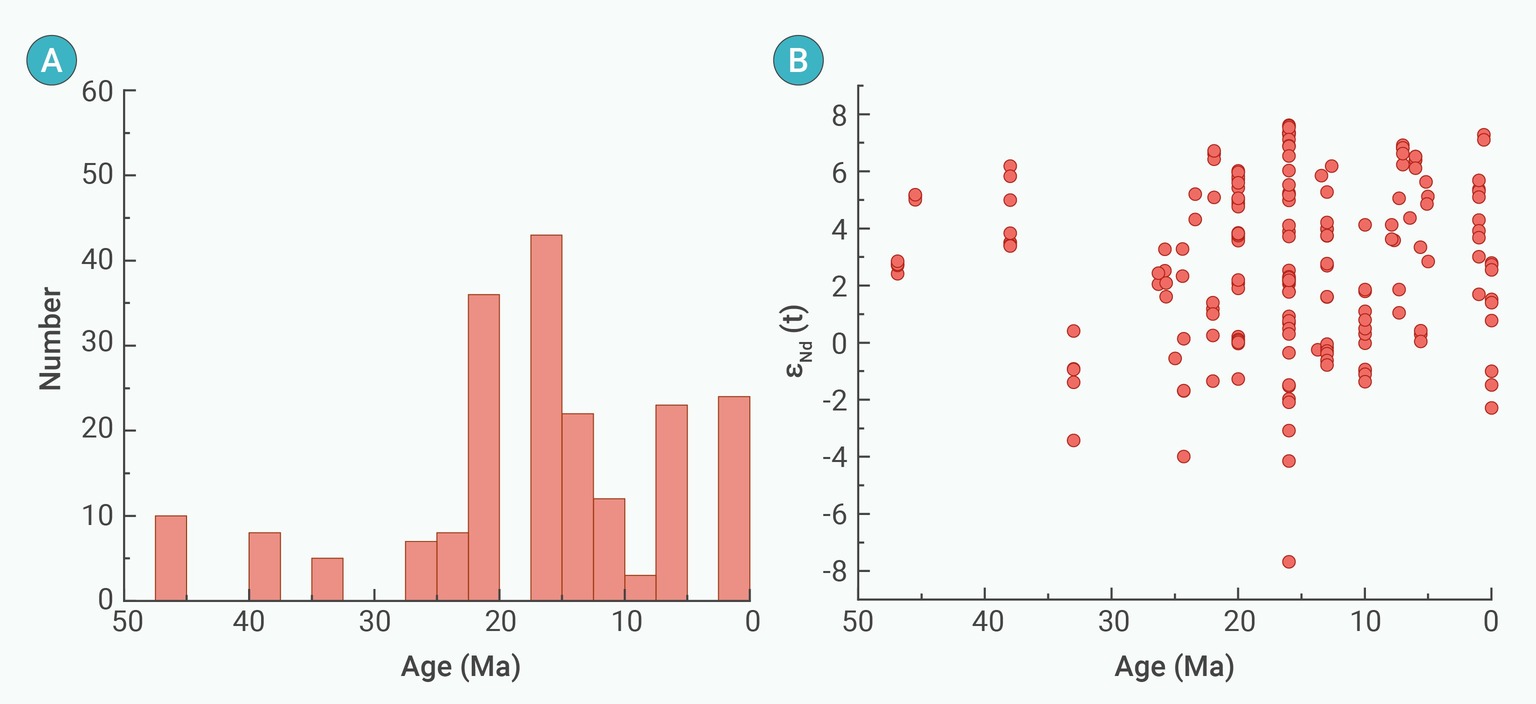
Figure 4.
Temporal distribution and Nd isotopic evolution of Cenozoic magmatism in the North China Craton
-
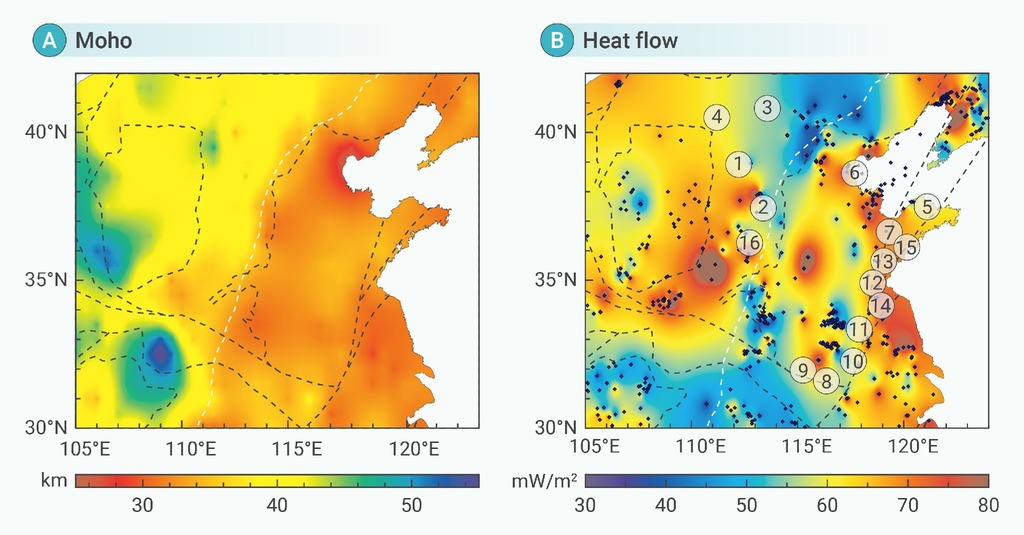
Figure 5.
Distribution of (A) Moho depth and (B) heat flow of north China
-
Figure 6.
3D schematic diagram of the Cenozoic destruction of the North China Craton.
