
Threats to energy transition embodied in global supply chains under extreme geopolitical scenarios
-
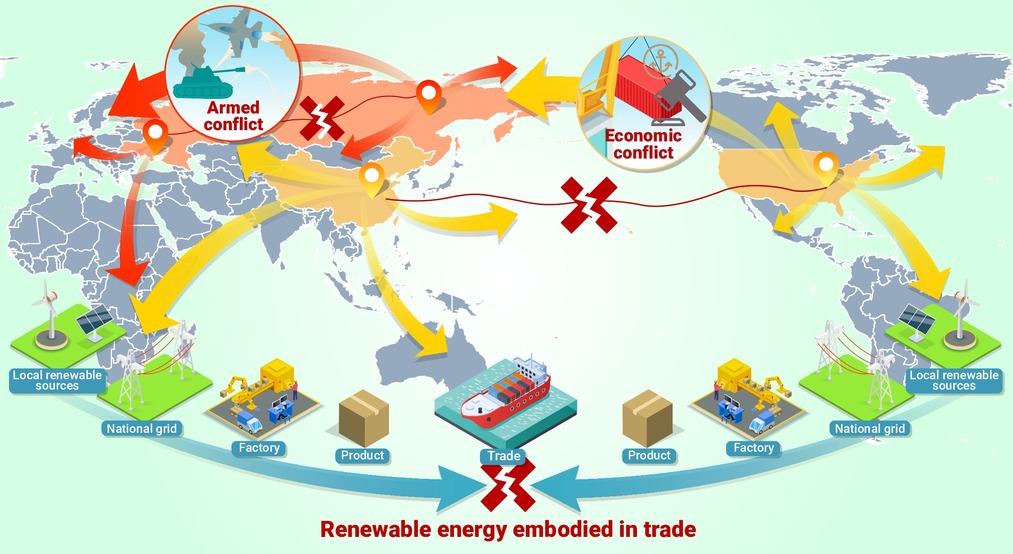
GRAPHICAL ABSTRACT
 DownLoad:
Full size image
DownLoad:
Full size image
-
PUBLIC SUMMARY
-
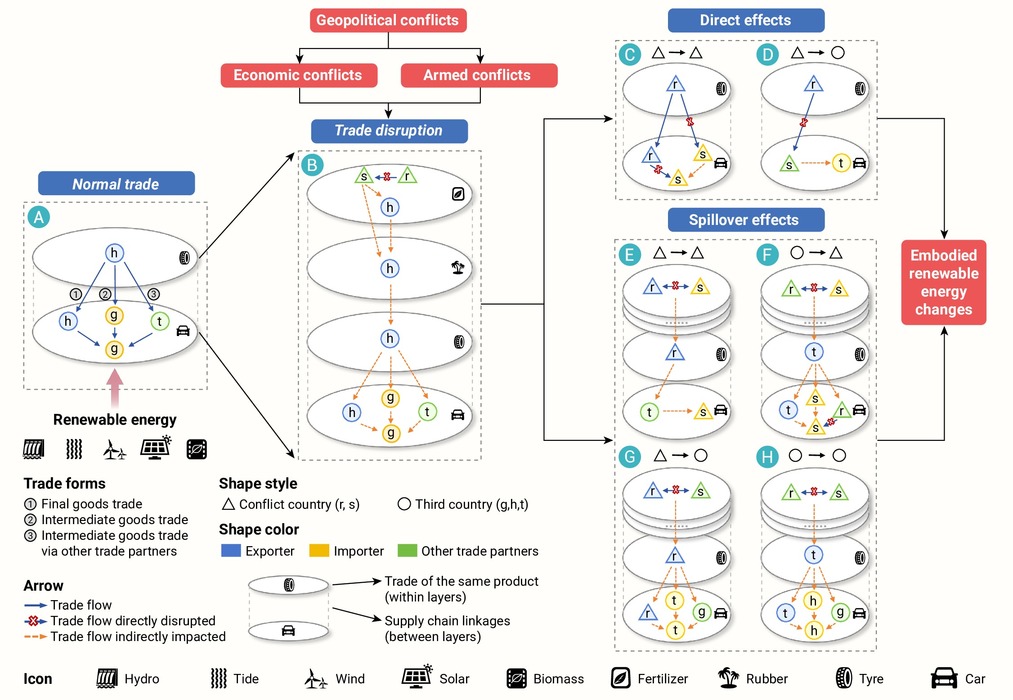
We develop a Conflict-Supply Chain-Effect (CSE) model to capture the cascading pathways of trade shocks.
First quantification of embodied renewable energy import losses under geopolitical conflict scenarios.
Trade disruptions exert uneven direct and spillover effects on conflict and third-party nations.
-
-
ABSTRACT
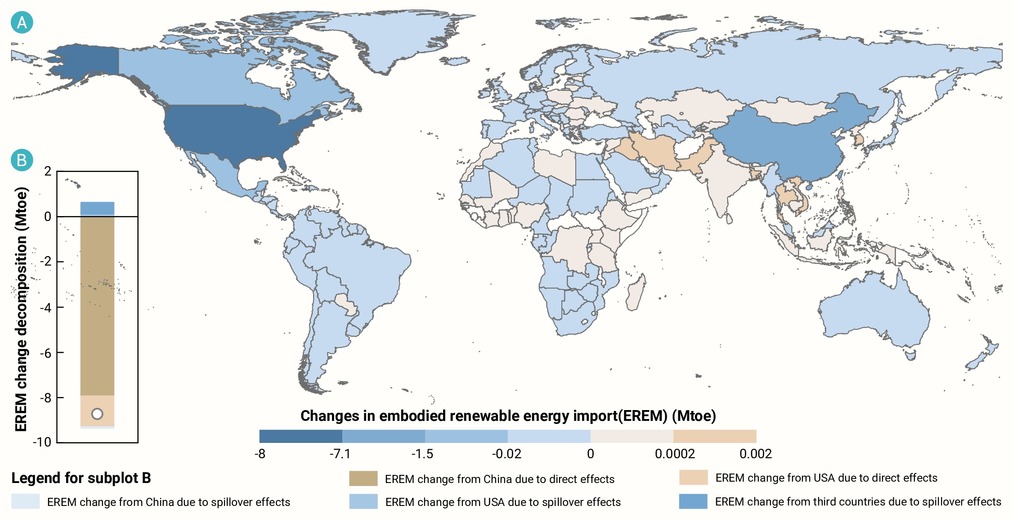
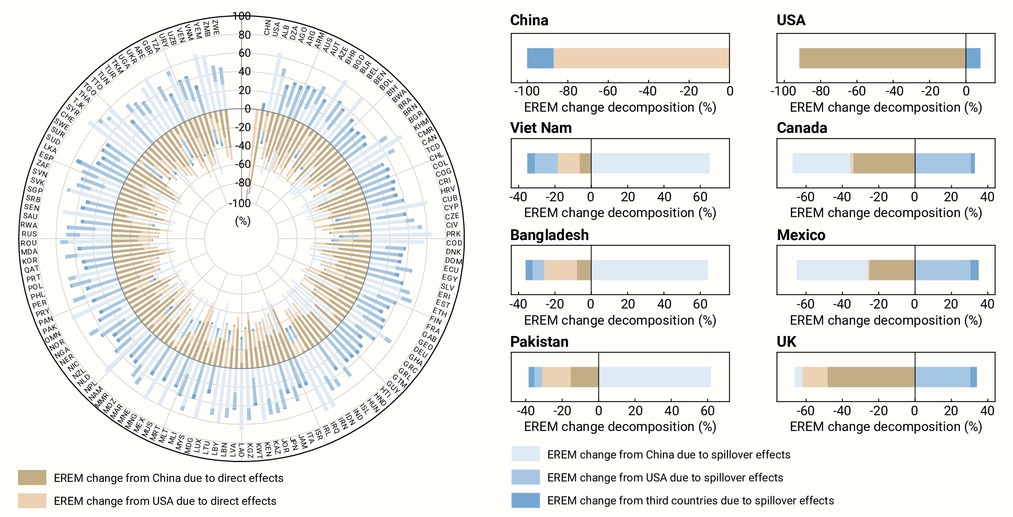
Geopolitical conflicts may threaten energy transition embodied in global supply chains via disruptions to embodied renewable energy imports (EREM). Current studies predominantly focus on direct shocks to conventional energy trade, largely overlooking the vulnerabilities of EREM and failing to disentangle the cascading transmission pathways of these disruptions. Here, we develop a Conflict-Supply Chain-Effect (CSE) model to quantify EREM change for both conflict participants and third countries under two scenarios: an economic conflict (the China-US trade dispute) and an armed conflict (the Russia-Ukraine war). We find that the China-US dispute reduces global EREM by 4.1%, with the US facing a sharper loss (7.1 Mtoe) than China (1.5 Mtoe). In the Russia-Ukraine scenario, global EREM declines by 8%. Notably, losses from spillover effects are nearly double those from direct effects, causing substantial losses (3.8 Mtoe) even among non-conflict nations. Crucially, we demonstrate that import substitution strategies fail to significantly mitigate these losses; instead, they deepen the hidden dependencies between the US and China and the asymmetric reliance of Russia on sanctioning nations. Our findings underscore that the energy transition transcends environmental concerns to become a complex geopolitical issue and ensuring supply chain resilience is critical for a secure global energy future.-
Keywords:
- renewable energy /
- trade disputes /
- war /
- global supply chains /
- multi-regional input-output
-

-
REFERENCES
[1] Markard J. (2018). The next phase of the energy transition and its implications for research and policy. Nat. Energy 3:628−633. DOI:10.1038/s41560-018-0171-7 [2] Peng K., Feng K., Chen B., et al. (2023). The global power sector’s low-carbon transition may enhance sustainable development goal achievement. Nat. Commun. 14:3144. DOI:10.1038/s41467-023-38987-4 [3] Wiedmann T. and Lenzen M. (2018). Environmental and social footprints of international trade. Nat. Geosci. 11:314−321. DOI:10.1038/s41561-018-0113-9 [4] Shepard J.U. and Pratson L.F. (2022). The myth of US energy independence. Nat. Energy 7:462−464. DOI:10.1038/s41560-022-01053-2 [5] He J., Yang Y., Liao Z., et al. (2022). Linking SDG 7 to assess the renewable energy footprint of nations by 2030. Appl. Energy 317:119167. DOI:10.1016/J.APENERGY.2022.119167 [6] Yang Y., Cheng Y., Poon J.P.H., et al. (2025). A database for identifying and tracking renewable energy embodied in global trade. Nat. Sustain. 8:1223−1233. DOI:10.1038/s41893-025-01614-9 [7] Shumilova O., Tockner K., Sukhodolov A., et al. (2023). Impact of the Russia–Ukraine armed conflict on water resources and water infrastructure. Nat. Sustain. 6:578–586. DOI:10.1038/s41893-023-01068-x [8] Gleick P., Vyshnevskyi V. and Shevchuk S. (2023). Rivers and Water Systems as Weapons and Casualties of the Russia-Ukraine War. Earths Future 11:e2023EF003910. DOI:10.1029/2023EF003910 [9] Doronina I., Arlt M.-L., Torres M.G., et al. (2024). Why renewables should be at the center of rebuilding the Ukrainian electricity system. Joule 8:2715−2720. DOI:10.1016/j.joule.2024.08.014 [10] Wang M., Mao X., Xing Y., et al. (2021). Breaking down barriers on PV trade will facilitate global carbon mitigation. Nat. Commun. 12:6820. DOI:10.1038/s41467-021-26547-7 [11] Hughes L. and Meckling J. (2017). The politics of renewable energy trade: The US-China solar dispute. Energy Policy 105:256−262. DOI:10.1016/j.enpol.2017.02.044 [12] Shao Y. and Li J. (2025). When renewable energy technology products exports meet geopolitical risks: Can environmental policies sweeten the bitter pill of the trade. Energy Econ. 145:108498. DOI:10.1016/j.eneco.2025.108498 [13] Wang M. and Xie Z. (2025). International trade barriers, export and industrial resilience: An empirical study based on the EU and USA antidumping and countervailing policies on photovoltaic products. Energy Policy 201:114556. DOI:10.1016/j.enpol.2025.114556 [14] Guan Y., Yan J., Shan Y., et al. (2023). Burden of the global energy price crisis on households. Nat. Energy 8:304−316. DOI:10.1038/s41560-023-01209-8 [15] Umar M., Riaz Y. and Yousaf I. (2022). Impact of Russian-Ukraine war on clean energy, conventional energy, and metal markets: Evidence from event study approach. Resour. Policy 79:102966. DOI:10.1016/j.resourpol.2022.102966 [16] Lu J., Mao X., Wang M., et al. (2020). Global and national environmental impacts of the US–China trade war. Environ. Sci. Technol. 54:16108−16118. DOI:10.1021/acs.est.0c03863 [17] Huang G., Chen L. and Luo B. (2024). International trade sanctions imposed due to the Russia-Ukraine war may cause unequal distribution of environmental and health impacts. Commun. Earth Environ. 5:1−13. DOI:10.1038/s43247-024-01741-9 [18] Liu L.-J., Jiang H.-D., Liang Q.-M., et al. (2023). Carbon emissions and economic impacts of an EU embargo on Russian fossil fuels. Nat. Clim. Chang. 13:290−296. DOI:10.1038/s41558-023-01606-7 [19] Laber M., Klimek P., Bruckner M., et al. (2023). Shock propagation from the Russia–Ukraine conflict on international multilayer food production network determines global food availability. Nat. Food 4:508−517. DOI:10.1038/s43016-023-00771-4 [20] Zhou X.-Y., Lu G., Xu Z., et al. (2023). Influence of Russia-Ukraine war on the global energy and good security. Resour. Conserv. Recycl. 188:106657. DOI:10.1016/j.resconrec.2022.106657 [21] Wang F. and Wu M. (2023). How does trade policy uncertainty affect China’s economy and energy. J. Environ. Manage. 330:117198. DOI:10.1016/j.jenvman.2022.117198 [22] Jiang X. and Green C. (2017). The impact on global greenhouse gas emissions of geographic shifts in global supply chains. Ecol. Econ. 139:102−114. DOI:10.1016/j.ecolecon.2017.04.027 [23] Yuan R., Rodrigues J.F.D., Wang J., et al. (2023). The short-term impact of US-China trade war on global GHG emissions from the perspective of supply chain reallocation. Environ. Impact Assess. Rev. 98:106980. DOI:10.1016/j.eiar.2022.106980 [24] Wu Z., Yang L., Chen Q., et al. (2021). The impacts of international trade on global greenhouse gas emissions: A thought experiment based on a novel no-trade analysis. J. Environ. Manage. 300:113836. DOI:10.1016/j.jenvman.2021.113836 [25] Cheng Y. and Yang Y. (2025). A database for identifying and tracking renewable energy embodied in global trade. DOI:10.5281/zenodo.15826919 [26] Lenzen M., Moran D., Kanemoto K., et al. (2013). Building Eora: A global multi-region input–output database at high country and sector resolution. Econ. Syst. Res. 25:20−49. DOI:10.1080/09535314.2013.769938 [27] Lenzen M., Kanemoto K., Moran D., et al. (2012). Mapping the structure of the world economy. Environ. Sci. Technol. 46:8374−8381. DOI:10.1021/es300171x [28] Xia Y., Kong Y., Ji Q., et al. (2019). Impacts of China-US trade conflicts on the energy sector. China Econ. Rev. 58:101360. DOI:10.1016/j.chieco.2019.101360 [29] Chai L., Liu A., Li X., et al. (2024). Telecoupled impacts of the Russia–Ukraine war on global cropland expansion and biodiversity. Nat. Sustain. 7:432–441. DOI:10.1038/s41893-024-01292-z [30] Sun Y., Zhu S., Wang D., et al. (2024). Global supply chains amplify economic costs of future extreme heat risk. Nature 627:797–804. DOI:10.1038/s41586-024-07147-z [31] Malik A., Li M., Lenzen M., et al. (2022). Impacts of climate change and extreme weather on food supply chains cascade across sectors and regions in Australia. Nat. Food 3:631−643. DOI:10.1038/s43016-022-00570-3 [32] Bruckner B., Shan Y., Prell C., et al. (2023). Ecologically unequal exchanges driven by EU consumption. Nat. Sustain. 6:587−598. DOI:10.1038/s41893-022-01055-8 [33] Hong C., Zhao H., Qin Y., et al. (2022). Land-use emissions embodied in international trade. Science 376:597−603. DOI:10.1126/science.abj1572 [34] Wiebe K.S. and Yamano N. (2016). Estimating CO2 Emissions embodied in final demand and trade using the OECD ICIO 2015: Methodology and results. OECD Sci. Technol. Ind. Work. Pap. 5:38. DOI:10.1787/5jlrcm216xkl-en [35] Luttwak E.N. (1990). From geopolitics to geo-economics: Logic of conflict, grammar of commerce. Natl. Interest 20:17–23. https://www.jstor.org/stable/42894676 [36] WTO (2024). Global trade outlook and statistics. https://data.wto.org/en/dataset/wto_gtos [37] BP (2024). Statistical review of world energy 2024. https://www.energyinst.org/__data/assets/pdf_file/0010/1540549/sr-2024.pdf [38] FAO (2023). Trade of agricultural commodities. [39] Funakoshi M., Lawson H. and Deka K. (2022). Tracking sanctions against Russia. Reuters. https://www.reuters.com/graphics/UKRAINE-CRISIS/SANCTIONS/byvrjenzmve [40] Freund C., Mattoo A., Mulabdic A., et al. (2024). Is US trade policy reshaping global supply chains. J. Int. Econ. 152:104011. DOI:10.1016/j.jinteco.2024.104011 [41] Itskhoki O. and Ribakova E. (2024). The economics of sanctions: from theory into practice. Brook. Pap. Econ. Act. 2024:425−497. DOI:10.1353/eca.2024.a964374 [42] IRENA (2023). Renewable energy statistics 2023. International Renewable Energy Agency, Abu Dhabi. https://unreeea.org/wp-content/uploads/2023/04/IRENA_RE_Capacity_Statistics_2023.pdf -
ABOUT THIS ARTICLE
Cite this article:
Cheng Y., Yang Y., Poon J. P.H., et al. (2026). Threats to energy transition embodied in global supply chains under extreme geopolitical scenarios. The Innovation Geoscience 4:100218. https://doi.org/10.59717/j.xinn-geo.2026.100218
Welcome!
To request copyright permission to republish or share portions of our works, please visit Copyright Clearance Center's (CCC) Marketplace website at marketplace.copyright.com.
Export File
Citation
Cheng Y., Yang Y., Poon J. P.H., et al. (2026). Threats to energy transition embodied in global supply chains under extreme geopolitical scenarios. The Innovation Geoscience 4:100218. https://doi.org/10.59717/j.xinn-geo.2026.100218

Format
Content
-
Figure 1.
CSE model overview
-
Figure 2.
Changes in embodied renewable energy import (EREM) under the China-US domestic substitution scenario
-
Figure 3.
Decomposition of EREM variations into direct and spillover effects for individual economies under the China-US domestic substitution scenario
-
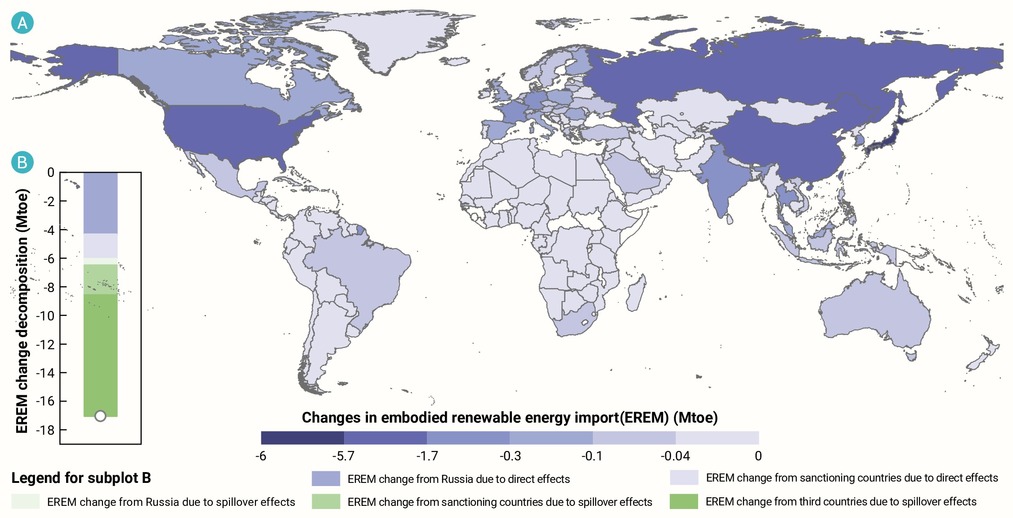
Figure 4.
Changes in embodied renewable energy import (EREM) under the Russia-Ukraine domestic substitution scenario
-
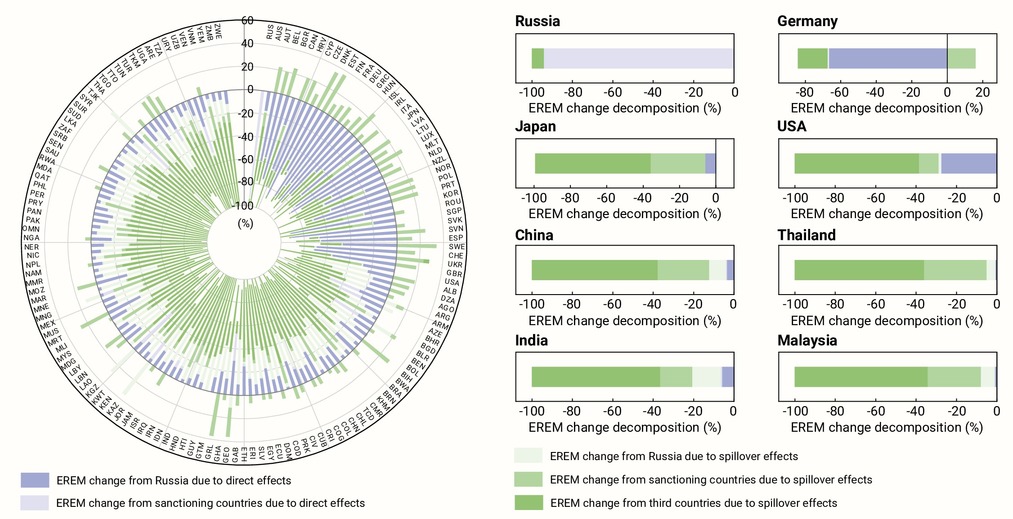
Figure 5.
Decomposition of EREM variations into direct and spillover effects for individual economies under the Russia-Ukraine domestic substitution scenario
-
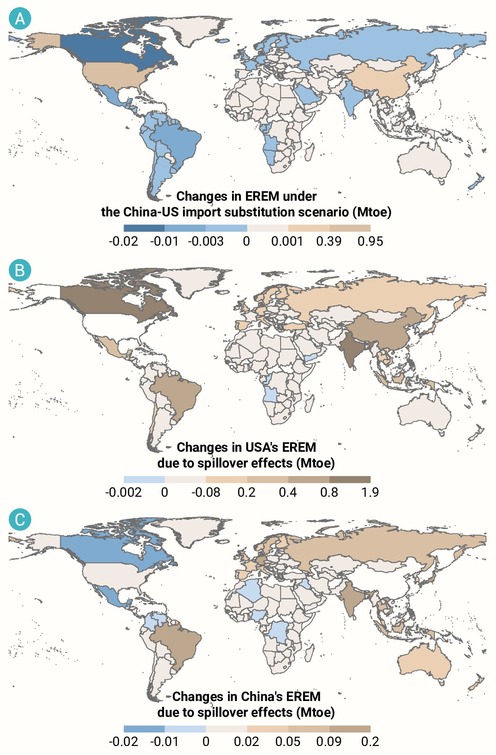
Figure 6.
Geographic distribution of embodied renewable energy import (EREM) changes under China-US import substitution scenarios
-
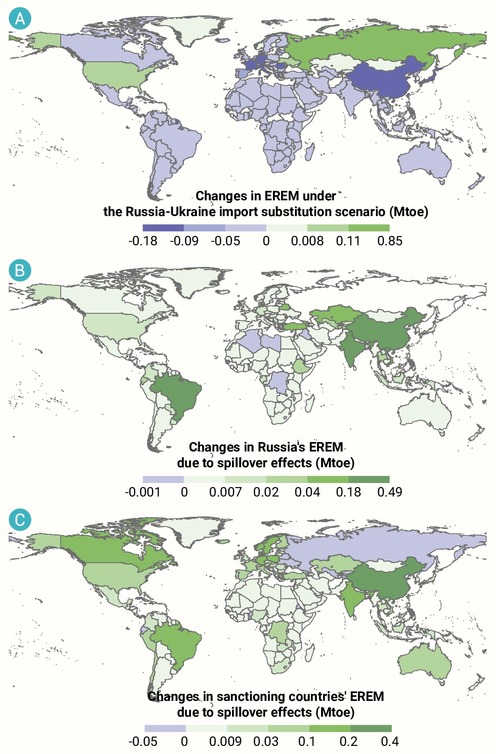
Figure 7.
Geographic distribution of embodied renewable energy import (EREM) changes under Russia-Ukraine import substitution scenarios
