
Bridging medical imaging and reports: Learning radiologist’s nuances via fine-grained multi-modal alignment
-
GRAPHICAL ABSTRACT
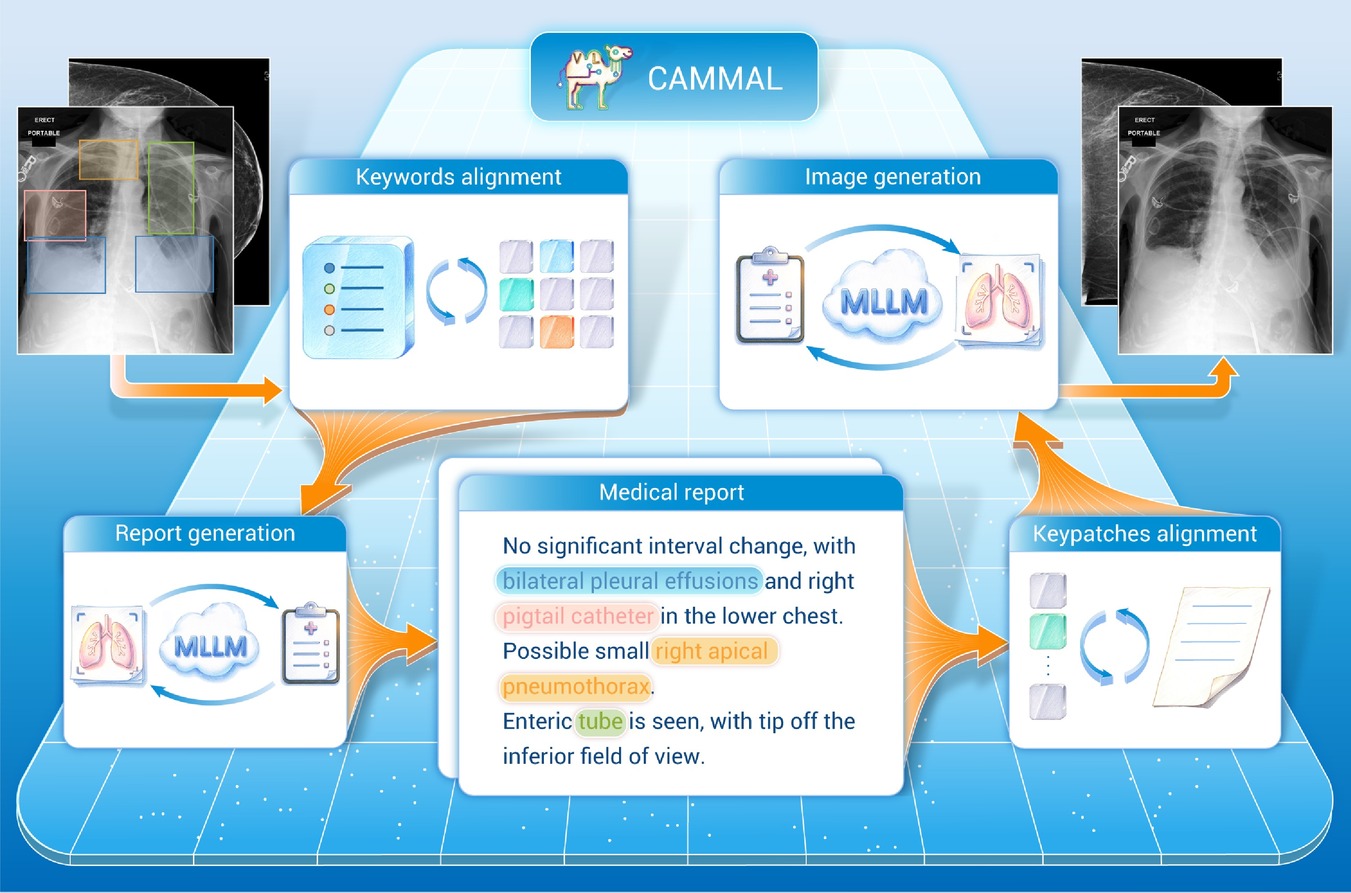
 DownLoad:
Full size image
-
PUBLIC SUMMARY
-
CAMMAL links specific areas in medical images to words in radiology reports.
It generates reports from chest X-rays and creates synthetic medical images from text.
It outperformed comparison models in describing mammograms and generating chest X-ray reports..
Correct chest X-ray and report matches ranked in the top 10 in over 94% of searches.
-
-
ABSTRACT
Precise and explainable alignment between data from different data modalities is crucial for advancing artificial general intelligence in medicine. In this work, we present CAMMAL (Cyclic Adaptive Medical Modality ALignment), a framework that can achieve fine-grained vision-language alignment through two key innovations, including an Adaptive Patch-Word Matching (AdaMatch) mechanism that dynamically correlates regions in medical images with specific words in radiology reports, and a bidirectional generative architecture that leverages the alignment between textual and visual codebooks to guide the translation between modalities within a single model. Evaluation of CAMMAL on the chest X-rays (combined MIMIC-CXR and OpenI datasets) and mammography (EMBED dataset) demonstrates its superior performance across multiple metrics over other methods. Human reader studies by radiologists validate the clinical effectiveness of the generated reports and synthetic images, particularly in capturing anatomical structures (73% rated good/excellent) and meaningful findings (56% rated very good/excellent). By enabling systematic capture of inter-modality medical data correspondence and fluid multi-way translation between modalities, CAMMAL could advance the development of interpretable and clinically reliable AI systems by bridging the gap between medical images and textual descriptions. Its ability to accurately retrieve, generate, and align reports with imaging data offers potential improvements in learning detailed radiologists' knowledge, which could be vital for AI-assisted diagnosis and medical education. The bidirectional generative approach further enhances model transparency and explainability, fostering trust for AI-driven healthcare applications. As multimodal medical foundation models continue to evolve, CAMMAL provides a foundation for integrating vision and language understanding, with the potential for broader clinical applications beyond radiology. -

-
REFERENCES
[1] Radford A., Kim J.W., Hallacy C., et al. (2021). Learning transferable visual models from natural language supervision. ICML. 139: 8748–63. https://proceedings.mlr.press/v139/radford21a.html [2] Oquab M., Darcet T., Moutakanni T., et al. (2024). DINOv2: Learning robust visual features without supervision. Trans. Mach. Learn. Res. https://openreview.net/forum?id=a68SUt6zFt [3] Kirillov A., Mintun E., Ravi N., et al. (2023). Segment anything. ICCV. 2023: 3992−4003. DOI:10.1109/iccv51070.2023.00371 [4] He K., Fan H., Wu Y., et al. (2020). Momentum contrast for unsupervised visual representation learning. CVPR. 2020: 9726−9735. DOI:10.1109/cvpr42600.2020.00975 [5] Chen R.J., Ding T., Lu M.Y., et al. (2024). Towards a general-purpose foundation model for computational pathology. Nat. Med. 30:850−862. DOI:10.1038/s41591-024-02857-3 [6] Wu L., Zhuang J. and Chen H. (2024). VoCo: A simple-yet-effective volume contrastive learning framework for 3D medical image analysis. CVPR. 2024: 22873−22882. DOI:10.1109/cvpr52733.2024.02158 [7] Ma J., He Y., Li F., et al. (2024). Segment anything in medical images. Nat. Commun. 15:654. DOI:10.1038/s41467-024-44824-z [8] Zhou Y., Chia M.A., Wagner S.K., et al. (2023). A foundation model for generalizable disease detection from retinal images. Nature 622:156−63. DOI:10.1038/s41586-023-06555-x [9] He Y., Yang G., Ge R., et al. (2023). Geometric visual similarity learning in 3D medical image self-supervised pre-training. CVPR. 2023: 9538−47. DOI:10.1109/cvpr52729.2023.00920 [10] Wang J., Wang K., Yu Y., et al. (2025). Self-improving generative foundation model for synthetic medical image generation and clinical applications. Nat. Med. 31:609−17. DOI:10.1038/s41591-024-03359-y [11] Kondepudi A., Pekmezci M., Hou X., et al. (2025). Foundation models for fast, label-free detection of glioma infiltration. Nature 637:439−45. DOI:10.1038/s41586-024-08169-3 [12] Huang W., Li C., Zhou H.Y., et al. (2024). Enhancing representation in radiography-reports foundation model: A granular alignment algorithm using masked contrastive learning. Nat. Commun. 15:7620. DOI:10.1038/s41467-024-51749-0 [13] Wang X., Zhao J., Marostica E., et al. (2024). A pathology foundation model for cancer diagnosis and prognosis prediction. Nature 634:970−8. DOI:10.1038/s41586-024-07894-z [14] Vorontsov E., Bozkurt A., Casson A., et al. (2024). A foundation model for clinicalgrade computational pathology and rare cancers detection. Nat. Med. 30:2924−35. DOI:10.1038/s41591-024-03141-0 [15] Christensen M., Vukadinovic M., Yuan N., et al. (2024). Vision-language foundation model for echocardiogram interpretation. Nat. Med. 30:1481−8. DOI:10.1038/s41591-024-02959-y [16] Jin Q., Wang Z., Floudas C.S., et al. (2024). Matching patients to clinical trials with large language models. Nat. Commun. 15:9074. DOI:10.1038/s41467-024-53081-z [17] Zhang K., Zhou R., Adhikarla E., et al. (2024). A generalist vision-language foundation model for diverse biomedical tasks. Nat. Med. 30:3129−41. DOI:10.1038/s41591-024-03185-2 [18] Bluethgen C., Chambon P., Delbrouck J.B., et al. (2025). A vision-language foundation model for the generation of realistic chest x-ray images. Nat. Biomed. Eng. 9:494−506. DOI:10.1038/s41551-024-01246-y [19] Zhao T., Gu Y., Yang J., et al. (2025). A foundation model for joint segmentation, detection and recognition of biomedical objects across nine modalities. Nat. Methods 22:166−76. DOI:10.1038/s41592-024-02499-w [20] Tanno R., Barrett D.G.T., Sellergren A., et al. (2025). Collaboration between clinicians and vision-language models in radiology report generation. Nat. Med. 31:599−608. DOI:10.1038/s41591-024-03302-1 [21] Lu M.Y., Chen B., Williamson D.F.K., et al. (2024). A visual-language foundation model for computational pathology. Nat. Med. 30:863−74. DOI:10.1038/s41591-024-02856-4 [22] Huang Z., Bianchi F., Yuksekgonul M., et al. (2023). A visual-language foundation model for pathology image analysis using medical Twitter. Nat. Med. 29:2307−16. DOI:10.1038/s41591-023-02504-3 [23] Li J., Guan Z., Wang J., et al. (2024). Integrated image-based deep learning and language models for primary diabetes care. Nat. Med. 30:2886−96. DOI:10.1038/s41591-024-03139-8 [24] Kim C., Gadgil S.U., DeGrave A.J., et al. (2024). Transparent medical image AI via an image-text foundation model grounded in medical literature. Nat. Med. 30:1154−65. DOI:10.1038/s41591-024-02887-x [25] Li X., Zhao L., Zhang L., et al. (2025). Artificial general intelligence for medical imaging analysis. IEEE Rev. Biomed. Eng. 18:113−29. DOI:10.1109/rbme.2024.3493775 [26] Bradshaw T.J., Tie X., Warner J., et al. (2025). Large language models and large multimodal models in medical imaging: A primer for physicians. J. Nucl. Med. 66:173−82. DOI:10.2967/jnumed.124.268072 [27] Shi Y., Li Q., Sun J., et al. (2025). Enhancing cognition and explainability of multimodal foundation models with self-synthesized data. ICLR 2025: 85780–803. https://proceedings.iclr.cc/paper_files/paper/2025/hash/d51cd79a85833b022841f7a2383b32d3-Abstract-Conference.html [28] Zhong T., Zhao W., Zhang Y., et al. (2026). Chatradio-valuer: A chat large language model for generalizable radiology impression generation on multi-institution and multi-system data. IEEE Trans. Biomed. Eng. 73:1050−61. DOI:10.1109/tbme.2025.3597325 [29] Guo Z., Li X., Huang H., et al. (2019). Deep learning-based image segmentation on multimodal medical imaging. IEEE Trans. Radiat. Plasma Med. Sci. 3:162−9. DOI:10.1109/trpms.2018.2890359 [30] Peng Y., Qi J. and Yuan Y. (2018). Modality-specific cross-modal similarity measurement with recurrent attention network. IEEE Trans. Image Process. 27:5585−99. DOI:10.1109/tip.2018.2852503 [31] Cui H., Mao L., Liang X., et al. (2024). Biomedical visual instruction tuning with clinician preference alignment. NeurIPS 37:96449−67. DOI:10.52202/079017-3057 [32] Ma C., Jiang H., Chen W., et al. (2024). Eye-gaze guided multi-modal alignment for medical representation learning. NeurIPS. 37:6126−53. DOI:10.52202/079017-0198 [33] Kline A., Wang H., Li Y., et al. (2022). Multimodal machine learning in precision health: A scoping review. npj Digit. Med. 5:171. DOI:10.1038/s41746-022-00712-8 [34] Jia C., Yang Y., Xia Y., et al. (2021). Scaling up visual and vision-language representation learning with noisy text supervision. ICML. 139: 4904–16.https://proceedings.mlr.press/v139/jia21b.html [35] Jang J., Kong C., Jeon D., et al. (2023). Unifying vision-language representation space with single-tower transformer. AAAI. 37:980−8. DOI:10.1609/aaai.v37i1.25178 [36] Wang W., Bao H., Dong L., et al. (2023). Image as a foreign language: BEiT pretraining for vision and vision-language tasks. CVPR. 2023:19175−86. DOI:10.1109/cvpr52729.2023.01838 [37] Yang J., Duan J., Tran S., et al. (2022). Vision-language pre-training with triple contrastive learning. CVPR. 2022:15650−9. DOI:10.1109/cvpr52688.2022.01522 [38] Chen Y.C., Li L., Yu L., et al. (2020). UNITER: Universal image-text representation learning. ECCV. 2020: 104–20. DOI: 10.1007/978-3-030-58577-8_7 [39] Li X., Yin X., Li C., et al. (2020). OSCAR: Object-semantics aligned pre-training for vision-language tasks. ECCV. 2020:121–37. DOI: 10.1007/978-3-030-58577-8_8 [40] Li W., Gao C., Niu G., et al. (2021). UNIMO: Towards unified-modal understanding and generation via cross-modal contrastive learning. ACL-IJCNLP. 2021: 2592–607. DOI: 10.18653/v1/2021.acl-long.202 [41] Zhan X., Wu Y., Dong X., et al. (2021). Product1M: Towards weakly supervised instance-level product retrieval via cross-modal pretraining. ICCV. 2021:11762–71. DOI: 10.1109/iccv48922.2021.01157 [42] Kim W., Son B. and Kim I. (2021). ViLT: Vision-and-language transformer without convolution or region supervision. ICML. 139: 5583–94. https://proceedings.mlr.press/v139/kim21k.html [43] Yao L., Huang R., Hou L., et al. (2022). FILIP: Fine-grained interactive language-image pre-training. ICLR. URL: https://openreview.net/forum?id=cpDhcsEDC2 [44] Ji Z., Shaikh M.A., Moukheiber D., et al. (2021). Improving joint learning of chest x-ray and radiology report by word region alignment. MLMI. 2021:110−9. DOI:10.1007/978-3-030-87589-3_12 [45] Wang F., Zhou Y., Wang S., et al. (2022). Multi-granularity cross-modal alignment for generalized medical visual representation learning. NeurIPS. 35:33536−49. DOI:10.52202/068431-2430 [46] Moon J.H., Lee H., Shin W., et al. (2022). Multi-modal understanding and generation for medical images and text via vision-language pre-training. IEEE J. Biomed. Health Inform. 26:6070−80. DOI:10.1109/jbhi.2022.3207502 [47] Huang S.C., Shen L., Lungren M.P., et al. (2021). GLoRIA: A multimodal global-local representation learning framework for label-efficient medical image recognition. ICCV. 2021: 3922–31. DOI: 10.1109/iccv48922.2021.00391 [48] Yan B. and Pei M. (2022). Clinical-BERT: Vision-language pre-training for radiograph diagnosis and reports generation. AAAI. 36: 2982–90. DOI: 10.1609/aaai.v36i3.20204 [49] Wan Z., Liu C., Zhang M., et al. (2023). Med-UniC: Unifying cross-lingual medical vision-language pre-training by diminishing bias. NeurIPS. 36: 56186–97. DOI:10.52202/075280-2450 [50] Chen X., He Y., Xue C., et al. (2023). Knowledge boosting: Rethinking medical contrastive vision-language pre-training. MICCAI. 2023: 405−15. DOI:10.1007/978-3-031-43907-0_39 [51] Liu C., Cheng S., Shi M., et al. (2025). IMITATE: Clinical prior guided hierarchical vision-language pre-training. IEEE Trans. Med. Imaging 44: 519–29. DOI: 10.1109/tmi.2024.3449690 [52] Esser P., Rombach R. and Ommer B. (2021). Taming transformers for high-resolution image synthesis. CVPR. 2021: 12868–78. DOI: 10.1109/cvpr46437.2021.01268 [53] Johnson A.E.W., Pollard T.J., Berkowitz S.J., et al. (2019). MIMIC-CXR, a de-identified publicly available database of chest radiographs with free-text reports. Sci. Data 6:317. DOI:10.1038/s41597-019-0322-0 [54] Demner-Fushman D., Kohli M.D., Rosenman M.B., et al. (2016). Preparing a collection of radiology examinations for distribution and retrieval. J. Am. Med. Inform. Assoc. 23:304−10. DOI:10.1093/jamia/ocv080 [55] Jeong J.J., Vey B.L., Bhimireddy A., et al. (2023). The EMory BrEast imaging Dataset (EMBED): A racially diverse, granular dataset of 3.4 million screening and diagnostic mammo-graphic images. Radiol. Artif. Intell. 5:e220047. DOI:10.1148/ryai.220047 [56] Chen Z., Song Y., Chang T.H., et al. (2020). Generating radiology reports via memory-driven transformer. EMNLP. 1439−49. DOI:10.18653/v1/2020.emnlp-main.112 [57] Chen Z., Shen Y., Song Y., et al. (2021). Cross-modal memory networks for radiology report generation. ACL-IJCNLP. 2021: 5904–14. DOI: 10.18653/v1/2021.acl-long.459 DOI:10.18653/v1/2021.acl-long.459 [58] Yang Y., Yu J., Zhang J., et al. (2023). Joint embedding of deep visual and semantic features for medical image report generation. IEEE Trans. Multimedia 25:167−78. DOI:10.1109/tmm.2021.3122542 [59] Wang J., Bhalerao A. and He Y. (2022). Cross-modal prototype driven network for radiology report generation. ECCV. 2022: 563−79. DOI:10.1007/978-3-031-19833-5_33 [60] Voutharoja B.P., Wang L. and Zhou L. (2023). Automatic radiology report generation by learning with increasingly hard negatives. ECAI. 2023:2427−34. DOI:10.3233/faia230545 [61] Yang S., Wu X., Ge S., et al. (2023). Radiology report generation with a learned knowledge base and multi-modal alignment. Med. Image Anal. 86:102798. DOI:10.1016/j.me-dia.2023.102798 [62] Rombach R., Blattmann A., Lorenz D., et al. (2022). High-resolution image synthesis with latent diffusion models. CVPR. 2022: 10674−85. DOI:10.1109/cvpr52688.2022.01042 [63] Chambon P., Bluethgen C., Langlotz C.P., et al. (2022). Adapting pretrained vision-language foundational models to medical imaging domains. arXiv preprint. DOI: 10.48550/arXiv.2210.04133 [64] Bluethgen C., Chambon P., Delbrouck J.B., et al. (2025). A vision-language foundation model for the generation of realistic chest x-ray images. Nat. Biomed. Eng. 9:494−506. DOI:10.1038/s41551-024-01246-y [65] Lee H., Kim W., Kim J.H., et al. (2023). Unified chest X-ray and radiology report generation model with multi-view chest X-rays. arXiv preprint. DOI: 10.48550/arXiv.2302.12172 [66] Lee S., Kim W.J. and Ye J.C. (2023). LLM itself can read and generate CXR images. arXiv preprint. DOI: 10.48550/arXiv.2305.11490 [67] Fang H., Gupta S., Iandola F., et al. (2015). From captions to visual concepts and back. CVPR. 2025: 1473−82. DOI:10.1109/cvpr.2015.7298754 [68] Chauhan G., Liao R., Wells W., et al. (2020). Joint modeling of chest radiographs and radiology reports for pulmonary edema assessment. MICCAI. 2020: 529−39. DOI:10.1007/978-3030-59713-9_51 [69] Zhang Y., Jiang H., Miura Y., et al. (2022). Contrastive learning of medical visual representations from paired images and text. MLHC. 182: 2–25. https://proceedings.mlr.press/v182/zhang22a.html [70] Dawidowicz G., Hirsch E. and Tal A. (2023). LIMITR: Leveraging local information for medical image-text representation. ICCV. 2023: 21108–16. DOI: 10.1109/iccv51070.2023.01935 [71] Lin B., Chen Z., Li M., et al. (2023). Towards medical artificial general intelligence via knowledge-enhanced multimodal pretraining. arXiv preprint. DOI: 10.48550/arXiv.2304.14204 [72] Li C., Wong C., Zhang S., et al. (2023). LLaVA-Med: Training a large language-and-vision assistant for biomedicine in one day. NeurIPS. 36:28541−64. DOI:10.52202/075280-1240 [73] Mao D., Liu C., Wang L., et al. (2024). AI-MARRVEL—A knowledge-driven AI system for diagnosing mendelian disorders. NEJM AI. 1:AIoa2300009. DOI:10.1056/aioa2300009 [74] Nobel J.M., van Geel K. and Robben S.G.F. (2022). Structured reporting in radiology: A systematic review to explore its potential. Eur. Radiol. 32:2837−54. DOI:10.1007/s00330-021-08327-5 [75] Sugi M.D., Kennedy T.A., Shah V., et al. (2021). Bridging the gap: Interactive, case-based learning in radiology education. Abdom. Radiol. 46:5503−8. DOI:10.1007/s00261-021-03147-z -
ABOUT THIS ARTICLE
Cite this article:
Chen W., Ren H., Oh Y., et al. (2026). Bridging medical imaging and reports: Learning radiologist’s nuances via fine-grained multi-modal alignment. The Innovation Informatics 2:100069. https://doi.org/10.59717/j.xinn-inform.2026.100069
Welcome!
To request copyright permission to republish or share portions of our works, please visit Copyright Clearance Center's (CCC) Marketplace website at marketplace.copyright.com.
Export File
Citation
Chen W., Ren H., Oh Y., et al. (2026). Bridging medical imaging and reports: Learning radiologist’s nuances via fine-grained multi-modal alignment. The Innovation Informatics 2:100069. https://doi.org/10.59717/j.xinn-inform.2026.100069

Format
Content
-
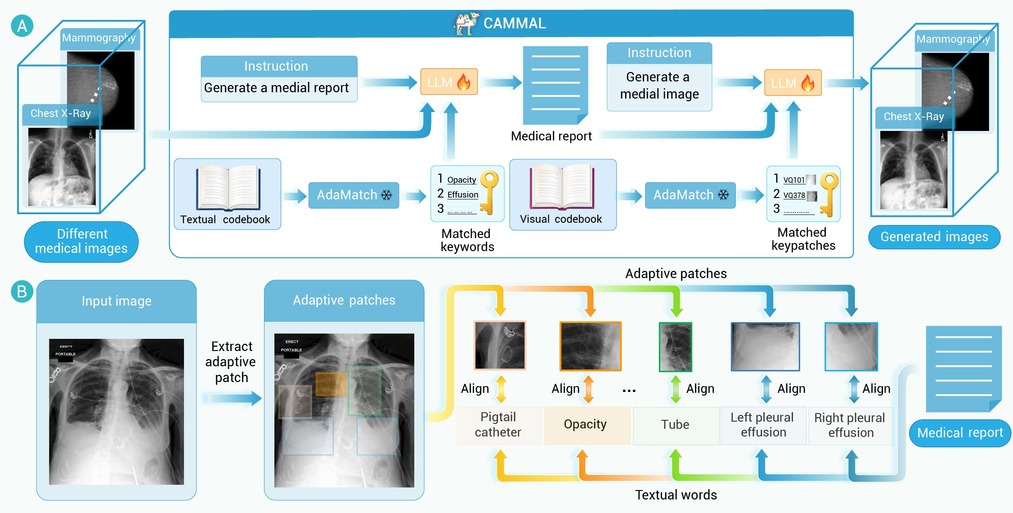
Figure 1.
Illustrative diagram of the CAMMAL framework within a CXR/mammograph report and image generation task
-
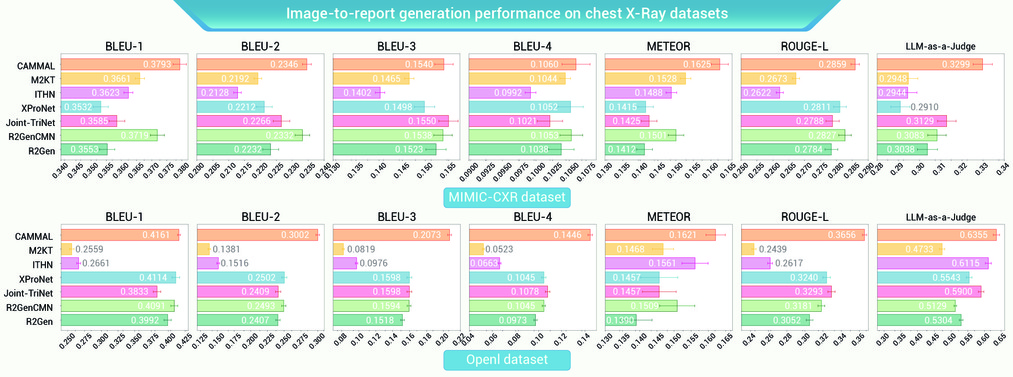
Figure 2.
Image-to-report generation performance in comparison to existing report generation methods on the MIMIC-CXR and OpenI datasets.
-
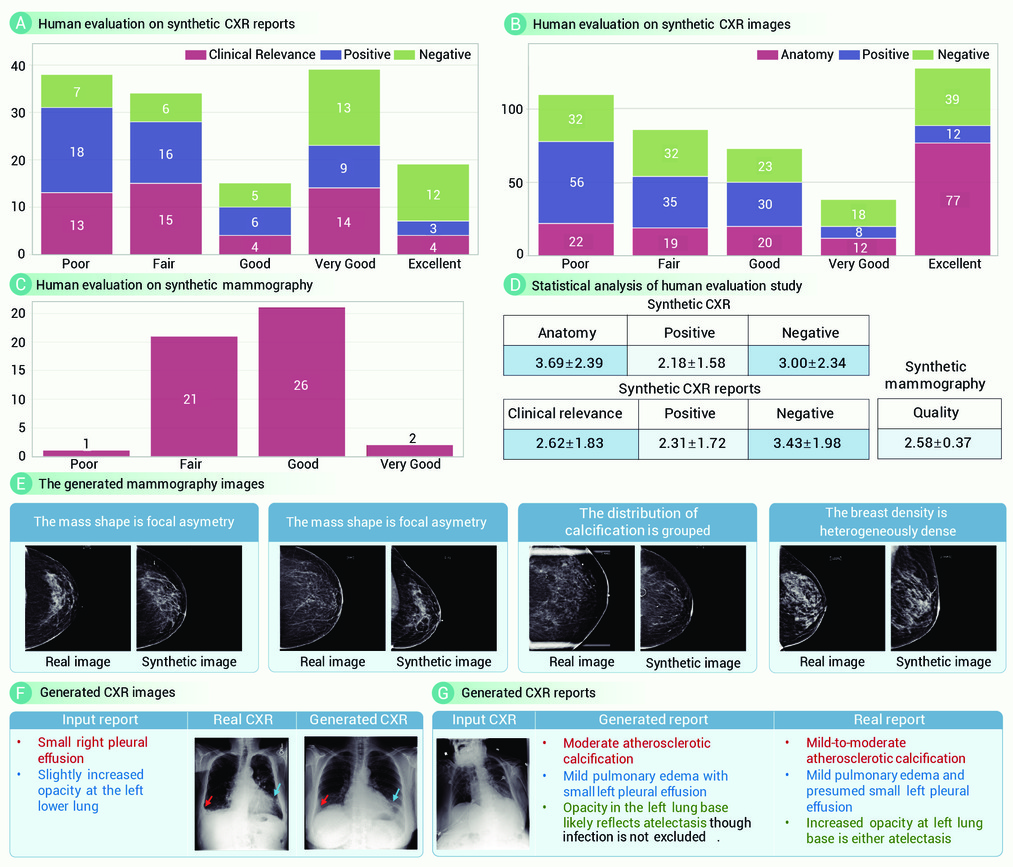
Figure 5.
Human evaluation study and case visualization
-
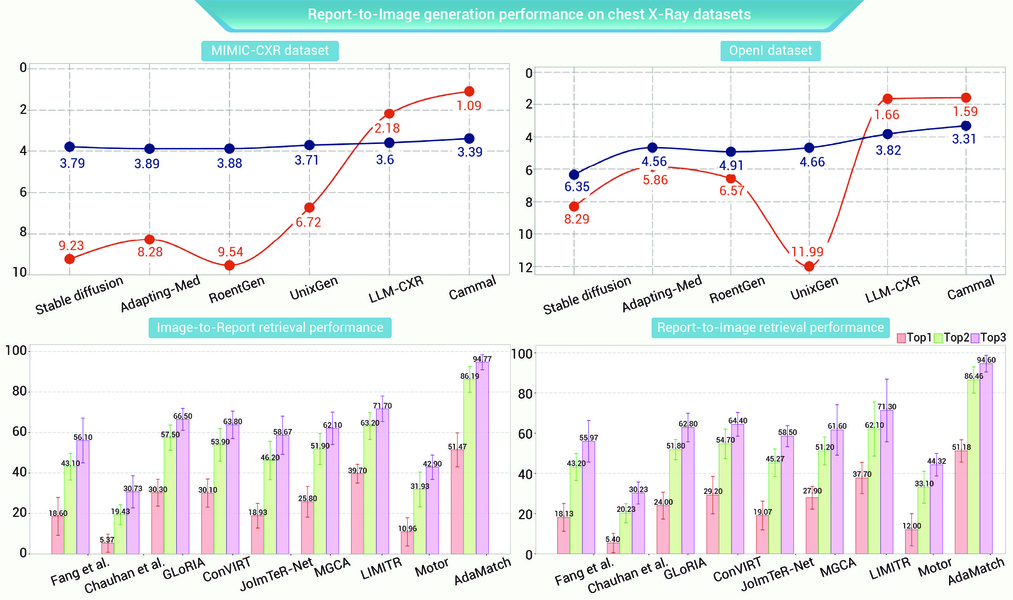
Figure 3.
Quantitative evaluation on the chest x-ray (CXR) datasets
-
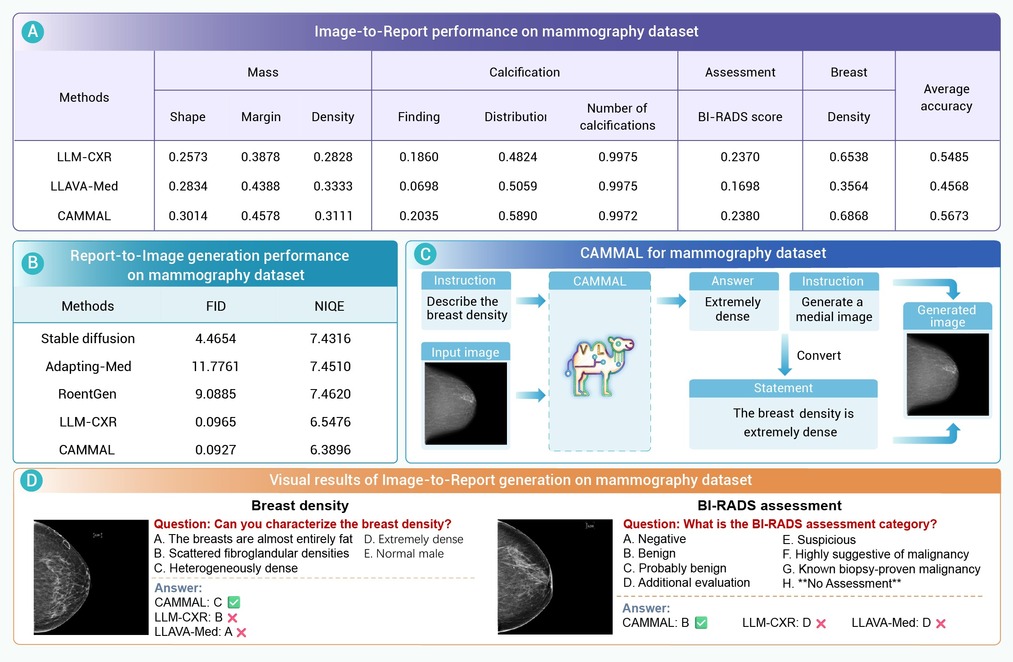
Figure 4.
Quantitative evaluation and visual results on a mammography dataset
-
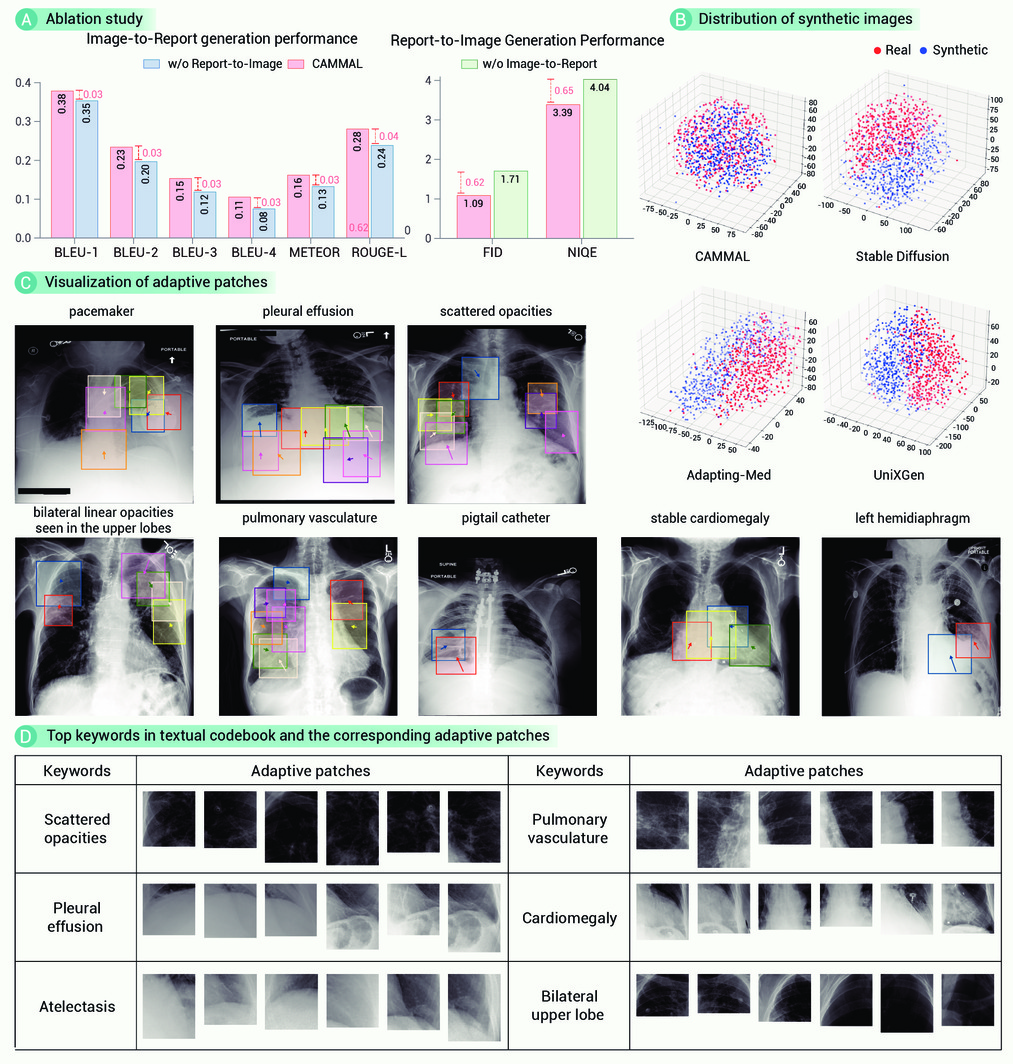
Figure 6.
Ablation study and visualization of adaptive patches
