
Causal representation learning for medical time series: Toward mechanism-aware intelligence
-

-
REFERENCES
[1] Lutsker G., Sapir G., Shilo S., et al. (2026). A foundation model for continuous glucose monitoring data. Nature 650:978−986. DOI:10.1038/s41586-025-09925-9 [2] El Ouahidi Y., Lys J., Tholke P., et al. (2025). REVE: A foundation model for EEG—adapting to any setup with large-scale pretraining on 25,000 subjects. Adv. Neural Inf. Process. Syst. 38. DOI:10.52202/085713-0760 [3] Li Z., Fu M., Huang J., et al. (2025). Towards identifiability of hierarchical temporal causal representation learning. Adv. Neural Inf. Process. Syst. 38. DOI:10.52202/085713-0662 [4] Yao D., Huang S., Cadei R., et al. (2025). The third pillar of causal analysis? A measurement perspective on causal representations. Adv. Neural Inf. Process. Syst. 38. DOI:10.52202/085713-1444 [5] Gamella J.L., Bing S. and Runge J. (2025). Sanity checking causal representation learning on a simple real-world system. Proc. Mach. Learn. Res. 267:18143−18169. DOI:10.48550/arXiv.2502.20099 -
ABOUT THIS ARTICLE
Cite this article:
Wang W., Lyu X., Li X., et al. (2026). Causal representation learning for medical time series: Toward mechanism-aware intelligence. The Innovation Informatics 2:100070. https://doi.org/10.59717/j.xinn-inform.2026.100070
Welcome!
To request copyright permission to republish or share portions of our works, please visit Copyright Clearance Center's (CCC) Marketplace website at marketplace.copyright.com.
Export File
Citation
Wang W., Lyu X., Li X., et al. (2026). Causal representation learning for medical time series: Toward mechanism-aware intelligence. The Innovation Informatics 2:100070. https://doi.org/10.59717/j.xinn-inform.2026.100070

Format
Content
 DownLoad:
-
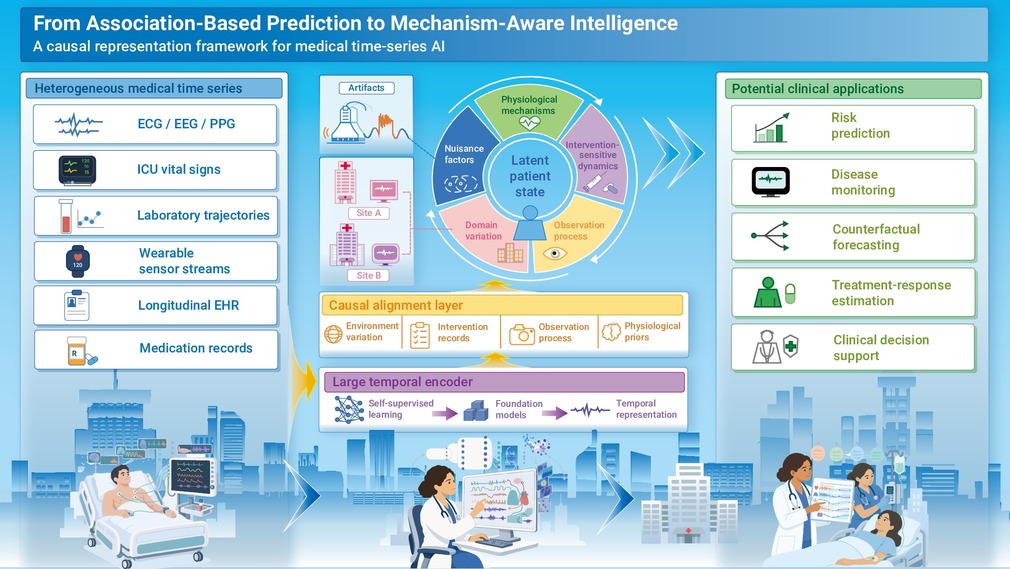
Figure 1.
A causal representation framework for medical time-series AI.
