
Toward health-aware urban flood resilience: A conceptual framework linking drainage conditions to flood forecasting and control
-

-
REFERENCES
[1] Yao J., Ma C., Wang M., et al. (2026). Toward minute-level flood stereoscopic intelligence: Real-time multimodal remote sensing under an on-orbit AI paradigm. Innov. Inform. 2:100022. DOI:10.59717/j.xinn-inform.2026.100022 [2] Xue B., Lichtfouse E. and Zhou X. (2025). Methods to monitor the defects of the drainage pipe network: A review. Environ. Chem. Lett. 23:1877−1894. DOI:10.1007/s10311-025-01874-z [3] Wang X., Xia J., Feng J., et al. (2025). Numerical modelling of the impact of drainage system clogging on urban flood processes. J. Environ. Manage. 388:125969. DOI:10.1016/j.jenvman.2025.125969 [4] Bartos M. and Kerkez B. (2021). Pipedream: An interactive digital twin model for natural and urban drainage systems. Environ. Model. Softw. 144:105120. DOI:10.1016/j.envsoft.2021.105120 [5] Karniadakis G.E., Kevrekidis I.G., Lu L., et al. (2021). Physics-informed machine learning. Nat. Rev. Phys. 3:422−440. DOI:10.1038/s42254-021-00314-5 -
ABOUT THIS ARTICLE
Cite this article:
Lu W., Liang B., Wu Y., et al. (2026). Toward health-aware urban flood resilience: A conceptual framework linking drainage conditions to flood forecasting and control. The Innovation Informatics 2:100075. https://doi.org/10.59717/j.xinn-inform.2026.100075
Welcome!
To request copyright permission to republish or share portions of our works, please visit Copyright Clearance Center's (CCC) Marketplace website at marketplace.copyright.com.
Export File
Citation
Lu W., Liang B., Wu Y., et al. (2026). Toward health-aware urban flood resilience: A conceptual framework linking drainage conditions to flood forecasting and control. The Innovation Informatics 2:100075. https://doi.org/10.59717/j.xinn-inform.2026.100075

Format
Content
 DownLoad:
-
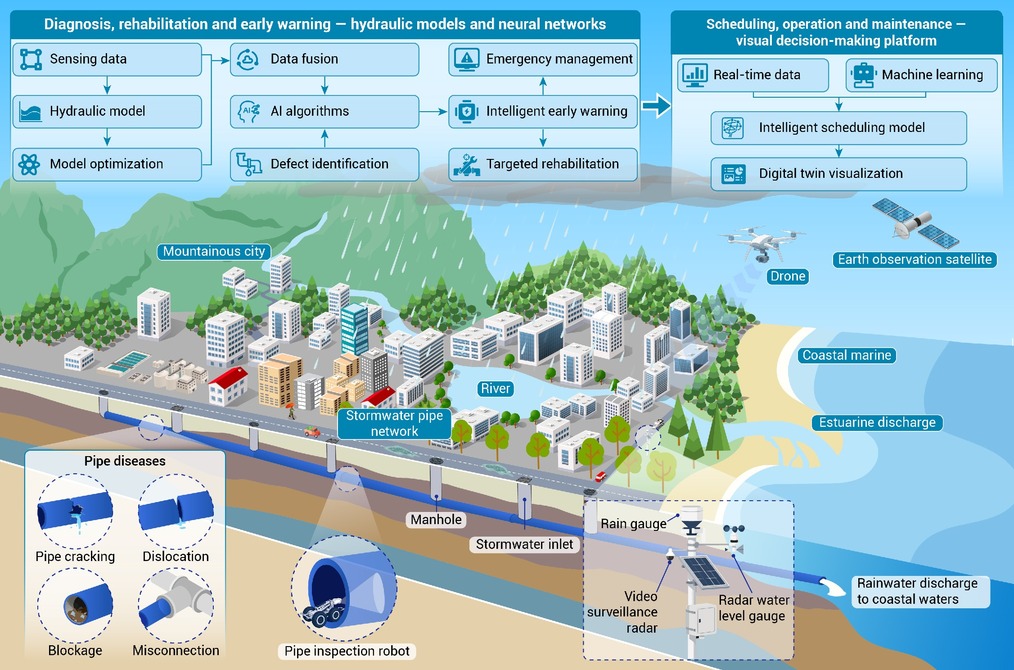
Figure 1.
Health-aware urban flood resilience as a closed loop linking multimodal observation, health diagnosis, hydrodynamic forecasting, and control actions; arrows connect components and return intervention outcomes to the health record.
