
The first near-complete telomere-to-telomere genome of Atlantic salmon (Salmo salar) provides insights for genetic diversity
-
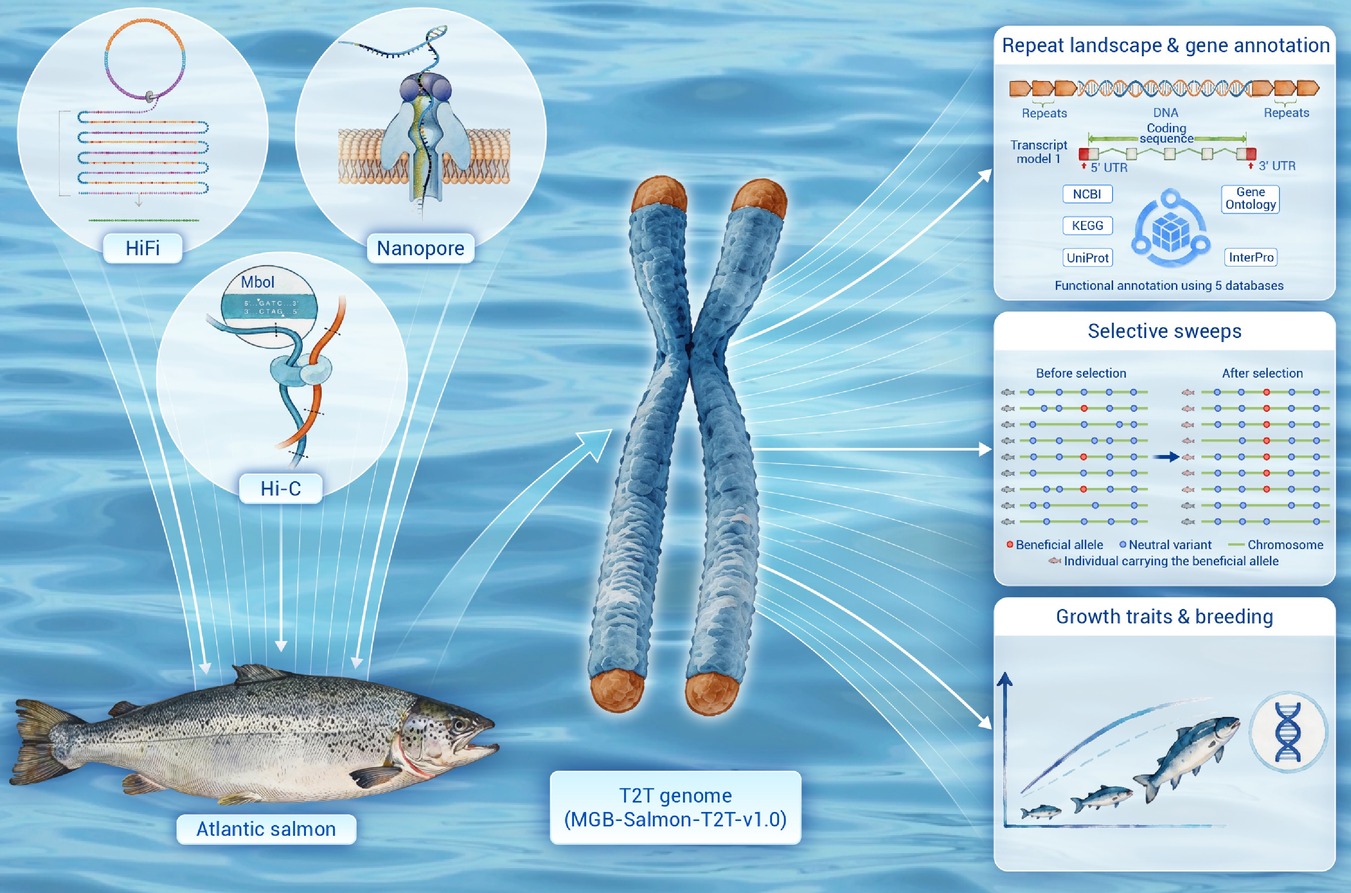
GRAPHICAL ABSTRACT
 DownLoad:
Full size image
DownLoad:
Full size image
-
PUBLIC SUMMARY
-
We generated the first telomere-to-telomere (T2T) genome assembly of Atlantic salmon.
The assembly showed high continuity and contained 15 complete T2T chromosomes.
This Atlantic salmon genome assembly provides a key resource for selective breeding.
-
-
ABSTRACT
Atlantic salmon is one of the world’s most valuable aquaculture species, providing substantial economic and nutritional benefits. In China, the identification of the Yellow Sea Cold Water Mass has enabled offshore salmon farming and supported the development of innovative deep-sea aquaculture platforms such as Deep Blue No. 1. However, the lack of a gap-free telomere-to-telomere (T2T) reference genome has limited progress in population genetics, functional genomics, and genetic improvement programs, including ICSASG_v2 and Ssa_v3.1, contained unresolved gaps and collapsed duplicated regions. To overcome these constraints, we integrated PacBio HiFi long reads, ultra-long Oxford Nanopore reads, and Hi-C scaffolding to generate a T2T genome assembly (MGB-Salmon-T2T-v1.0) with a contig N50 of 101.69 Mb and scaffold N50 of 114.45 Mb, representing a substantial advance in genome continuity and completeness. This work provides the first T2T genome assembly of Atlantic salmon, marking a major milestone in aquaculture genomics and establishing a powerful foundation for selective breeding of this globally important species. Furthermore, constructing a species-wide catalogue of genetic variants represents a critical step toward comprehensive functional genome annotation and underpins the ongoing international FarmGTEx project, which aims to link genetic variation with regulatory activity, tissue-specific expression, and phenotypic outcomes. -

-
REFERENCES
[1] FAO (2020). The state of world fisheries and aquaculture 2020. Sustainability in action (FAO). DOI:10.4060/ca9229en [2] Kobayashi M., Msangi S., Batka M., et al. (2015). Fish to 2030: The role and opportunity for aquaculture. Aquacult. Econ. Manage. 19:282−300. DOI:10.1080/13657305.2015.994240 [3] Gjedrem T. and Robinson N. (2014). Advances by selective breeding for aquatic species: A review. Agric. Sci. 5:1152−1158. DOI:10.4236/as.2014.512125 [4] Afewerki S., Asche F., Misund B., et al. (2023). Innovation in the Norwegian aquaculture industry. Rev. Aquac. 15:759−771. DOI:10.1111/raq.12755 [5] Garlock T., Asche F., Anderson J., et al. (2020). A global blue revolution: Aquaculture growth across regions, species, and countries. Rev. Fish. Sci. Aquac. 28:107−116. DOI:10.1080/23308249.2019.1678111 [6] Iversen A., Asche F., Hermansen O., et al. (2020). Production cost and competitiveness in major salmon farming countries 2003-2018. Aquaculture 522:735089. DOI:10.1016/j.aquaculture.2020.735089 [7] Osmundsen T.C., Olsen M.S., Gauteplass A., et al. (2022). Aquaculture policy: Designing licenses for environmental regulation. Mar. Policy 138:104978. DOI:10.1016/j.marpol.2022.104978 [8] Li A., Yu F., Si G., et al. (2017). Long-term temperature variation of the Southern Yellow Sea Cold Water Mass from 1976 to 2006. Chin. J. Oceanol. Limnol. 35:1032−1044. DOI:10.1007/s00343-017-6037-1 [9] Guo J., Yuan H., Song J., et al. (2020). Hypoxia, acidification and nutrient accumulation in the Yellow Sea Cold Water of the South Yellow Sea. Sci. Total Environ. 745:141050. DOI:10.1016/j.scitotenv.2020.141050 [10] Dong S.L. (2019). Research progress and prospects of large salmonid aquaculture in the Yellow Sea Cold Water Mass. Period. Ocean Univ. China 49:1−9. DOI:10.16441/j.cnki.hdxb.20180303 [11] Lutfi E., Berge G., Baeverfjord G., et al. (2022). Increasing dietary levels of the omega-3 long-chain polyunsaturated fatty acids, EPA and DHA, improves the growth, welfare, robustness, and fillet quality of Atlantic salmon in sea cages. Br. J. Nutr. 129:10−28. DOI:10.1017/S0007114522000642 [12] Houston R.D., Bean T.P., Macqueen D.J., et al. (2020). Harnessing genomics to fast-track genetic improvement in aquaculture. Nat. Rev. Genet. 21:389−409. DOI:10.1038/s41576-020-0227-y [13] Song H., Dong T., Yan X., et al. (2023). Genomic selection and its research progress in aquaculture breeding. Rev. Aquac. 15:274−291. DOI:10.1111/raq.12716 [14] Yanez J.M., Barria A., Lopez M.E., et al. (2023). Genome-wide association and genomic selection in aquaculture. Rev. Aquac. 15:645−675. DOI:10.1111/raq.12750 [15] Lien S., Koop B.F., Sandve S.R., et al. (2016). The Atlantic salmon genome provides insights into rediploidization. Nature 533:200−205. DOI:10.1038/nature17164 [16] Fang L., Teng J., Lin Q., et al. (2025). The farm animal genotype-tissue expression (FarmGTEx) project. Nat. Genet. 57:786−796. DOI:10.1038/s41588-025-02121-5 [17] Pineda P., Macphillamy C., Ren Y., et al. (2025). Insights into natural neocentromere evolution from a cattle T2T X chromosome. Nat. Commun. 16:10745. DOI:10.1038/s41467-025-65778-w [18] Zong W., Chen L., Zhang D., et al. (2025). Two telomere-to-telomere pig genome assemblies and pan-genome analyses provide insights into genomic structural landscape and genetic adaptations. iMeta 4:e70013. DOI:10.1002/imt2.70013 [19] Liu R., Yang X., Zhang Y., et al. (2025). A telomere-to-telomere pangenome reveals structural variations as key drivers of complex traits in chickens. DOI:10.21203/rs.3.rs-7302767/v1 [20] Luo L.-Y., Wu H., Zhao L.-M., et al. (2025). Telomere-to-telomere sheep genome assembly identifies variants associated with wool fineness. Nat. Genet. 57:218−230. DOI:10.1038/s41588-024-02037-6 [21] Sereika M., Kirkegaard R.H., Karst S.M., et al. (2022). Oxford Nanopore R10.4 long-read sequencing enables the generation of near-finished bacterial genomes from pure cultures and metagenomes without short-read or reference polishing. Nat. Methods 19: 823-826. DOI:10.1038/s41592-022-01539-7 [22] Han W., Wu S., Ding H., et al. (2023). Improved chromosomal-level genome assembly and re-annotation of leopard coral grouper. Sci. Data 10:156. DOI:10.1038/s41597-023-02051-z [23] Shen W., Le S., Li Y., et al. (2016). SeqKit: A cross-platform and ultrafast toolkit for FASTA/Q file manipulation. PLoS One 11:e0163962. DOI:10.1371/journal.pone.0163962 [24] Cheng H., Concepcion G.T., Feng X., et al. (2021). Haplotype-resolved de novo assembly using phased assembly graphs with hifiasm. Nat. Methods 18:170−175. DOI:10.1038/s41592-020-01056-5 [25] Durand N.C., Shamim M.S., Machol I., et al. (2016). Juicer provides a one-click system for analyzing loop-resolution Hi-C experiments. Cell Syst. 3:95−98. DOI:10.1016/j.cels.2016.07.002 [26] Lin Y., Ye C., Li X., et al. (2023). quarTeT: A telomere-to-telomere toolkit for gap-free genome assembly and centromeric repeat identification. Hortic. Res. 10:uhad127. DOI:10.1093/hr/uhad127 [27] Hu J., Wang Z., Liang F., et al. (2024). NextPolish2: A repeat-aware polishing tool for genomes assembled using HiFi long reads. Genomics Proteomics Bioinformatics 22:qzad009. DOI:10.1093/gpbjnl/qzad009 [28] Gabriel L., Bruna T., Hoff K.J., et al. (2024). BRAKER3: Fully automated genome annotation using RNA-seq and protein evidence with GeneMark-ETP, AUGUSTUS, and TSEBRA. Genome Res. 34:769−777. DOI:10.1101/gr.278090.123 [29] Shumate A. and Salzberg S.L. (2021). Liftoff: Accurate mapping of gene annotations. Bioinformatics 37:1639−1643. DOI:10.1093/bioinformatics/btaa1016 [30] Pertea G. and Pertea M. (2020). GFF Utilities: GffRead and GffCompare. DOI:10.12688/f1000research.23297.1 [31] Bolger A.M., Lohse M. and Usadel B. (2014). Trimmomatic: A flexible trimmer for Illumina sequence data. Bioinformatics 30:2114−2120. DOI:10.1093/bioinformatics/btu170 [32] Li H. and Durbin R. (2009). Fast and accurate short read alignment with Burrows-Wheeler transform. Bioinformatics 25:1754−1760. DOI:10.1093/bioinformatics/btp324 [33] McKenna A., Hanna M., Banks E., et al. (2010). The Genome Analysis Toolkit: A MapReduce framework for analyzing next-generation DNA sequencing data. Genome Res. 20:1297−1303. DOI:10.1101/gr.107524.110 [34] Danecek P., Auton A., Abecasis G., et al. (2011). The variant call format and VCFtools. Bioinformatics 27:2156−2158. DOI:10.1093/bioinformatics/btr330 [35] Purcell S., Neale B., Todd-Brown K., et al. (2007). PLINK: A tool set for whole-genome association and population-based linkage analyses. Am. J. Hum. Genet. 81:559−575. DOI:10.1086/519795 [36] Pavlidis P., Zivkovic D., Stamatakis A., et al. (2013). SweeD: Likelihood-based detection of selective sweeps in thousands of genomes. Mol. Biol. Evol. 30:2224−2234. DOI:10.1093/molbev/mst112 [37] Chen H., Patterson N. and Reich D. (2010). Population differentiation as a test for selective sweeps. Genome Res. 20:393−402. DOI:10.1101/gr.100545.109 [38] Falcon S. and Gentleman R. (2007). Using GOstats to test gene lists for GO term association. Bioinformatics 23:257−258. DOI:10.1093/bioinformatics/btl567 [39] Wu T., Hu E., Xu S., et al. (2021). clusterProfiler 4.0: A universal enrichment tool for interpreting omics data. The Innovation 2: 100141. DOI:10.1016/j.xinn.2021.100141 [40] De Bie T., Cristianini N., Demuth J.P., et al. (2006). CAFE: A computational tool for the study of gene family evolution. Bioinformatics 22:1269−1271. DOI:10.1093/bioinformatics/btl097 -
ABOUT THIS ARTICLE
Cite this article:
Yu X., Zhao B., Han W., et al. (2026). The first near-complete telomere-to-telomere genome of Atlantic salmon (Salmo salar) provides insights for genetic diversity. The Innovation Life 4:100236. https://doi.org/10.59717/j.xinn-life.2026.100236
Welcome!
To request copyright permission to republish or share portions of our works, please visit Copyright Clearance Center's (CCC) Marketplace website at marketplace.copyright.com.
Export File
Citation
Yu X., Zhao B., Han W., et al. (2026). The first near-complete telomere-to-telomere genome of Atlantic salmon (Salmo salar) provides insights for genetic diversity. The Innovation Life 4:100236. https://doi.org/10.59717/j.xinn-life.2026.100236

Format
Content
-
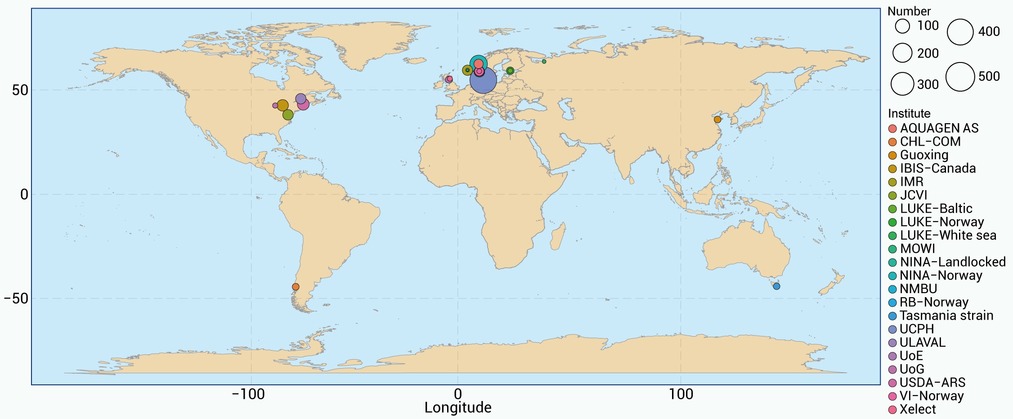
Figure 1.
Geographic distribution map of all collected sample data.
-
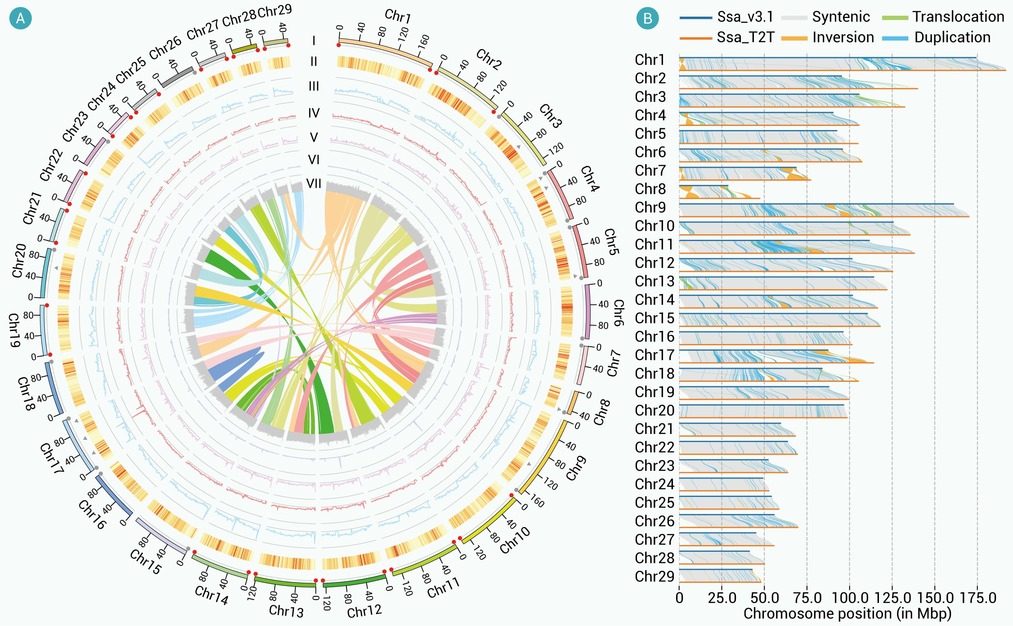
Figure 2.
(A) Genomic features and homology distribution map; (I) Telomeres: red dots indicate telomeres in T2T chromosomes, while gray dots represent telomeres in non-T2T chromosomes; gray blocks denote gaps, with each gap represented by N = 500; (II) Gene density; (III) DNA transposable elements; (IV) LINE elements; (V) LTR elements; (VI) SINE elements; (VII) GC content (range: min = 0.30, max = 0.55); The inner links represent collinear blocks across the 29 chromosomes; (B) Comparison of different genome versions.
-
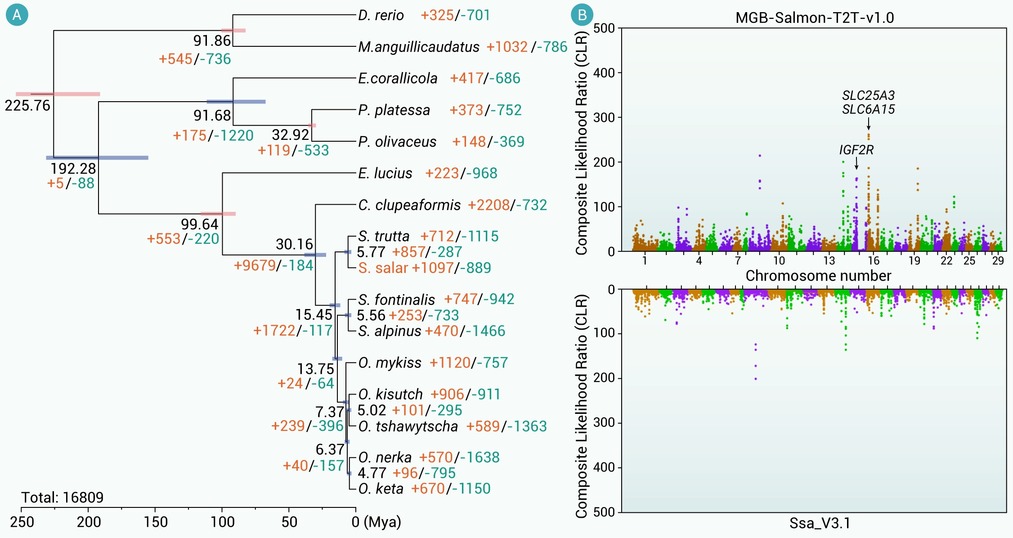
Figure 3.
(A) Evolutionary and phylogenetic analysis of Atlantic salmon; (B) Noval selection signatures identified using the T2T genome in the Guoxing population.
