
Universal Taxol molecular binding engineering in dual-polarity MoS2 photodetector
-
GRAPHICAL ABSTRACT

 DownLoad:
Full size image
DownLoad:
Full size image
-
PUBLIC SUMMARY
-
Taxol molecules hold considerable potential for enhancing the optoelectronic performance of 2D materials.
Taxol can effectively passivate the interfacial defects of MoS2 while preserving its crystalline integrity.
Establishing interfacial Mo-O bonding pathways enables directional electron transfer.
Taxol modification strategy enables increased carrier mobility and reduced electronic noise.
-
-
ABSTRACT
Intrinsic defects in two-dimensional (2D) atomic crystals impose severe constraints on carrier utilization through defect-induced trapping and recombination. While surface modification and mobility recovery strategies have been widely explored, the development of a universal defect mitigation protocol remains unresolved. Here, we introduce a molecular passivation strategy in which Taxol molecules, via their hydroxyl radicals, repair intrinsic sulfur vacancies in monolayer MoS2, thereby markedly accelerating carrier transport dynamics. The Taxol framework not only modulates the electronic structure of n-type MoS2 lattices but also shows compatibility with p-type MoS2 configurations, enabling robust interfacial unit cell binding. Following modification, both n- and p-type MoS2 exhibit acoustic phonon-limited mobilities enhanced and more than an order of magnitude for p-type conuterpart. This universal lattice-reconstruction strategy further suppresses noise power by up to six orders of magnitude and restrain interface state, while achieving a responsivity above 200 A W−1 and specific detectivity exceeding 1.0 × 10¹² Jones — representing an improvement of four orders of magnitude. Complementary theoretical calculations confirm that Taxol-mediated coordination effectively passivates sulfur vacancies and optimizes charge transport. These findings establish a universal molecular coordination protocol to mitigate defect-related noise currents and boost detection sensitivity, advancing the performance of 2D photodetectors for next-generation optoelectronic and biosensing applications. -

-
REFERENCES
[1] Zhang W., Qiu F., Li Y. et al. (2021). Lattice defect engineering enables performance-enhanced MoS2 photodetection through a paraelectric BaTiO3 dielectric. ACS Nano 15:13370−13379. DOI:10.1021/acsnano.1c03402 [2] Hu T., Zhang R., Li J.P. et al. (2022). Photodetectors based on two-dimensional MoS2 and its assembled heterostructures. Chip 1:100017. DOI:10.1016/j.chip.2022.100017 [3] Purbayanto M.A.K., Chandel M., Birowska M. et al. (2023). Optically active Mxenes in van der Waals heterostructures. Adv. Mater. 35:2301850. DOI:10.1002/adma.202301850 [4] Lin H., Zhang Z.F., Zhang H.H. et al. (2022). Engineering van der Waals materials for advanced metaphotonics. Chem. Rev. 122:15204−15355. DOI:10.1021/acs.chemrev.2c00048 [5] Liu C.S., Chen H.W., Wang S.Y. et al. (2020). Two-dimensional materials for next-generation computing technologies. Nat. Nanotechnol. 15:545−557. DOI:10.1038/s41565-020-0724-3 [6] Zhang Y., Yang H., Wei D. et al. (2021). Mitochondria-targeted nanoparticles in treatment of neurodegenerative diseases. Exploration 1:20210115. DOI:10.1002/EXP.20210115 [7] Wang J., Chen D., Huang W. et al. (2023). Aptamer-functionalized Field-Effect Transistor biosensors for disease diagnosis and environmental monitoring. Exploration 3:20210027. DOI:10.1002/EXP.20210027 [8] Nan H. Y., Wang Z. L., Wang W. H. et al. (2014). Strong photoluminescence enhancement of MoS2 through defect engineering and oxygen bonding. ACS Nano 8:5738−5745. DOI:10.1021/nn500532f [9] Ni Z.H., Ponomarenko L.A., Nair R.R. et al. (2010). On resonant scatterers as a factor limiting carrier mobility in graphene. Nano Lett. 10:3868−3872. DOI:10.1021/nl101399r [10] Jiang J., Yang P., Liou J.J. et al. (2022). Defect engineering of two-dimensional materials towards next-generation electronics and optoelectronics. Nano Res. 16:3104−3124. DOI:10.1007/s12274-022-5016-9 [11] Xu Z.H., He M., Wu Q.K. et al. (2023). Ultrafast charge transfer 2D MoS2/organic heterojunction for sensitive photodetector. Adv. Sci. 10:2207743. DOI:10.1002/advs.202207743 [12] Wang C., Cusin L., Ma C. et al. (2024). Enhancing the carrier transport in monolayer MoS2 through interlayer coupling with 2D covalent organic frameworks. Adv. Mater. 36:2305882. DOI:10.1002/adma.202305882 [13] Han J.Y., Wang F.K., Han S. et al. (2022). Recent progress in 2D inorganic/organic charge transfer heterojunction photodetectors. Adv. Funct. Mater. 32:2205150. DOI:10.1002/adfm.202205150 [14] Zhao B.L., Gan Z.Y., Johnson M. et al. (2021). 2D van der Waals heterojunction of organic and inorganic monolayers for high responsivity phototransistors. Adv. Funct. Mater. 31:2105444. DOI:10.1002/adfm.202105444 [15] Xu X.M., Lou Z.R., Cheng S.M. et al. (2021). Van der Waals organic/inorganic heterostructures in the two-dimensional limit. Chem. 7:2989−3026. DOI:10.1016/j.chempr.2021.08.013 [16] Park S., Mutz N., Kovalenko S.A. et al. (2021). Type-I energy level alignment at the ptcda—monolayer MoS2 interface promotes resonance energy transfer and luminescence enhancement. Adv. Sci. 8:2100215. DOI:10.1002/advs.202100215 [17] Yang F.X., Cheng S.S., Zhang X.T. et al. (2018). 2D organic materials for optoelectronic applications. Adv. Mater. 30:1702415. DOI:10.1002/adma.201702415 [18] Oyedele A.D., Rouleau C.M., Geohegan D.B. et al. (2018). The growth and assembly of organic molecules and inorganic 2D materials on graphene for van der Waals heterostructures. Carbon 131:246−257. DOI:10.1016/j.carbon.2018.02.020 [19] Zhang X.K., Liao Q.L., Liu S. et al. (2017). Poly(4-styrenesulfonate)-induced sulfur vacancy self-healing strategy for monolayer MoS2 homojunction photodiode. Nat. Commun. 8:15881. DOI:10.1038/ncomms15881 [20] Huang Y., Zhuge F.W., Hou J.X. et al. (2018). Van der Waals coupled organic molecules with monolayer MoS2 for fast response photodetectors with gate-tunable responsivity. ACS Nano 12:4062−4073. DOI:10.1021/acsnano.8b02380 [21] Hong J.H., Jin C.H., Yuan J. et al. (2017). Atomic defects in two-dimensional materials: From single-atom spectroscopy to functionalities in opto-/electronics, nanomagnetism, and catalysis. Adv. Mater. 29:1606434. DOI:10.1002/adma.201606434 [22] Huang T., Ding J.F., Liu Z.R. et al. (2022). Insight into the underlying competitive mechanism for the shift of the charge neutrality point in a trilayer-graphene field-effect transistor. eScience 2:319−328. DOI:10.1016/j.esci.2022.03.005 [23] Wang X.W., Wang B.L., Zhang Q.H. et al. (2021). Grain-boundary engineering of monolayer MoS2 for energy-efficient lateral synaptic devices. Adv. Mater. 33:2102435. DOI:10.1002/adma.202102435 [24] Li H., Zhang N., Yang J. et al. (2025). Surface modification technologies for promoting the widespread use and recycling of carbon fibers in the construction industry. Innov. Mater. 3:100149. DOI:10.59717/j.xinn-mater.2025.100149 [25] Park J.H., Sanne A., Guo Y.Z. et al. (2017). Defect passivation of transition metal dichalcogenides via a charge transfer van der Waals interface. Sci. Adv. 3:e1701661. DOI:10.1126/sciadv.1701661 [26] Kwon S., Jeong D.Y., Hong C. et al. (2022). Exciton transfer at heterointerfaces of MoS2 monolayers and fluorescent molecular aggregates. Adv. Sci. 9:2201875. DOI:10.1002/advs.202201875 [27] Wang Y., Gali S.M., Slassi A. et al. (2020). Collective dipole-dominated doping of monolayer MoS2: Orientation and magnitude control via the supramolecular approach. Adv. Funct. Mater. 30:2002846. DOI:10.1002/adfm.202002846 [28] Feng Q.S., Sun Y., Li Y.Z. et al. (2021). Highly photoluminescent monolayer MoS2 and WS2 achieved via superacid assisted vacancy reparation and doping strategy. Laser Photon. Rev. 15:2170064. DOI:10.1002/lpor.202100104 [29] Zhao Y.D., Bertolazzi S. and Samorì P. (2019). A universal approach toward light-responsive two-dimensional electronics: Chemically tailored hybrid van der Waals heterostructures. ACS Nano 13:4814−4825. DOI:10.1021/acsnano.9b01716 [30] Ji H.G., Solís-Fernández P., Yoshimura D. et al. (2019). Chemically tuned p- and n-Type WSe2 monolayers with high carrier mobility for advanced electronics. Adv. Mater. 31:1903613. DOI:10.1002/adma.201903613 [31] Kim J.K., Cho K., Jang J. et al. (2021). Molecular dopant-dependent charge transport in surface-charge-transfer-doped tungsten diselenide field effect transistors. Adv. Mater. 33:2101598. DOI:10.1002/adma.202101598 [32] Wang C., de Oliveira R.F., Jiang K.Y. et al. (2022). Boosting the electronic and catalytic properties of 2D semiconductors with supramolecular 2D hydrogen- bonded superlattices. Nat. Commun. 13:510. DOI:10.1038/s41467-022-28116-y [33] Chu J.Y., Liu Z.R., Liu P.D. et al. (2024). Synergistic effect of graphene enhances the responsivity of hybrid perovskite photodetector. Cell Rep. Phys. Sci. 5:102054. DOI:10.1016/j.xcrp.2024.102054 [34] Joo P., Jo K., Ahn G. et al. (2014). Functional polyelectrolyte nanospaced MoS2 multilayers for enhanced photoluminescence. Nano Lett. 14:6456−6462. DOI:10.1021/nl502883a [35] Luo Y., Lu H.Q., Huang J.W. et al. (2024). A molecular coordination strategy for regulating the interface of MoS2 field effect transistors. J. Am. Chem. Soc. 146:9709−9720. DOI:10.1021/jacs.3c13696 [36] Duan R., Qi W.H., Tang K.W. et al. (2025). Sub-nano cluster decoration for the manipulation of the photogenerated carrier behavior of MoS2. InfoMat 7:e12610. DOI:10.1002/inf2.12610 [37] Ketchum R.E.B., Gibson D.M. (1995). A novel method of isolating taxanes from cell suspension cultures of yew (taxus spp.). J. Liq. Chromatography 18:1093−1111. DOI:10.1080/10826079508009278 [38] Petrov R.A., Maklakova S.Y., Ivanenkov Y.A. et al. (2018). Synthesis and biological evaluation of novel mono- and bivalent ASGP-R-targeted drug-conjugates. Bioorg. Med. Chem. Lett. 28:382−387. DOI:10.1016/j.bmcl.2017.12.032 [39] Jennewein S., Croteau R. (2001). Taxol: Biosynthesis, molecular genetics, and biotechnological applications. Appl. Microbiol. Biotechnol. 57:13−19. DOI:10.1007/s002530100757 [40] Choudhary N., Park J., Hwang J.Y. et al. (2014). Growth of large-scale and thickness-modulated MoS2 nanosheets. ACS Appl. Mater. Interfaces 6:21215−21222. DOI:10.1021/am506198b [41] Zhou J.D., Lin J.H., Huang X.W. et al. (2018). A library of atomically thin metal chalcogenides. Nature 556:355−359. DOI:10.1038/s41586-018-0008-3 [42] Garg P., Balachandran S., Adlakha I. et al. (2018). Revealing the role of nitrogen on hydride nucleation and stability in pure niobium using first-principles calculations. Supercond. Sci. Technol. 31:115007. DOI:10.1088/1361-6668/aae147 [43] Kresse, Furthmuller (1996). Efficient iterative schemes for Ab initio total-energy calculations using a plane-wave basis set. Phys. Rev. B 54:11169-11186. DOI:10.1103/PhysRevB.54.11169. [44] Jiang Y., Liu P., Wang S. et al. (2025). Compensation effect enables high-mobility in Te-doped gallium antimonide. Inf. Funct. Mater. 2:93−101. DOI:10.1002/ifm2.30 [45] Perdew, Burke, Ernzerhof (1996). Generalized gradient approximation made simple. Phys. Rev. Lett. 77:3865-3868. DOI:10.1103/PhysRevLett.77.3865. [46] Perdew, Burke, Wang (1996). Generalized gradient approximation for the exchange-correlation hole of a many-electron system. Phys. Rev. B 54:16533-16539. DOI:10.1103/PhysRevB.54.16533. [47] Grimme S., Ehrlich S., Goerigk L. (2011). Effect of the damping function in dispersion corrected density functional theory. J. Comput. Chem. 32:1456−1465. DOI:10.1002/jcc.21759 [48] Zhang W., Zou G.F., Choi J.H. (2020). Adsorption behavior of the hydroxyl radical and its effects on monolayer MoS2. ACS Omega 5:1982−1986. DOI:10.1021/acsomega.9b03837 [49] Bardeen J., Shockley W. (1950). Deformation potentials and mobilities in non-polar crystals. Phys. Rev. 80:72−80. DOI:10.1103/PhysRev.80.72 [50] Feng S., Liu C., Zhu Q.B. et al. (2021). An ultrasensitive molybdenum-based double-heterojunction phototransistor. Nat. Commun. 12:4094. DOI:10.1038/s41467-021-24397-x [51] Wang F., Zhang T., Xie R.Z. et al. (2023). How to characterize figures of merit of two-dimensional photodetectors. Nat. Commun. 14:2224. DOI:10.1038/s41467-023-37635-1 [52] Li H., Zhang Q., Yap C.C.R. et al. (2012). From bulk to monolayer MoS2: Evolution of raman scattering. Adv. Funct. Mater. 22:1385−1390. DOI:10.1002/adfm.201102111 [53] Zhan Y.J., Liu Z., Najmaei S. et al. (2012). Large-area vapor-phase growth and characterization of MoS2 atomic layers on a SiO2 substrate. Small 8:966−971. DOI:10.1002/smll.201102654 [54] Zeng Z.Y., Yin Z.Y., Huang X. et al. (2011). Single-layer semiconducting nanosheets: High-yield preparation and device fabrication. Angew. Chem. Int. Edit. 50:11093−11097. DOI:10.1002/anie.201106004 [55] Radisavljevic B., Radenovic A., Brivio J. et al. (2011). Single-layer MoS2 transistors. Nat. Nanotechnol. 6:147−150. DOI:10.1038/nnano.2010.279 [56] Fang Y.J., Armin A., Meredith P. et al. (2019). Accurate characterization of next-generation thin-film photodetectors. Nat. Photonics 13:1−4. DOI:10.1038/s41566-018-0288-z [57] Tu L.Q., Cao R.R., Wang X.D. et al. (2020). Ultrasensitive negative capacitance phototransistors. Nat. Commun. 11:101. DOI:10.1038/s41467-019-13769-z [58] Wang J.B., Chen S.C., Yin Z.G. et al. (2020). Broadband organic photodetectors based on ternary blend active layers with enhanced and spectrally flat response. J. Mater. Chem. C 8:14049−14055. DOI:10.1039/d0tc02708a [59] Wang J.B., Liu Z.Y., Zhu T.Q. et al. (2024). Strategies for achieving high-performance photomultiplication-type organic photodetectors and their promising applications. Nano Energy 132:110399. DOI:10.1016/j.nanoen.2024.110399 [60] Yuan G.W., Lin D.J., Wang Y. et al. (2020). Proton-assisted growth of ultra-flat graphene films. Nature 577:204−208. DOI:10.1038/s41586-019-1870-3 [61] Lu Z.Y., Chen Y., Dang W.Q. et al. (2023). Wafer-scale high-Κ dielectrics for two-dimensional circuits via van der Waals integration. Nat. Commun. 14:2340. DOI:10.1038/s41467-023-37887-x [62] Zeng D.B., Zhang Z.Y., Xue Z.Y. et al. (2024). Single-crystalline metal-oxide dielectrics for top-gate 2D transistors. Nature 632:788−794. DOI:10.1038/s41586-024-07786-2 [63] Huang F.B., Liu C.X., Yang Q.Y. et al. (2025). Lead-based perovskites significantly suppress dark currents toward high-performance multilayer SnS2/perovskite photodetectors. ACS Nano 19:10989−11000. DOI:10.1021/acsnano.4c16539 [64] Huang F.B., Yang Q.Y., Sun Y.Y. et al. (2025). Insight into the effect of h-BN modification on the performance of MoS2 phototransistors with van der Waals contacts. ACS Appl. Nano Mater. 8:5805−5814. DOI:10.1021/acsanm.5c00540 [65] Huang F.B., Chen J.H., Du C.Y. et al. (2022). Mechanically exfoliated few-layer SnS2 and integrated van der Waals electrodes for ultrahigh responsivity phototransistors. ACS Appl. Electron. Mater. 4:5333−5339. DOI:10.1021/acsaelm.2c01010 [66] Liu P.D., Zhang X., Zhang B.L. et al. (2025). Molecular engineering enables high-performance hybrid perovskite photodetector. Chip 4:100125. DOI:10.1016/j.chip.2024.100125 [67] Liu Z.R., Jiang Y.K., Chu J.Y. et al. (2025). Mitigating dielectric confinement effect for ultra-high gain in quasi-2D ruddlesden-popper perovskite photodetectors. Adv. Opt. Mater. 13:e01145. DOI:10.1002/adom.202501145 [68] Shin W., Byeon J., Koo R.H. et al. (2024). Toward ideal low-frequency noise in monolayer CVD MoS2 FETs: influence of van der Waals junctions and sulfur vacancy management. Adv. Sci. 11:2307196. DOI:10.1002/advs.202307196 [69] Yu S., Xiong H.D., Eshun K. et al. (2015). Phase transition, effective mass and carrier mobility of MoS2 monolayer under tensile strain. Appl. Surf. Sci. 325:27−32. DOI:10.1016/j.apsusc.2014.11.079 [70] Cai Y.Q., Zhang G., Zhang Y.W. (2014). Polarity-reversed robust carrier mobility in monolayer MoS2 nanoribbons. J. Am. Chem. Soc. 136:6269−6275. DOI:10.1021/ja4109787 [71] Long M., Wang P., Fang H. et al. (2019). Progress, challenges, and opportunities for 2D material based photodetectors. Adv. Funct. Mater. 29:1803807. DOI:10.1002/adfm.201803807 [72] Wu H.L., Si H.N., Zhang Z.H. et al. (2018). All-inorganic perovskite quantum dot-monolayer MoS2 mixed-dimensional van der Waals heterostructure for ultrasensitive photodetector. Adv. Sci. 5:1801219. DOI:10.1002/advs.201801219 [73] Ying H.T., Li X., Wang H.M. et al. (2020). Band structure engineering in MoS2 based heterostructures toward high-performance phototransistors. Adv. Opt. Mater. 8:2000430. DOI:10.1002/adom.202000430 [74] Abidi I.H., Giridhar S.P., Tollerud J.O. et al. (2024). Oxygen driven defect engineering of monolayer MoS2 for tunable electronic, optoelectronic, and electrochemical devices. Adv. Funct. Mater. 34:2402402. DOI:10.1002/adfm.202402402 [75] Liu X.Y., Zhu J.Q., Shan Y.F. et al. (2024). An ultrasensitive and broad-spectrum MoS2 photodetector with extrinsic response using surrounding homojunction. Adv. Sci. 11:2408299. DOI:10.1002/advs.202408299 [76] Wang K., Wang F., Cao Y. et al. (2024). High-performance photodetectors based on suspended ultralong CNTs-MoS2 heterojunction networks. Adv. Funct. Mater. 35:2421980. DOI:10.1002/adfm.202421980 [77] Chu Y.T., Chen P.L., Huang S.H. et al. (2025). All-van-der-Waals heterostructure of MoS2 grating and InSe flake for spectrally selective polarization-sensitive photodetection in NIR region. ACS Nano 19:18545−18555. DOI:10.1021/acsnano.5c02102 [78] Kumar A., Chakkar A.G., Das C. et al. (2025). Self-powered broadband photodetectors based on WS2-anchored MoS2 with enhanced responsivity and detectivity. Small 21:2502900. DOI:10.1002/smll.202502900 [79] Wang B., Zhang N.N., You J. et al. (2025). Visible-near-infrared wavelength-selective photodetection and imaging based on floating-gate phototransistors. InfoMat 7:e12661. DOI:10.1002/inf2.12661 [80] Yi O.Y., Zhang C.Y., Wang J. et al. (2025). Gate-tunable dual-mode optoelectronic device for self-powered photodetector and optoelectronic synapse. Adv. Sci. 12:2416259. DOI:10.1002/advs.202416259 -
ABOUT THIS ARTICLE
Cite this article:
Jiang Y., Xie Y., Pan Q., et al. (2026). Universal Taxol molecular binding engineering in dual-polarity MoS2 photodetector. The Innovation Materials 4:100191. https://doi.org/10.59717/j.xinn-mater.2026.100191
Welcome!
To request copyright permission to republish or share portions of our works, please visit Copyright Clearance Center's (CCC) Marketplace website at marketplace.copyright.com.
Article Metrics
Relative Articles
Cited by
Export File
Citation
Jiang Y., Xie Y., Pan Q., et al. (2026). Universal Taxol molecular binding engineering in dual-polarity MoS2 photodetector. The Innovation Materials 4:100191. https://doi.org/10.59717/j.xinn-mater.2026.100191

Format
Content
-
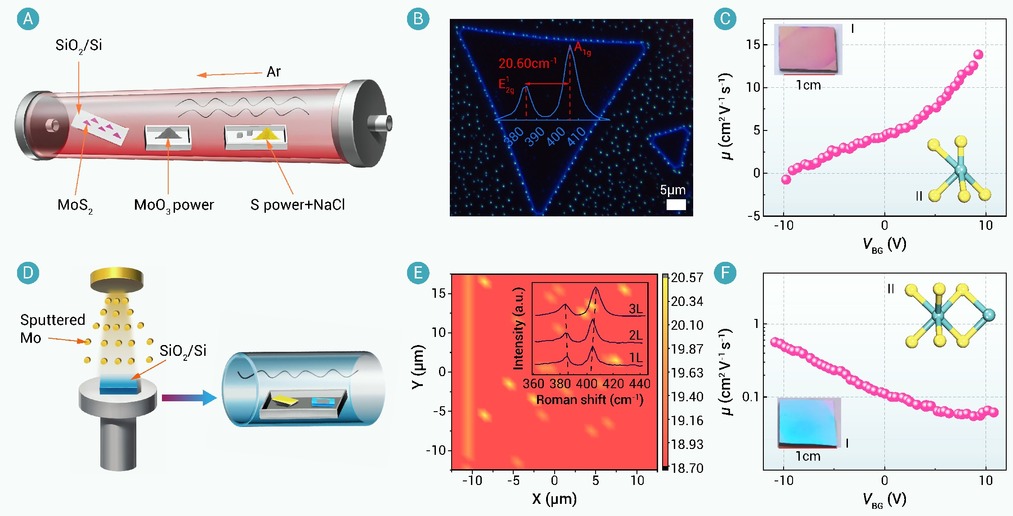
Figure 1.
Growth and characterisation of MoS2 films
-
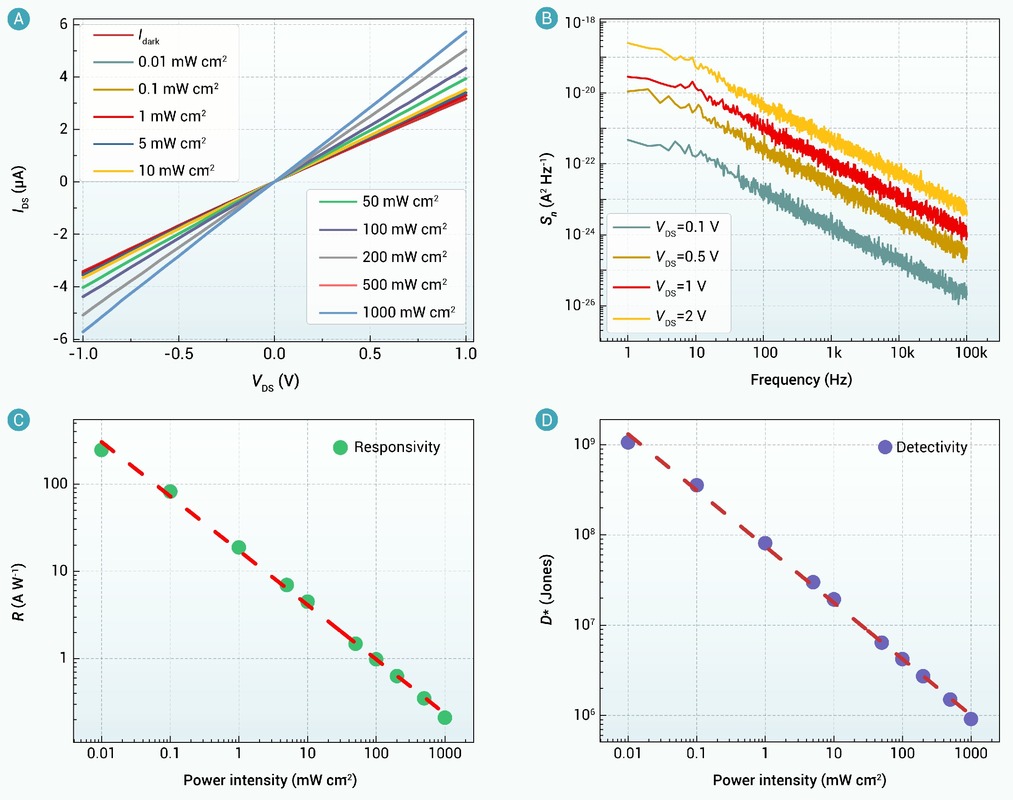
Figure 2.
Optoelectronic performance of n-MoS2 photodetectors prepared by one-step method
-
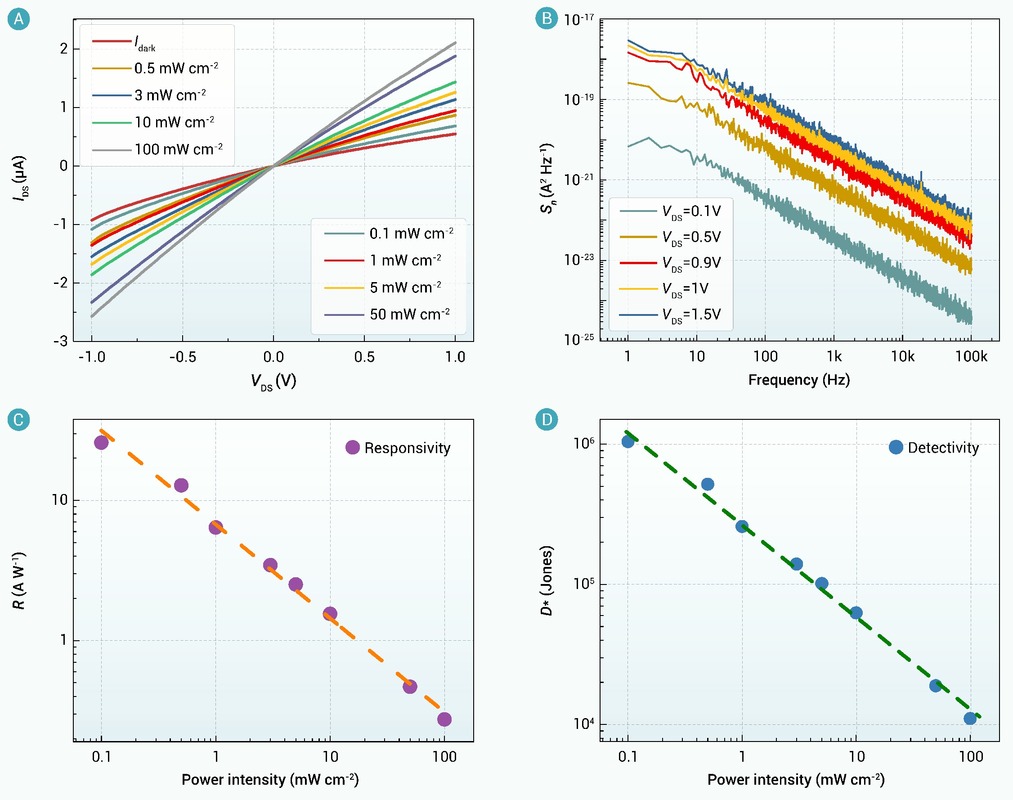
Figure 3.
Optoelectronic performance of p-MoS2 photodetectors prepared by two-step method
-
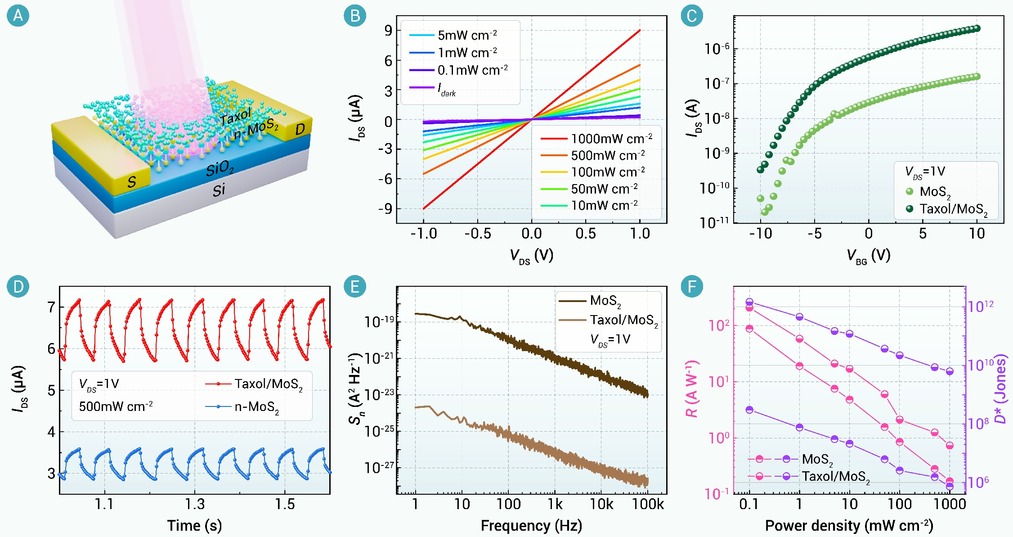
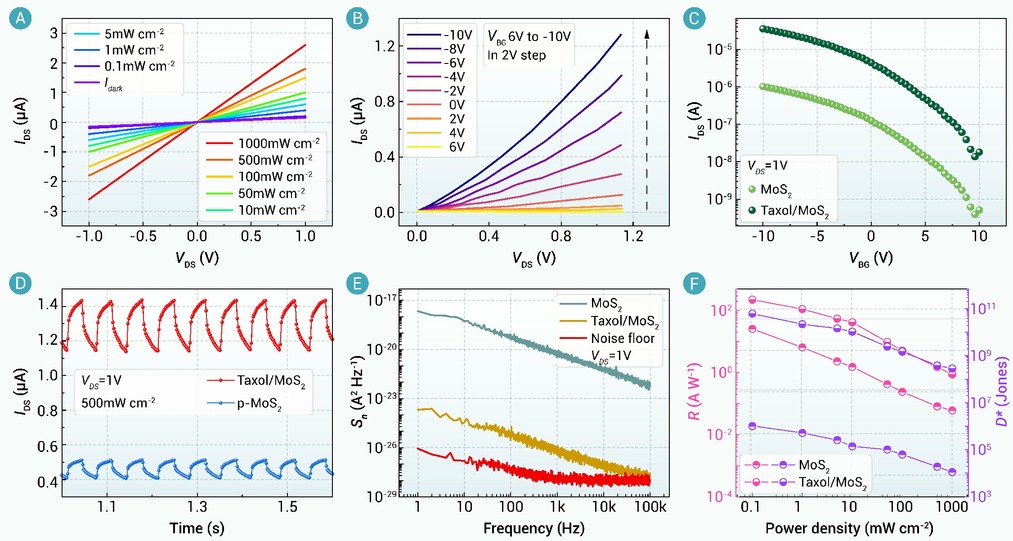
Figure 4.
Photodetection performance of n-MoS2 FETs before and after Taxol modification
-
Figure 5.
Photodetection performance of p-MoS2 FETs before and after Taxol modification
-
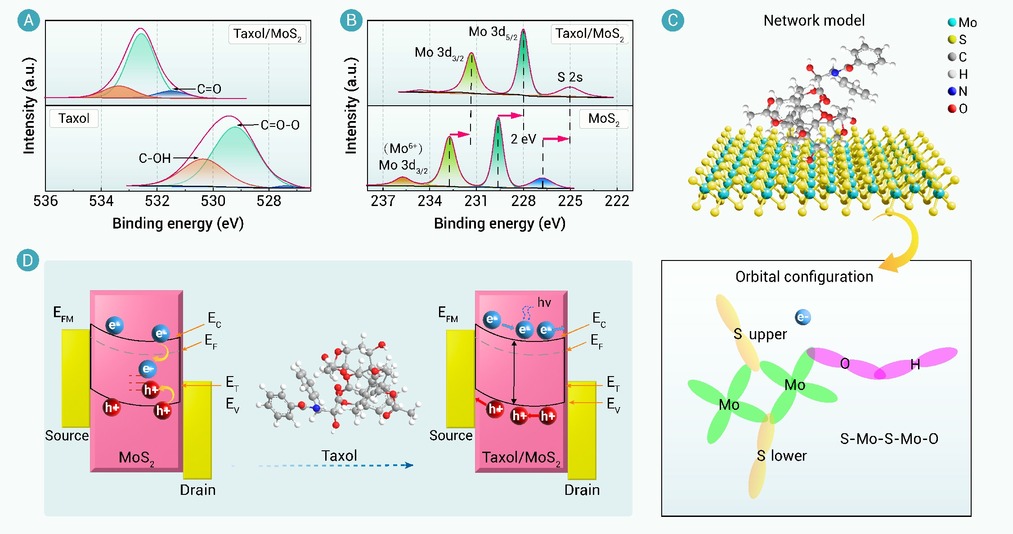
Figure 6.
XPS characterisation and interaction mechanism of Taxol/MoS2.
-
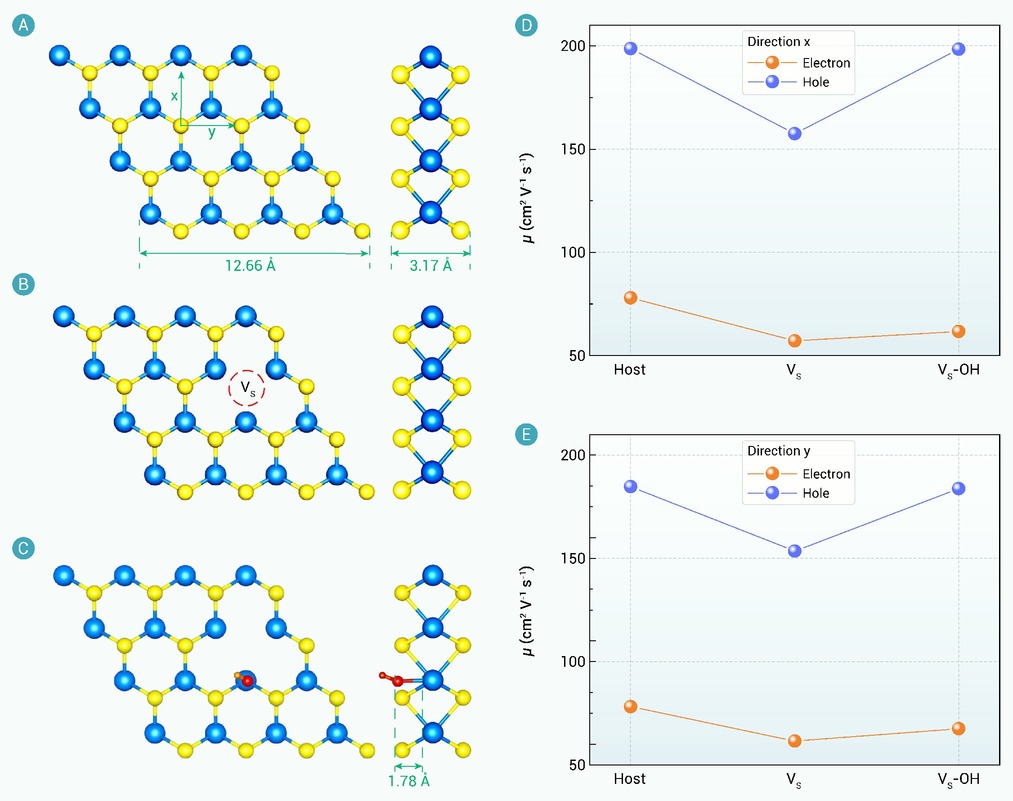
Figure 7.
First-principles calculation models (top and side views) and the corresponding variations in carrier mobility
