
Wafer-scale epitaxy of TiN nanoarrays on fluorophlogopites for flexible, refractory, and multifunctional plasmonic metamaterials
-
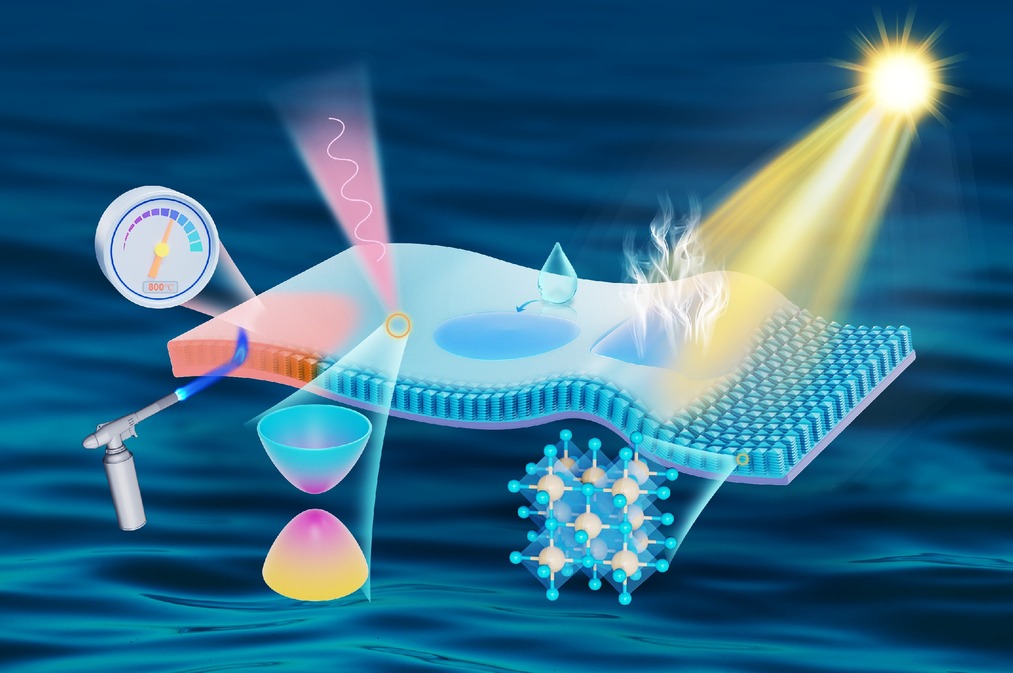
GRAPHICAL ABSTRACT
 DownLoad:
Full size image
DownLoad:
Full size image
-
PUBLIC SUMMARY
-
To overcome challenge of fabricating flexible and single-crystalline plasmonic nanostructure arrays (PNAs).
A wafer-scale route by epitaxy of TiN nanoarrays on fluorophlogopites was demonstrated.
Flexible TiN nanoarrays show plasmonic hyperbolic dispersion, superhydrophilicity, and solar steam generation.
The excellent thermal stability of flexible TiN nanoarrays far surpasses that of ordinary flexible PNAs.
-
-
ABSTRACT
Developing strategies for flexible, single-crystalline, but refractory plasmonic nanostructure arrays (PNAs) is important for flexible, high-performance, and reliable plasmonic metamaterials, which have broad applications in refractory plasmonics, nanophotonics, sensors, and photothermal conversion. However, the scalable fabrication of flexible, single-crystalline, but refractory PNAs is extremely challenging due to the incompatibilities of synthesis temperatures, crystal structures, and thermal expansion coefficient between typical plasmonic materials and conventional flexible organic substrates. Here, an easy and scalable route to the flexible single-crystalline PNAs is demonstrated by self-assembled growth of TiN nanopillar arrays on flexible van der Waals fluorophlogopite mica substrates using a reactive magnetron sputtering epitaxy system. Remarkably, the wafer scale flexible TiN nanopillar arrays exhibit several intriguing properties, including tunable plasmonic hyperbolic dispersions, superhydrophilicity, strong light absorption, and efficient solar steam generation. Moreover, these flexible TiN nanoarrays demonstrate excellent thermal stability at 800°C, far exceeding the operating temperature (below ~ 200°C) of current flexible noble-metal PNAs on organic substrates. This work offers an easy and scalable approach for fabricating flexible, wafer-scale, single-crystalline, but refractory PNAs with versatile and tunable properties, which can significantly expand the applications of flexible PNAs in flexible electronics, nanophotonic, and photothermal devices. -

-
REFERENCES
[1] Wang W., Ramezani M., Vakevainen A.I., et al. (2018). The rich photonic world of plasmonic nanoparticle arrays. Mater. Today 21:303−314. DOI:10.1016/j.mattod.2017.09.002 [2] Zhang H., Kinnear C., and Mulvaney P. (2020). Fabrication of single-nanocrystal arrays. Adv. Mater. 32:1904551. DOI:10.1002/adma.201904551 [3] Feng L., Huo P., Liang Y., et al. (2020). Photonic metamaterial absorbers: Morphology engineering and interdisciplinary applications. Adv. Mater. 32:1903787. DOI:10.1002/adma.201903787 [4] Yang K., Yao X., Liu B., et al. (2021). Metallic plasmonic array structures: Principles, fabrications, properties, and applications. Adv. Mater. 33:2007988. DOI:10.1002/adma.202007988 [5] Liu Y., Kim M., Cho S.H., et al. (2021). Vertically aligned nanostructures for a reliable and ultrasensitive SERS-active platform: Fabrication and engineering strategies. Nano Today 37:101063. DOI:10.1016/j.nantod.2020.101063 [6] Wang P., Krasavin A.V., Liu L., et al. (2022). Molecular plasmonics with metamaterials. Chem. Rev. 122:15031−15081. DOI:10.1021/acs.chemrev.2c00333 [7] Yang B., Li C., Wang Z., et al. (2022). Thermoplasmonics in solar energy conversion: Materials, nanostructured designs, and applications. Adv. Mater. 34:2107351. DOI:10.1002/adma.202107351 [8] Jia H., Tsoi C.C., Abed A.E., et al. (2023). Metallic plasmonic nanostructure arrays for enhanced solar photocatalysis. Laser Photonics Rev. 17:2200700. DOI:10.1002/lpor.202200700 [9] Aksu S., Huang M., Artar A., et al. (2011). Flexible plasmonics on unconventional and nonplanar substrates. Adv. Mater. 23:4422−4430. DOI:10.1002/adma.201102430 [10] Kim Y.D., Kim H., Cho Y., et al. (2015). Bright visible light emission from graphene. Nat. Nanotechnol. 10:676−681. DOI:10.1038/NNANO.2015.118 [11] Li L., Lin H., Qiao S., et al. (2018). Monolithically integrated stretchable photonics. Light: Sci. Appl. 7:17138−17138. DOI:10.1038/lsa.2017.138 [12] Geiger S., Michon J., Liu S., et al. (2020). Flexible and stretchable photonics: The next stretch of opportunities. ACS Photonics 7:2618−2635. DOI:10.1021/acsphotonics.0c00983 [13] Fu R., Lu Y.,Cheng W. (2022). Soft plasmonics: Design, fabrication, characterization, and applications. Adv. Opt. Mater. 10:2101436. DOI:10.1002/adom.202101436 [14] Simovski C.R., Belov P.A., Atrashchenko A.V., et al. (2012). Wire metamaterials: Physics and applications. Adv. Mater. 24:4229−4248. DOI:10.1002/adma.201200931 [15] Vinnacombe-Willson G.A., Conti Y., Stefancu A., et al. (2023). Direct bottom-up in situ growth: A paradigm shift for studies in wet-chemical synthesis of gold nanoparticles. Chem. Rev. 123:8488−8529. DOI:10.1021/acs.chemrev.2c00914 [16] Walia S., Shah C.M., Gutruf P., et al. (2015). Flexible metasurfaces and metamaterials: A review of materials and fabrication processes at micro- and nano-scales. Appl. Phys. Rev. 2:011303. DOI:10.1063/1.4913751 [17] Guler U., Boltasseva A.,Shalaev V.M. (2014). Refractory plasmonics. Science 344:263−264. DOI:10.1126/science.1252722 [18] Naik G.V., Shalaev V.M.,Boltasseva A. (2013). Alternative plasmonic materials: Beyond gold and silver. Adv. Mater. 25:3264−3294. DOI:10.1002/adma.201205076 [19] Boltasseva A., Shalaev V.M. (2015). All that glitters need not be gold. Science 347:1308−1310. DOI:10.1126/science.aaa8282 [20] Gui L., Bagheri S., Strohfeldt N., et al. (2016). Nonlinear refractory plasmonics with titanium nitride nanoantennas. Nano Lett. 16:5708−5713. DOI:10.1021/acs.nanolett.6b02376 [21] Korobenko A., Saha S., Godfrey A.T.K., et al. (2021). High-harmonic generation in metallic titanium nitride. Nat. Commun. 12:4981. DOI:10.1038/s41467-021-25224-z [22] Reese T., Reed A.N., Sample A.D., et al. (2021). Ultrafast spectroscopy of plasmonic titanium nitride nanoparticle lattices. ACS Photonics 8:1556−1561. DOI:10.1021/acsphotonics.1c00297 [23] Zhang R., Li X., Meng F., et al. (2021). Wafer-scale epitaxy of flexible nitride films with superior plasmonic and superconducting performance. ACS Appl. Mater. Interfaces 13:60182−60191. DOI:10.1021/acsami.1c18278 [24] Zhang R., Ma Q.-Y., Liu H., et al. (2021). Crystal orientation-dependent oxidation of epitaxial tin films with tunable plasmonics. ACS Photonics 8:847−856. DOI:10.1021/acsphotonics.0c01827 [25] Shah D., Yang M., Kudyshev Z., et al. (2022). Thickness-dependent drude plasma frequency in transdimensional plasmonic TiN. Nano Lett. 22:4622−4629. DOI:10.1021/acs.nanolett.1c04692 [26] Bitla Y., Chen C., Lee H.-C., et al. (2016). Oxide heteroepitaxy for flexible optoelectronics. ACS Appl. Mater. Interfaces 8:32401−32407. DOI:10.1021/acsami.6b10631 [27] Li C.-I., Lin J.-C., Liu H.-J., et al. (2016). Van der waal epitaxy of flexible and transparent VO2 film on muscovite. Chem. Mater. 28:3914−3919. DOI:10.1021/acs.chemmater.6b01180 [28] Yen M., Lai Y.-H., Kuo C.-Y., et al. (2020). Mechanical modulation of colossal magnetoresistance in flexible epitaxial perovskite manganite. Adv. Funct. Mater. 30:2004597. DOI:10.1002/adfm.202004597 [29] Jiang J., Bitla Y., Huang C.W., et al. (2017). Flexible ferroelectric element based on van der waals heteroepitaxy. Sci. Adv. 3:e1700121. DOI:10.1126/sciadv.1700121 [30] Zhang R., Lin T., Peng S., et al. (2023). Flexible but refractory single-crystalline hyperbolic metamaterials. Nano Lett. 23:3879−3886. DOI:10.1021/acs.nanolett.3c00512 [31] Mukhopadhyay D., Rao D., Rawat R.S., et al. (2024). Flexible near-infrared plasmon-polaritons in epitaxial scandium nitride enabled by van der waals heteroepitaxy. Nano Lett. 24:14493−14499. DOI:10.1021/acs.nanolett.4c04616 [32] McCauley J.W., Newnham R.E.,Gibbs G.V. (1973). Crystal-structure analysis of synthetic fluorophlogopite. Am. Mineral. 58:249−254. [33] Balasubramanian K., Khare S.V.,Gall D. (2018). Energetics of point defects in rocksalt structure transition metal nitrides: Thermodynamic reasons for deviations from stoichiometry. Acta Mater. 159:77−88. DOI:10.1016/j.actamat.2018.07.074 [34] Judek J., Wróbel P., Michałowski P.P., et al. (2021). Titanium nitride as a plasmonic material from near-ultraviolet to very-long-wavelength infrared range. Materials 14:7095. DOI:10.3390/ma14227095 [35] Wu P.-C., Chen P.-F., Thi Hien D., et al. (2016). Heteroepitaxy of Fe3O4/muscovite: A new perspective for flexible spintronics. ACS Appl. Mater. Interfaces 8:33794−33801. DOI:10.1021/acsami.6b11610 [36] Gupta S., Moatti A., Bhaumik A., et al. (2019). Room-temperature ferromagnetism in epitaxial titanium nitride thin films. Acta Mater. 166:221−230. DOI:10.1016/j.actamat.2018.12.041 [37] Poddubny A., Iorsh I., Belov P., et al. (2013). Hyperbolic metamaterials. Nat. Photonics 7:948−957. DOI:10.1038/NPHOTON.2013.243 [38] Smalley J.S.T., Vallini F., Zhang X., et al. (2018). Dynamically tunable and active hyperbolic metamaterials. Adv. Opt. Photonics 10:354−408. DOI:10.1364/aop.10.000354 [39] Huo P., Zhang S., Liang Y., et al. (2019). Hyperbolic metamaterials and metasurfaces: Fundamentals and applications. Adv. Opt. Mater. 7:1801616. DOI:10.1002/adom.201801616 [40] Aigner A., Dawes J.M., Maier S.A., et al. (2022). Nanophotonics shines light on hyperbolic metamaterials. Light: Sci. Appl. 11:9. DOI:10.1038/s41377-021-00688-2 [41] Wang B., Nawarat P., Lewis K.M., et al. (2021). Tunable infrared plasmonic properties of epitaxial Ti1-xMgxN(001) layers. ACS Appl. Mater. Interfaces 13:22738−22748. DOI:10.1021/acsami.1c03667 [42] Peng S., Zhang X., Li G., et al. (2025). One-step epitaxy of transition metal nitride nanopillar arrays with an oxidation-tunable hyperbolic dispersion. ACS Appl. Mater. Interfaces 17:3733−3741. DOI:10.1021/acsami.4c13931 [43] Naik G.V., Saha B., Liu J., et al. (2014). Epitaxial superlattices with titanium nitride as a plasmonic component for optical hyperbolic metamaterials. Proc. Natl. Acad. Sci. USA 111:7546. DOI:10.1073/pnas.1319446111 [44] Yao Y., Zhou J., Liu Z., et al. (2021). Refractory materials and plasmonics based perfect absorbers. Nanotechnology 32:132002. DOI:10.1088/1361-6528/abd275 [45] Yang Y., Ding, Q., Wei, Y., et al., (2025) A flexible plasmonic array with both high q ‐factor and strong near‐field. Adv. Opt. Mater. 13:2402274 DOI:10.1002/adom.202402274 [46] Palermo G., Cataldi, U., Condello, A., et al., (2018) Flexible thermo-plasmonics: an opto-mechanical control of the heat generated at the nanoscale. Nanoscale 10:16556-16561 DOI:10.1039/C8NR04228D [47] Zhang J., Yan, Y., Miao, P., et al., (2017) Fabrication of gold-coated PDMS surfaces with arrayed triangular micro/nanopyramids for use as SERS substrates. Beilstein J. Nanotechnol. 8:2271-2282 DOI:10.3762/bjnano.8.227 [48] Li L., Zhao, J., Wu, S., et al., (2025) Flexible plasmonic nanodisk arrays as SERS and biosensing platforms. Opt. Express 33:12989 DOI:10.1364/OE.551641 [49] Ko J., Park, S.-G., Lee, S., et al., (2018) Culture-free detection of bacterial pathogens on plasmonic nanopillar arrays using rapid Raman mapping. ACS Appl. Mater. Interfaces 10:6831-6840 DOI:10.1021/acsami.7b15085 [50] Lim H., Jeon, C.S., Park, Y.M., et al., (2022) Controllable fabrication of silver-deposited polyurethane acrylate nanopillar array film as a flexible surface-enhanced Raman scattering (SERS) substrate with high sensitivity and reproducibility. Microchim. Acta 189:288 DOI:10.1007/s00604-022-05391-6 [51] Li K., Zhang, N., Zhang, T., et al., (2018) Formation of ultra-flexible, conformal, and nano-patterned photonic surfaces via polymer cold-drawing. J. Mater. Chem. C 6:4649-4657 DOI:10.1039/C8TC00884A [52] Che W., Wu, J., Cheng, M., et al., (2021) Polymer-nanoimprinting route for the construction of large-area Au@Ag plasmonic arrays using as highly-uniform SERS platforms. Opt. Mater. 121:111532 DOI:10.1016/j.optmat.2021.111532 [53] Cai J., Zhang, C., Liang, C., et al., (2019) Solution-processed large-area gold nanocheckerboard metasurfaces on flexible plastics for plasmonic biomolecular sensing. Adv. Opt. Mater. 7:1900516 DOI:10.1002/adom.201900516 [54] Wang T.-J., Barveen, N.R., Liu, Z.-Y., et al., (2021) Transparent, flexible plasmonic Ag NP/PMMA substrates using chemically patterned ferroelectric crystals for detecting pesticides on curved surfaces. ACS Appl. Mater. Interfaces 13:34910-34922 DOI:10.1021/acsami.1c08233 [55] Zhang Y., Wang Y., Yu B., et al. (2022). Hierarchically structured black gold film with ultrahigh porosity for solar steam generation. Adv. Mater. 34:e2200108. DOI:10.1002/adma.202200108 [56] Zhu C., Xu L., Liu Y., et al. (2024). Polyoxometalate-based plasmonic electron sponge membrane for nanofluidic osmotic energy conversion. Nat. Commun. 15:4213. DOI:10.1038/s41467-024-48613-6 [57] Xu B., Ganesan M., Devi R.K., et al. (2025). Hierarchically promoted light harvesting and management in photothermal solar steam generation. Adv. Mater. 37:2406666. DOI:10.1002/adma.202406666 [58] Liu L., Gao X., Zheng S., et al. (2025). Recent progress on liquid superspreading and its applications. Adv. Mater. early view:2501734. DOI:10.1002/adma.202501734 [59] Huang Q., Liang X., Yan C., et al. (2021). Review of interface solar-driven steam generation systems: High-efficiency strategies, applications and challenges. Appl. Energy 283:116361. DOI:10.1016/j.apenergy.2020.116361 [60] Yu B., Zhang Y., Wang Y., et al. (2023). Recent advances and challenges of metal-based materials for solar steam generation. Adv. Funct. Mater. 33:2307533. DOI:10.1002/adfm.202307533 [61] Wu X., Lu Y., Ren X., et al. (2024). Interfacial solar evaporation: From fundamental research to applications. Adv. Mater. 36:2313090. DOI:10.1002/adma.202313090 [62] Mascaretti L., Schirato A., Zboril R., et al. (2021). Solar steam generation on scalable ultrathin thermoplasmonic TiN nanocavity arrays. Nano Energy 83:105828. DOI:10.1016/j.nanoen.2021.105828 [63] Ghasemi H., Ni, G., Marconnet, A.M., et al., (2014) Solar steam generation by heat localization. Nat. Commun. 5:4449 DOI:10.1038/ncomms5449 [64] Tao P., Ni, G., Song, C., et al., (2018) Solar-driven interfacial evaporation. Nat. Energy 3:1031-1041 DOI:10.1038/s41560-018-0260-7 [65] Wagner W., Pruß, A., (2002) The IAPWS formulation 1995 for the thermodynamic properties of ordinary water substance for general and scientific use. J. Phys. Chem. Ref. Data 31:387-535 DOI:10.1063/1.1461829 [66] Zhang P., Wang H., Wang J., et al. (2024). Boosting the viable water harvesting in solar vapor generation: From interfacial engineering to devices design. Adv. Mater. 36:2303976. DOI:10.1002/adma.202303976 -
ABOUT THIS ARTICLE
Cite this article:
Peng S., Wang X., Bi J., et al. (2026). Wafer-scale epitaxy of TiN nanoarrays on fluorophlogopites for flexible, refractory, and multifunctional plasmonic metamaterials. The Innovation Materials 4:100189. https://doi.org/10.59717/j.xinn-mater.2026.100189
Welcome!
To request copyright permission to republish or share portions of our works, please visit Copyright Clearance Center's (CCC) Marketplace website at marketplace.copyright.com.
Article Metrics
Relative Articles
Cited by
Export File
Citation
Peng S., Wang X., Bi J., et al. (2026). Wafer-scale epitaxy of TiN nanoarrays on fluorophlogopites for flexible, refractory, and multifunctional plasmonic metamaterials. The Innovation Materials 4:100189. https://doi.org/10.59717/j.xinn-mater.2026.100189

Format
Content
-
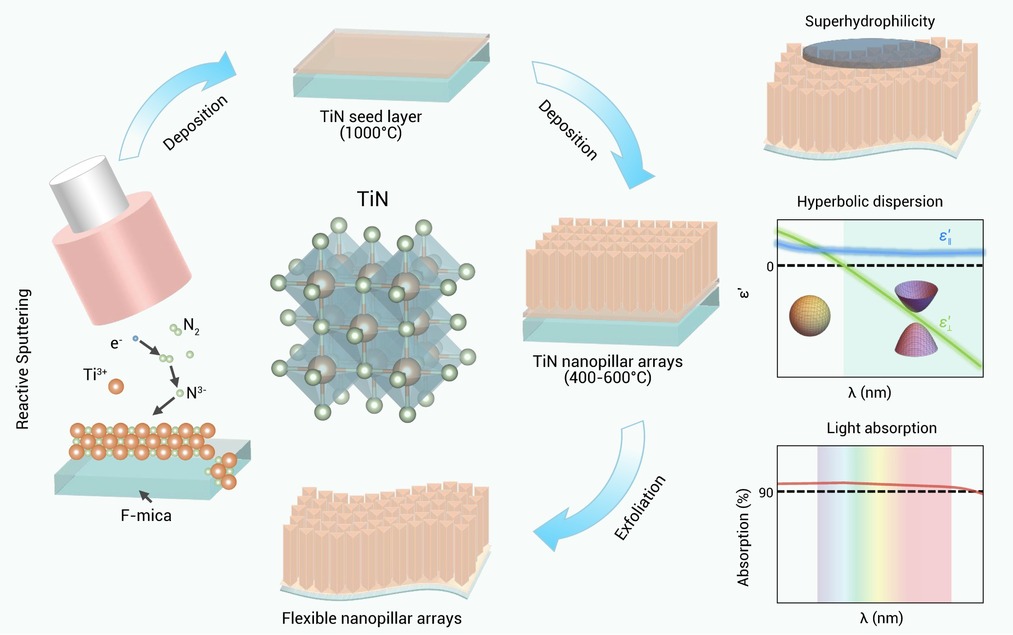
Figure 1.
Schematic process of synthesizing flexible single-crystalline TiN nanopillar arrays with multifunctionalities including superhydrophilicity, plasmonic hyperbolic dispersion, and light absorption.
-
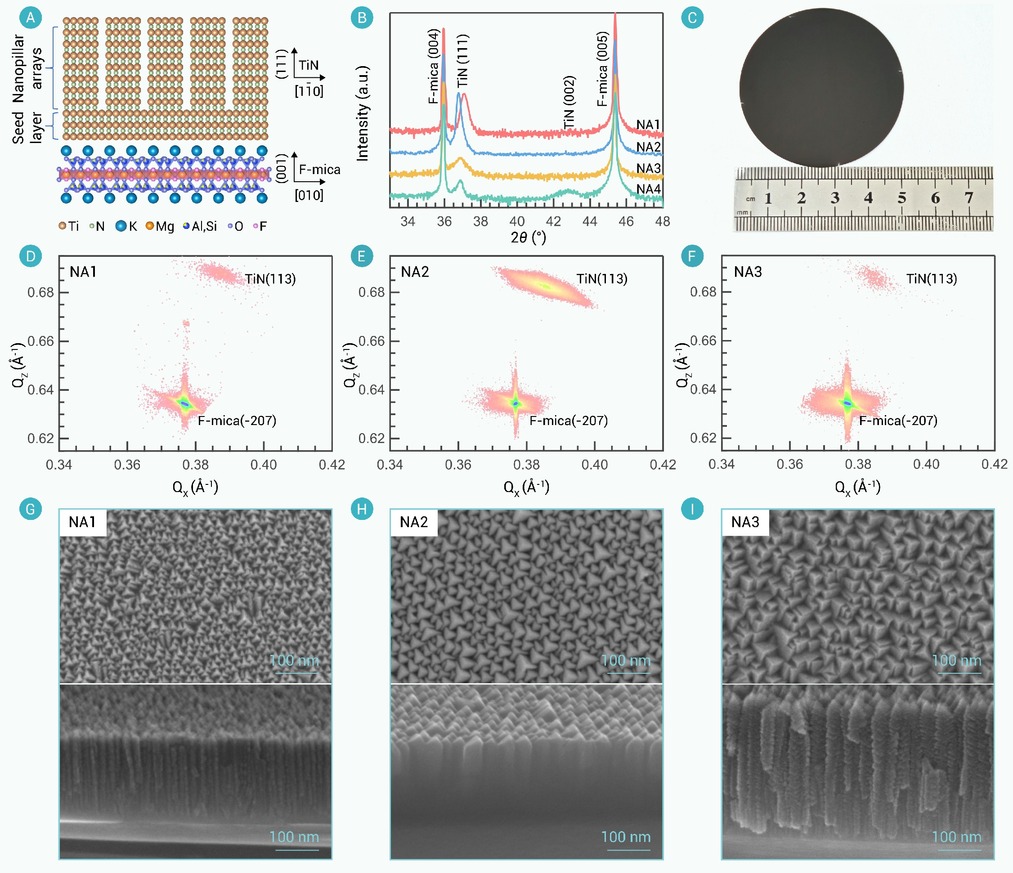
Figure 2.
Crystal structures, photo image, and structural characterizations of TiN nanopillar arrays deposited on F-mica substrates
-
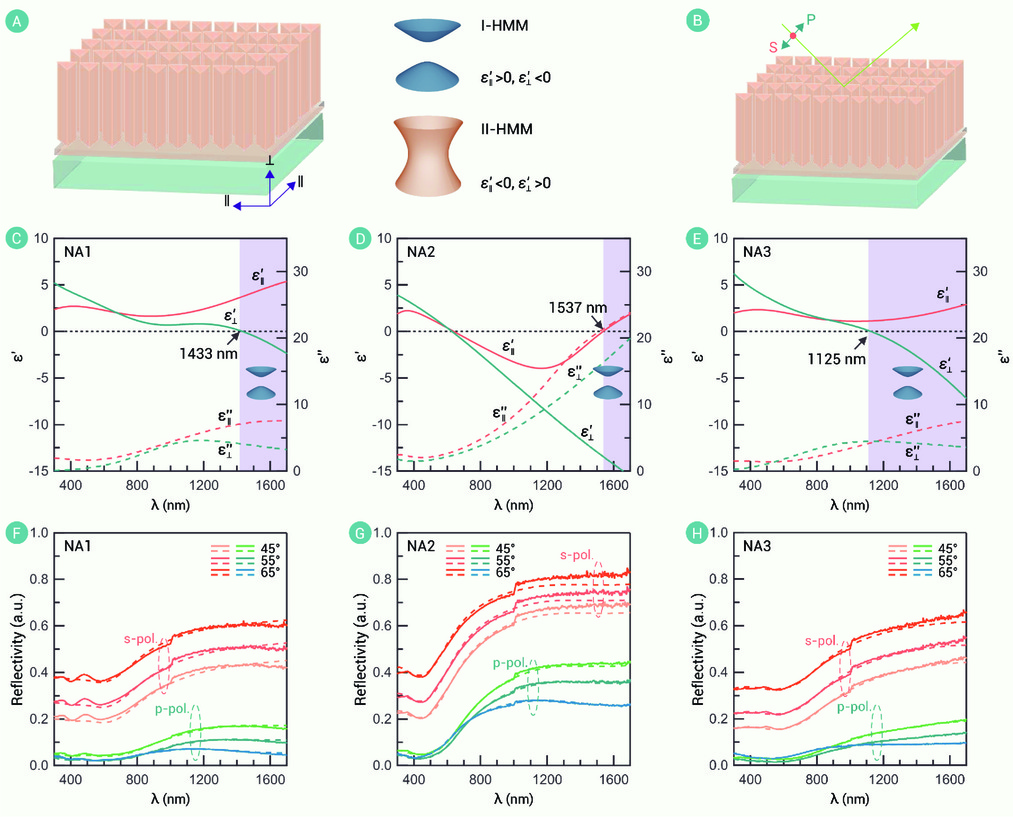
Figure 3.
The plasmonic hyperbolic dispersions and polarized reflectivities for the samples NA1, NA2, and NA3
-
Figure 4.
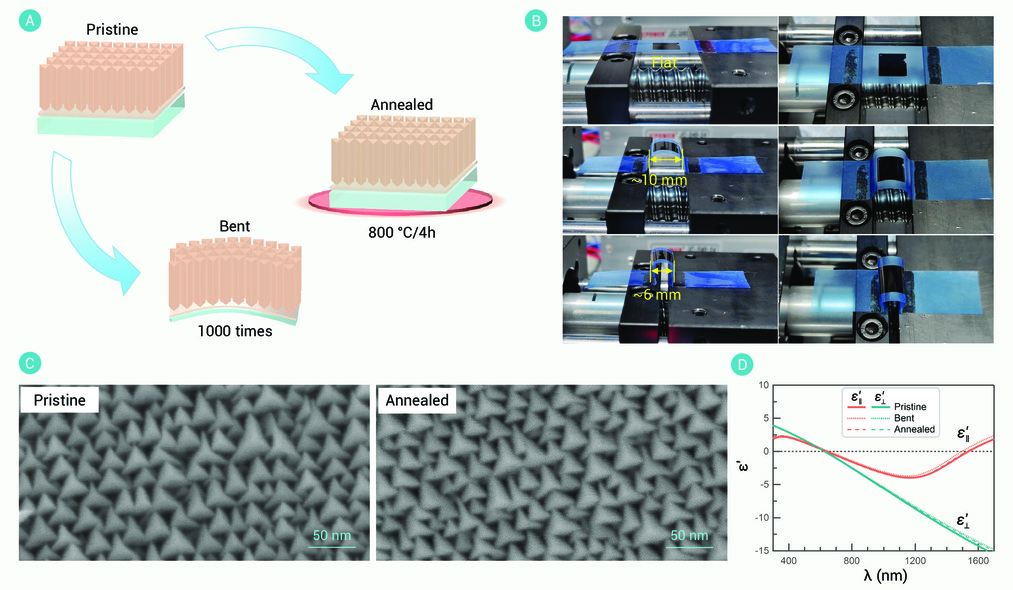
Stability of flexible TiN nanopillar arrays upon repeated bending and high-temperature treatment
-
Figure 5.
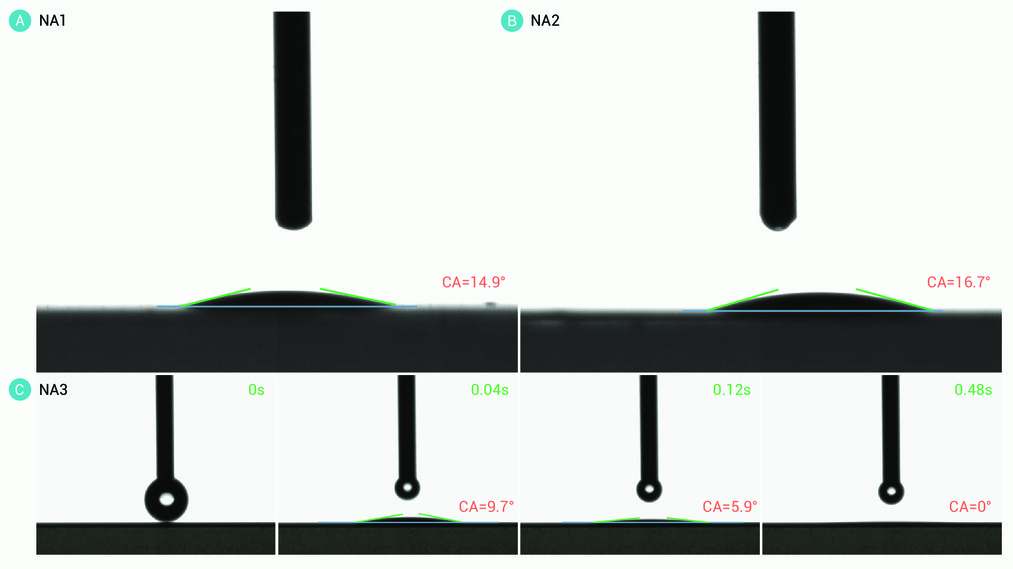
Contact angle measurements
-
Figure 6.
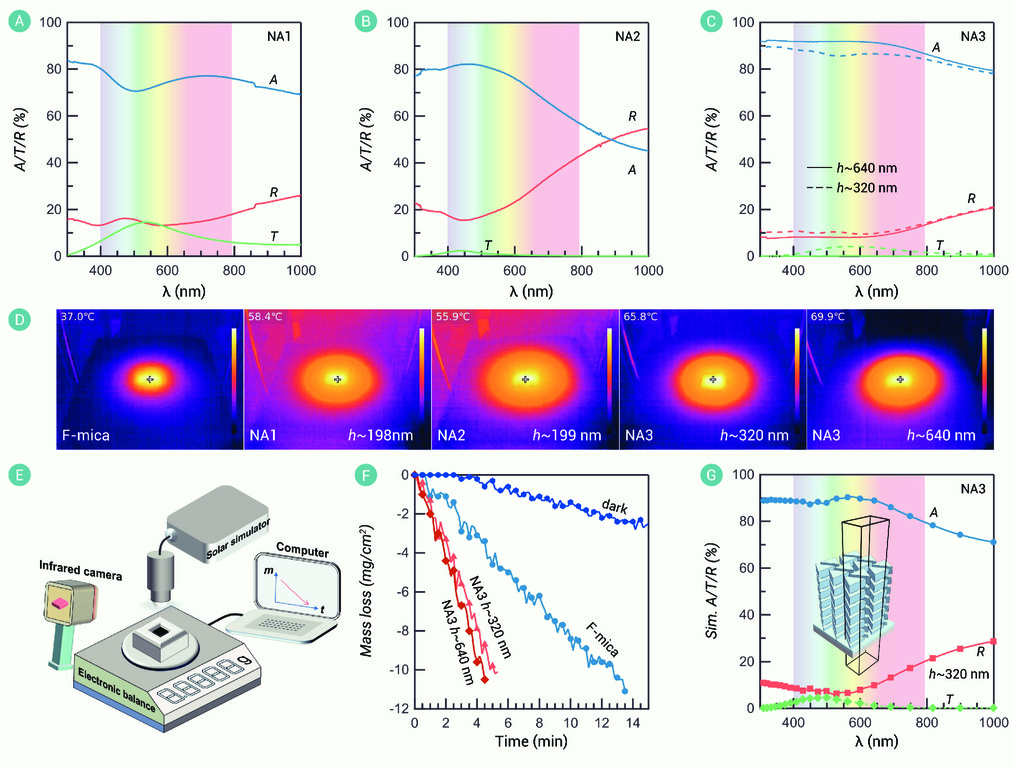
Light absorption and solar steam generation
