
Interstitial electrons: A real-space electronic dimension for quantum materials
-

-
REFERENCES
[1] Dye J.L. (2003). Electrides: Ionic salts with electrons as the anions. Science 301:607−608. DOI:10.1126/science.1088105 [2] Hosono H. and Kitano M. (2021). Advances in materials and applications of electrides. Chem. Rev. 121:3121−3185. DOI:10.1021/acs.chemrev.0c00732 [3] You J.-Y., Lyu P., Wang Y.-M., et al. (2022). Emergent kagome bands in the electride Li5Si. J. Am. Chem. Soc. 144:5527−5533. DOI:10.1021/jacs.1c12816 [4] Geng S., Wang X., Guo R., et al. (2026). Experimental realization of dice-lattice flat band at the Fermi level in layered electride YCl. Nat. Commun. 17:2213. DOI:10.1038/s41467-026-69049-0 [5] Liu Z., Wang X., Yang Y., et al. (2026). Free-anionic duality of interstitial electrons drives superconductivity in electrides. J. Am. Chem. Soc. 148:27520−27527. DOI:10.1021/jacs.6c05978 -
ABOUT THIS ARTICLE
Cite this article:
Yang Y., Ma P. and Liu Z. (2026). Interstitial electrons: A real-space electronic dimension for quantum materials. The Innovation Materials 4:100249. https://doi.org/10.59717/j.xinn-mater.2026.100249
Welcome!
To request copyright permission to republish or share portions of our works, please visit Copyright Clearance Center's (CCC) Marketplace website at marketplace.copyright.com.
Export File
Citation
Yang Y., Ma P. and Liu Z. (2026). Interstitial electrons: A real-space electronic dimension for quantum materials. The Innovation Materials 4:100249. https://doi.org/10.59717/j.xinn-mater.2026.100249

Format
Content
 DownLoad:
-
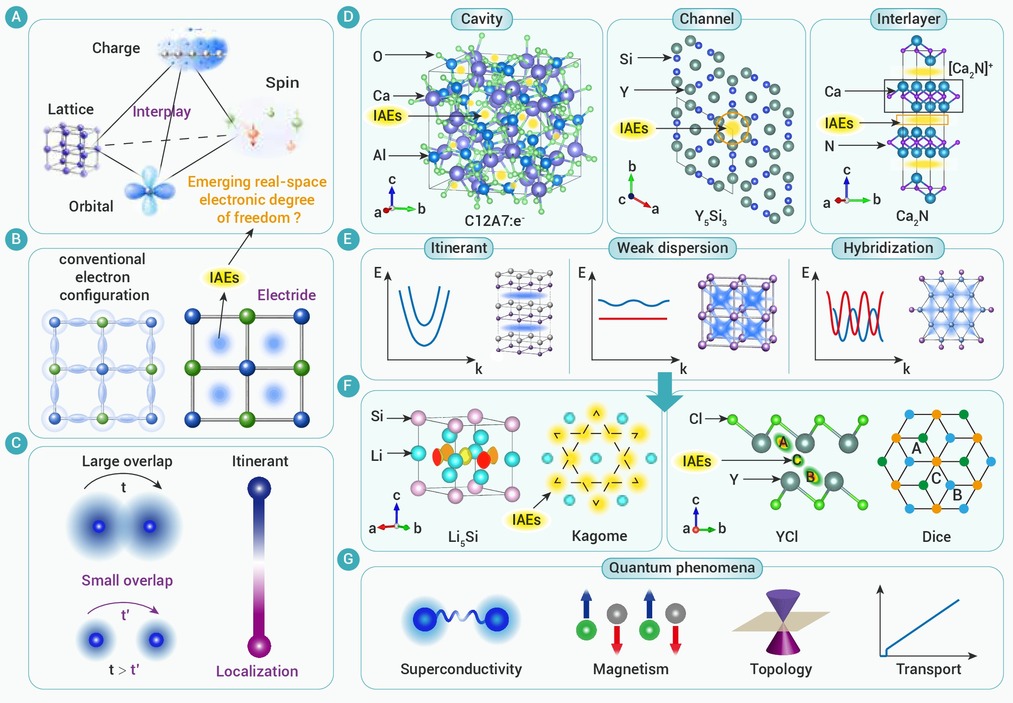
Figure 1.
Interstitial anion electrons (IAEs) as a real-space electronic dimension bridging crystal architecture and quantum phenomena
