
A dynamic ion-transport channel: Interface-controlled bulk oxygen spillover redefines metal–support interactions
-

-
REFERENCES
[1] Wang W., Xu H., Liu S., et al. (2026). Imaging interface-controlled bulk oxygen spillover. Nature 652:655−659. DOI:10.1038/s41586-026-10324-x [2] Karim W., Spreafico C., Kleibert A., et al. (2017) Catalyst support effects on hydrogen spillover. Nature 541:68-71. DOI: 10.1038/nature20782. [3] Tauster S. J., Fung S. C., Garten R. L. (1978) Strong metal-support interactions. Group 8 noble metals supported on titanium dioxide. J. Am. Chem. Soc. 100:170-175. DOI: 10.1021/ja00469a029. [4] Yuan W., Zhu B., Fang K., et al. (2021) In situ manipulation of the active au-TiO2 interface with atomic precision during CO oxidation. Science 371:517-521. DOI: 10.1126/science.abe3558. [5] Chen, S., Zhang, K., Chen, Y. et al. (2025) Interface engineering to regulate oxidation dynamics of supported nanoparticles. Nat. Commun 16:4834. DOI: 10.1038/s41467-025-60151-3. -
ABOUT THIS ARTICLE
Cite this article:
Li Q., Han L., Chen K., et al. (2026). A dynamic ion-transport channel: Interface-controlled bulk oxygen spillover redefines metal–support interactions. The Innovation Materials 4:100250. https://doi.org/10.59717/j.xinn-mater.2026.100250
Welcome!
To request copyright permission to republish or share portions of our works, please visit Copyright Clearance Center's (CCC) Marketplace website at marketplace.copyright.com.
Export File
Citation
Li Q., Han L., Chen K., et al. (2026). A dynamic ion-transport channel: Interface-controlled bulk oxygen spillover redefines metal–support interactions. The Innovation Materials 4:100250. https://doi.org/10.59717/j.xinn-mater.2026.100250

Format
Content
 DownLoad:
-
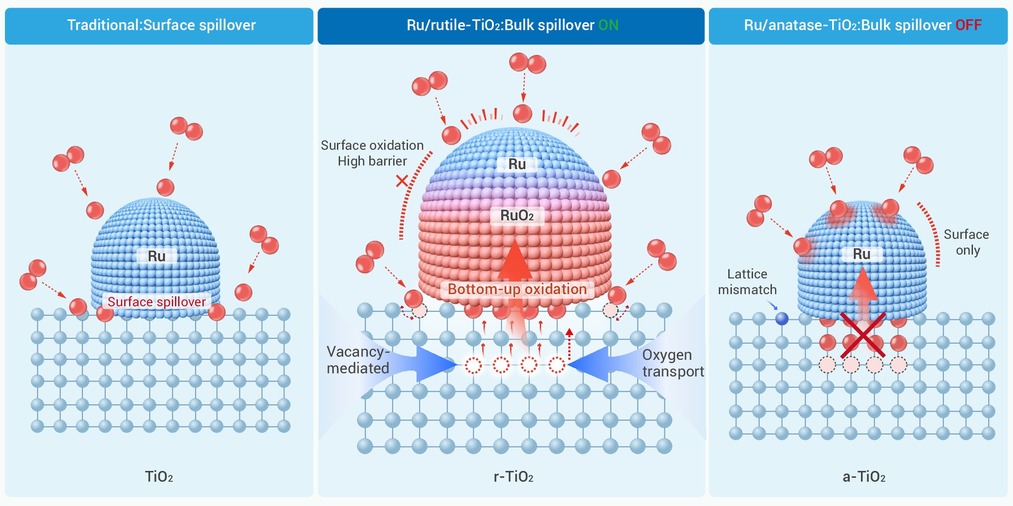
Figure 1.
Shifting paradigms from surface oxygen spillover to interface-controlled bulk oxygen transport. (black circle, oxygen vacancy)
