
One toolkit, many materials: How snails tune mucus for lubrication, adhesion, and protection
-

-
REFERENCES
[1] Denny M. (1980). The role of gastropod pedal mucus in locomotion. Nature 285:160−161. DOI:10.1038/285160a0 [2] Li Y., Bai P., Cao H. et al. (2022). Imaging dynamic three-dimensional traction stresses. Sci. Adv. 8:eabm0984. DOI:10.1126/sciadv.abm0984 [3] Gabler M., Raguin E., Scoppola E., et al. (2026) Calcium tunes snail mucus–based materials to multiple functions. Science 393:596-600. DOI: 10.1126/science.adx7367. [4] Neumann M., di Marco G., Iudin D., et al. (2023) Stimuli-responsive hydrogels: The dynamic smart biomaterials of tomorrow. Macromolecules 56:8377–8392. DOI: 10.1021/acs.macromol.3c00967. [5] Kim J.W., Allen M. J., Recker E. A., et al. (2025). Hybrid epoxy–acrylate resins for wavelength-selective multimaterial 3D printing. Nat. Mater. 24:1116−1125. DOI:10.1038/s41563-025-02249-z -
ABOUT THIS ARTICLE
Cite this article:
Li Y., Liu C. and Tian Y. (2026). One toolkit, many materials: How snails tune mucus for lubrication, adhesion, and protection. The Innovation Materials 4:100251. https://doi.org/10.59717/j.xinn-mater.2026.100251
Welcome!
To request copyright permission to republish or share portions of our works, please visit Copyright Clearance Center's (CCC) Marketplace website at marketplace.copyright.com.
Export File
Citation
Li Y., Liu C. and Tian Y. (2026). One toolkit, many materials: How snails tune mucus for lubrication, adhesion, and protection. The Innovation Materials 4:100251. https://doi.org/10.59717/j.xinn-mater.2026.100251

Format
Content
 DownLoad:
-
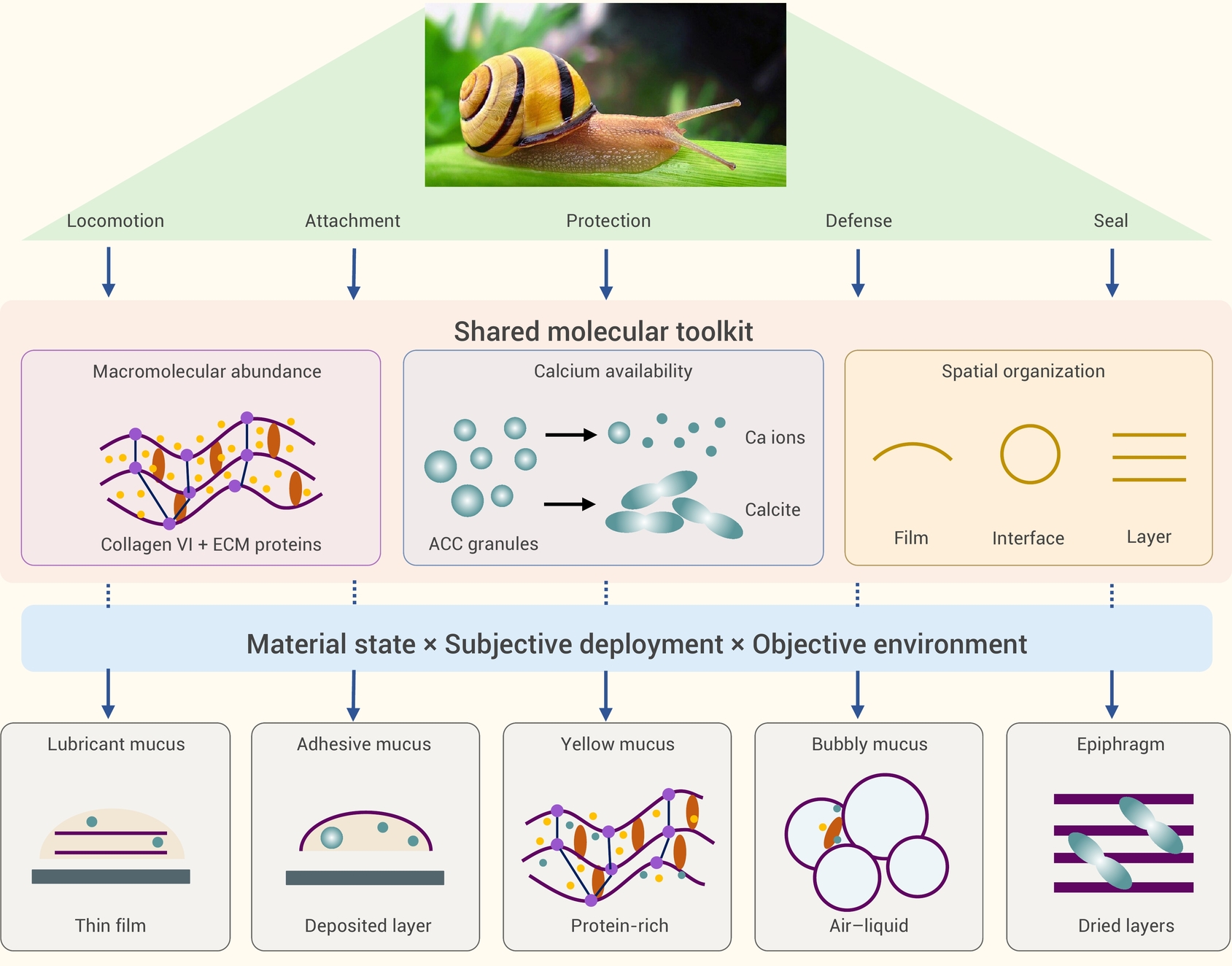
Figure 1.
A shared molecular toolkit generates functionally distinct snail mucus materials through coordinated state tuning
