
Tandem mass spectrometry in newborn screening for inherited metabolic diseases: A comprehensive review
-
GRAPHICAL ABSTRACT
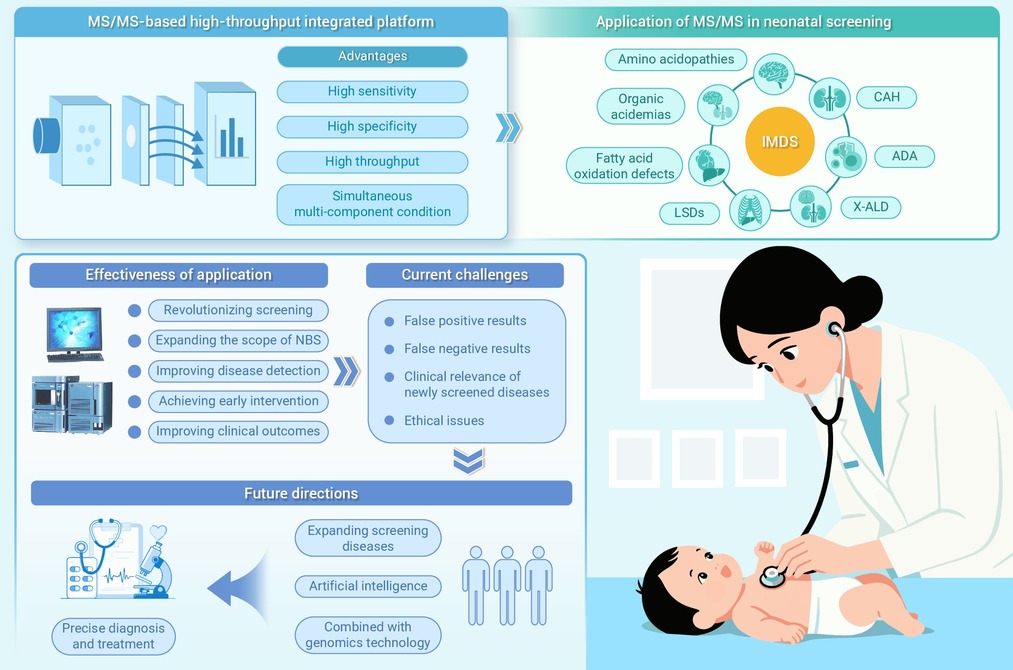
 DownLoad:
Full size image
DownLoad:
Full size image
-
PUBLIC SUMMARY
-
Newborn screening is a key public health strategy for preventing childhood diseases and deaths.
MS/MS has revolutionized screening by detecting dozens of metabolic disorders in a single run.
This review outlines MS/MS principles and evidence of improved detection, early treatment, and outcomes.
Challenges remain, including false-positive results, clinical relevance confirmation, and ethical concerns.
Future directions include AI, expanded panels, and genomics for precise diagnosis and personalized care.
-
-
ABSTRACT
Newborn screening represents a critical public health strategy for preventing childhood morbidity and mortality. The introduction of tandem mass spectrometry (MS/MS) has revolutionized the screening landscape for inherited metabolic diseases, shifting the paradigm from single-disease assays to a high-throughput, integrated platform capable of detecting dozens of disorders in a single run. This review systematically outlines the applications and challenges of MS/MS in newborn screening. It begins by outlining the technical principles underlying MS/MS, highlighting its unique capacity to simultaneously quantify multiple amino acids, organic acids, and fatty acid oxidation metabolites. Then, it summarizes global implementation experiences and overviews evidence to demonstrate that MS/MS significantly enhances disease detection rates, enables early intervention, and substantially improves clinical outcomes. However, its widespread adoption introduces new challenges, such as the interpretation of false-positive results, confirmation of clinical relevance for newly screened conditions, and accompanying ethical concerns. Future directions include leveraging artificial intelligence to refine interpretive workflows, expanding the screening panel, and integrating genomic technologies with MS/MS to achieve more precise diagnosis and personalized management. This review aims to offer public health policymakers, clinicians, and laboratory specialists a comprehensive interdisciplinary overview to advance the next developmental phase of newborn screening systems. -

-
REFERENCES
[1] Waters D., Adeloye D., Woolham D., et al. (2018). Global birth prevalence and mortality from inborn errors of metabolism: A systematic analysis of the evidence. J. Glob. Health 8:021102. DOI:10.7189/jogh.08.021102 [2] Guthrie R. and Susi A. (1963). A simple phenylalanine method for detecting phenylketonuria in large populations of newborn infants. Pediatrics 32:338−343. [3] Dussault J. H., Parlow A., Letarte J., et al. (1976). TSH measurements from blood spots on filter paper: A confirmatory screening test for neonatal hypothyroidism. J. Pediatr. 89:550−552. DOI:10.1016/s0022-3476(76)80384-8 [4] Pang S., Murphey W., Levine L. S., et al. (1982). A pilot newborn screening for congenital adrenal hyperplasia in Alaska. J. Clin. Endocrinol. Metab. 55:413−420. DOI:10.1210/jcem-55-3-413 [5] Van Hove J. L., Chace D. H., Kahler S. G., et al. (1993). Acylcarnitines in amniotic fluid: Application to the prenatal diagnosis of propionic acidaemia. J. Inherit. Metab. Dis. 16:361−367. DOI:10.1007/BF00710283 [6] Zytkovicz T. H., Fitzgerald E. F., Marsden D., et al. (2001). Tandem mass spectrometric analysis for amino, organic, and fatty acid disorders in newborn dried blood spots: A two-year summary from the New England Newborn Screening Program. Clin. Chem. 47:1945−1955. [7] American College of Medical Genetics Newborn Screening Expert Group. (2006). Newborn screening: Toward a uniform screening panel and system--executive summary. Pediatrics 117:S296-307. DOI:10.1542/peds.2005-2633I [8] Simonsen H., Jensen U. G., Brandt N. J., et al. (1999). Design of a pilot study to evaluate tandem mass spectrometry for neonatal screening. Southeast Asian J. Trop. Med. Public Health 30 Suppl 2:166-169. [9] Kononets V., Zharmakhanova G., Balmagambetova S., et al. (2025). Tandem mass spectrometry in screening for inborn errors of metabolism: comprehensive bibliometric analysis. Front. Pediatr. 13:1463294. DOI:10.3389/fped.2025.1463294 [10] Garg U. and Dasouki M. (2006). Expanded newborn screening of inherited metabolic disorders by tandem mass spectrometry: Clinical and laboratory aspects. Clin. Biochem. 39:315−332. DOI:10.1016/j.clinbiochem.2005.12.009 [11] Rinaldo P., Tortorelli S. and Matern D. (2004). Recent developments and new applications of tandem mass spectrometry in newborn screening. Curr. Opin. Pediatr. 16:427−433. DOI:10.1097/01.mop.0000133635.79661.84 [12] Younesi S., Yazdani B., Taheri Amin M. M., et al. (2022). Incorporation of second-tier tests and secondary biomarkers to improve positive predictive value (PPV) rate in newborn metabolic screening program. J. Clin. Lab. Anal. 36:e24471. DOI:10.1002/jcla.24471 [13] Gelb M. H., Basheeruddin K., Burlina A., et al. (2022). Liquid chromatography-tandem mass spectrometry in newborn screening laboratories. Int. J. Neonatal. Screen 8:62. DOI:10.3390/ijns8040062 [14] Ozben T. (2013). Expanded newborn screening and confirmatory follow-up testing for inborn errors of metabolism detected by tandem mass spectrometry. Clin. Chem. Lab. Med. 51:157−176. DOI:10.1515/cclm-2012-0472 [15] Shigematsu Y., Yuasa M., Ishige N., et al. (2021). Development of second-tier liquid chromatography-tandem mass spectrometry analysis for expanded newborn screening in Japan. Int. J. Neonatal. Screen 7:44. DOI:10.3390/ijns7030044 [16] Ombrone D., Giocaliere E., Forni G., et al. (2016). Expanded newborn screening by mass spectrometry: New tests, future perspectives. Mass Spectrom. Rev. 35:71−84. DOI:10.1002/mas.21463 [17] Yoon H. R. (2015). Screening newborns for metabolic disorders based on targeted metabolomics using tandem mass spectrometry. Ann. Pediatr. Endocrinol. Metab. 20:119−124. DOI:10.6065/apem.2015.20.3.119 [18] Kuk M. U., Lee Y. H., Kim J. W., et al. (2021). Potential treatment of lysosomal storage disease through modulation of the mitochondrial-lysosomal axis. Cells 10:420. DOI:10.3390/cells10020420 [19] Platt F. M., d'Azzo A., Davidson B. L., et al. (2018). Lysosomal storage diseases. Nat. Rev. Dis. Primers 4:27. DOI:10.1038/s41572-018-0025-4 [20] Poswar F. O., Vairo F., Burin M., et al. (2019). Lysosomal diseases: Overview on current diagnosis and treatment. Genet. Mol. Biol. 42:165−177. DOI:10.1590/1678-4685-GMB-2018-0159 [21] Gelb M. H., Scott C. R. and Turecek F. (2015). Newborn screening for lysosomal storage diseases. Clin. Chem. 61:335−346. DOI:10.1373/clinchem.2014.225771 [22] Millington D. S. (2005). Newborn screening for lysosomal storage disorders. Clin. Chem. 51:808−809. DOI:10.1373/clinchem.2005.048553 [23] Lukacs Z., Barr M. and Hamilton J. (2017). Best practice in the measurement and interpretation of lysosomal acid lipase in dried blood spots using the inhibitor Lalistat 2. Clin. Chim. Acta 471:201−205. DOI:10.1016/j.cca.2017.05.027 [24] Hamilton J., Jones I., Srivastava R., et al. (2012). A new method for the measurement of lysosomal acid lipase in dried blood spots using the inhibitor Lalistat 2. Clin. Chim. Acta 413:1207−1210. DOI:10.1016/j.cca.2012.03.019 [25] Hall E. M., Flores S. R. and De Jesus V. R. (2015). Influence of hematocrit and total-spot volume on performance characteristics of dried blood spots for newborn screening. Int. J. Neonatal. Screen. 1:69−78. DOI:10.3390/ijns1020069 [26] Strovel E. T., Cusmano-Ozog K., Wood T., et al. (2022). Measurement of lysosomal enzyme activities: A technical standard of the American College of Medical Genetics and Genomics (ACMG). Genet. Med. 24:769−783. DOI:10.1016/j.gim.2021.12.013 [27] Chang S., Zhan X., Liu Y., et al. (2024). Newborn screening for 6 lysosomal storage disorders in China. JAMA Netw. Open 7:e2410754. DOI:10.1001/jamanetworkopen.2024.10754 [28] Blanchard S., Sadilek M., Scott C. R., et al. (2008). Tandem mass spectrometry for the direct assay of lysosomal enzymes in dried blood spots: Application to screening newborns for mucopolysaccharidosis I. Clin. Chem. 54:2067−2070. DOI:10.1373/clinchem.2008.115410 [29] Zhang X. K., Elbin C. S., Chuang W. L., et al. (2008). Multiplex enzyme assay screening of dried blood spots for lysosomal storage disorders by using tandem mass spectrometry. Clin. Chem. 54:1725−1728. DOI:10.1373/clinchem.2008.104711 [30] Wasserstein M. P., Orsini J. J., Goldenberg A., et al. (2021). The future of newborn screening for lysosomal disorders. Neurosci. Lett. 760:136080. DOI:10.1016/j.neulet.2021.136080 [31] Onuki T., Tajika M., Sugiyama Y., et al. (2025). Japanese experience of newborn screening for lysosomal storage diseases and adrenoleukodystrophy. Orphanet. J. Rare Dis. 20:373. DOI:10.1186/s13023-025-03848-4 [32] Sawada T., Kido J., Yoshida S., et al. (2020). Newborn screening for Fabry disease in the western region of Japan. Mol. Genet. Metab. Rep. 22:100562. DOI:10.1016/j.ymgmr.2019.100562 [33] Momosaki K., Kido J., Yoshida S., et al. (2019). Newborn screening for Pompe disease in Japan: Report and literature review of mutations in the GAA gene in Japanese and Asian patients. J. Hum. Genet. 64:741−755. DOI:10.1038/s10038-019-0603-7 [34] Kubaski F., Sousa I., Amorim T., et al. (2023). Pilot study of newborn screening for six lysosomal diseases in Brazil. Mol. Genet. Metab. 140:107654. DOI:10.1016/j.ymgme.2023.107654 [35] Wittmann J., Karg E., Turi S., et al. (2012). Newborn screening for lysosomal storage disorders in hungary. JIMD Rep. 6:117−125. DOI:10.1007/8904_2012_130 [36] Spiewak J., Doykov I., Papandreou A., et al. (2023). New perspectives in dried blood spot biomarkers for lysosomal storage diseases. Int. J. Mol. Sci. 24. DOI:10.3390/ijms241210177. [37] de Souza H. M. R., Scalco F. B., Garrett R., et al. (2023). Development of a kit for urine collection on filter paper as an alternative for Pompe disease screening and monitoring by LC-HRMS. Anal. Methods 15:3932−3939. DOI:10.1039/d3ay00587a [38] Bezman L., Moser A. B., Raymond G. V., et al. (2001). Adrenoleukodystrophy: Incidence, new mutation rate, and results of extended family screening. Ann. Neurol. 49:512−517. [39] Bessey A., Chilcott J. B., Leaviss J., et al. (2018). Economic impact of screening for X-linked Adrenoleukodystrophy within a newborn blood spot screening programme. Orphanet. J. Rare Dis. 13:179. DOI:10.1186/s13023-018-0921-4 [40] Rajabi F. (2018). Updates in newborn screening. Pediatr. Ann. 47:e187−e190. DOI:10.3928/19382359-20180426-01 [41] Huffnagel I. C., van de Beek M. C., Showers A. L., et al. (2017). Comparison of C26:0-carnitine and C26:0-lysophosphatidylcholine as diagnostic markers in dried blood spots from newborns and patients with adrenoleukodystrophy. Mol. Genet. Metab. 122:209−215. DOI:10.1016/j.ymgme.2017.10.012 [42] Moser A. B., Kreiter N., Bezman L., et al. (1999). Plasma very long chain fatty acids in 3,000 peroxisome disease patients and 29,000 controls. Ann. Neurol. 45:100−110. DOI:3.0.co;2-u">10.1002/1531-8249(199901)45:1<100::aid-art16>3.0.co;2-u [43] Hubbard W. C., Moser A. B., Tortorelli S., et al. (2006). Combined liquid chromatography-tandem mass spectrometry as an analytical method for high throughput screening for X-linked adrenoleukodystrophy and other peroxisomal disorders: Preliminary findings. Mol. Genet. Metab. 89:185−187. DOI:10.1016/j.ymgme.2006.05.001 [44] Jaspers Y. R. J., Ferdinandusse S., Dijkstra I. M. E., et al. (2020). Comparison of the diagnostic performance of C26:0-lysophosphatidylcholine and very long-chain fatty acids analysis for peroxisomal disorders. Front. Cell Dev. Biol. 8:690. DOI:10.3389/fcell.2020.00690 [45] Lacey J. M., Minutti C. Z., Magera M. J., et al. (2004). Improved specificity of newborn screening for congenital adrenal hyperplasia by second-tier steroid profiling using tandem mass spectrometry. Clin. Chem. 50:621−625. DOI:10.1373/clinchem.2003.027193 [46] Oglesbee D., Sanders K. A., Lacey J. M., et al. (2008). Second-tier test for quantification of alloisoleucine and branched-chain amino acids in dried blood spots to improve newborn screening for maple syrup urine disease (MSUD). Clin. Chem. 54:542−549. DOI:10.1373/clinchem.2007.098434 [47] la Marca G., Malvagia S., Pasquini E., et al. (2007). Rapid 2nd-tier test for measurement of 3-OH-propionic and methylmalonic acids on dried blood spots: Reducing the false-positive rate for propionylcarnitine during expanded newborn screening by liquid chromatography-tandem mass spectrometry. Clin. Chem. 53:1364−1369. DOI:10.1373/clinchem.2007.087775 [48] Dreves B., Reznik Y. and Tabarin A. (2023). Congenital adrenal hyperplasia: New biomarkers and adult treatments. Ann. Endocrinol. (Paris) 84:472−480. DOI:10.1016/j.ando.2023.01.008 [49] El-Maouche D., Arlt W. and Merke D. P. (2017). Congenital adrenal hyperplasia. Lancet 390:2194−2210. DOI:10.1016/S0140-6736(17)31431-9 [50] Auer M. K., Nordenstrom A., Lajic S., et al. (2023). Congenital adrenal hyperplasia. Lancet 401:227−244. DOI:10.1016/S0140-6736(22)01330-7 [51] Miller W. L. and Auchus R. J. (2011). The molecular biology, biochemistry, and physiology of human steroidogenesis and its disorders. Endocr. Rev. 32:81−151. DOI:10.1210/er.2010-0013 [52] Haddad N. G. and Eugster E. A. (2019). Peripheral precocious puberty including congenital adrenal hyperplasia: Causes, consequences, management and outcomes. Best Pract. Res. Clin. Endocrinol. Metab. 33:101273. DOI:10.1016/j.beem.2019.04.007 [53] He Z., Dai H., Shen J., et al. (2024). Development and evaluation of a candidate reference measurement procedure for detecting 17alpha-hydroxyprogesterone in dried blood spots using isotope dilution liquid chromatography tandem mass spectrometry. Anal. Bioanal. Chem. 416:4635−4645. DOI:10.1007/s00216-024-05411-9 [54] Adriaansen B. P. H., Oude Alink S. E., Swinkels D. W., et al. (2024). Reference intervals for serum 11-oxygenated androgens in children. Eur. J. Endocrinol. 190:96-103. DOI:10.1093/ejendo/lvae008 [55] Zhan X., Han L., Qiu W., et al. (2022). Steroid profile in dried blood spots by liquid chromatography tandem mass spectrometry: Application to newborn screening for congenital adrenal hyperplasia in China. Steroids 185:109056. DOI:10.1016/j.steroids.2022.109056 [56] Yu S., Yin Y., Zou Y., et al. (2024). A comprehensive LC-MS/MS method for the simultaneous measurement of 24 adrenal steroids: From research to clinical practice. J. Chromatogr. B Analyt. Technol. Biomed. Life Sci. 1232:123941. DOI:10.1016/j.jchromb.2023.123941 [57] Chiu H. H. and Kuo C. H. (2020). Gas chromatography-mass spectrometry-based analytical strategies for fatty acid analysis in biological samples. J. Food Drug. Anal. 28:60−73. DOI:10.1016/j.jfda.2019.10.003 [58] Dietzen D. J., Rinaldo P., Whitley R. J., et al. (2009). National academy of clinical biochemistry laboratory medicine practice guidelines: Follow-up testing for metabolic disease identified by expanded newborn screening using tandem mass spectrometry; executive summary. Clin. Chem. 55:1615−1626. DOI:10.1373/clinchem.2009.131300 [59] Zhou H., Fernhoff P. and Vogt R. F. (2011). Newborn bloodspot screening for lysosomal storage disorders. J. Pediatr. 159:7-13 e11. DOI:10.1016/j.jpeds.2011.02.026 [60] Seashore M. R. and Seashore C. J. (2005). Newborn screening and the pediatric practitioner. Semin. Perinatol. 29:182−188. DOI:10.1053/j.semperi.2005.05.001 [61] Pitt J. J. (2010). Newborn screening. Clin. Biochem. Rev. 31:57−68. [62] Lehotay D. C., Hall P., Lepage J., et al. (2011). LC-MS/MS progress in newborn screening. Clin. Biochem. 44:21−31. DOI:10.1016/j.clinbiochem.2010.08.007 [63] Yang L., Zhang Y., Yang J., et al. (2018). Effects of birth weight on profiles of dried blood amino-acids and acylcarnitines. Ann. Clin. Biochem. 55:92−99. DOI:10.1177/0004563216688038 [64] Wilson C., Knoll D., de Hora M., et al. (2017). The risk of fatty acid oxidation disorders and organic acidemias in children with normal newborn screening. JIMD Rep. 35:53−58. DOI:10.1007/8904_2016_25 [65] Rauschert S., Raubenheimer K., Melton P. E., et al. (2020). Machine learning and clinical epigenetics: A review of challenges for diagnosis and classification. Clin. Epigenetics 12:51. DOI:10.1186/s13148-020-00842-4 [66] Dai J., Xu H., Chen T., et al. (2025). Artificial intelligence for medicine 2025: Navigating the endless frontier. Innov. Med. 3:100120. DOI:10.59717/j.xinn-med.2025.100120 [67] Cao C., Zhao W., Guo J., et al. (2025). Leveraging artificial intelligence and machine learning for unraveling pathogenesis and advancing precision medicine in autoimmune diseases. Innov. Med. 3:100154. DOI:10.59717/j.xinn-med.2025.100154 [68] Huang T., Xu H., Wang H., et al. (2023). Artificial intelligence for medicine: Progress, challenges, and perspectives. Innov. Med. 1:100030. DOI:10.59717/j.xinn-med.2023.100030 [69] Zaunseder E., Haupt S., Mutze U., et al. (2022). Opportunities and challenges in machine learning-based newborn screening-A systematic literature review. JIMD Rep. 63:250−261. DOI:10.1002/jmd2.12285 [70] Zaunseder E., Mutze U., Garbade S. F., et al. (2023). Machine learning methods improve specificity in newborn screening for isovaleric aciduria. Metabolites 13. DOI:10.3390/metabo13020304. [71] Zhu Z., Gu J., Genchev G. Z., et al. (2020). Improving the diagnosis of phenylketonuria by using a machine learning-based screening model of neonatal MRM data. Front. Mol. Biosci. 7:115. DOI:10.3389/fmolb.2020.00115 [72] Peng G., Tang Y., Cowan T. M., et al. (2020). Reducing false-positive results in newborn screening using machine learning. Int. J. Neonatal. Screen. 6:16. DOI:10.3390/ijns6010016 [73] Yang X., Ding S., Zhang J., et al. (2024). The significance of machine learning in neonatal screening for inherited metabolic diseases. Front. Pediatr. 12:1366891. DOI:10.3389/fped.2024.1366891 [74] Adhikari A. N., Gallagher R. C., Wang Y., et al. (2020). The role of exome sequencing in newborn screening for inborn errors of metabolism. Nat. Med. 26:1392−1397. DOI:10.1038/s41591-020-0966-5 [75] Berg J. S., Agrawal P. B., Bailey D. B., Jr., et al. (2017). Newborn sequencing in genomic medicine and public health. Pediatrics 139:e20162252. DOI:10.1542/peds.2016-2252 [76] Downie L., Halliday J., Lewis S., et al. (2021). Principles of genomic newborn screening programs: A systematic review. JAMA Netw. Open 4:e2114336. DOI:10.1001/jamanetworkopen.2021.14336 [77] Bodian D. L., Klein E., Iyer R. K., et al. (2016). Utility of whole-genome sequencing for detection of newborn screening disorders in a population cohort of 1,696 neonates. Genet. Med. 18:221−230. DOI:10.1038/gim.2015.111 [78] Ceyhan-Birsoy O., Murry J. B., Machini K., et al. (2019). Interpretation of genomic sequencing results in healthy and Ill newborns: Results from the BabySeq project. Am. J. Hum. Genet. 104:76−93. DOI:10.1016/j.ajhg.2018.11.016 [79] Pavey A. R., Bodian D. L., Vilboux T., et al. (2017). Utilization of genomic sequencing for population screening of immunodeficiencies in the newborn. Genet. Med. 19:1367−1375. DOI:10.1038/gim.2017.57 [80] Roman T. S., Crowley S. B., Roche M. I., et al. (2020). Genomic sequencing for newborn screening: Results of the NC NEXUS project. Am. J. Hum. Genet. 107:596−611. DOI:10.1016/j.ajhg.2020.08.001 [81] Jian M., Wang X., Sui Y., et al. (2022). A pilot study of assessing whole genome sequencing in newborn screening in unselected children in China. Clin. Transl. Med. 12:e843. DOI:10.1002/ctm2.843 [82] Kingsmore S. F., Smith L. D., Kunard C. M., et al. (2022). A genome sequencing system for universal newborn screening, diagnosis, and precision medicine for severe genetic diseases. Am. J. Hum. Genet. 109:1605−1619. DOI:10.1016/j.ajhg.2022.08.003 [83] Chen T., Fan C., Huang Y., et al. (2023). Genomic sequencing as a first-tier screening test and outcomes of newborn screening. JAMA Netw. Open 6:e2331162. DOI:10.1001/jamanetworkopen.2023.31162 [84] Balciuniene J., Liu R., Bean L., et al. (2023). At-risk genomic findings for pediatric-onset disorders from genome sequencing vs medically actionable gene panel in proactive screening of newborns and children. JAMA Netw. Open 6:e2326445. DOI:10.1001/jamanetworkopen.2023.26445 [85] Ziegler A., Koval-Burt C., Kay D. M., et al. (2025). Expanded newborn screening using genome sequencing for early actionable conditions. JAMA 333:232−240. DOI:10.1001/jama.2024.19662 -
ABOUT THIS ARTICLE
Cite this article:
Wan Z., Han J., Yang H., et al. (2026). Tandem mass spectrometry in newborn screening for inherited metabolic diseases: A comprehensive review. The Innovation Medicine 4:100215. https://doi.org/10.59717/j.xinn-med.2026.100215
Welcome!
To request copyright permission to republish or share portions of our works, please visit Copyright Clearance Center's (CCC) Marketplace website at marketplace.copyright.com.
Export File
Citation
Wan Z., Han J., Yang H., et al. (2026). Tandem mass spectrometry in newborn screening for inherited metabolic diseases: A comprehensive review. The Innovation Medicine 4:100215. https://doi.org/10.59717/j.xinn-med.2026.100215

