
Active presynaptic regulation, besides passive depletion, underlies DBS efficacy
-

-
REFERENCES
[1] Li J., Zhou J., He B., et al. (2025). Differential synaptic depression mediates the therapeutic effect of deep brain stimulation. Nat. Neurosci. 28:2575−2587. DOI:10.1038/s41593-025-02088-w [2] Du D., Fu W., Su S., et al. (2025). Remote regulation of molecular diffusion in extracellular space of Parkinson's disease rat model by subthalamic nucleus deep brain stimulation. Cyborg Bionic Syst. 6:0218. DOI:10.34133/cbsystems.0218 [3] Alten B., Guzikowski N.J., Zurawski Z., et al. (2022). Presynaptic mechanisms underlying GABAB-receptor-mediated inhibition of spontaneous neurotransmitter release. Cell Rep. 38:110255. DOI:10.1016/j.celrep.2021.110255 [4] Xu Z., Duan W., Yuan S., et al. (2025). Deep brain stimulation alleviates Parkinsonian motor deficits through desynchronizing GABA release in mice. Nat. Commun. 16:3726. DOI:10.1038/s41467-025-59113-6 [5] Gao J., Gao Y., Wang H., et al. (2024). Late-stage Parkinson’s disease: Skilled walking with a neuroprosthesis. Innov. Med. 2:100073. DOI:10.59717/j.xinn-med.2024.100073 -
ABOUT THIS ARTICLE
Cite this article:
Li J., Wang H., Gao Y., et al. (2026). Active presynaptic regulation, besides passive depletion, underlies DBS efficacy. The Innovation Medicine 4:100228. https://doi.org/10.59717/j.xinn-med.2026.100228
Welcome!
To request copyright permission to republish or share portions of our works, please visit Copyright Clearance Center's (CCC) Marketplace website at marketplace.copyright.com.
Export File
Citation
Li J., Wang H., Gao Y., et al. (2026). Active presynaptic regulation, besides passive depletion, underlies DBS efficacy. The Innovation Medicine 4:100228. https://doi.org/10.59717/j.xinn-med.2026.100228

Format
Content
 DownLoad:
-
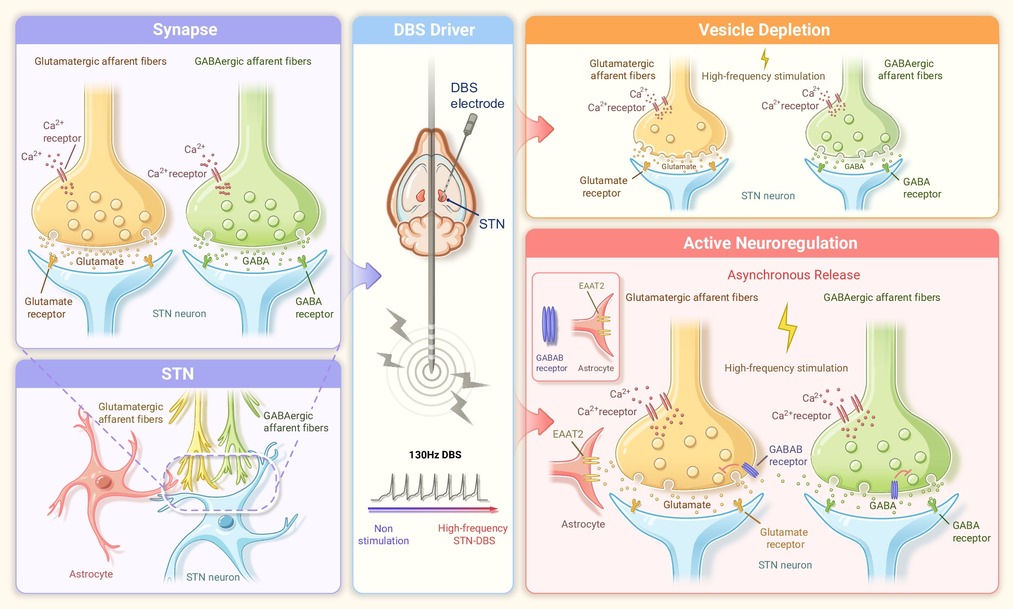
Figure 1.
Schematic diagram of two neural mechanism hypotheses for high-frequency STN-DBS in treating Parkinson’s disease
