
Beyond nutrients: Inositol as a signaling architect of the gut-host axis and a global health imperative
-
ABSTRACT
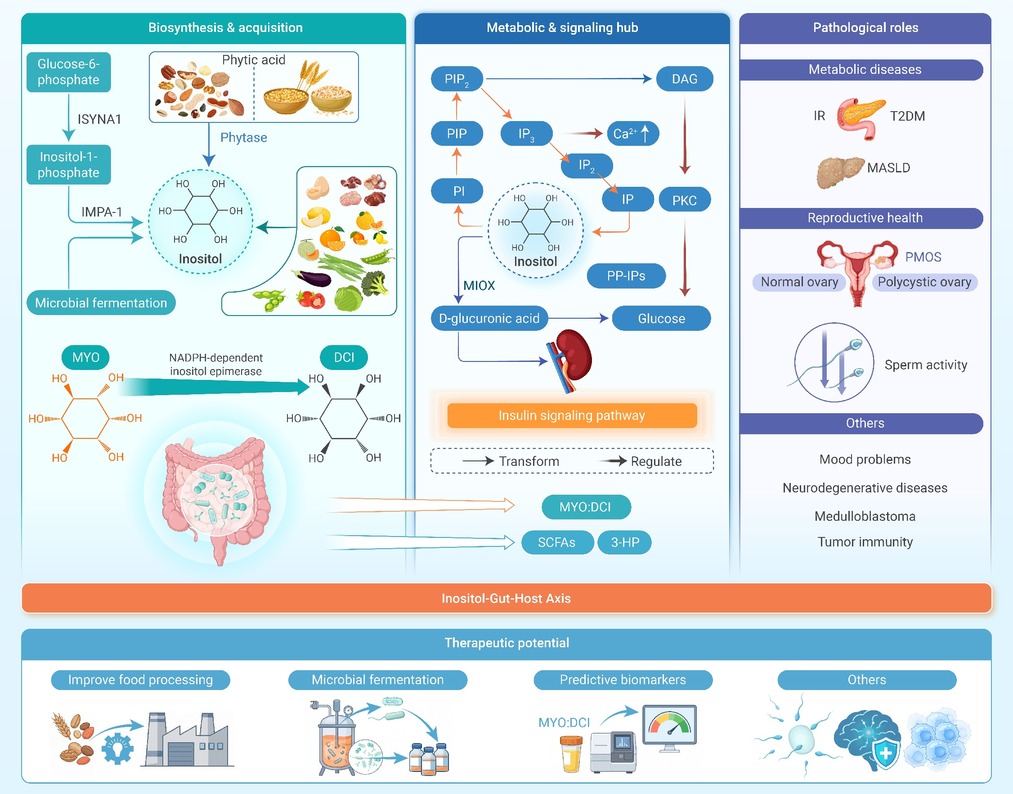
Inositol is a naturally occurring hexahydroxycyclohexane that participates in a wide range of physiological processes, including signal transduction, glucose and lipid metabolism, osmotic regulation, and communication between the gut microbiota and the host. Among its isomers, myo-inositol (MYO) and D-chiro-inositol (DCI) are the most biologically active. They play central roles in insulin signaling and metabolic homeostasis. When inositol metabolism is disrupted, it has been linked to conditions such as metabolic syndrome, polyendocrine metabolic ovarian syndrome (PMOS; conventionally termed polycystic ovary syndrome, PCOS), neurodegenerative disorders, and cancer. This perspective summarizes the challenges and future development trends related to inositol research, providing a comprehensive understanding of its application in public health and clinical settings. -

-
REFERENCES
[1] Michell R. H. (2011). Inositol and its derivatives: Their evolution and functions. Adv Enzyme Regul. 51:84−90. DOI:10.1016/j.advenzreg.2010.10.002 [2] Heaver S. L., Le H. H., Tang P., et al. (2022). Characterization of inositol lipid metabolism in gut-associated bacteroidetes. Nat Microbiol. 7:986−1000. DOI:10.1038/s41564-022-01152-6 [3] Schlemmer U., Frølich W., Prieto R.M., et al. (2009). Phytate in foods and significance for humans: Food sources, intake, processing, bioavailability, protective role and analysis. Mol Nutr Food Res. 53 Suppl 2:S330-375. DOI: 10.1002/mnfr.200900099. [4] Zhuang Y., Wang Y., Tu Q., et al. (2025). Synthetic biology: Revolutionizing animal breeding and biomanufacturing. Innov. Life 3:100169. DOI:10.59717/j.xinn-life.2025.100169 [5] Li J., Huang Q., Nie Q., et al. (2024). Effects of myo-inositol on regulating glucose and lipid metabolism and alternative splicing events coexpressed with lncrnas in the liver tissues of diabetic mice. Heliyon 10:e32460. DOI:10.1016/j.heliyon.2024.e32460 [6] Jessen H. and Bui T.P.N. (2025). Metabolism of inositol derivatives by the gut microbiome. Gut Microbes. 17:2564765. DOI:10.1080/19490976.2025.2564765 [7] Pani A., Giossi R., Menichelli D., et al. (2020). Inositol and non-alcoholic fatty liver disease: A systematic review on deficiencies and supplementation. Nutrients 12. DOI: 10.3390/nu12113379. [8] Laganà A.S., Forte G., Bizzarri M., et al. (2022). Inositols in the ovaries: Activities and potential therapeutic applications. Expert Opin Drug Metab Toxicol. 18:123−133. DOI:10.1080/17425255.2022.2071259 [9] Etrusco A., Laganà A.S., Chiantera V., et al. (2024). Myo-inositol in assisted reproductive technology from bench to bedside. Trends in Endocrinology & Metabolism. 35:74−83. DOI:10.1016/j.tem.2023.09.005 [10] Badodi S., Pomella N., Zhang X., et al. (2021). Inositol treatment inhibits medulloblastoma through suppression of epigenetic-driven metabolic adaptation. Nat Commun. 12:2148. DOI:10.1038/s41467-021-22379-7 -
ABOUT THIS ARTICLE
Cite this article:
Xue X.-Y., Gao Y.-Z., Zhang D., et al. (2026). Beyond nutrients: Inositol as a signaling architect of the gut-host axis and a global health imperative. The Innovation Nutrition 1:100031. https://doi.org/10.59717/j.xinn-nutri.2026.100031
Welcome!
To request copyright permission to republish or share portions of our works, please visit Copyright Clearance Center's (CCC) Marketplace website at marketplace.copyright.com.
Export File
Citation
Xue X.-Y., Gao Y.-Z., Zhang D., et al. (2026). Beyond nutrients: Inositol as a signaling architect of the gut-host axis and a global health imperative. The Innovation Nutrition 1:100031. https://doi.org/10.59717/j.xinn-nutri.2026.100031

Format
Content
 DownLoad:
-
Figure 1.
Beyond Nutrients: Inositol as a Signaling Architect of the Gut-Host Axis and a Global Health Imperative
