
Association of the Planetary Health Diet 2.0 with risk of metabolic dysfunction-associated steatotic liver disease
-
GRAPHICAL ABSTRACT
 DownLoad:
Full size image
-
PUBLIC SUMMARY
-
Planetary Health Diet 2.0 is a sustainable dietary framework designed to promote human and planetary health.
This diet emphasizes plant-based foods while limiting animal-source foods, saturated fat, sugar, and sodium.
Adherence to this diet is related to lower risk of metabolic dysfunction-associated steatotic liver disease.
Magnetic resonance imaging results support the hepatoprotective link of the Planetary Health Diet 2.0.
-
-
ABSTRACT
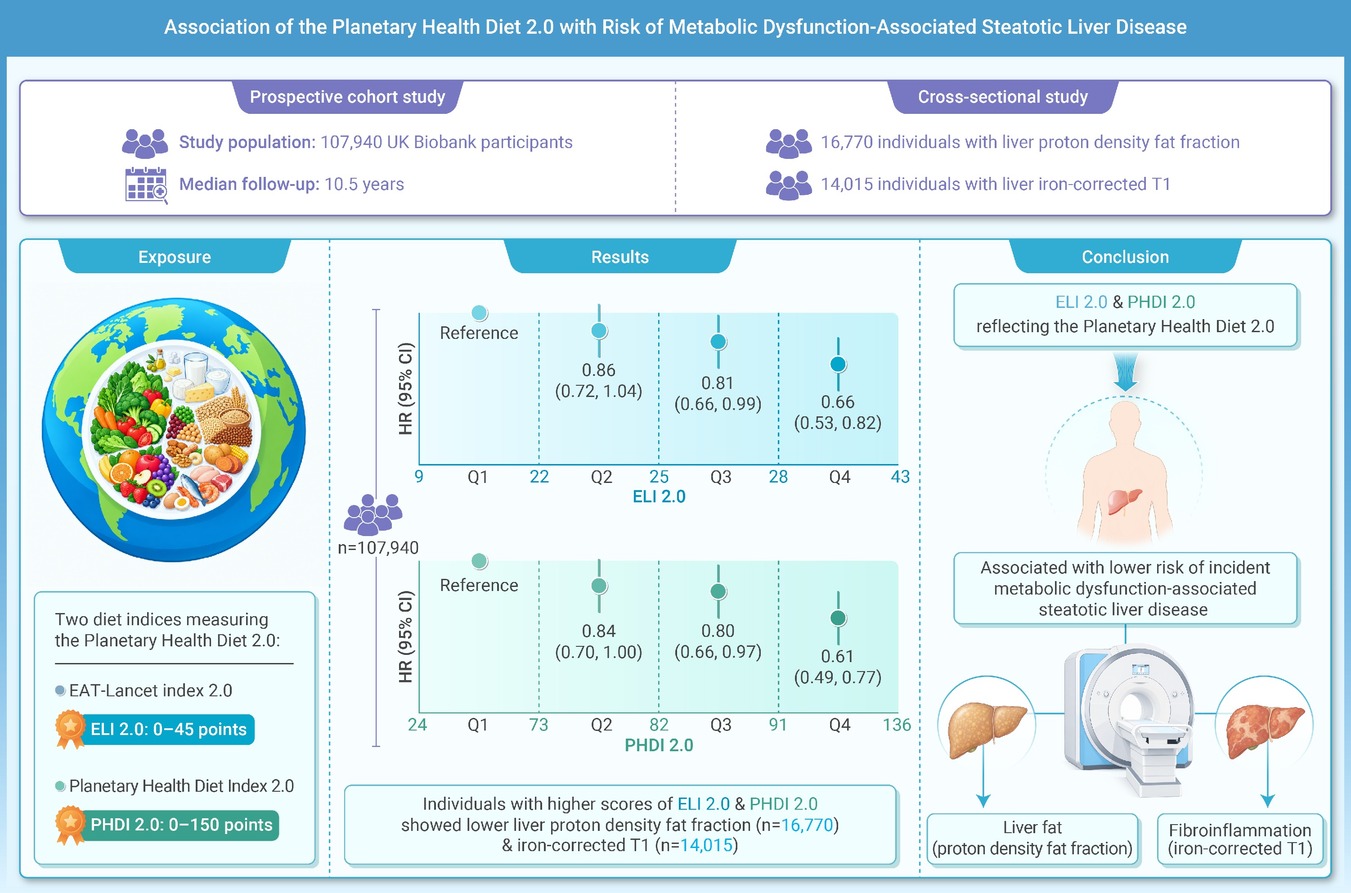
The second EAT-Lancet Commission in 2025 updated the Planetary Health Diet (PHD 2.0) to support the transition toward healthy, sustainable, and just food systems. However, little is known regarding its association with metabolic dysfunction-associated steatotic liver disease (MASLD). This prospective cohort study analyzed data from 107,940 participants who completed at least two 24-hour dietary assessments within the UK Biobank. Adherence to the PHD 2.0 was quantified using the EAT-Lancet index 2.0 (range: 0-45 points) and modified Planetary Health Diet Index (range: 0-150 points). Incident MASLD was identified through electronic health records. In addition, proton density fat fraction (n = 16,770) and iron-corrected T1 (n = 14,015) were assessed using magnetic resonance imaging. Associations were analyzed using Cox proportional hazards models and logistic models. Over a median follow-up of 10.5 years, 775 developed MASLD. The fully adjusted hazard ratios (95% confidence intervals) for incident MASLD comparing the highest with the lowest quartiles were 0.66 (0.53, 0.82) for the EAT-Lancet index 2.0 and 0.61 (0.49, 0.77) for the modified Planetary Health Diet Index, respectively (P for trend <0.0001 ). Moreover, both diet indices showed inverse associations with hepatic steatosis defined by proton density fat fraction (odds ratios [95% confidence intervals]: 0.56 [0.50, 0.63] and 0.59 [0.53, 0.66] for comparing the extreme quartiles) and elevated iron-corrected T1 (odds ratios [95% confidence intervals]: 0.63 [0.49, 0.80] and 0.61 [0.48, 0.78]). In conclusion, greater adherence to the PHD 2.0 is associated with a decreased risk of MASLD as well as favorable magnetic resonance imaging biomarkers. -

-
REFERENCES
[1] Tilg H., Petta S., Stefan N., et al. (2026). Metabolic dysfunction-associated steatotic liver disease in adults: A review. JAMA 335:163−174. DOI:10.1001/jama.2025.19615 [2] Targher G., Byrne C. D. and Tilg H. (2024). MASLD: A systemic metabolic disorder with cardiovascular and malignant complications. Gut 73:691−702. DOI:10.1136/gutjnl-2023-330595 [3] Li W., Alazawi W. and Loomba R. (2026). Current and emerging therapeutic landscape for metabolic dysfunction-associated steatohepatitis. Lancet Gastroenterol. Hepatol. 11:150−162. DOI:10.1016/S2468-1253(25)00260-2 [4] Zeng X. F., Varady K. A., Wang X. D., et al. (2024). The role of dietary modification in the prevention and management of metabolic dysfunction-associated fatty liver disease: An international multidisciplinary expert consensus. Metabolism 161:156028. DOI:10.1016/j.metabol.2024.156028 [5] Tilman D. and Clark M. (2014). Global diets link environmental sustainability and human health. Nature 515:518−522. DOI:10.1038/nature13959 [6] Willett W., Rockstrom J., Loken B., et al. (2019). Food in the Anthropocene: The EAT-Lancet commission on healthy diets from sustainable food systems. Lancet 393:447−492. DOI:10.1016/S0140-6736(18)31788-4 [7] Zhang S., Yan Y., Zeng X. F., et al. (2025). Associations of the EAT-Lancet reference diet with metabolic dysfunction-associated steatotic liver disease and its severity: A multicohort study. Hepatology 81:1583−1594. DOI:10.1097/HEP.0000000000001039 [8] Zhang S., Zeng X. F., Borne Y., et al. (2025). Adherence to the EAT-Lancet reference diet and risk of type 2 diabetes, metabolic dysfunction-associated steatotic liver disease, and their co-occurrence. Food Funct. 16:6773−6785. DOI:10.1039/d4fo05852f [9] Stubbendorff A., Janzi S., Jukkola J., et al. (2025). Mini-review of the EAT-Lancet planetary health diet and its role in cardiometabolic disease prevention. Metabolism 172:156373. DOI:10.1016/j.metabol.2025.156373 [10] Rockstrom J., Thilsted S. H., Willett W. C., et al. (2025). The EAT-Lancet Commission on healthy, sustainable, and just food systems. Lancet 406:1625−1700. DOI:10.1016/S0140-6736(25)01201-2 [11] Shojaei-Zarghani S., Safarpour A. R., Fattahi M. R., et al. (2022). Sodium in relation with nonalcoholic fatty liver disease: A systematic review and meta-analysis of observational studies. Food Sci. Nutr. 10:1579−1591. DOI:10.1002/fsn3.2781 [12] Zhang S., Huo Z., Borne Y., et al. (2025). Adding salt to foods and risk of metabolic dysfunction-associated steatotic liver disease and other chronic liver diseases. Eur. J. Nutr. 64:224. DOI:10.1007/s00394-025-03745-3 [13] Stubbendorff A., Ericson U., Hallstrom E., et al. (2026). EAT-Lancet index 2.0: A dietary index measuring adherence to the Planetary Health Diet 2.0. Lancet Planet Health 10:101469. DOI:10.1016/j.lanplh.2026.101469. [14] Bui L. P., Pham T. T., Wang F., et al. (2024). Planetary Health Diet Index and risk of total and cause-specific mortality in three prospective cohorts. Am. J. Clin. Nutr. 120:80−91. DOI:10.1016/j.ajcnut.2024.03.019 [15] Ollier W., Sprosen T. and Peakman T. (2005). UK Biobank: From concept to reality. Pharmacogenomics 6:639−646. DOI:10.2217/14622416.6.6.639 [16] Xu X., Dong Y., Hu J., et al. (2026). Planetary health diet index and risk of irritable bowel syndrome: A prospective cohort study. Eur. J. Nutr. 65:199. DOI:10.1007/s00394-026-04055-y [17] Vandenbroucke J. P., von Elm E., Altman D. G., et al. (2014). Strengthening the Reporting of Observational Studies in Epidemiology (STROBE): Explanation and elaboration. Int J Surg 12:1500−1524. DOI:10.1016/j.ijsu.2014.07.014 [18] Lachat C., Hawwash D., Ocke M. C., et al. (2016). Strengthening the Reporting of Observational Studies in Epidemiology-Nutritional Epidemiology (STROBE-nut): An Extension of the STROBE Statement. PLoS Med. 13:e1002036. DOI:10.1371/journal.pmed.1002036 [19] Greenwood D. C., Hardie L. J., Frost G. S., et al. (2019). Validation of the Oxford WebQ online 24-hour dietary questionnaire using biomarkers. Am. J. Epidemiol. 188:1858−1867. DOI:10.1093/aje/kwz165 [20] Perez-Cornago A., Pollard Z., Young H., et al. (2021). Description of the updated nutrition calculation of the Oxford WebQ questionnaire and comparison with the previous version among 207,144 participants in UK Biobank. Eur. J. Nutr. 60:4019−4030. DOI:10.1007/s00394-021-02558-4 [21] Piernas C., Perez-Cornago A., Gao M., et al. (2021). Describing a new food group classification system for UK Biobank: Analysis of food groups and sources of macro- and micronutrients in 208,200 participants. Eur. J. Nutr. 60:2879−2890. DOI:10.1007/s00394-021-02535-x [22] Hagstrom H., Adams L. A., Allen A. M., et al. (2021). Administrative coding in electronic health care record-based research of NAFLD: An expert panel consensus statement. Hepatology 74:474−482. DOI:10.1002/hep.31726 [23] Wilman H. R., Kelly M., Garratt S., et al. (2017). Characterisation of liver fat in the UK Biobank cohort. PLoS One 12:e0172921. DOI:10.1371/journal.pone.0172921 [24] Jackson E., Dennis A., Alkhouri N., et al. (2025). Cardiac and liver impairment on multiorgan MRI and risk of major adverse cardiovascular and liver events. Nat. Med. 31:2289−2296. DOI:10.1038/s41591-025-03654-2 [25] Caussy C., Alquiraish M. H., Nguyen P., et al. (2018). Optimal threshold of controlled attenuation parameter with MRI-PDFF as the gold standard for the detection of hepatic steatosis. Hepatology 67:1348−1359. DOI:10.1002/hep.29639 [26] Craig C. L., Marshall A. L., Sjostrom M., et al. (2003). International physical activity questionnaire: 12-country reliability and validity. MED SCI SPORT EXER 35:1381−1395. DOI:10.1249/01.MSS.0000078924.61453.FB [27] Schisterman E. F., Cole S. R. and Platt R. W. (2009). Overadjustment bias and unnecessary adjustment in epidemiologic studies. Epidemiology 20:488−495. DOI:10.1097/EDE.0b013e3181a819a1 [28] Desquilbet L. and Mariotti F. (2010). Dose-response analyses using restricted cubic spline functions in public health research. Stat. Med. 29:1037−1057. DOI:10.1002/sim.3841 [29] Mathur M. B., Ding P., Riddell C. A., et al. (2018). Website and R package for computing E-values. Epidemiology 29:e45−e47. DOI:10.1097/EDE.0000000000000864 [30] VanderWeele T. J. and Ding P. (2017). Sensitivity analysis in observational research: Introducing the E-value. Ann. Intern. Med 167:268−274. DOI:10.7326/M16-2607 [31] Uno H., Cai T., Pencina M. J., et al. (2011). On the C-statistics for evaluating overall adequacy of risk prediction procedures with censored survival data. Stat. Med. 30:1105−1117. DOI:10.1002/sim.4154 [32] Harrell F. E., Jr., Lee K. L. and Mark D. B. (1996). Multivariable prognostic models: Issues in developing models, evaluating assumptions and adequacy, and measuring and reducing errors.Stat. Med. 15:361−387. DOI:3.0.CO;2-4">10.1002/(SICI)1097-0258(19960229)15:4<361::AID-SIM168>3.0.CO;2-4 [33] Pencina M. J., D'Agostino R. B., Sr. and Steyerberg E. W. (2011). Extensions of net reclassification improvement calculations to measure usefulness of new biomarkers. Stat. Med. 30:11−21. DOI:10.1002/sim.4085 [34] Wu S. Y., Bo Y. C., Li Z. Y., et al. (2025). EAT-Lancet diet and risk of metabolic dysfunction-associated steatotic liver disease and other liver chronic diseases: A large prospective cohort study in the UK Biobank. Front. Nutr. 12:1589424. DOI:10.3389/fnut.2025.1589424 [35] Wu H., Wei J., Wang S., et al. (2024). Dietary pattern modifies the risk of MASLD through metabolomic signature. JHEP Rep 6:101133. DOI:10.1016/j.jhepr.2024.101133 [36] Qiu X., Shen S., Jiang N., et al. (2025). Adherence to the planetary health diet index and metabolic dysfunction-associated steatotic liver disease: A cross-sectional study. Front. Nutr. 12:1534604. DOI:10.3389/fnut.2025.1534604 [37] Liu Z. Q., Zhou B. G., Fang J. W., et al. (2025). Protective role of the planetary health diet index against metabolic dysfunction-associated steatotic liver disease: Global and individual evidence. Front. Nutr. 12:1673662. DOI:10.3389/fnut.2025.1673662 [38] Doustmohammadian A., Esfandyari S., Motamed N., et al. (2026). EAT-Lancet dietary pattern adherence and metabolic dysfunction-associated steatotic liver disease: A cross-sectional analysis of the Amol Cohort Study. J Nutr 156:101433. DOI:10.1016/j.tjnut.2026.101433 [39] Kamrani F., Imannezhad M., Etesami E., et al. (2026). Higher adherence to the EAT-Lancet diet is associated with reduced risk of metabolic dysfunction-associated steatotic liver disease: a 5-year middle eastern cohort study. Diabetol Metab Syndr 18:176. DOI:10.1186/s13098-026-02198-w [40] Mozaffarian D., Fahimi S., Singh G. M., et al. (2014). Global sodium consumption and death from cardiovascular causes. NEJM 371:624−634. DOI:10.1056/NEJMoa1304127 [41] Collaborators G. B. D. D. (2019). Health effects of dietary risks in 195 countries, 1990-2017: A systematic analysis for the Global Burden of Disease Study 2017. Lancet 393:1958−1972. DOI:10.1016/S0140-6736(19)30041-8 [42] Hu F. B. (2024). Diet strategies for promoting healthy aging and longevity: An epidemiological perspective. J. Intern. Med. 295:508−531. DOI:10.1111/joim.13728 [43] Jurek J. M., Zablocka-Slowinska K., Pieczynska J., et al. (2025). Systematic review of the effects of plant-based foods on metabolic outcomes in adults with MASLD and comorbidities such as obesity, metabolic syndrome, and type 2 diabetes. Nutrients 17:3020. DOI:10.3390/nu17183020 [44] Lv Y., Rong S., Deng Y., et al. (2023). Plant-based diets, genetic predisposition and risk of non-alcoholic fatty liver disease. BMC MED 21:351. DOI:10.1186/s12916-023-03028-w [45] Carli F., Della Pepa G., Sabatini S., et al. (2024). Lipid metabolism in MASLD and MASH: From mechanism to the clinic. JHEP Rep 6:101185. DOI:10.1016/j.jhepr.2024.101185 [46] Zhou Y., Chen D., Zhu W., et al. (2025). Causal relationships between iron status and nonalcoholic fatty liver disease: Two-sample, multivariable, and two-step Mendelian randomization. Int. J. Vitam. Nutr. Res. 95:26773. DOI:10.31083/IJVNR26773 [47] Lanaspa M. A., Kuwabara M., Andres-Hernando A., et al. (2018). High salt intake causes leptin resistance and obesity in mice by stimulating endogenous fructose production and metabolism. PNAS. 115:3138−3143. DOI:10.1073/pnas.1713837115 [48] Che Z., Xue W., Zhao X., et al. (2025). Regulatory role and biomarker potential of gut microbiota metabolites in the progression of metabolic dysfunction-associated steatotic liver disease to hepatocellular carcinoma. CTG 16:e00914. DOI:10.14309/ctg.0000000000000914 [49] Bahitham W., Banoun Y., Aljahdali M., et al. (2025). "Trust your gut": Exploring the connection between gut microbiome dysbiosis and the advancement of metabolic associated steatosis liver disease (MASLD)/metabolic associated steatohepatitis (MASH): A systematic review of animal and human studies. Front. Nutr. 12:1637071. DOI:10.3389/fnut.2025.1637071 [50] Zhang J., Geng T., Wang Y., et al. (2026). Challenges, advances and future directions in nutritional epidemiology. Innov.Nutri. 1:100009. DOI:10.59717/j.xinn-nutri.2026.100009 -
ABOUT THIS ARTICLE
Cite this article:
Xu X., Stubbendorff A., Borné Y., et al. (2026). Association of the Planetary Health Diet 2.0 with risk of metabolic dysfunction-associated steatotic liver disease. The Innovation Nutrition 1:100041. https://doi.org/10.59717/j.xinn-nutri.2026.100041
Welcome!
To request copyright permission to republish or share portions of our works, please visit Copyright Clearance Center's (CCC) Marketplace website at marketplace.copyright.com.
Export File
Citation
Xu X., Stubbendorff A., Borné Y., et al. (2026). Association of the Planetary Health Diet 2.0 with risk of metabolic dysfunction-associated steatotic liver disease. The Innovation Nutrition 1:100041. https://doi.org/10.59717/j.xinn-nutri.2026.100041

Format
Content
-
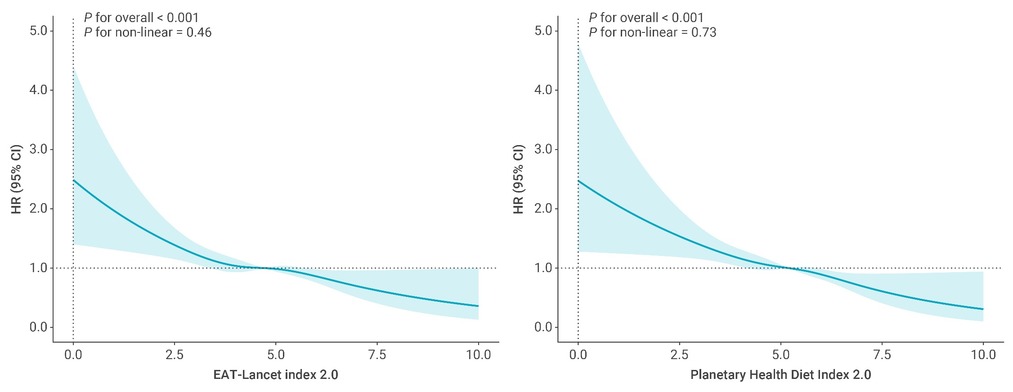
Figure 1.
Dose-response association between the Planetary Health Diet 2.0 and risk of incident metabolic dysfunction-associated steatotic liver disease
