
Mediterranean diet and cancer risk: Current understanding and epidemiological evidence
-
GRAPHICAL ABSTRACT
 DownLoad:
Full size image
-
PUBLIC SUMMARY
-
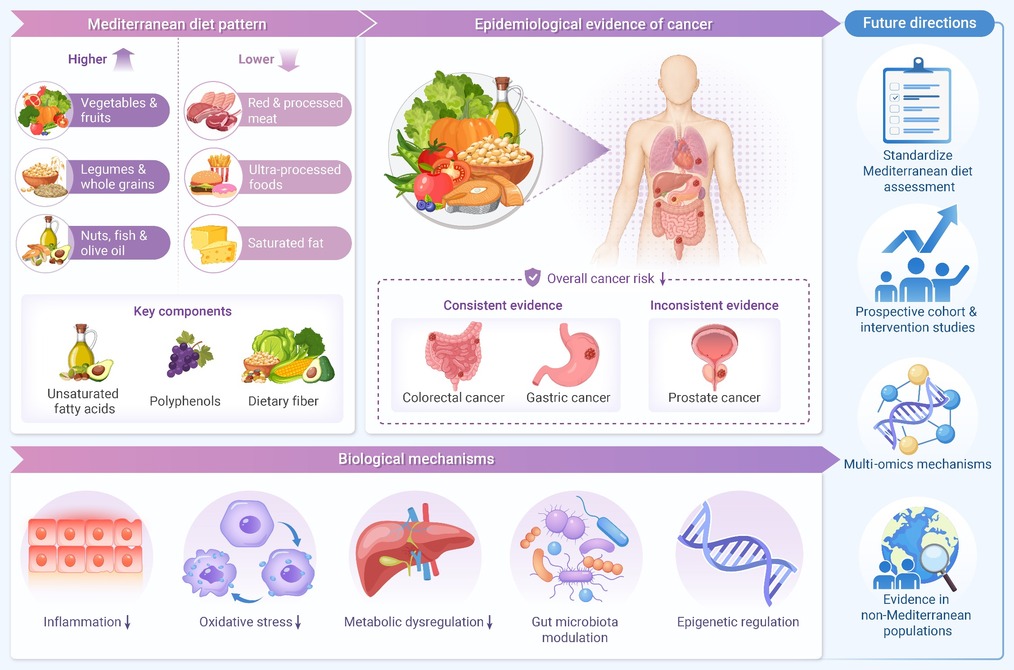
Higher Mediterranean diet adherence is generally associated with a lower overall cancer risk.
Evidence is more consistent for colorectal and gastric cancers than for other cancer types.
Potential mechanisms involve inflammation, oxidative stress, metabolism, gut microbiota, and epigenetics.
More studies in Asian and other non-Mediterranean populations are needed to inform cancer prevention.
-
-
ABSTRACT
Cancer is a major public health threat, leading to substantial mortality and disease burden worldwide. Carcinogenesis is modulated by a multitude of genetic, environmental, and lifestyle-related determinants, among which diet constitutes a critical modifiable risk factor. In recent years, Mediterranean diet (MedDiet), characterized by high intake of plant foods and low intake of red meat and processed foods, has garnered widespread attention for its potential health benefits. This narrative review synthesizes recent epidemiological studies, meta-analyses, and mechanistic research on the association between MedDiet and cancer. Current evidence generally suggests an inverse association between MedDiet adherence and overall cancer risk, particularly for colorectal and gastric cancers, whereas findings regarding other cancers remain controversial. Potential underlying mechanisms of MedDiet include the modulation of chronic inflammation, oxidative stress, metabolic dysregulation, gut microbiota, and epigenetics. In addition, key dietary components such as unsaturated fatty acids, polyphenols, and dietary fiber may play important roles in cancer prevention. However, variable exposure definitions, dietary measurement bias, between-site cancer heterogeneity, and regional disparities in dietary profiles limit the interpretation and generalizability of existing findings. Particularly, most available evidence has been derived from European and American populations, and its applicability to Asian and other non-Mediterranean populations requires further validation. Moreover, the predominance of observational studies limits causal inference. In the future, research should prioritize high-quality prospective and interventional studies, alongside multi-omics studies on mechanisms, to clarify the real effects and key biological mechanisms of MedDiet, thereby providing a more reliable scientific basis for cancer prevention and dietary guidance.-
Keywords:
- Mediterranean diet /
- Dietary pattern /
- Nutritional epidemiology /
- Cancer /
- Primary prevention
-

-
REFERENCES
[1] Sung H., Filho A. M., Laversanne M., et al. (2026). Global cancer statistics 2024: GLOBOCAN estimates of incidence and mortality worldwide for 34 cancers in 186 countries. CA Cancer J. Clin. 76:e70090. DOI:10.3322/caac.70090 [2] Fink H., Langselius O., Vignat J., et al. (2026). Global and regional cancer burden attributable to modifiable risk factors to inform prevention. Nat. Med. 32:1306−1315. DOI:10.1038/s41591-026-04219-7 [3] Kerr J., Anderson C. and Lippman S. M. (2017). Physical activity, sedentary behaviour, diet, and cancer: An update and emerging new evidence. Lancet Oncol. 18:e457−e471. DOI:10.1016/s1470-2045(17)30411-4 [4] Chu A. H., Lin K., Croker H., et al. (2025). Dietary-lifestyle patterns and colorectal cancer risk: Global cancer update programme (CUP Global) systematic literature review. Am. J. Clin. Nutr. 121:986−998. DOI:10.1016/j.ajcnut.2025.01.014 [5] Widmer R. J., Flammer A. J., Lerman L. O., et al. (2015). The Mediterranean diet, its components, and cardiovascular disease. Am. J. Med. 128:229−238. DOI:10.1016/j.amjmed.2014.10.014 [6] Guasch-Ferré M. and Willett W. C. (2021). The Mediterranean diet and health: A comprehensive overview. J. Intern. Med. 290:549−566. DOI:10.1111/joim.13333 [7] Gardener H. and Caunca M. R. (2018). Mediterranean diet in preventing neurodegenerative diseases. Curr. Nutr. Rep. 7:10−20. DOI:10.1007/s13668-018-0222-5 [8] Mentella M. C., Scaldaferri F., Ricci C., et al. (2019). Cancer and Mediterranean diet: A review. Nutrients 11. DOI:10.3390/nu11092059. [9] Tosti V., Bertozzi B. and Fontana L. (2018). Health benefits of the Mediterranean diet: Metabolic and molecular mechanisms. J. Gerontol. A. Biol. Sci. Med. Sci. 73:318−326. DOI:10.1093/gerona/glx227 [10] Cuttano R., Mazzarelli F., Afanga K. M., et al. (2024). MicroRNAs and the Mediterranean diet: A nutri-omics perspective for lung cancer. J. Transl. Med. 22:632. DOI:10.1186/s12967-024-05454-7 [11] Keys A. (1970). Coronary heart disease in seven countries, edited by Ancel Keys (American Heart Assn.). [12] Davis C., Bryan J., Hodgson J., et al. (2015). Definition of the Mediterranean diet; A literature review. Nutrients 7:9139−9153. DOI:10.3390/nu7115459 [13] Estruch R. and Salas-Salvadó J. (2013). "Towards an even healthier Mediterranean diet". Nutr. Metab. Cardiovasc. Dis. 23:1163−1166. DOI:10.1016/j.numecd.2013.09.003 [14] United Nations Educational, Scientific and Cultural Organization. (2010). Decision of the Intergovernmental Committee: 5.com 6.41. https://ich.unesco.org/en/decisions/5.com/6.41. [15] United Nations Educational, Scientific and Cultural Organization. (2013). Inscribed in 2013 on the Representative List of the Intangible Cultural Heritage of Humanity. https://ich.unesco.org/en/RL/mediterranean-diet-00884. [16] Bach-Faig A., Berry E. M., Lairon D., et al. (2011). Mediterranean diet pyramid today. Science and cultural updates. Public Health Nutr. 14:2274−2284. DOI:10.1017/s1368980011002515 [17] D'Alessandro A. and De Pergola G. (2015). Mediterranean diet and cardiovascular disease: A critical evaluation of a priori dietary indexes. Nutrients 7:7863−7888. DOI:10.3390/nu7095367 [18] Trichopoulou A., Kouris-Blazos A., Wahlqvist M. L., et al. (1995). Diet and overall survival in elderly people. BMJ. 311:1457−1460. DOI:10.1136/bmj.311.7018.1457 [19] Fung T. T., McCullough M. L., Newby P. K., et al. (2005). Diet-quality scores and plasma concentrations of markers of inflammation and endothelial dysfunction. Am. J. Clin. Nutr. 82:163−173. DOI:10.1093/ajcn.82.1.163 [20] Schröder H., Fitó M., Estruch R., et al. (2011). A short screener is valid for assessing Mediterranean diet adherence among older Spanish men and women. J. Nutr. 141:1140−1145. DOI:10.3945/jn.110.135566 [21] Trichopoulou A., Costacou T., Bamia C., et al. (2003). Adherence to a Mediterranean diet and survival in a Greek population. N. Engl. J. Med. 348:2599−2608. DOI:10.1056/NEJMoa025039 [22] Bekar C. and Goktas Z. (2023). Validation of the 14-item mediterranean diet adherence screener. Clin. Nutr. ESPEN 53:238−243. DOI:10.1016/j.clnesp.2022.12.026 [23] Hebestreit K., Yahiaoui-Doktor M., Engel C., et al. (2017). Validation of the German version of the Mediterranean Diet Adherence Screener (MEDAS) questionnaire. BMC Cancer 17:341. DOI:10.1186/s12885-017-3337-y [24] Martínez-González M., Hershey M. S., Zazpe I., et al. (2017). Transferability of the Mediterranean diet to non-Mediterranean countries. What is and what is not the Mediterranean diet. Nutrients 9. DOI:10.3390/nu9111226. [25] Schwingshackl L. and Hoffmann G. (2014). Adherence to Mediterranean diet and risk of cancer: A systematic review and meta-analysis of observational studies. Int. J. Cancer 135:1884−1897. DOI:10.1002/ijc.28824 [26] Morze J., Danielewicz A., Przybyłowicz K., et al. (2021). An updated systematic review and meta-analysis on adherence to mediterranean diet and risk of cancer. Eur. J. Nutr. 60:1561-1586. DOI:10.1007/s00394-020-02346-6 [27] Zhong Y., Zhu Y., Li Q., et al. (2020). Association between Mediterranean diet adherence and colorectal cancer: a dose-response meta-analysis. Am. J. Clin. Nutr. 111:1214−1225. DOI:10.1093/ajcn/nqaa083 [28] Ungvari Z., Fekete M., Fekete J. T., et al. (2025). Adherence to the Mediterranean diet and its protective effects against colorectal cancer: a meta-analysis of 26 studies with 2,217,404 participants. Geroscience 47:1105−1121. DOI:10.1007/s11357-024-01296-9 [29] Moazzen S., van der Sloot K. W. J., Bock G. H., et al. (2021). Systematic review and meta-analysis of diet quality and colorectal cancer risk: is the evidence of sufficient quality to develop recommendations. Crit. Rev. Food. Sci. Nutr. 61:2773−2782. DOI:10.1080/10408398.2020.1786353 [30] Jafari Nasab S., Clark C. C. T. and Entezari M. (2024). Mediterranean diet and colorectal adenomas: A systematic review and meta-analysis of observational studies. Eur. J. Cancer Prev. 33:223−231. DOI:10.1097/cej.0000000000000861 [31] Bai X., Li X., Ding S., et al. (2023). Adherence to the Mediterranean diet and risk of gastric cancer: A systematic review and meta-analysis. Nutrients 15. DOI:10.3390/nu15173826 [32] Zhu Q., Shu L., Zhou F., et al. (2023). Adherence to the Mediterranean diet and risk of gastric cancer: A systematic review and dose-response meta-analysis. Front. Nutr. 10:1259453. DOI:10.3389/fnut.2023.1259453 [33] Schulpen M., Peeters P. H. and van den Brandt P. A. (2019). Mediterranean diet adherence and risk of esophageal and gastric cancer subtypes in the Netherlands Cohort Study. Gastric Cancer 22:663−674. DOI:10.1007/s10120-019-00927-x [34] Nucci D., Nardi M., Cinnirella A., et al. (2023). Adherence to Mediterranean diet and risk of pancreatic cancer: Systematic review and meta-analysis. Int. J. Environ. Res. Public Health 20. DOI:10.3390/ijerph20032403 [35] Julián-Serrano S., Reedy J., Robien K., et al. (2022). Adherence to 5 diet quality indices and pancreatic cancer risk in a large US prospective cohort. Am. J. Epidemiol. 191:1584−1600. DOI:10.1093/aje/kwac082 [36] van den Brandt P. A. and Schulpen M. (2017). Mediterranean diet adherence and risk of postmenopausal breast cancer: Results of a cohort study and meta-analysis. Int. J. Cancer 140:2220−2231. DOI:10.1002/ijc.30654 [37] Buckland G., Travier N., Cottet V., et al. (2013). Adherence to the mediterranean diet and risk of breast cancer in the European prospective investigation into cancer and nutrition cohort study. Int. J. Cancer 132:2918−2927. DOI:10.1002/ijc.27958 [38] Dianatinasab M., Rezaian M., HaghighatNezad E., et al. (2020). Dietary patterns and risk of invasive ductal and lobular breast carcinomas: A systematic review and meta-analysis. Clin. Breast Cancer 20:e516−e528. DOI:10.1016/j.clbc.2020.03.007 [39] Cheng S., Zheng Q., Ding G., et al. (2019). Mediterranean dietary pattern and the risk of prostate cancer: A meta-analysis. Medicine (Baltimore) 98:e16341. DOI:10.1097/md.0000000000016341 [40] Zalaquett N., Lidoriki I., Lampou M., et al. (2025). Adherence to the Mediterranean diet and the risk of head and neck cancer: A systematic review and meta-analysis of case-control studies. Nutrients 17. DOI:10.3390/nu17020287 [41] Shrivastava R., Gupta A., Mehta N., et al. (2024). Dietary patterns and risk of oral and oropharyngeal cancers: A systematic review and meta-analysis. Cancer Epidemiol. 93:102650. DOI:10.1016/j.canep.2024.102650 [42] Bahrami A., Khalesi S., Makiabadi E., et al. (2022). Adherence to the Mediterranean diet and the risk of lung cancer: A systematic review and dose-response meta-analysis of observational studies. Nutr. Rev. 80:1118−1128. DOI:10.1093/nutrit/nuab117 [43] Anic G. M., Park Y., Subar A. F., et al. (2016). Index-based dietary patterns and risk of lung cancer in the NIH-AARP diet and health study. Eur. J. Clin. Nutr. 70:123−129. DOI:10.1038/ejcn.2015.122 [44] Dianatinasab M., Forozani E., Akbari A., et al. (2022). Dietary patterns and risk of bladder cancer: A systematic review and meta-analysis. BMC Public Health 22:73. DOI:10.1186/s12889-022-12516-2 [45] Leone A., Martínez-González M., Martin-Gorgojo A., et al. (2020). Mediterranean diet, dietary approaches to stop hypertension, and pro-vegetarian dietary pattern in relation to the risk of basal cell carcinoma: A nested case-control study within the Seguimiento Universidad de Navarra (SUN) cohort. Am. J. Clin. Nutr. 112:364−372. DOI:10.1093/ajcn/nqaa127 [46] Schwingshackl L. and Hoffmann G. (2015). Adherence to Mediterranean diet and risk of cancer: An updated systematic review and meta-analysis of observational studies. Cancer Med. 4:1933−1947. DOI:10.1002/cam4.539 [47] Schwingshackl L., Schwedhelm C., Galbete C., et al. (2017). Adherence to Mediterranean diet and risk of cancer: An updated systematic review and meta-analysis. Nutrients 9. DOI:10.3390/nu9101063 [48] Karimi M., Asbaghi O., Hooshmand F., et al. (2025). Adherence to Mediterranean diet and breast cancer risk: A meta-analysis of prospective observational studies. Health Sci. Rep. 8:e70736. DOI:10.1002/hsr2.70736 [49] Hanahan D. and Weinberg R. A. (2011). Hallmarks of cancer: The next generation. Cell 144:646−674. DOI:10.1016/j.cell.2011.02.013 [50] Coussens L. M. and Werb Z. (2002). Inflammation and cancer. Nature 420:860−867. DOI:10.1038/nature01322 [51] Esposito K., Marfella R., Ciotola M., et al. (2004). Effect of a mediterranean-style diet on endothelial dysfunction and markers of vascular inflammation in the metabolic syndrome: A randomized trial. JAMA. 292:1440−1446. DOI:10.1001/jama.292.12.1440 [52] Koelman L., Egea Rodrigues C. and Aleksandrova K. (2022). Effects of dietary patterns on biomarkers of inflammation and immune responses: A systematic review and meta-analysis of randomized controlled trials. Adv. Nutr. 13:101−115. DOI:10.1093/advances/nmab086 [53] Schwingshackl L. and Hoffmann G. (2014). Mediterranean dietary pattern, inflammation and endothelial function: A systematic review and meta-analysis of intervention trials. Nutr. Metab. Cardiovasc. Dis. 24:929−939. DOI:10.1016/j.numecd.2014.03.003 [54] Romagnolo D. F. and Selmin O. I. (2017). Mediterranean diet and prevention of chronic diseases. Nutr. Today 52:208−222. DOI:10.1097/nt.0000000000000228 [55] Kabisch S., Hajir J., Sukhobaevskaia V., et al. (2025). Impact of dietary fiber on inflammation in humans. Int. J. Mol. Sci. 26. DOI:10.3390/ijms26052000. [56] Reuter S., Gupta S. C., Chaturvedi M. M., et al. (2010). Oxidative stress, inflammation, and cancer: How are they linked. Free Radic. Biol. Med. 49:1603−1616. DOI:10.1016/j.freeradbiomed.2010.09.006 [57] Jelic M. D., Mandic A. D., Maricic S. M., et al. (2021). Oxidative stress and its role in cancer. J. Cancer Res. Ther. 17:22−28. DOI:10.4103/jcrt.JCRT_862_16 [58] Negrati M., Razza C., Biasini C., et al. (2021). Mediterranean diet affects blood circulating lipid-soluble Micronutrients and inflammatory biomarkers in a cohort of breast cancer survivors: Results from the SETA study. Nutrients 13. DOI:10.3390/nu13103482. [59] Skouroliakou M., Grosomanidis D., Massara P., et al. (2018). Serum antioxidant capacity, biochemical profile and body composition of breast cancer survivors in a randomized Mediterranean dietary intervention study. Eur. J. Nutr. 57:2133−2145. DOI:10.1007/s00394-017-1489-9 [60] Cicerale S., Lucas L. and Keast R. (2010). Biological activities of phenolic compounds present in virgin olive oil. Int. J. Mol. Sci. 11:458−479. DOI:10.3390/ijms11020458 [61] Sureda A., Bibiloni M. D., Martorell M., et al. (2016). Mediterranean diets supplemented with virgin olive oil and nuts enhance plasmatic antioxidant capabilities and decrease xanthine oxidase activity in people with metabolic syndrome: The PREDIMED study. Mol. Nutr. Food Res. 60:2654−2664. DOI:10.1002/mnfr.201600450 [62] Rauf A., Imran M., Butt M. S., et al. (2018). Resveratrol as an anti-cancer agent: A review. Crit. Rev. Food Sci. Nutr. 58:1428−1447. DOI:10.1080/10408398.2016.1263597 [63] Lauby-Secretan B., Scoccianti C., Loomis D., et al. (2016). Body fatness and cancer--viewpoint of the IARC working group. N. Engl. J. Med. 375:794-798. DOI:10.1056/NEJMsr1606602. [64] Pollak M. (2008). Insulin and insulin-like growth factor signalling in neoplasia. Nat. Rev. Cancer 8:915−928. DOI:10.1038/nrc2536 [65] Park J., Euhus D. M. and Scherer P. E. (2011). Paracrine and endocrine effects of adipose tissue on cancer development and progression. Endocr. Rev. 32:550−570. DOI:10.1210/er.2010-0030 [66] Galié S., García-Gavilán J., Papandreou C., et al. (2021). Effects of Mediterranean diet on plasma metabolites and their relationship with insulin resistance and gut microbiota composition in a crossover randomized clinical trial. Clin. Nutr. 40:3798−3806. DOI:10.1016/j.clnu.2021.04.028 [67] Papadaki A., Nolen-Doerr E. and Mantzoros C. S. (2020). The effect of the Mediterranean diet on metabolic health: A systematic review and meta-analysis of controlled trials in adults. Nutrients 12. DOI:10.3390/nu12113342. [68] Lynch S. V. and Pedersen O. (2016). The Human intestinal microbiome in health and disease. N. Engl. J. Med. 375:2369−2379. DOI:10.1056/NEJMra1600266 [69] Koh A., De Vadder F., Kovatcheva-Datchary P., et al. (2016). From dietary fiber to host physiology: Short-chain fatty acids as key bacterial metabolites. Cell 165:1332−1345. DOI:10.1016/j.cell.2016.05.041 [70] Donohoe D. R., Holley D., Collins L. B., et al. (2014). A gnotobiotic mouse model demonstrates that dietary fiber protects against colorectal tumorigenesis in a microbiota- and butyrate-dependent manner. Cancer Discov. 4:1387−1397. DOI:10.1158/2159-8290.Cd-14-0501 [71] De Filippis F., Pellegrini N., Vannini L., et al. (2016). High-level adherence to a Mediterranean diet beneficially impacts the gut microbiota and associated metabolome. Gut 65:1812−1821. DOI:10.1136/gutjnl-2015-309957 [72] Meslier V., Laiola M., Roager H. M., et al. (2020). Mediterranean diet intervention in overweight and obese subjects lowers plasma cholesterol and causes changes in the gut microbiome and metabolome independently of energy intake. Gut 69:1258−1268. DOI:10.1136/gutjnl-2019-320438 [73] Ridlon J. M., Kang D. J. and Hylemon P. B. (2006). Bile salt biotransformations by human intestinal bacteria. J. Lipid Res. 47:241−259. DOI:10.1194/jlr.R500013-JLR200 [74] Bhootra S., Jill N., Shanmugam G., et al. (2023). DNA methylation and cancer: Transcriptional regulation, prognostic, and therapeutic perspective. Med. Oncol. 40:71. DOI:10.1007/s12032-022-01943-1 [75] Croce C. M. (2009). Causes and consequences of microRNA dysregulation in cancer. Nat. Rev. Genet. 10:704−714. DOI:10.1038/nrg2634 [76] Hastie N. D., Dempster M., Dunlop M. G., et al. (1990). Telomere reduction in human colorectal carcinoma and with ageing. Nature 346:866−868. DOI:10.1038/346866a0 [77] Link A., Balaguer F. and Goel A. (2010). Cancer chemoprevention by dietary polyphenols: Promising role for epigenetics. Biochem. Pharmacol. 80:1771−1792. DOI:10.1016/j.bcp.2010.06.036 [78] Hardy T. M. and Tollefsbol T. O. (2011). Epigenetic diet: Impact on the epigenome and cancer. Epigenomics 3:503−518. DOI:10.2217/epi.11.71 [79] Arpón A., Milagro F. I., Razquin C., et al. (2017). Impact of consuming extra-virgin olive oil or nuts within a Mediterranean diet on DNA methylation in peripheral white blood cells within the PREDIMED-Navarra randomized controlled trial: A role for dietary lipids. Nutrients 10. DOI:10.3390/nu10010015. [80] Illescas O., Ferrero G., Belfiore A., et al. (2024). Modulation of faecal miRNAs highlights the preventive effects of a Mediterranean low-inflammatory dietary intervention. Clin. Nutr. 43:951−959. DOI:10.1016/j.clnu.2024.02.023 [81] Canudas S., Becerra-Tomás N., Hernández-Alonso P., et al. (2020). Mediterranean diet and telomere length: A systematic review and meta-analysis. Adv. Nutr. 11:1544−1554. DOI:10.1093/advances/nmaa079 [82] Satija A., Yu E., Willett W. C., et al. (2015). Understanding nutritional epidemiology and its role in policy. Adv. Nutr. 6:5−18. DOI:10.3945/an.114.007492 [83] Freedman L. S., Commins J. M., Moler J. E., et al. (2014). Pooled results from 5 validation studies of dietary self-report instruments using recovery biomarkers for energy and protein intake. Am. J. Epidemiol. 180:172−188. DOI:10.1093/aje/kwu116 [84] Chooi Y. C., Zhang Q. A., Magkos F., et al. (2024). Effect of an Asian-adapted Mediterranean diet and pentadecanoic acid on fatty liver disease: The TANGO randomized controlled trial. Am. J. Clin. Nutr. 119:788−799. DOI:10.1016/j.ajcnut.2023.11.013 [85] Salamanca-Sanabria A., Chooi Y. C., Loo E. X. L., et al. (2025). Potential effects of Asian-adapted Mediterranean diet in depression and anxiety among women with metabolic dysfunction-associated steatotic liver disease: A secondary analysis. Front. Nutr. 12:1589412. DOI:10.3389/fnut.2025.1589412 -
ABOUT THIS ARTICLE
Cite this article:
Zhao J.-E. and Li W.-Q. (2026). Mediterranean diet and cancer risk: Current understanding and epidemiological evidence. The Innovation Nutrition 1:100044. https://doi.org/10.59717/j.xinn-nutri.2026.100044
Welcome!
To request copyright permission to republish or share portions of our works, please visit Copyright Clearance Center's (CCC) Marketplace website at marketplace.copyright.com.
Export File
Citation
Zhao J.-E. and Li W.-Q. (2026). Mediterranean diet and cancer risk: Current understanding and epidemiological evidence. The Innovation Nutrition 1:100044. https://doi.org/10.59717/j.xinn-nutri.2026.100044

