
Joint IT-Cooling System Optimization for Data Center Energy Efficiency: A Critical Review
-
GRAPHICAL ABSTRACT

 DownLoad:
Full size image
DownLoad:
Full size image
-
ABSTRACT
Data center energy efficiency requires collaborative optimization of IT and cooling systems. However, comprehensive reviews that provide whole-process optimization guidance based on thermoelectric coupling are still scarce. This paper bridges this gap by analyzing the thermoelectric coupling characteristics of data centers and systematically reviewing evaluation indicators, design measures, and control methods for energy saving optimization, with the goal of providing theoretical guidance for holistic energy-efficiency improvement.Specifically, to determine the objective of collaborative energy saving optimization, this paper focuses on analyzing the limitations of PUE and its derived indicators. Secondly, to facilitate collaborative energy saving optimization at the design stage, this paper reviews the optimization schemes and measures for IT and cooling systems and highlights the key design aspects of cooling systems. Afterwards, to promote collaborative energy saving optimization at the operational stage, this paper reviews research into individual optimization as well as joint optimization between IT and cooling systems and points out the core problems of existing joint optimization methods. On this basis, this paper also proposes two future research directions in the field: the evaluation indicators of "computational efficiency" and a universal cross-scale thermoelectric coupling model. -

-
REFERENCES
[1] Nicola J. (2018). How to stop data centres from gobbling up the world's electricity. Nature 561:163−166. DOI:10.1038/d41586-018-06610-y [2] Andrae A. and Edler T. (2015). On Global Electricity Usage of Communication Technology: Trends to 2030. Challenges 6:117−157. DOI:10.3390/challe6010117 [3] Ministry of Industry and Information Technology of the People’s Republic of China (Department of Information and Communication Development; General Office; MIIT Weibo) (2023). The 2023 China Computing Power Conference was held in Yinchuan. [4] China Academy of Information and Communications Technology (2023). White Paper on Data Centers. [5] Xuan Y., (2023). Current status and challenges of data center energy management. [6] Wang S., Tu R., Chen X., et al. (2023). Thermal performance analyses and optimization of data center centralized-cooling system. Appl. Therm. Eng. 222:119817. DOI:10.1016/j.applthermaleng.2022.119817 [7] Wang Y., Song K., Han K., et al. (2025). Full-stack linkage study of high-density racks in data centers from a computing power–electric power–thermal power coordination perspective. Sci. China Tech. Sci. 55:213−232. DOI:10.1360/SST-2024-0170 [8] Lin J., Lin W., Huang H., et al. (2023). Thermal modeling and thermal-aware energy saving methods for cloud data centers: A review. IEEE Trans. Sustain. Comput. 9:571−590. DOI:10.1109/TSUSC.2023.3346332 [9] Cheng H., Liu B., Lin W., et al. (2021). A survey of energy-saving technologies in cloud data centers. J. Supercomput. 77:13385−13420. DOI:10.1007/s11227-021-03805-5 [10] Cao K., Li Z., Luo H., et al. (2024). Comprehensive review and future prospects of multi-level fan control strategies in data centers for joint optimization of thermal management systems. J.Build. Eng. 94:110021. DOI:10.1016/j.jobe.2024.110021 [11] Xu Y., Yan C., Liu H., et al. (2020). Smart energy systems: A critical review on design and operation optimization. Sustain. Cities Soc. 62:102369. DOI:10.1016/j.scs.2020.102369 [12] Zhu J., Liu D., Li B., et al. (2023). A data-center server power consumption model for temperature estimation based on CPU operating states. Auto. Elect. Power Sys. 47:140−148. [13] Cheng H., Chen H., Shao S., et al. (2020). Comprehensive COP evaluation of data center cooling systems. J. Refrig. 41:77−84. [14] Gusmann C., Bacon M. and Cassidy D. The Data Center Optimization Initiative (DCOI) and its Potential Effects on Government Contracting. [15] Implementation Plan for Promoting Green and High-Quality Development of Data Centers, 5G and Other New Infrastructure in Accordance with the Carbon Peaking and Carbon Neutrality Goals.pdf [16] Zhang X., Lindberg T., Xiong N., et al. (2017). Cooling Energy Consumption Investigation of Data Center IT Room with Vertical Placed Server. Energy Procedia 105:2047-2052. DOI:https://doi.org/10.1016/j.egypro.2017.03.581 [17] Zhang Z., Shao X., Song P., et al. (2022). Influencing factors and evaluation indicators of data center energy efficiency. Heating Ventilating & Air Conditioning 52:148−156+199. DOI:10.19991/j.hvac1971.2022.03.24 [18] Ren F. (2020). Optimization and application study of cooling-tower free cooling technology for data centers. M.S. thesis. [19] Information technology-Data centres-Key performance indicators-Part 2: Power usage effectiveness ( PUE) : ISO/IEC30134-2: 2016/AMD 1: 2018. (2016). Ceneva: InternationalOrganization for Standardization [ISO]. [20] Information technology-Data centre facilities and infrastruc-tures Part 4-7: Cooling efficiency ratio: BS EN 50600-47:2020 [S]. (2020). London: European Committee for Electrotechnical Standardization. [21] Data center cooling systems-Part 1: Overall coefficient of performance (GCOP) test and calculation method:T/CAR 9.1-2021[S]. (2021). Beijing: China Standards Press. [22] Tian Z. (2020). Theory and analysis of applying a novel evaporative-cooling air-conditioning system in data center computer rooms. M.S. thesis. [23] Puri R., Choudhury M., Qian H., et al. (2014). Bridging high performance and low power in processor design. IEEE. DOI:10.1145/2627369.2631642 [24] Malik M. and Homayoun H. (2015). Big data on low power cores: Are low power embedded processors a good fit for the big data workloads? IEEE. DOI:10.1109/ICCD.2015.7357128 [25] Ziegler M.M., Puri R., Philhower B., et al. (2014). POWER8 design methodology innovations for improving productivity and reducing power. IEEE. DOI:10.1109/CICC.2014.6946042 [26] Bartolini S., Foglia P. and Prete C. A. (2018). Exploring the relationship between architectures and management policies in the design of NUCA-based chip multicore systems. Future Gen. Comp. Sys. 78:481−501. DOI:10.1016/j.future.2017.06.001 [27] Momeni M. and Shahhoseini H. S. (2022). Energy efficient 3D network-on-chip based on approximate communication. Computer Networks 203:108652. DOI:10.1016/j.comnet.2021.108652 [28] Huang Y., Zheng L., Yao P., et al. (2020). A heterogeneous PIM hardware-software co-design for energy-efficient graph processing. IEEE. DOI:10.1109/IPDPS47924.2020.00076 [29] Karpowicz M. P., Arabas P. and Niewiadomska-Szynkiewicz E. (2018). Design and implementation of energy-aware application-specific CPU frequency governors for the heterogeneous distributed computing systems. Future Gen. Comp. Sys. 78:302−315. DOI:10.1016/j.future.2016.05.011 [30] Rethinagiri S.K., Palomar O., Sobe A., et al. (2015). ParaDIME: Parallel Distributed Infrastructure for Minimization of Energy. IEEE. 39:1174-1189. DOI:10.1016/j.micpro.2015.06.005 [31] Widjaja I., Walid A., Luo Y., et al. (2014). The importance of switch dimension for energy-efficient datacenter design. Comp. commun. 50:152−161. DOI:10.1016/j.comcom.2014.02.017 [32] Li D. (2024). Virtualization and energy management optimization of high speed computer network data centers based on optical switching and network technology. Therm. Sci. Engi. Prog. 55:102918. DOI:10.1016/j.tsep.2024.102918 [33] Wang B., Qi Z., Ma R., et al. (2015). A survey on data center networking for cloud computing. Computer Networks 91:528−547. DOI:10.1016/j.comnet.2015.08.040 [34] Xiao C., Zhang L., Liu W., et al. (2019). Energy-efficient crypto acceleration with HW/SW co-design for HTTPS. Future Gen. Comp. Sys. 96:336−347. DOI:10.1016/j.future.2019.02.023 [35] Handbook A. (1996). HVAC systems and equipment (chapter). [36] Wang W., Liang C., Zha F., et al. (2023). Air conditioning system with dual-temperature chilled water for air grading treatment in data centers. Energy Build. 290:113073. DOI:10.1016/j.enbuild.2023.113073. [37] Zhang Y., Li H. and Wang S. (2024). Life-cycle optimal design and energy benefits of centralized cooling systems for data centers concerning progressive loading. Renew. Energy 230:120847. DOI:10.1016/j.renene.2024.120847. [38] Xiang K., Tian Z., Zhou C., et al. (2025). Performance analysis and optimization of a hybrid mechanical and free cooling system with cold water storage for a data center. Appl. Therm. Eng. 267:125831. DOI:10.1016/j.applthermaleng.2025.125831. [39] Zhao C., Jing Y., Xie X., et al. (2025). Application and simulation of IEC water chillers for summer free cooling in data centers. Appl. Therm. Eng. 260:124915. DOI:10.1016/j.applthermaleng.2024.124915. [40] Wang H., Yuan X., Zhang K., et al. (2024). Performance evaluation and optimization of data center servers using single-phase immersion cooling. Int. J. Heat Mass Trans. 221:125057. DOI:10.1016/j.ijheatmasstransfer.2023.125057 [41] Zhang Y., Zhao Y., Dai S., et al. (2022). Cooling technologies for data centres and telecommunication base stations – A comprehensive review. J. Clean. Product. 334:130280. DOI:10.1016/j.jclepro.2021.130280 [42] Hnayno M., Chehade A., Klaba H., et al. (2023). Experimental investigation of a data-centre cooling system using a new single-phase immersion/liquid technique. Case Studies Therm. Eng. 45:102925. DOI:10.1016/j.csite.2023.102925 [43] Li J. (2023). Design and energy-saving study of liquid-cooling heat dissipation systems for data centers. M.S. thesis. [44] Muneeshwaran M., Lin Y.-C. and Wang C.-C. (2023). Performance analysis of single-phase immersion cooling system of data center using FC-40 dielectric fluid. Int. Commun. Heat Mass Transf. 145:106843. DOI:10.1016/j.icheatmasstransfer.2023.106843. [45] Ebrahimi K., Jones G. F. and Fleischer A. S. (2015). Thermo-economic analysis of steady state waste heat recovery in data centers using absorption refrigeration. Appl. Energy 139:384−397. DOI:10.1016/j.apenergy.2014.10.067 [46] Haywood A., Sherbeck J., Phelan P., et al. (2012). Thermodynamic feasibility of harvesting data center waste heat to drive an absorption chiller. Energy Conver. Manag. 58:26−34. DOI:10.1016/j.enconman.2011.12.017 [47] Pan Q., Peng J. and Wang R. (2021). Application analysis of adsorption refrigeration system for solar and data center waste heat utilization. Energy Conver. Manag. 228:113564. DOI:10.1016/j.enconman.2020.113564 [48] Du S., Cui Z., Wang R. Z., et al. (2024). Development and experimental study of a compact silica gel-water adsorption chiller for waste heat driven cooling in data centers. Energy Conver. Manag. 300:117985. DOI:10.1016/j.enconman.2023.117985. [49] Hao T. (2023). Performance and mechanism study of treating recirculating cooling water using electrochemical advanced oxidation. M.S. thesis (North China Electric Power University). [50] Zhou Y. (2024). Study on the scale-inhibition effects of microbial agents in reclaimed-water reuse recirculating cooling water. M.S. thesis (North China Electric Power University). [51] Liu Q. (2025). Development of a high-energy-efficiency electrochemical descaling technology system for recirculating cooling-water systems and its reaction mechanisms. M.S. thesis (Qingdao University of Technology). [52] Liu H. (2017). Design and energy-efficiency analysis of a data-center heat dissipation system based on separated heat pipes. M.S. thesis. [53] Qian X., Li Z. and Li Z. (2012). Experimental study on a heat-pipe air-conditioning system for data rooms. J. Eng. Thermophys. 33:1217−1220. [54] Zou S. (2022). Heat-transfer performance and energy-saving study of a separated heat-pipe cooling system for data rooms. Ph.D. dissertation. [55] Wang N., Guo Y., Yu H., et al. (2024). Investigation on performance enhancement of micro-channel separated heat pipe in data center: A coupled heat-mass-flow characterization approach. Appl. Therm. Eng. 248:123327. DOI:10.1016/j.applthermaleng.2024.123327 [56] Li L., Tong Z., Liu X., et al. (2023). Review of applications of separated heat pipes in the HVAC field. Heating Ventilating & Air Conditioning 53:1−12. DOI:10.19991/j.hvac1971.2023.08.01 [57] Gong B. (2024). Performance study of a water-cooled microchannel separated fluorocarbon-pump heat-pipe system for data centers. M.S. thesis. [58] Vasta S., Palomba V., La Rosa D., et al. (2020). Experimental assessment and numerical study of a pump-assisted loop heat pipe for high capacity thermal systems. Appl. Therm. Eng. 180:115828. DOI:10.1016/j.applthermaleng.2020.115828. [59] Li X., Zhang C., Dong J., et al. (2023). Feasibility investigation on a novel rack-level cooling system for energy-saving retrofit of medium-and-small data centers. Appl. Therm. Eng. 229:120644. DOI:10.1016/j.applthermaleng.2023.120644 [60] Lin Y. (2020). Experimental study of a hybrid air-conditioning system with fluorocarbon-pump boosting. M.S. thesis. [61] Mehta K., Mehta N. and Patel V. (2020). Influence of the channel profile on the thermal resistance of closed-loop flat-plate oscillating heat pipe. J. Brazilian Soc. Mechan. Sci. Eng. 42:123. DOI:10.1007/s40430-020-2213-x [62] Chen M. (2024). Heat transfer and flow characteristics of oscillating heat pipes under non-uniform heating conditions. M.S. thesis. [63] Liu X. (2024). Flow and heat transfer performance of oscillating heat pipes with novel irregular-channel structures. M.S. thesis. [64] Lu Q. (2016). Study on a data-center rack cooling system based on oscillating heat pipes. M.S. thesis. [65] Chen C. (2020). Design and experimental study of a variable-frequency multi-split precision air-conditioning system for data rooms with free cooling. M.S. thesis. [66] Yang Z., Fan C. and Liao Y. (2025). Applicability and influencing-factor analysis of evaporative pre-cooling systems for data centers in hot-humid climates. Refrig. Air Condi. 25:27−33. DOI:10.20245/j.issn.1009-8402.2025.03.005 [67] Huang X., Yang L., Chu J., et al. (2025). Energy-saving characteristics of an evaporative-condensation and fluorocarbon-pump heat-pipe air-conditioning system. Refrig. Air Condi. 25:40−43. DOI:10.20245/j.issn.1009-8402.2025.03.007 [68] Bai K., Ma G., Zhou F., et al. (2016). Performance characteristics of a year-round hybrid cooling system combining pump-driven loop heat pipes and mechanical refrigeration. Heat. Ventilat. Air Condi. 46:109−115. DOI:10.19991/j.hvac1971.2016.09.024 [69] Wang F., Wang J., Shi Z., et al. (2017). Research and experiments on heat-pipe hybrid precision air-conditioning for data rooms. Refrig.Air Condi. 17:37−41. [70] Han Z., Ji Q., Wei H., et al. (2020). Simulation study on performance of data center air-conditioning system with novel evaporative condenser. Energy 210:118521. DOI:10.1016/j.energy.2020.118521 [71] Siriwardana J., Jayasekara S. and Halgamuge S. K. (2013). Potential of air-side economizers for data center cooling: A case study for key Australian cities. Appl. Energy 104:207−219. DOI:10.1016/j.apenergy.2012.10.046 [72] Oró E., Depoorter V., Pflugradt N., et al. (2015). Overview of direct air free cooling and thermal energy storage potential energy savings in data centres. Appl. Therm. Eng. 85:100−110. DOI:10.1016/j.applthermaleng.2015.03.001 [73] Ham S.-W., Kim M.-H., Choi B.-N., et al. (2015). Energy saving potential of various air-side economizers in a modular data center. Appl. Energy 138:258−275. DOI:10.1016/j.apenergy.2014.10.066 [74] Yu Y. and Wang L. (2019). Solid sorption heat pipe coupled with direct air cooling technology for thermal control of rack level in internet data centers: Design and numerical simulation. International Journal of Heat and Mass Transfer 145:118714. DOI:10.1016/j.ijheatmasstransfer.2019.118714 [75] Kim J.-Y., Chang H.-J., Jung Y.-H., et al. (2017). Energy conservation effects of a multi-stage outdoor air enabled cooling system in a data center. Energy Build. 138:257-270. DOI:10.1016/j.enbuild.2016.12.057 [76] Zou S. and Pan Y. (2024). Performance of a hybrid thermosyphon cooling system using airside economizers for data center free cooling under different climate conditions. J. Build. Eng. 98:111235. DOI:10.1016/j.jobe.2024.111235 [77] Wang J., Cao X., Yuan Y., et al. (2025). Experimental study on free cooling performance of an integrated cooling system based on loop thermosyphon for data centers. Energy 322:135706. DOI:10.1016/j.energy.2025.135706 [78] Liu C., Hao N., Zhang T., et al. (2024). Optimization of data-center immersion cooling using liquid air energy storage. J. Energy Storage 90:111806. DOI:10.1016/j.est.2024.111806 [79] Ting Y., Zhen P., Zhenbo L., et al. (2025). Design, analysis, and multi-objective optimization of LNG cold energy cascade utilization CCHP system including ORC, cold storage, and data center cooling. Cryogenics 150:104152. DOI:10.1016/j.cryogenics.2025.104152 [80] Yuan X., Liang Y., Hu X., et al. (2023). Waste heat recoveries in data centers: A review. Renew. Sustain. Energy Rev. 188:113777. DOI:10.1016/j.rser.2023.113777 [81] Weng Y.-C., Cho H.-P., Chang C.-C., et al. (2011). Heat pipe with PCM for electronic cooling. Appl. Energy 88:1825-1833. DOI:10.1016/j.apenergy.2010.12.004 [82] Demir M. E. and Erden H. S. (2025). Effective energy use and passive cooling in data centers using heat pipes and PCM-integrated TEG systems. J. Energy Storage 122:116625. DOI:10.1016/j.est.2025.116625 [83] Data Center Storage Equipment Thermal Guidelines, Issues, and Best Practices. (2015). [84] Zapater M., Ayala J.L., Moya J.M., et al. (2013). Leakage and temperature aware server control for improving energy efficiency in data centers. IEEE. DOI:10.7873/DATE.2013.067 [85] Moshe J. (2023). Device for cooling data center computer servers using phase change materials. Patent. DOI:CA3265979A1 [86] Zhou E. and Pan Y. (2024). Liquid-cooled server heat dissipation device coupling a composite cold plate with phase-change thermal storage. [87] Li Y., Mughees M., Chen Y., et al. (2024). The unseen AI disruptions for power grids: LLM-induced transients. arXiv preprint arXiv:2409.11416. DOI:10.48550/arXiv.2409.11416 [88] Feng D. (2021). Low-energy workflow scheduling method based on merge allocation in cloud environments. M.S. thesis. [89] Cui Y. (2023). Research on energy-efficient task scheduling strategies and performance optimization in heterogeneous cloud environments. Ph.D. dissertation. [90] Han X. M., Wang J. X., Wu J. X., et al. (2025). Energy-efficient cloud systems: Virtual machine consolidation with G-robustness optimization. iScience 28:111897. DOI:10.1016/j.isci.2025.111897 [91] Kim Y. G., Kim S. Y., Choi S. H., et al. (2021). Thermal-aware adaptive VM allocation considering server locations in heterogeneous data centers. J. Sys. Archi. 117. DOI:10.1016/j.sysarc.2021.102071 [92] Dabbagh M., Hamdaoui B., Guizani M., et al. (2018). An Energy-Efficient VM Prediction and Migration Framework for Overcommitted Clouds. IEEE Trans. Cloud Comput. 6:955−966. DOI:10.1109/tcc.2016.2564403 [93] Wu J. (2022). Research and system implementation of energy-consumption-aware virtual machine scheduling strategies in cloud computing environments. M.S. thesis. [94] Xu J. (2022). Research and implementation of load-prediction-based elastic scaling schemes in cloud environments. M.S. thesis. [95] Zapater M., Ayala J.L., Moya J.M., et al. (2013). Leakage and temperature aware server control for improving energy efficiency in data centers. DATE. DOI:10.7873/DATE.2013.067 [96] Li X., Garraghan P., Jiang X., et al. (2018). Holistic Virtual Machine Scheduling in Cloud Datacenters towards Minimizing Total Energy. IEEE TPDS. 29:1317−1331. DOI:10.1109/tpds.2017.2688445 [97] Chen R., Liu B., Lin W., et al. (2023). Power and thermal-aware virtual machine scheduling optimization in cloud data center. Future Gen. Comput. Sys. 145:578−589. DOI:10.1016/j.future.2023.03.049 [98] Li X., Li M., Zhang Y., et al. (2024). Rack-level cooling technologies for data centers – A comprehensive review. J. Build. Eng. 90. DOI:10.1016/j.jobe.2024.109535 [99] Lin J., Lin W., Lin W., et al. (2024). Multi-objective cooling control optimization for air-liquid cooled data centers using TCN-BiGRU-Attention-based thermal prediction models. Build. Simul. 17:2145−2161. DOI:10.1007/s12273-024-1185-7 [100] Zhang Q., Zheng H., Zhu Y., et al. (2024). Optimization of data center cooling energy consumption based on mixed-integer programming. J. Hunan Uni. 51:188−197. DOI:10.16339/j.cnki.hdxbzkb.2024099 [101] Qu S., Duan K., Guo Y., et al. (2024). Real-time optimization of the liquid-cooled data center based on cold plates under different ambient temperatures and thermal loads. Appl. Energy 363. DOI:10.1016/j.apenergy.2024.123101 [102] Jin C., Bai X., Yang C., et al. (2020). A review of power consumption models of servers in data centers. Applied Energy 265:114806−114806. DOI:10.1016/j.apenergy.2020.114806 [103] Xue P. N., Shi L. Y., Zhou Z. G., et al. (2024). An online fault detection and diagnosis method of sensors in district heating substations based on long short-term memory network and adaptive threshold selection algorithm. Energy Build. 308:22. 114009,DOI:10.1016/j.enbuild.2024.114009. [104] Ran Y., Hu H., Zhou X., et al. (2019). DeepEE: Joint Optimization of Job Scheduling and Cooling Control for Data Center Energy Efficiency Using Deep Reinforcement Learning. ICDCS. DOI:10.1109/ICDCS.2019.00070 [105] Alibaba. (2020). cluster-trace-v2020[EB/OL]. https://github.com/alibaba/clusterdata/tree/master/cluster-trace-gpu-v2020 [106] Ham S.-W., Kim M.-H., Choi B.-N., et al. (2015). Simplified server model to simulate data center cooling energy consumption. Energy Build. 86:328−339. DOI:10.1016/j.enbuild.2014.10.058 [107] Gupta R., Asgari S., Moazamigoodarzi H., et al. (2021). Energy, exergy and computing efficiency based data center workload and cooling management. Appl. Energy 299:117050. DOI:10.1016/j.apenergy.2021.117050 [108] Zhou B., Song X., Shi X., et al. (2019). Bridging Server and Cooling: Toward Effective Energy Management in Data Centers. ICPADS. DOI:10.1109/ICPADS47876.2019.00015 [109] Lin J., Lin W., Huang H., et al. (2024). Thermal Modeling and Thermal-Aware Energy Saving Methods for Cloud Data Centers: A Review. IEEE TSC 9:571−590. DOI:10.1109/tsusc.2023.3346332 [110] Zhou X., Wang R., Wen Y., et al. (2021). Joint IT-Facility Optimization for Green Data Centers via Deep Reinforcement Learning. IEEE Network 35:255−262. DOI:10.1109/MNET.011.2100101 [111] Chi C., Ji K., Song P., et al. (2021). Cooperatively improving data center energy efficiency based on multi-agent deep reinforcement learning. Energies 14:2071. DOI:10.3390/en14082071 [112] Xu Y., Tian M., Yan C., et al. (2025). A data center energy efficiency optimization method based on optimal temperature control of designated active servers. Energy Build. 345:116126. DOI:10.1016/j.enbuild.2025.116126 [113] Guidelines for Shanghai Intelligent Computing Centers (2025).pdf [114] Han H. and Ke Q. (2022). On the optimal granularity for improving data center efficiency. Inf. Commun. Techn. Policy:47-54. DOI:Cnki:Sun:Dxwj.0.2022-03-009 [115] Zhou H., Zhu J., Zhang J., et al. (2025). An intelligent virtual-machine scheduling framework based on a server CPU temperature–power model. Elect. Power Auto. Equip.:1-13. DOI:10.16081/j.epae.202507027 -
ABOUT THIS ARTICLE
Cite this article:
Hu K., Guo P., Yan C., et al. (2025). Joint IT-Cooling System Optimization for Data Center Energy Efficiency: A Critical Review. Energy Use 1:100020. https://doi.org/10.59717/ipj.energy-use.2025.100020
Welcome!
To request copyright permission to republish or share portions of our works, please visit Copyright Clearance Center's (CCC) Marketplace website at marketplace.copyright.com.
Export File
Citation
Hu K., Guo P., Yan C., et al. (2025). Joint IT-Cooling System Optimization for Data Center Energy Efficiency: A Critical Review. Energy Use 1:100020. https://doi.org/10.59717/ipj.energy-use.2025.100020

Format
Content
-
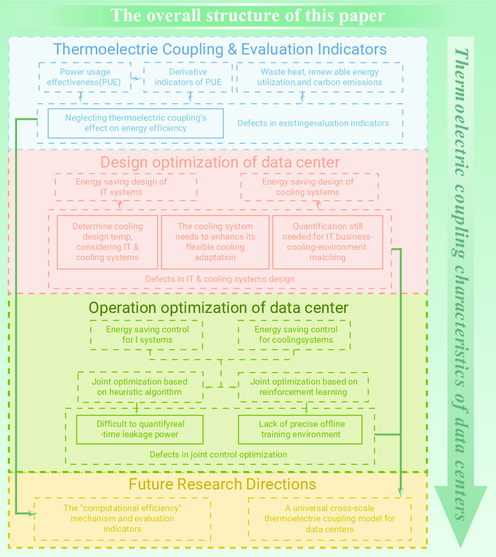
Figure 1.
The overall structure of this paper
-
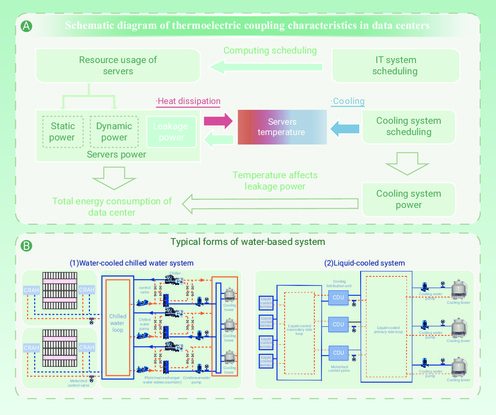
Figure 2.
Schematic diagram
-
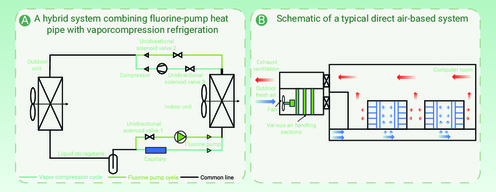
Figure 3.
(A) Hybrid system combining fluorine-pump heat pipe with vapor compression refrigeration.57 (B) Schematic of a typical direct air-based system
-
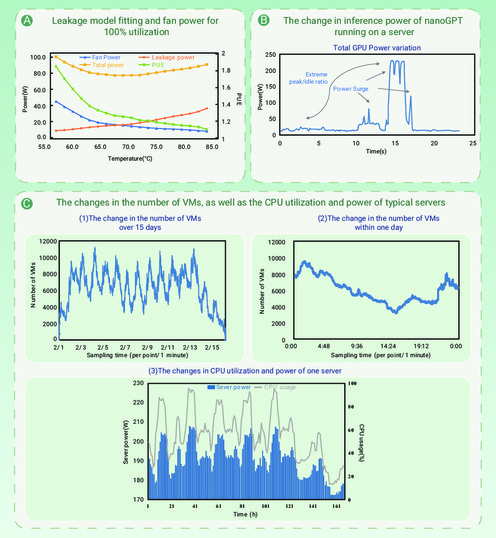
Figure 4.
(A) Leakage model fitting and fan power for 100% utilization.84 (B) The change in inference power of nanoGPT running on a server.87 (C) The changes in the number of VMs, as well as the CPU utilization and power of typical servers.105,106
-
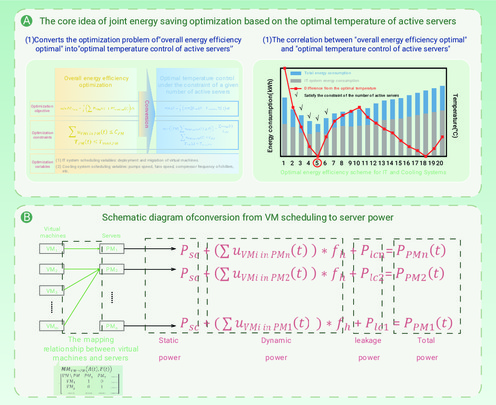
Figure 5.
(A) The core idea of joint energy saving optimization based on the optimal temperature of active servers.112 (B) Schematic diagram of conversion from VM scheduling to server power.