
IoT-Enabled Optimal Incentive Strategy for Flexible Loads in Intelligent Demand Response Frameworks
-

-
REFERENCES
[1] Liu P., Chokwitthaya C., Olofsson T., et al. (2026). Demand response optimization incorporating thermal comfort in single-family houses with on-site generation: A systematic review. Appl. Energy 406:127305. DOI:10.1016/j.apenergy.2025.127305 [2] Klepeis N.E., Nelson W.C., Ott W.R., et al. (2001). The National Human Activity Pattern Survey (NHAPS): A resource for assessing exposure to environmental pollutants. J. Expo. Anal. Environ. Epidemiol. 11:231−252. DOI:10.1038/sj.jea.7500165 [3] Mannan M., Al-Ghamdi S G. (2021). ·Indoor air quality in buildings: a comprehensive review on the factors influencing air pollution in residential and commercial structure. 18(6):3276. Int. J. Environ. Res. Public Health. DOI:10.3390/atmos12010129 [4] Wang Z., Lu B., Wang B., et al. (2023). Incentive based emergency demand response effectively reduces peak load during heatwave without harm to vulnerable groups. Nat. Commun. 14:1. DOI:10.1038/s41467-023-41970-8 [5] Hui H., Ding Y., Shi Q., et al. (2020). 5G network-based Internet of Things for demand response in smart grid: A survey on application potential. Appl. Energy 257:113972. DOI:10.1016/j.apenergy.2019.113972 [6] Saleem M.U., Shakir M., Usman M.R., et al. (2023). Integrating smart energy management system with Internet of Things and cloud computing for efficient demand side management in smart grids. Energies 16:4835. DOI:10.3390/en16124835 -
ABOUT THIS ARTICLE
Cite this article:
Li X., Gao Y., Zhou X., et al. (2026). IoT-Enabled Optimal Incentive Strategy for Flexible Loads in Intelligent Demand Response Frameworks. Energy Use 2:100048. https://doi.org/10.59717/ipj.energy-use.2026.100048
Welcome!
To request copyright permission to republish or share portions of our works, please visit Copyright Clearance Center's (CCC) Marketplace website at marketplace.copyright.com.
Export File
Citation
Li X., Gao Y., Zhou X., et al. (2026). IoT-Enabled Optimal Incentive Strategy for Flexible Loads in Intelligent Demand Response Frameworks. Energy Use 2:100048. https://doi.org/10.59717/ipj.energy-use.2026.100048

Format
Content
 DownLoad:
-
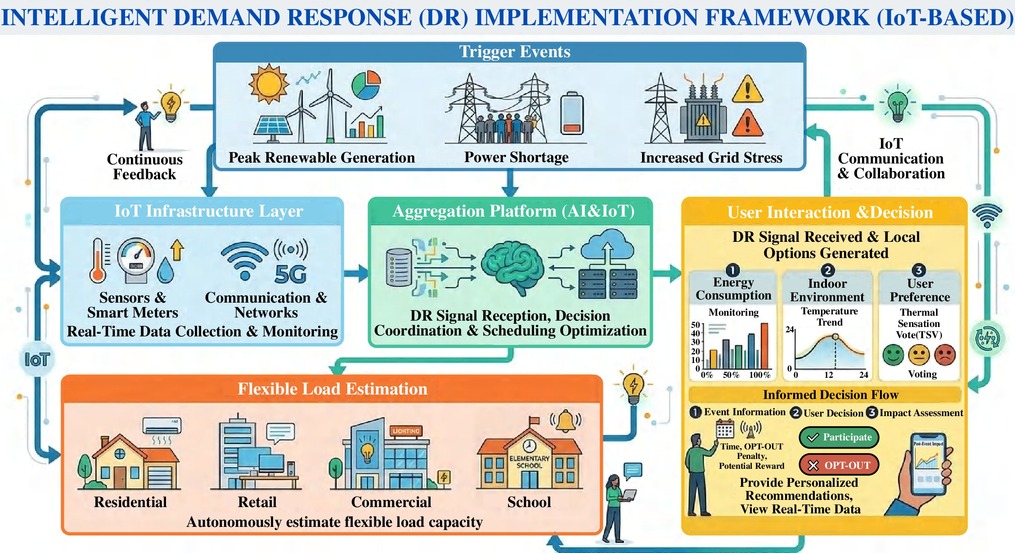
Figure 1.
Intelligent Demand Response Frameworks.